Coffee market shows firm prices lower exports and climate as main risk
Translation generated by AI
• New York and London register strong gains in coffee contracts
• Arabica in Brazil reaches BRL 2,323 per bag and robusta BRL 1,534 per bag
• Brazilian exports fall 42 percent in August according to preliminary data
• Coffee harvest in Brazil reaches 99.1 percent completed
• Return of La Niña raises concerns with irregular rainfall expected
• Funds increase net long positions showing stronger appetite for coffee
• Reuters survey points to surplus of 1.45 million bags in 2025/26
With no significant changes in fundamentals, coffee futures prices ended another week higher. A set of bullish factors has continued to support international prices. Among them are historically low global stocks for the period, a decline in Brazilian arabica production, and downward revisions in crop estimates. StoneX, for example, cut its forecast for Brazil’s arabica crop in 2025/26, now projecting a decline of more than 18 percent compared to its previous estimate.
Another important factor was the implementation of US tariffs on Brazilian coffee imports, which added upward pressure mainly on New York quotations. Frost on August 11 and 12 also raised concerns, with estimated losses of around 424,000 bags in the Cerrado Mineiro. Beyond the immediate damage, there is still risk to flower buds, which will only become clear after blooming. The flowering period for arabica is already starting in the main producing regions, while robusta has already seen significant flowering. However, climate models indicate uncertain conditions, heightening apprehension about the next crop.
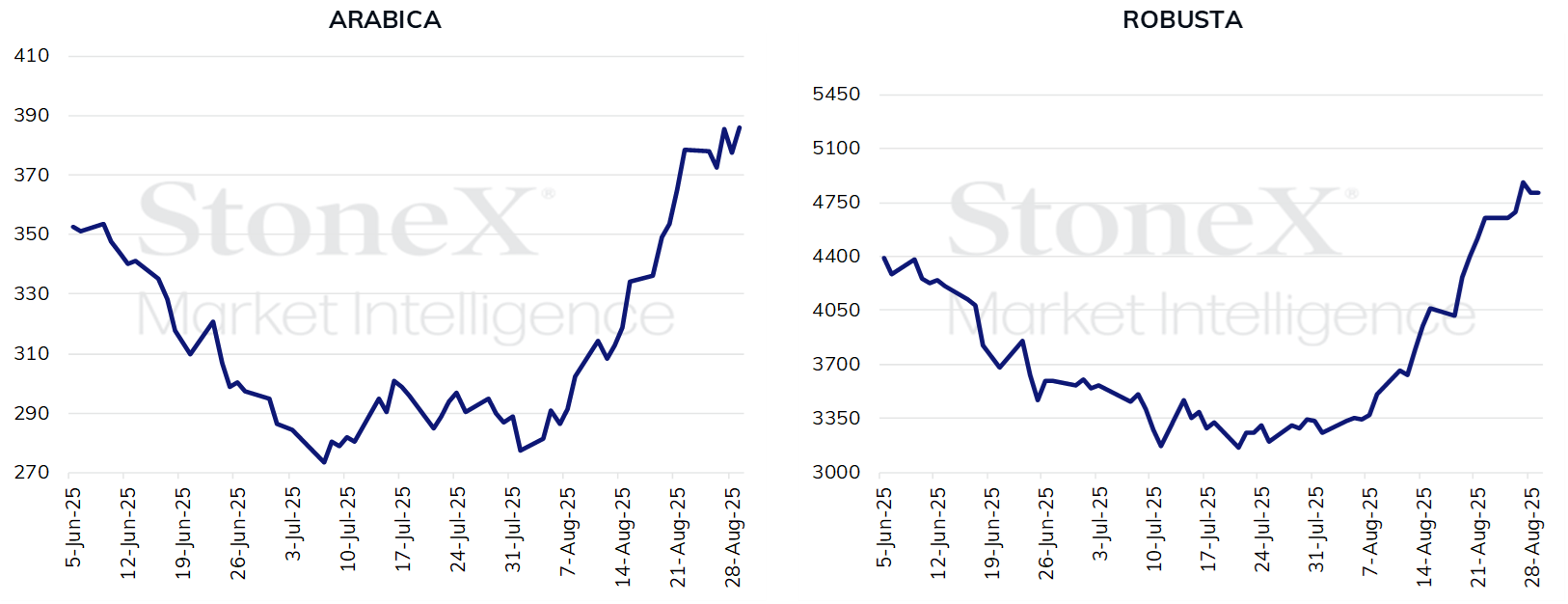
On the international market, prices reflected this uncertainty. In August, the most liquid arabica contract in New York rose more than 39 percent, advancing 2.1 percent in the last week. In London, robusta gained 47.7 percent in the month and 3.5 percent in the week. In Brazil, according to the Cepea index, arabica rose 31 percent in August and 4.2 percent in the week, while robusta climbed 49 percent in the month and 5.6 percent in the week.
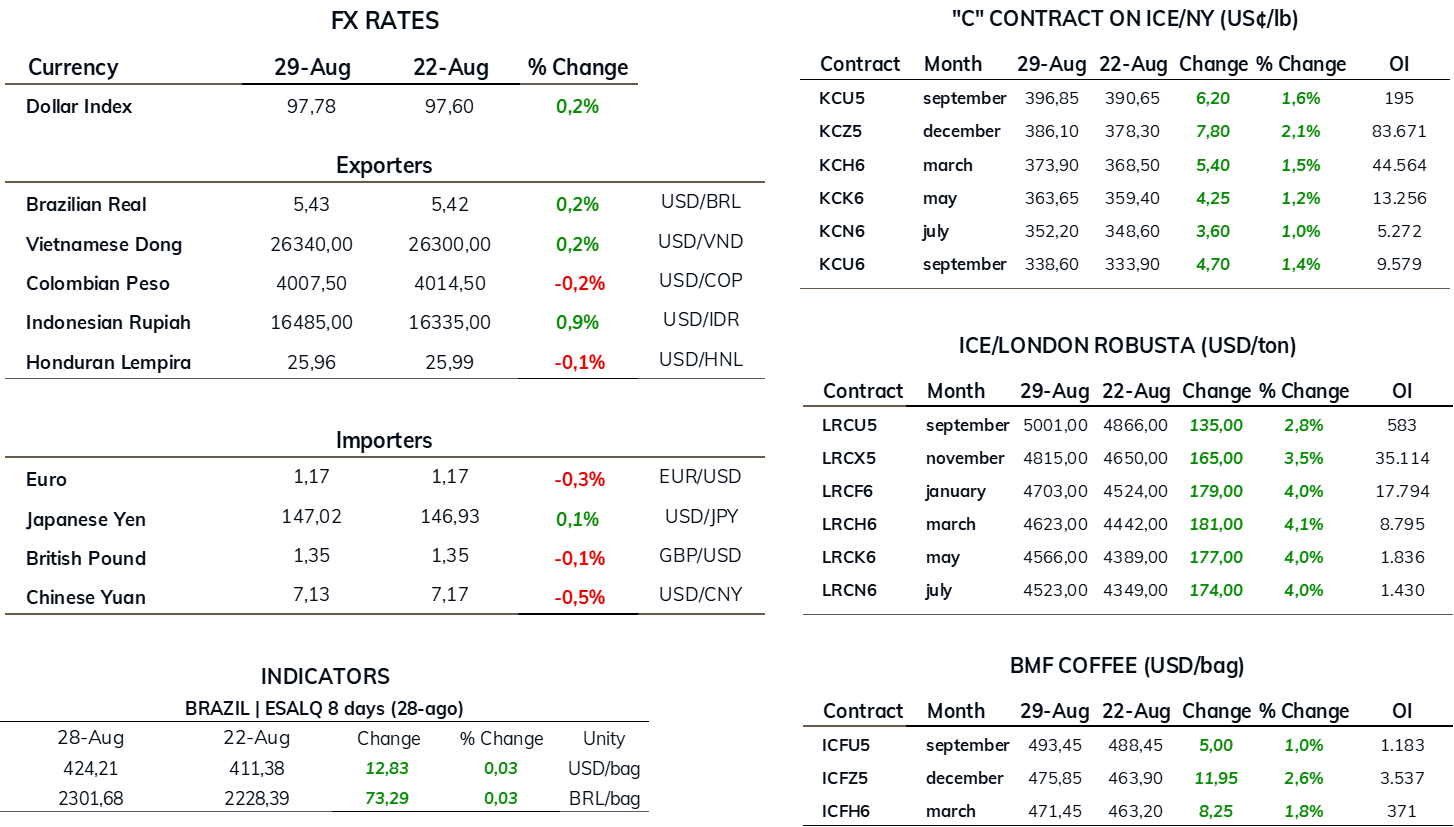
By Friday’s close, contracts stood at US¢ 386.1 per pound in New York and USD 4,815 per ton in London. In the domestic market according to Cepea arabica was traded at BRL 2,323 per bag and robusta at BRL 1,534 per bag. The exchange rate fell slightly more than 2 percent in August, closing the week almost unchanged at BRL 5.43.
Coffee futures prices arabica (US¢/lb) robusta (USD/ton)
Source: Cmdty View. Prepared by StoneX.
Brazilian exports posted a sharp decline in the month. Preliminary Cecafé data up to August 28 show just over 2 million bags of green coffee shipped, representing a 42 percent drop compared with the same period in 2024, when 3.48 million bags were exported. Robusta exports saw the sharpest fall of 58 percent, totaling 393,000 bags, while arabica exports declined 35 percent to 1.64 million bags. Soluble coffee also fell 41 percent, at 188,000 bags. In total, exports should close August at just over 2.22 million bags, down 42 percent. These figures are still preliminary and may be revised by the Council in the coming weeks, but they already indicate a relevant impact on the market.
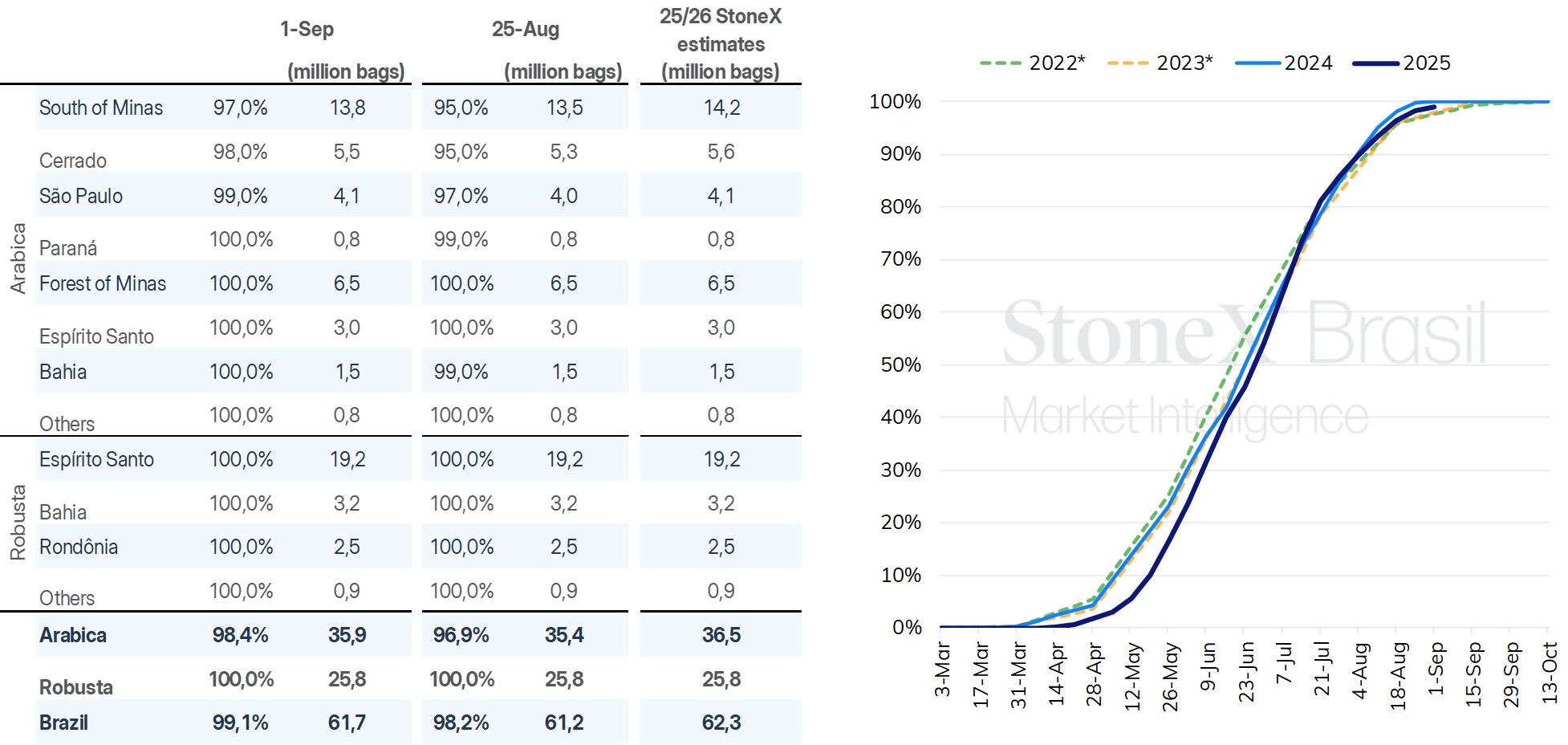
At the final stage of Brazil’s harvest, climate remains the main concern. According to StoneX data, by September 1, 99.1 percent of the national crop had been harvested, with robusta completed and arabica at 98.4 percent. With the harvest practically finished, all attention is now on weather conditions.
Brazil coffee harvest pace
Source: StoneX.
Forecasts point to the possible return of La Niña from September, with probability above 50 percent according to the NOAA model. Although impacts are not linear, in recent years the phenomenon has been associated with delayed rainfall and flowering problems in coffee trees. Current models indicate irregular and below-average rainfall in September, with more consistent rains only expected by the end of October. This scenario increases the risk of further losses for the 2026 crop, which has already been significantly impacted by the recent frost.
Read also: Despite the differences among the models, there are indications of a return of La Niña
Another highlight was the movement of investment funds. In New York, arabica funds, which had reduced their net long position to 15,000 contracts in July, expanded again to around 17,000. Earlier in the year, when prices reached record highs, that volume exceeded 50,000 contracts. Index funds also increased their positions, signaling stronger investor appetite. In London, the situation was similar: from a net short position of almost 6,000 contracts, funds shifted to a net long of 5,500, showing renewed interest in robusta.
Finally, a Reuters survey of market agents indicated that the global supply-demand balance for 2024/25 was stable, while 2025/26 is expected to show a surplus of 1.45 million bags. On average, respondents see Brazilian production at 65 million bags in 2025/26, reaching 70 million in 2026/27. Vietnam, in turn, is expected to recover and produce 31 million bags in 2025/26, a rise of more than 10 percent. As for prices, respondents project a decline by the end of 2025, with arabica in New York around US¢ 330 per pound, down almost 14.5 percent, and robusta in London near USD 3,500 per ton, down more than 27 percent.
INDICATORS
Sources: ICE/NY; ICE/EU; B3; Commodity Network Trader’s Pro.