After a decline last week coffee futures start the week higher
Translation generated by AI
• Prices rise on lack of rain and US executive order
• Arabica and robusta flowering depends on favorable weather
• Coffee included on US potential zero tariff list
• Funds increase long positions in New York and London
• Secex Brazilian exports down 31% in August 2.38 million bags
• Shipments to Colombia up 334% suggesting re-export to the US
• Conab revises production to 55.2 million bags in 2025
• La Niña risk worries coffee belt and flowering
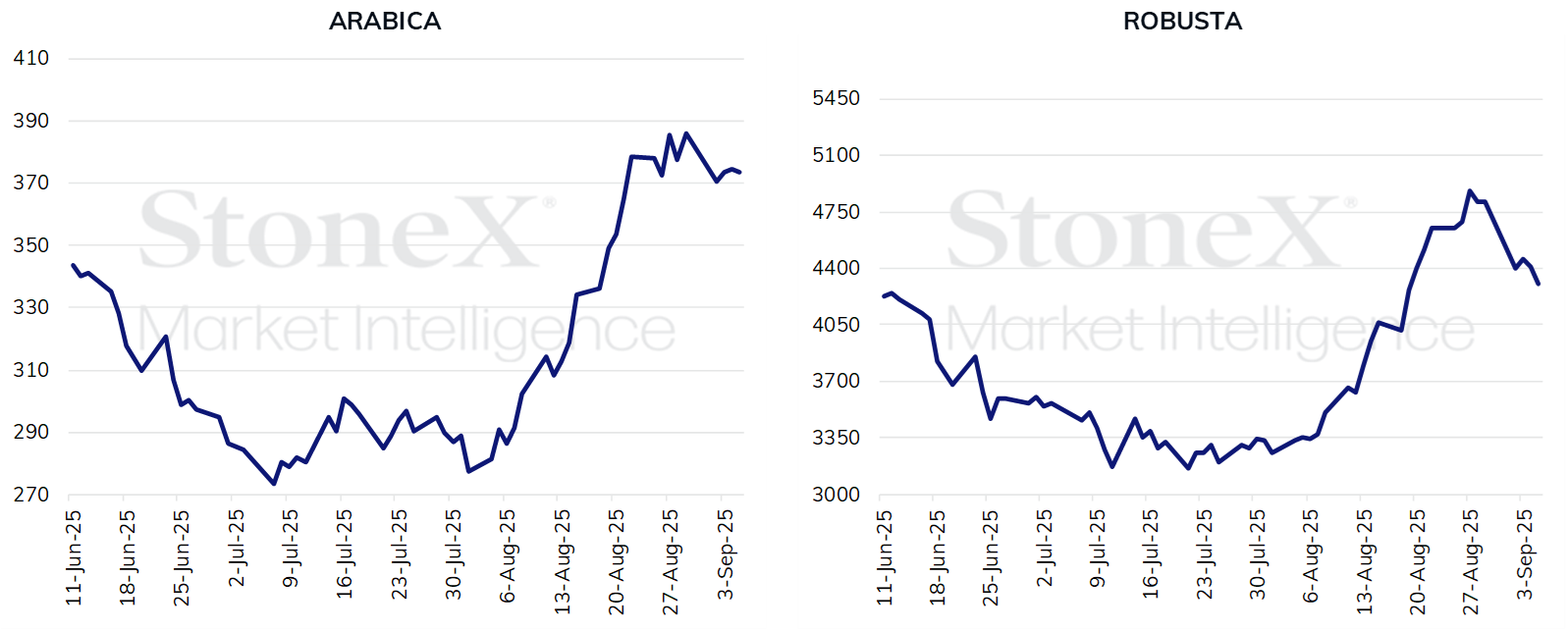
The coffee market ended the bullish trend seen in August and closed last week lower. In New York, prices began trading sideways, in a range between US¢ 370 and US¢ 380 per pound. In London, the move was even more negative, with consistent declines since the August 28 session, leading to a 10.5% drop for the November contract in the first week of September, while New York accumulated a 3.2% decline in the December contract in the same period. In the currency market, the dollar index fell 0.1% to 97.1 points, and the US currency fell 0.3% against the real, quoted at R$ 5.41.
The factors that had driven prices in recent weeks have already been absorbed by the market, which now seeks new fundamentals to define direction. Two points remain on the radar the US government’s decisions regarding tariffs on coffee and weather progress in Brazil. Robusta flowering had already begun and arabica flowering had also started, making it essential to maintain adequate conditions, with mild temperatures and regular rainfall, to ensure the productive potential of the 2026 crop.
In Monday’s session (08), coffee prices rose again. The most traded contract in New York gained more than 1100 points, traded at US¢ 385.00 per pound, while in London prices advanced more than USD 120 per ton, reaching USD 4,430 per ton. The upward move was driven by two main factors. First, weather models do not indicate regular rains for the coming weeks, raising concern about flowering in Brazil. Second, the announcement of an executive order by US President Donald Trump, which included coffee among the products that could have zero tariffs if trade agreements were signed with the United States. This does not mean immediate exemption, but it opens the door for the product to benefit through bilateral negotiations.
Arabica coffee futures prices (US¢/lb) robusta coffee (USD/ton)
Source Cmdty View. Prepared by StoneX.
August’s rally was also driven by funds’ appetite for risk assets. In New York, active management funds increased their net long position from 15 thousand to almost 19.5 thousand contracts by September 2. Index funds went from 30 thousand long contracts in June to more than 40 thousand currently. In London, the reversal was even more striking from a net short of 5.8 thousand contracts, funds turned to 11.5 thousand long contracts.
Last Friday (05), President Donald Trump signed an order providing tariff exemptions for certain products originating from countries that sign trade agreements with the United States. The document highlights items not produced domestically, including coffee, which could have tariffs reduced to zero through bilateral agreements. This does not mean automatic exemption, but it does open the possibility that coffee and other products may benefit from such negotiations. See the full content MODIFYING THE SCOPE OF RECIPROCAL TARIFFS AND ESTABLISHING PROCEDURES FOR IMPLEMENTING TRADE AND SECURITY AGREEMENTS
Meanwhile, the effects are already being felt foreign trade data shows a 31% drop in Brazilian exports in August, with 2.38 million bags shipped. Sales to the United States fell 17%, totaling just over 300 thousand bags, and there were also declines to Germany, Italy and Belgium. The lower supply of arabica, whose production fell 18.4% according to the latest StoneX update, limited availability. The positive highlight was a 334% increase in shipments to Colombia to more than 51 thousand bags, suggesting a re-export strategy, since the country faces only a 10% tariff on sales to the United States, compared to 50% applied to Brazil.
On the supply side, Conab released its estimate for Brazilian production in 2025 at 55.2 million bags, slightly below the previous projection of 55.7 million. Of this total, 35.2 million are arabica and 20.1 million robusta. Despite the revision, Conab remains among the institutions with the lowest figures, while StoneX projects 62.3 million and USDA 65 million. Despite the discrepancy, all estimates converge to a smaller crop, reflecting adverse weather conditions faced at the end of 2024.
Weather in Brazil remains a decisive factor. The rains at the end of August improved soil moisture and allowed flowering to begin, especially for arabica, while robusta had already started in July. However, weather models forecast dry conditions in the coming weeks, with only occasional and low-volume rainfall expected in mid-September. The expected return of the La Niña phenomenon, associated with below-average and delayed rainfall in the coffee belt, raises concerns. Even so, crops in 2025 entered this period with better soil moisture reserves compared to 2024, when prolonged drought and very high temperatures compromised flowering. This factor may partially mitigate risks, but weather developments in the coming weeks will be decisive for both the potential of the 2026 crop and the direction of prices in the coming months.
See also Soil Moisture in Focus: September Begins to Change the Agricultural Outlook!
INDICATORS TABLE
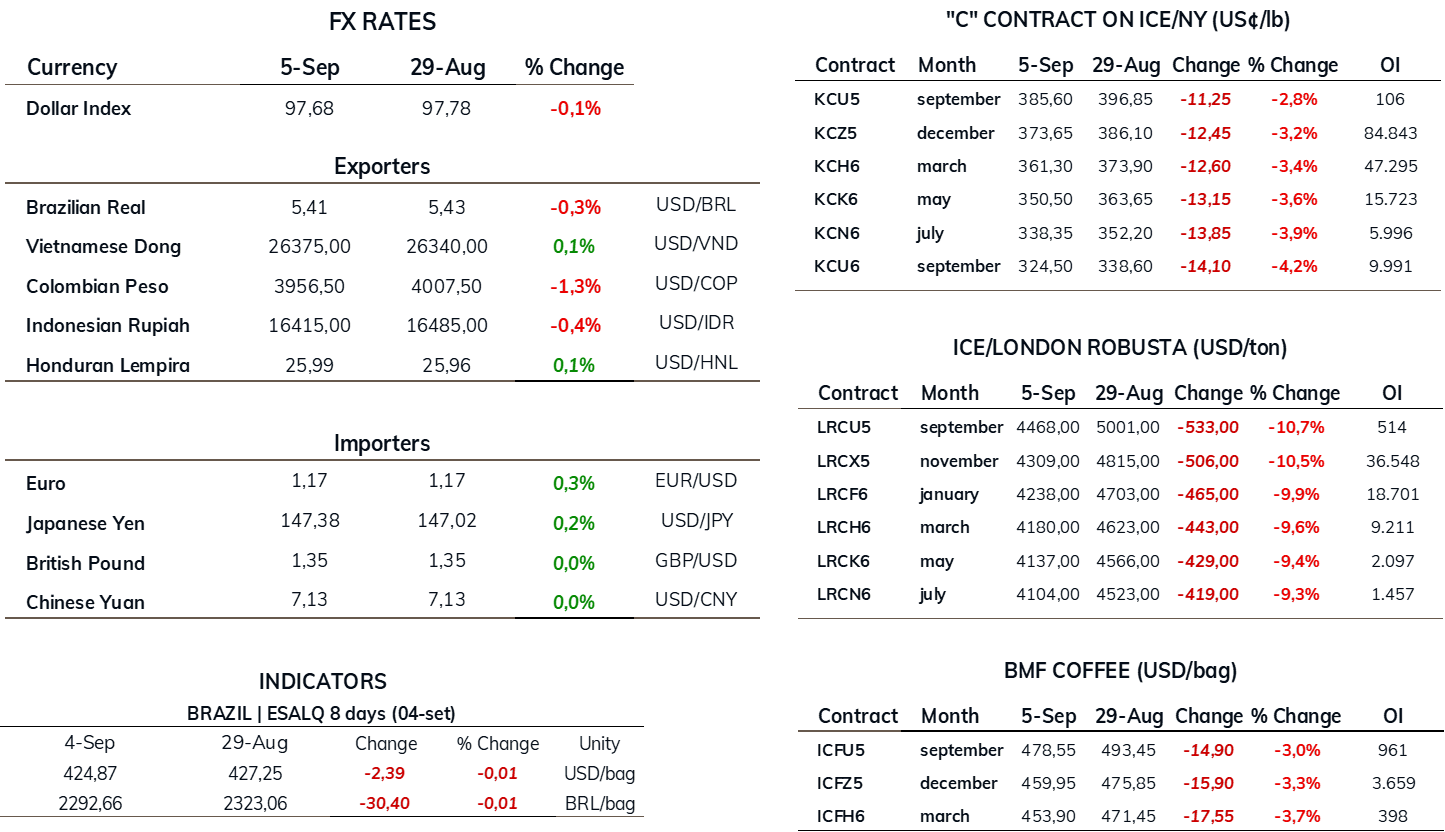
Sources ICE/NY ICE/EU B3 Commodity Network Trader’s Pro.