The coffee market opens the week with a rise of more than 2,000 points in New York
Translation generated by AI
• Low global stocks and lower Brazilian production sustain the bullish movement
• Below average rainfall and the risk of La Niña worry Brazilian producers
• Brazilian exports fall 17.5% in August, but revenue grows 10.5%
• US purchases drop 46.5%, Brazil gains ground in Mexico and Colombia
• US tariffs distort trade routes
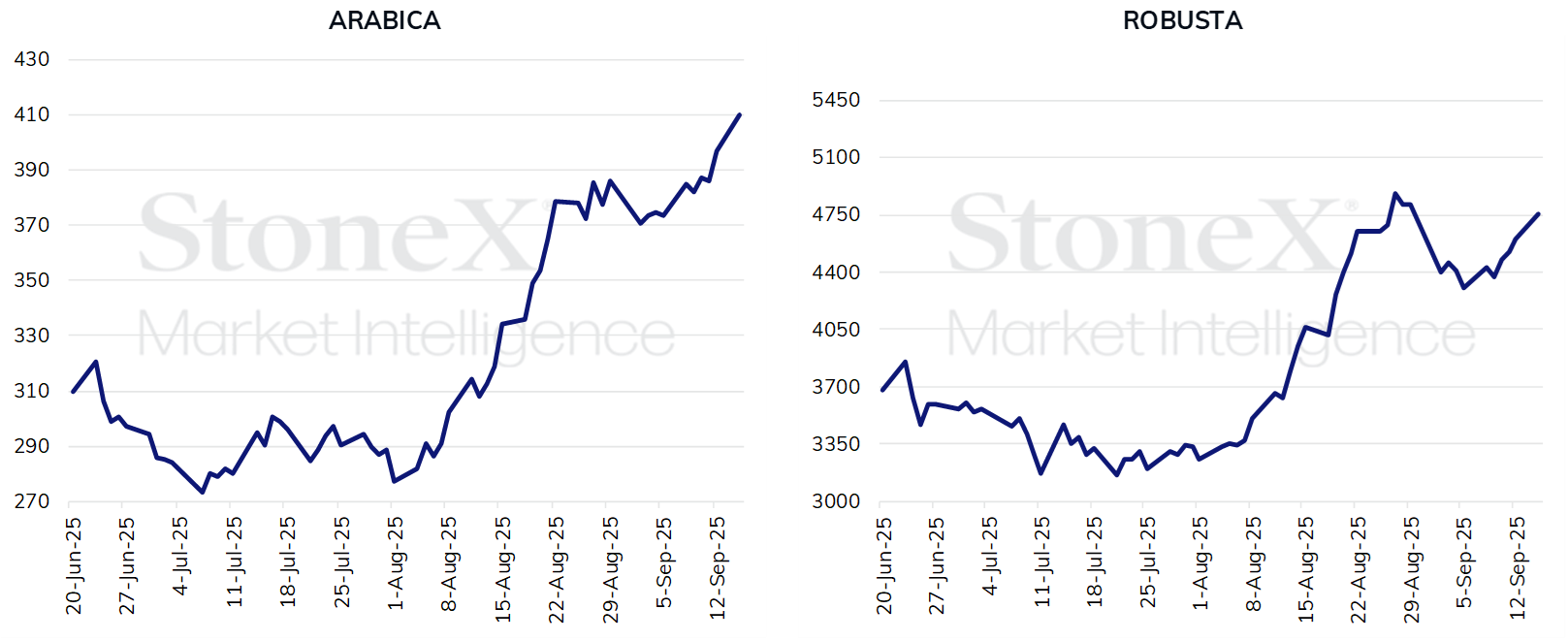
The coffee futures market in New York began the week with strong gains, recording an increase of more than 2,000 points. This movement reinforces the bullish trend observed since August, supported by low global stocks, lower arabica production in Brazil, and weather concerns related to the flowering development between September and October.
Last week, the most active contracts in New York, maturing in December, accumulated a gain of 2,320 points, equivalent to 6.2%, closing at US¢ 396.85 per pound. In London, the increase was 292 dollars per ton, or 6.8%, reaching 4,601 dollars per ton. The dollar fell 1.1% during the week to R\$ 5.35. This Monday, at the time of writing, New York was showing an increase of 2,155 points, equivalent to 5.43%, with the December contract trading slightly above US¢ 418 per pound. In London, the advance was 5.2%, reaching 4,840 dollars per ton.
This Monday, the exchange rate also played a relevant role in the market’s movement. The dollar was traded lower at R\$ 5.31, falling 0.78% compared to the previous week’s close. This movement mainly reflected expectations of a 0.25 percentage point cut in US interest rates by the Federal Reserve, along with the prospect of new cuts in the coming months. This scenario tends to reduce returns on US bonds and weaken the dollar. In Brazil, the expectation is for the basic interest rate to remain unchanged. The conviction of former president Jair Bolsonaro by the Federal Supreme Court also adds political uncertainties and raises questions about potential repercussions on the relationship between Brazil and the United States.
Arabica coffee futures prices (US¢/lb) robusta coffee (USD/ton
Source: Cmdty View. Prepared by: StoneX.
Coffee prices in the Brazilian market also advanced, although with less intensity due to the dollar’s decline throughout the week. The Cepea indicator for arabica rose 3%, reaching nearly R\$ 2,346 per bag. Meanwhile, the robusta indicator increased 4.6%, surpassing R\$ 1,421 per bag.
From a climatic perspective, Brazil remains the central focus. Weather models indicate the arrival of rains between September 23 and 24, with accumulations of 5 to 14 mm in the Cerrado Mineiro, around 45 mm in Matas de Minas, 10 to 42 mm in South Minas, and between 10 and 40 mm in Mogiana. Despite this, the projected volumes remain below the historical average. Temperatures are not expected to reach extremes but will remain high. The Cerrado Mineiro should register highs of 33ºC, while Espírito Santo may reach between 35ºC and 39ºC on September 22 and 23, before the arrival of a cold front that should lower temperatures.
The greatest concern is associated with the La Niña phenomenon, whose probability has been raised to 71% between October and December 2025. Historically, La Niña has brought rainfall delays and prolonged droughts, as occurred in 2020, 2021, and 2022, affecting the water regime and productivity. This risk increases uncertainty regarding the potential of the 2026 and 2027 crops.
Seasonal ENSO Forecasts | CPC/NOAA and IRI
According to Vietnam’s customs agency, coffee exports in August totaled 1.4 million bags. The volume represents a 16% decline compared to the previous month, but at the same time, a 16% increase compared to the same period last year. Even so, the result remains nearly 11% below the historical average for the month.
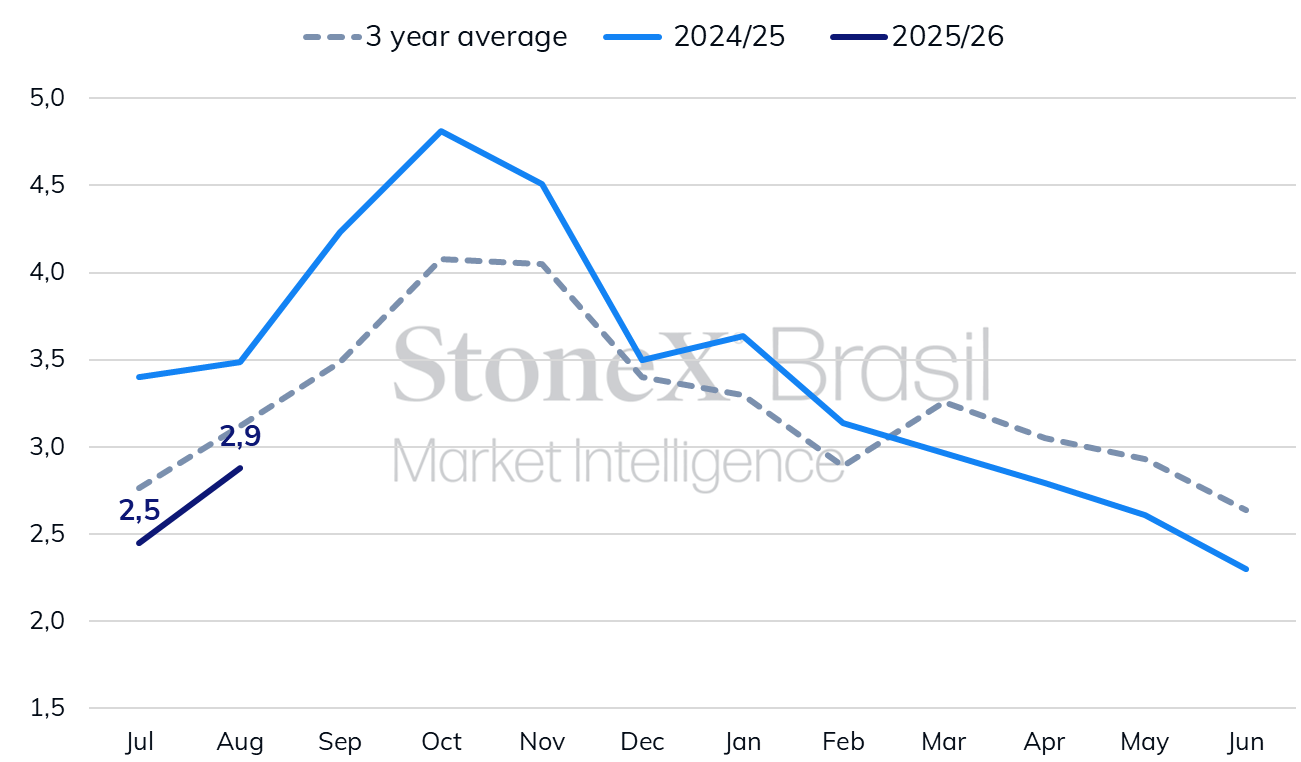
Exports also reflect market tensions. Brazil shipped 3.14 million bags in August, a 17.5% decline compared to the same period last year. Revenue, however, advanced 10.5%, reaching nearly 6 billion reais. Exports of green coffee totaled nearly 2.88 million bags, down 17.5%. Within this volume, robusta fell 34.5%, totaling just over 619 thousand bags, and arabica fell 11.2%, with 2.26 million bags. Processed coffee also declined 17.6%, reaching 267 thousand bags.
Brazilian coffee exports (million bags)
Source: Cecafé. Prepared by: StoneX.
The impacts of tariffs imposed by the United States are already showing significantly. Brazilian exports to the US market fell 46.5% in August, to just over 301 thousand bags. Due to lower supply, the decline was also felt in other traditional destinations such as Germany, Italy, Belgium, Turkey, and Spain. On the other hand, there was a sharp increase in exports to Japan, with growth of more than 53%, to Mexico, with an advance of over 90%, and to Colombia, with a jump of 578%, totaling nearly 113 thousand bags. This scenario shows a reconfiguration of trade routes, with Brazil losing share in the United States while gaining ground in other markets.
In the coming weeks, agents’ attention will remain focused on weather conditions in Brazil, especially during the flowering stage. Until the end of October, the climate will be decisive in determining whether the 2026 crop has recovery potential or if there will be another productivity setback. The StoneX team remains in the field monitoring the progress of the plantations and will release new updates in upcoming editions of the report.
Read also:StoneX vê mudança de déficit de oferta de café em 2024 para um mercado mais equilibrado em 2025
INDICATORS TABLE
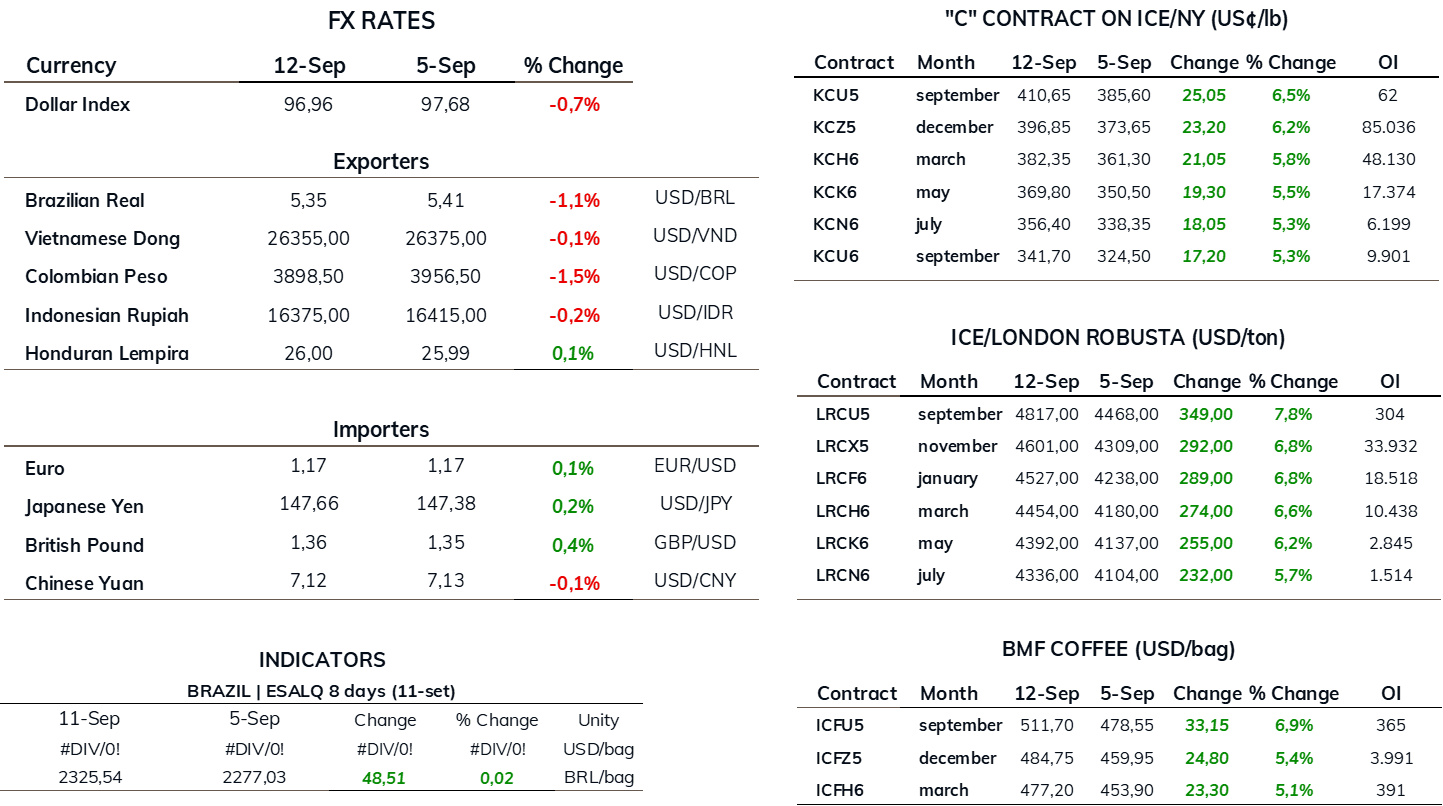
Sources: ICE/NY; ICE/EU; B3; Commodity Network Trader’s Pro.