Coffee rises amid Brazil weather concerns and tensions between Colombia and the US
Translation generated by AI
• Weather in Brazil and geopolitical tensions support price increases
• Below-average rainfall keeps concerns over the 2026 crop
• StoneX begins post-flowering survey for the 2026/27 crop
• US-Brazil rapprochement may ease tariffs on coffee
• Coffee consumption drops 3.7% in Japan
• Certified arabica stocks fall 8.3% over the past week
• Vietnam harvest expected to boost supply and pressure London prices
Coffee futures prices ended last week higher, driven by concerns over weather conditions in Brazil, the depreciation of the dollar, and the recent escalation of tensions between Colombia and the United States. In contrast, data released in Japan showed a decline in consumption.
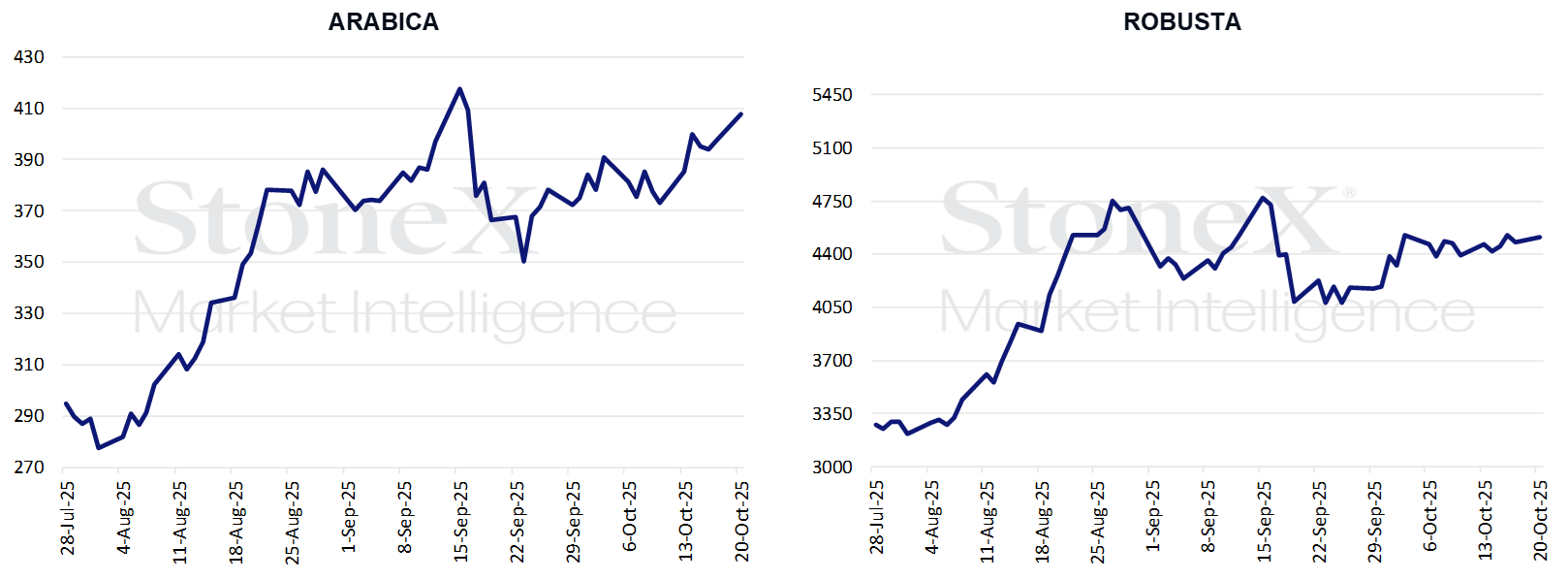
The dollar index fell 0.3% to 98.3 points, while the dollar against the Brazilian real dropped 2.1%, closing the week at R$ 5.41. In New York, the most active contract rose 6.5%, settling at US¢ 397.45 per pound. In London, the January contract increased 2% to US$ 4,478 per metric ton.
The beginning of this week maintained the positive trend. On Monday, at the time of writing, the December contract in New York was up 990 points, or 2.5%, at US¢ 407.35 per pound. In London, the January contract rose by 38 dollars per metric ton, or 0.85%, to US$ 4,516 per ton. The movement reflects both the weather situation in Brazil and the worsening diplomatic tensions between the United States and Colombia.
The American president made strong criticisms of Colombian president Gustavo Petro and indicated the possibility of imposing tariffs, which has raised concerns in the US market, given that Colombia is the second-largest coffee supplier to the United States, behind only Brazil. In 2024, Brazil accounted for 35% of US coffee imports, while Colombia supplied 20%. This scenario has supported prices, particularly in New York.
In Brazil, the domestic market followed the international trend: last week, the Cepea arabica indicator rose 3.2% to R$ 2,662.88 per bag, while the robusta indicator advanced 0.9% to R$ 1,400.77 per bag.
Arabica coffee futures prices (US¢/lb) Robusta coffee (USD/ton)
Fonte: Cmdty View. Elaboração: StoneX.
A topic that has gained attention is the forecast of lower temperatures in the coming days, with models indicating minimums close to 10°C in some areas of southern Minas Gerais. Despite this drop, there is currently no expectation of significant risks, as the lowest temperatures are expected in higher-altitude regions. In addition, the coffee flowering phase is nearing its final stage. This temperature drop is also expected to be temporary and does not pose a frost risk.
From a fundamental perspective, weather remains the main point of attention. Although rainfall has occurred in recent weeks, it has been irregular, and the accumulated volume remains below the historical average, raising concerns about crop development. Meteorological models now indicate less widespread precipitation than previously forecast. There is an expectation of a return to a more regular rainfall pattern next month (November), driven by the established presence of the La Niña phenomenon. On the other hand, there is a risk of flash droughts, especially in the early months of 2026 — severe dry spells and high temperatures that could affect coffee bean development, as experienced at the beginning of 2025.
This period is critical for the coffee crop cycle. Robusta flowering has already been completed, while arabica is currently in the flowering and early development stages. Any adverse weather conditions at this stage could compromise the productive potential of the 2026 crop. StoneX has begun field surveys for the post-flowering research and will release its first estimate for Brazil’s 2026/27 crop in November.
In the geopolitical context, the possibility of a rapprochement between the United States and Brazil brings partial relief to prices, with expectations of tariff reductions or removals on Brazilian coffee imports, reinforced by the recent meeting between U.S. Secretary of State Marco Rubio and Brazil’s Minister of Foreign Affairs, Mauro Vieira. Conversely, tensions between Washington and Bogotá remain an upward risk factor for prices.
On the demand side, the All Japan Coffee Association reported that Japanese coffee consumption totaled 4.43 million bags in the first eight months of 2025, a 3.7% decline compared to the same period in 2024. Domestic consumption in Brazil has also slowed, reflecting higher costs passed on to end consumers and the effects of global inflation on coffee prices.
Another factor supporting prices is the continuous decline in certified stocks, particularly of arabica coffee. Last week, stocks fell by 8.3%, to 467 thousand bags. Over the past month, the accumulated decline has exceeded 29%. Given current origin differentials, there is little incentive to certify new lots, keeping the market tight and tending to support prices.
In the coming weeks, the market is expected to remain volatile, influenced by multiple factors. Bearish drivers include the slowdown in global consumption, the potential normalization of trade relations between Brazil and the United States, and a favorable weather outlook across the coffee belt. Conversely, any adverse weather event in Brazil or escalation of tensions between the United States and Colombia would likely exert upward pressure on prices.
Another key development is the beginning of the coffee harvest in Vietnam, the world’s largest producer of robusta. According to USDA projections, Vietnamese production is expected to recover by approximately 7% in the 2025/26 season, reaching around 31 million bags. The harvest is scheduled to begin in mid-November, with coffee flow gaining momentum from December onward. The market will closely monitor this process, as the anticipated increase in global robusta supply is likely to exert downward pressure on London prices.
Global stocks remain historically low following a drawdown of more than 22 million bags between 2021 and 2024. For 2025, a balanced scenario is projected, with no significant replenishment expected. This limited supply continues to serve as a structural support factor for international coffee prices.
INDICATOR TABLE
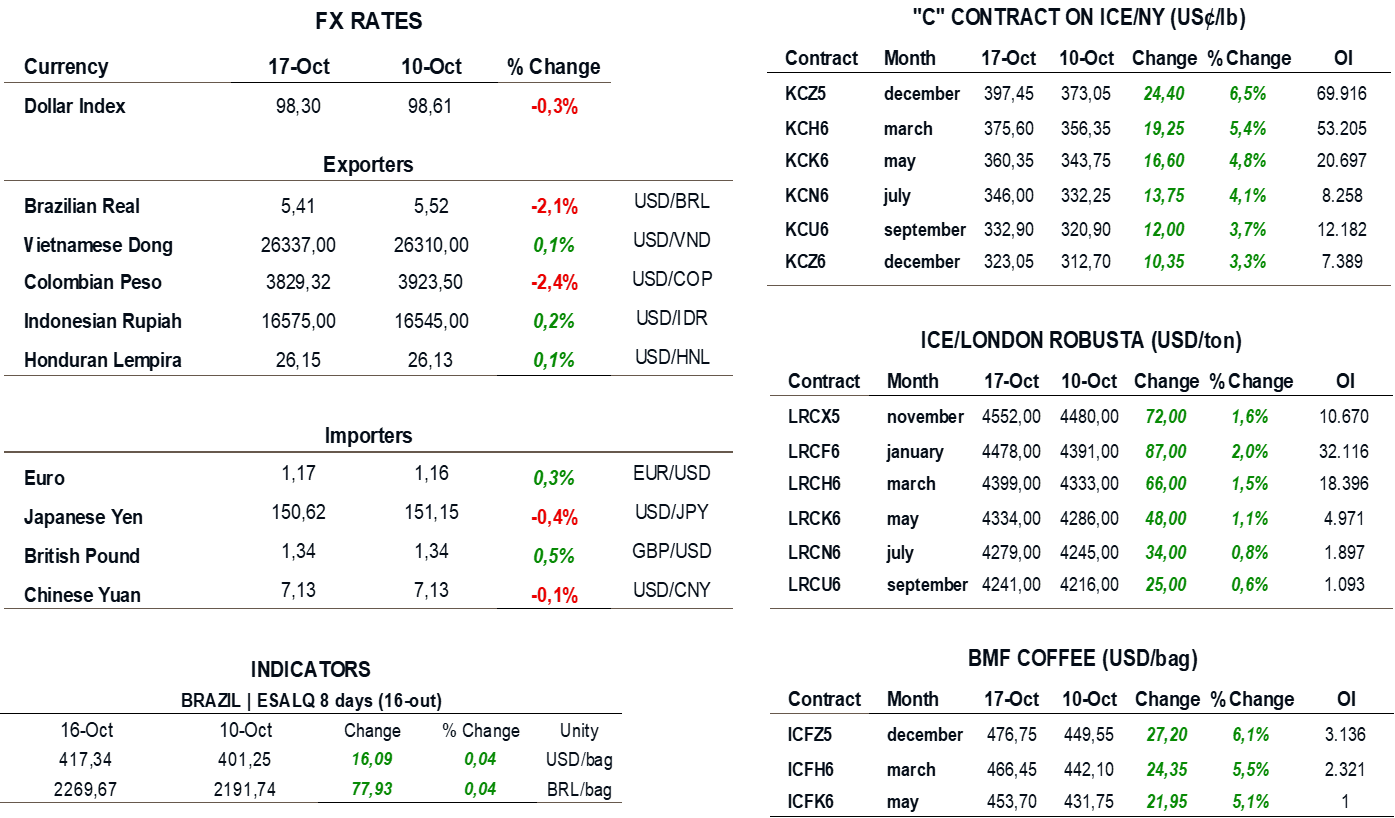
Sources: ICE/NY; ICE/EU; B3; Commodity Network Trader’s Pro.