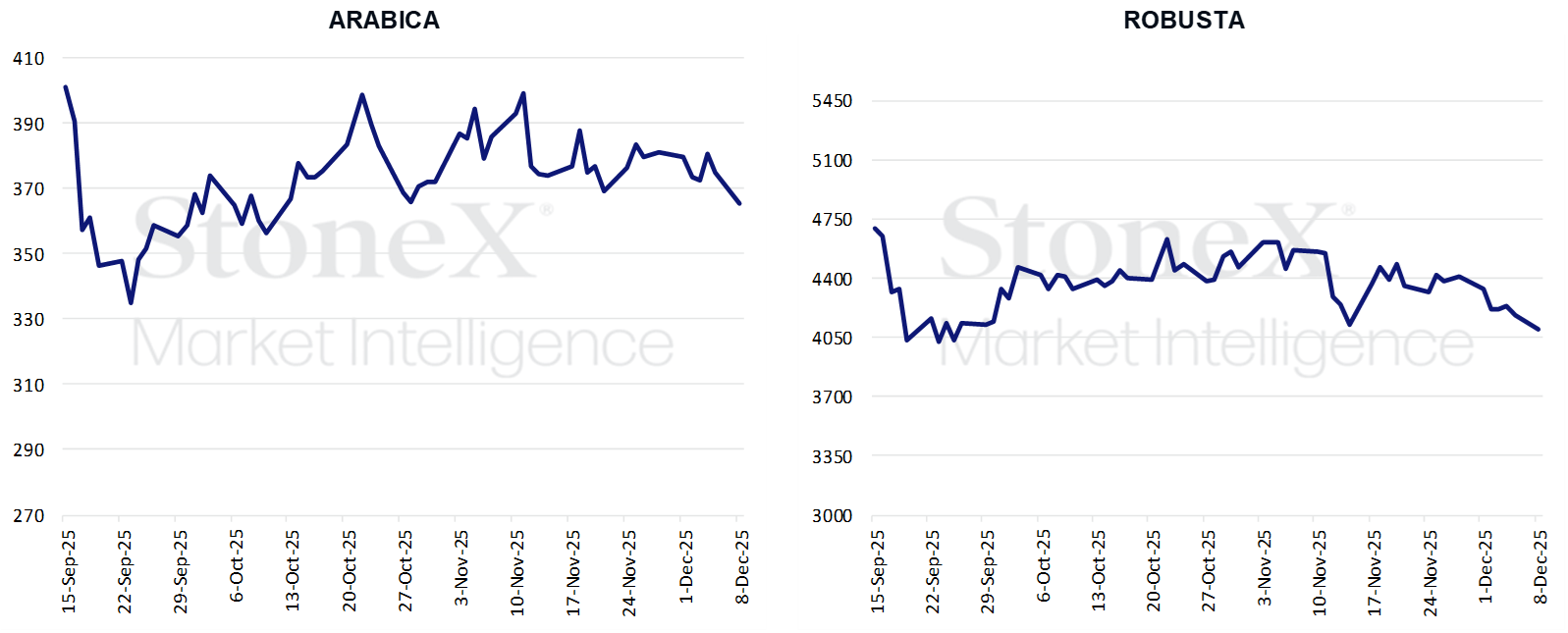
Coffee futures prices ended last week lower and started this week under continued pressure in both New York and London. There were no significant changes in market fundamentals, and the market's behavior mainly reflected the activity of short-term speculative agents, alongside the influence of USDA reports on key producing countries. Last week, the March arabica contract on the New York exchange dropped 1.7%, closing at US¢ 374.85 per pound. In London, the most traded contract, also for March delivery, fell 5.3%, ending at USD 4,178 per ton.
The sharper pressure on robusta prices in London is tied to expectations of improving weather conditions in Vietnam. The country has faced excessive rainfall in recent weeks, causing post-harvest issues, quality losses, harvest delays, and logistical challenges. Weather models now indicate a normalization of precipitation over the coming weeks, which is likely to ease some concerns. Simultaneously, the appreciation of the dollar has also impacted international prices. The U.S. currency rose 1.9% last week, closing at R$ 5.44.
At the start of this week, the arabica contract in New York continued its downward trend, falling 2.53% to trade at US¢ 365.15 per pound at the time of writing. In London, the March contract dropped 2%, priced at USD 4,094 per ton. In the Brazilian physical market, prices also declined. The CEPEA indicator for arabica fell 1.6%, reaching R$ 2,217 per bag, while the robusta indicator dropped 2.3%, settling at R$ 1,372.42 per bag.
Last week, the United States Department of Agriculture (USDA) released updated reports on coffee production in several major producing countries. These documents revise the estimates made in June for the 2025/26 crop year. Projections for 2026/27 will be announced next year. Reports were updated for Brazil, Vietnam, Colombia, Indonesia, and India. The agency lowered its production estimate for Brazil in 2025 due to adverse weather conditions. Vietnam's projections were slightly reduced, although growth of 6.2% compared to the previous year is still expected. Estimates for Colombia and Indonesia were revised upward, while production in India remained stable.
Across these countries, the previous estimate of 125.8 million bags was adjusted to 126.1 million, reflecting a 0.2% increase. On an annual basis, this represents growth of 0.3% compared to 2024. For exports, the department forecasts 95.5 million bags, a slight increase of 0.5% compared to the previous estimate but a 1.4% decrease compared to the volume exported in the previous season.
Summary of USDA Estimates
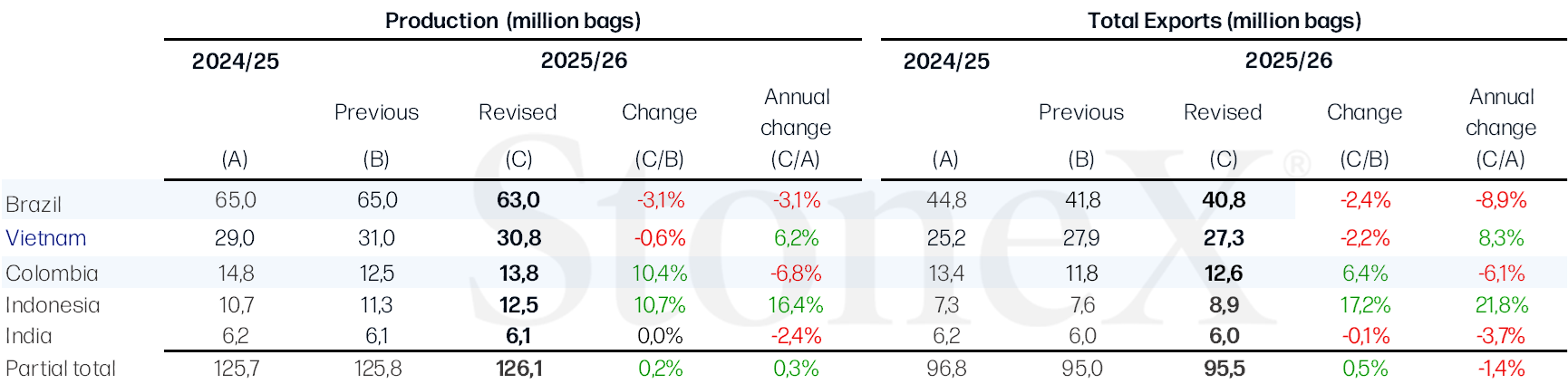
Source: USDA. Prepared by: StoneX.
This week, the market will closely monitor the release of Cecafé export data. This follows the recent removal of tariffs imposed by the United States on imports from Brazil. Weather conditions in Vietnam and Brazil, as well as the progress of the harvest in the Asian country, will also remain in focus for market participants.
Extreme Rainfall in Vietnam Causes Devastation, Precipitation Records, and Direct Impacts on Coffee-Producing Regions
The World Meteorological Organization (WMO) reported that several Asian countries have faced devastation in recent weeks due to exceptional rainfall. In Vietnam, since October, a series of extreme precipitation events has affected various regions of the country. During the first week of December, the impacts of storm Koto, which previously hit the Philippines, combined with the influence of a cold front, resulted in further episodes of intense rainfall, particularly in the central-southern part of Vietnam.
The WMO highlighted that at the end of October, a weather station in the city of Hue, central Vietnam, recorded 1,739.6 mm of precipitation over 24 hours — a new national record currently under formal evaluation by the WMO's extremes committee. If confirmed, this figure could become the second-highest 24-hour precipitation record in the Northern Hemisphere and Asia, coming very close to the global record of 1,825 mm.
Between November 15 and 21, strong easterly disturbances combined with intensified cold air caused widespread rainfall, with accumulations ranging from 400 to 700 mm, and some locations exceeding 1,000 mm. Dak Lak province, one of Vietnam's largest robusta coffee-producing regions, recorded between 700 and 900 mm, with localized areas surpassing 1,200 mm.
Figure A shows Dak Lak province, the main hub of the central highlands, with rainfall levels classified as very heavy (purple) and heavy (red). The second-largest producing area, Lam Dong, recorded levels ranging from heavy (red) to moderate rainfall (yellow), while Dak Nong experienced precipitation ranging from moderate to light (green).
The consequences have been severe: hundreds of millions of dollars in losses, particularly in agriculture, as well as flooding of historic sites, tourist destinations, and significant impacts on infrastructure. The WMO also reported nearly 100 fatalities linked to extreme rainfall and flooding events in Vietnam alone.
The forecast for the next 15 days indicates that cumulative rainfall in the three main coffee-producing hubs will be below the climatological average, approximately 50 mm lower than expected for this time of year (Figure B). This suggests light rainfall may occur, but the trend points to more stable conditions, favoring soil drainage, resumption of harvesting in unaffected areas, and repairs to agricultural and transportation infrastructure.
(A) Recorded cumulative precipitation from November 15 to 22, 2025, monitored by the Vietnam National Meteorology and Hydrology Administration (VNMHA); (B) Forecast for cumulative precipitation over the next 15 days (December 8–22).
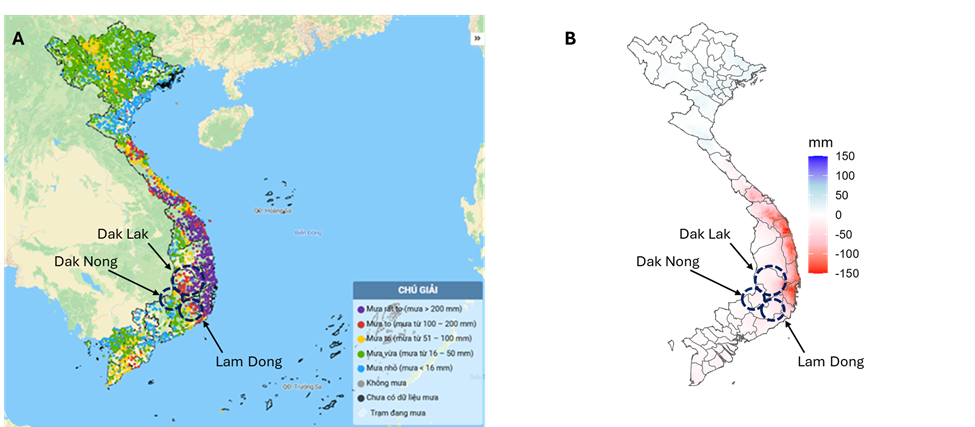
Source: WMO and CHIRPS.
INDICATORS TABLE
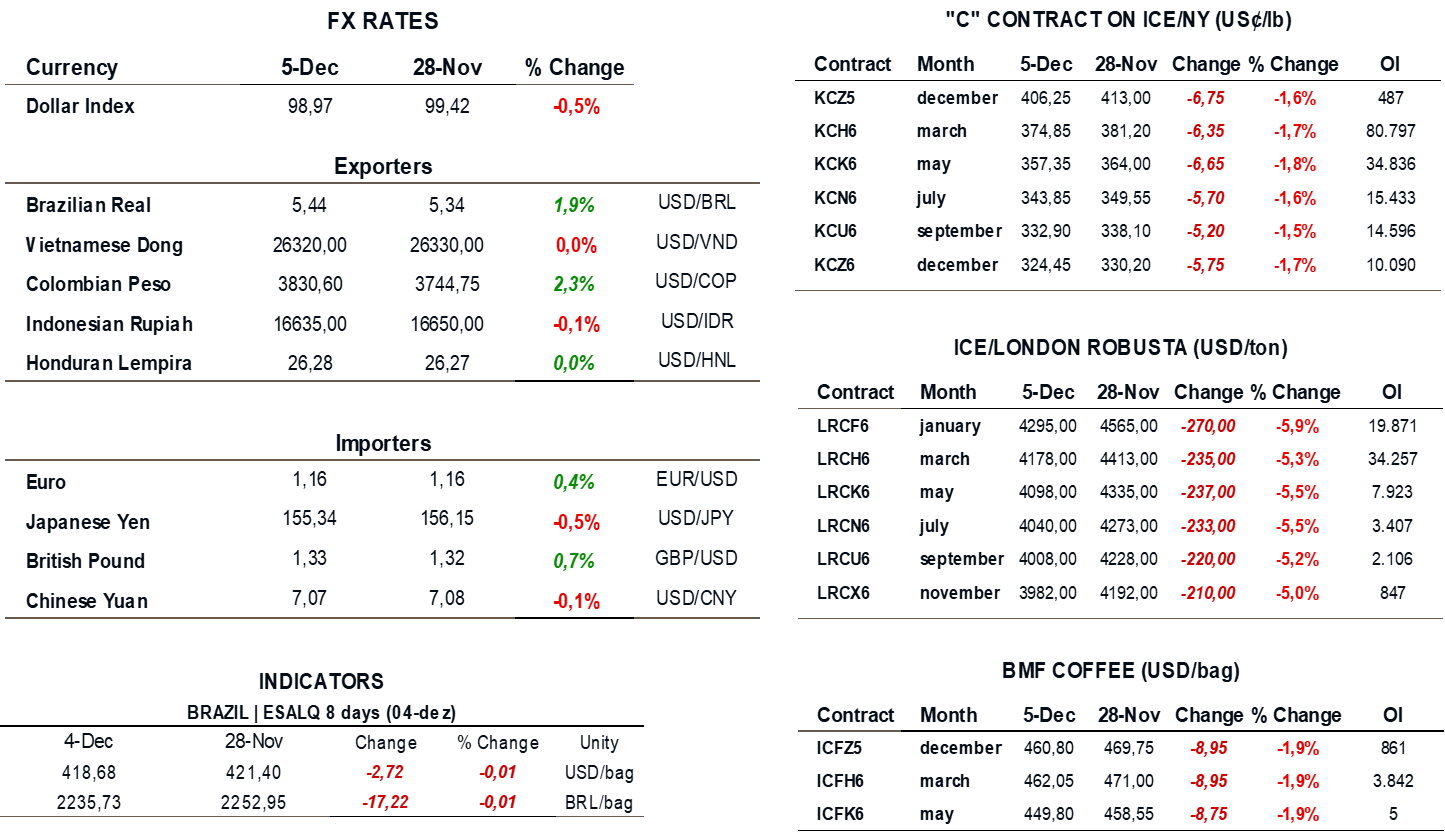
Sources: ICE/NY; ICE/EU; B3; Commodity Network Trader’s Pro.