

Daily Coffee Report 8/4/26
Daily coffee report
StoneX Coffee Team
- Coffee
By: Leonardo Rossetti, Market Intelligence Analyst

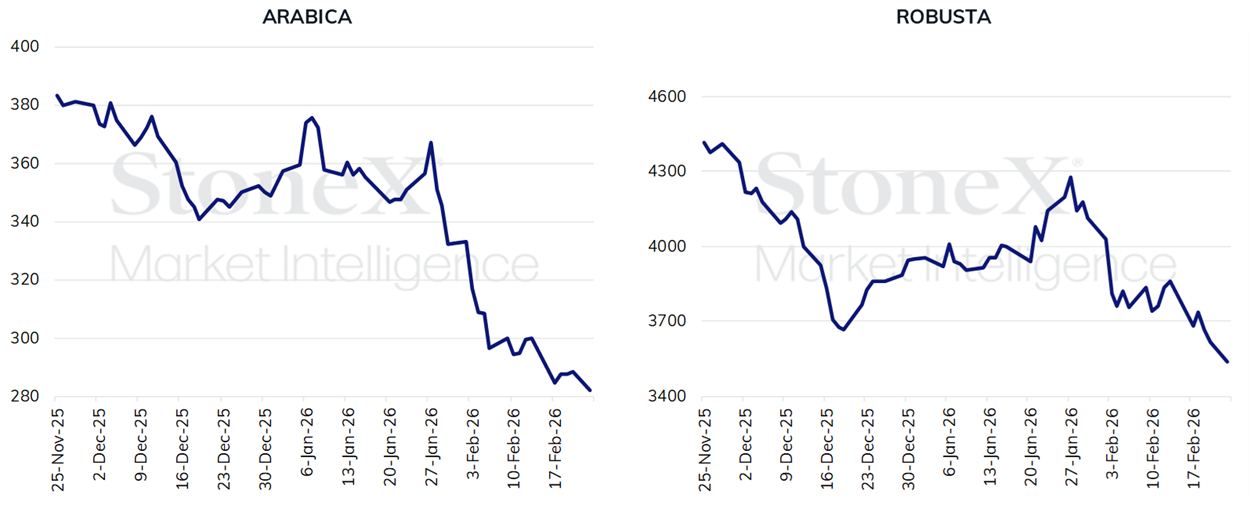
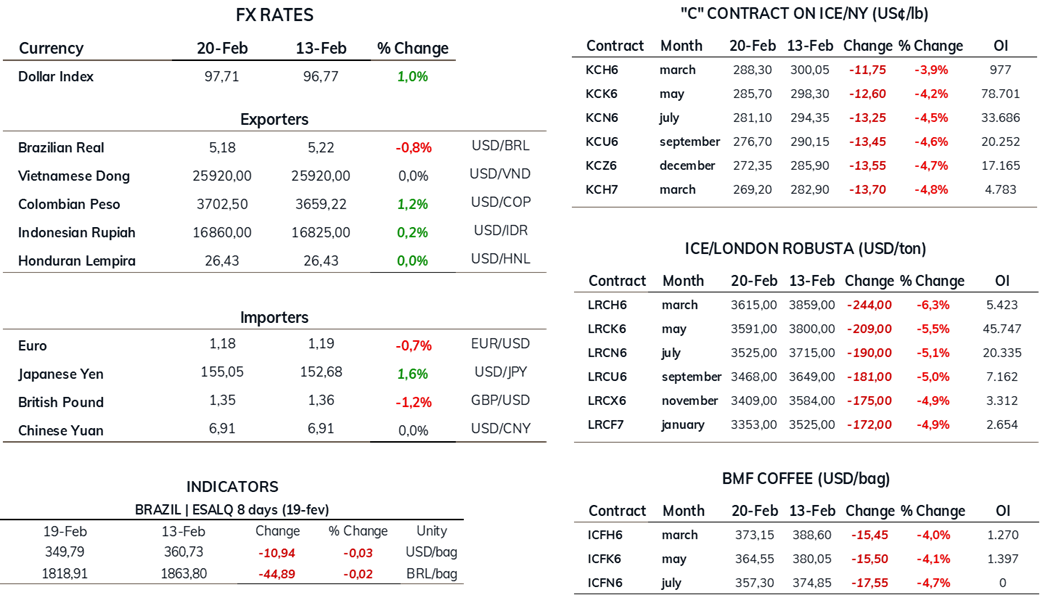
The past week was marked by declines in coffee futures at major exchanges, reaching the lowest levels since mid-2025 after successive recent drops. Arabica ended the period at USc 288.3/lb, a 3.9% decrease. Robusta closed at USD 3,615/t, down 6.3%. This movement reflected a lower risk premium environment and ongoing profit-taking, consistent with optimism regarding coffee availability in upcoming cycles.
Physical Market: In Brazil, prices also fell. The Cepea Indicator for Arabica dropped 4.9%, closing Friday (20th) at BRL 1,806.48/sack. As for Robusta, the decline was 4.5%, down to BRL 1,042.95/sack.
Accumulated Decline: With recent weeks’ losses, Arabica in New York has accumulated a drop of approximately 36% since the October 2025 peak, while Robusta in London has fallen 28% since the August peak. This represents a significant correction from recent historical highs, consistent with the restoration of negotiable supply and the dissipation of immediate weather shocks.
Weekly Fundamentals: Despite the price drop, the fundamentals remained relatively unchanged throughout the period.
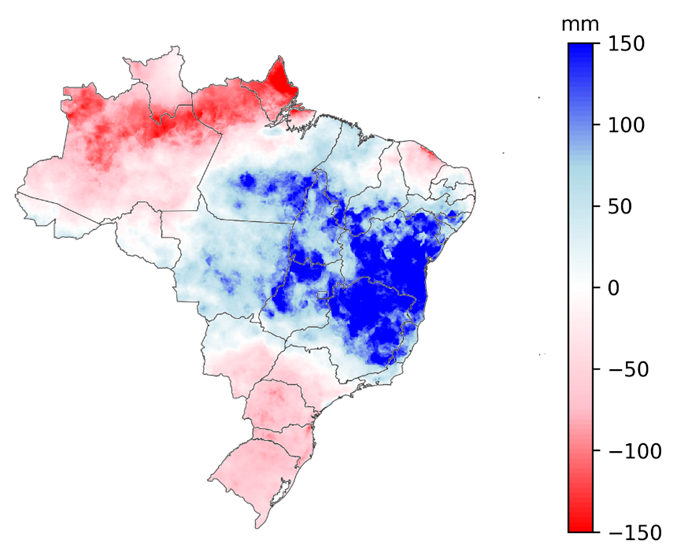
Precipitation Anomaly Forecast for the Next 15 Days in Brazil (mm)
Monday’s Movements: In the early trading sessions this week, futures extended the bearish movement seen last week. Initial indications show Arabica down approximately 2.65% and Robusta retreating 1.50%, aligning with the short-term outlook guided by more optimistic fundamentals.
Future Coffee Prices: Arabica (US¢/lb) and Robusta (USD/ton)
Late last week, the U.S. Supreme Court voted 6-3 to overturn the “reciprocal tariffs” imposed by Donald Trump in 2025, concluding that the administration overstepped its authority by using the International Emergency Economic Powers Act (IEEPA) to create tariffs without Congressional approval.
Overview: The measure, challenged by companies and governors and rejected by three lower courts, was deemed incompatible with IEEPA’s purpose, which does not authorize the creation of commercial tariffs. The decision brings months of uncertainty to an end, ordering the immediate suspension of tariffs and defying expectations that the conservative-majority Supreme Court might favor the administration.
In the coffee market, the main exporting countries faced the following tariffs:
It remains unclear how the U.S. tariff policy will evolve, as the administration claims to have various options to reinstate tariffs. Last Saturday, President Donald Trump announced via social media that he would raise global import tariffs to 15%, citing Section 122 of the Trade Act of 1974, which addresses balance of payments imbalances. Initially, the increase will be valid for 150 days, requiring Congressional approval for a longer implementation.
Why It Matters: This change may affect coffee pricing for key U.S. suppliers.
The Situation for Brazilian Soluble Coffee: Previous reports highlighted how Brazilian exports to the U.S. were impacted by the 50% tariffs. Even after negotiations reduced tariffs in November, soluble coffee remained subject to the 50% rate.
Why It Matters: With tariff reductions from 50% to 15%, the Brazilian soluble coffee industry is poised to regain competitiveness against its rivals. Higher volumes could gradually return, potentially providing additional support to product prices.
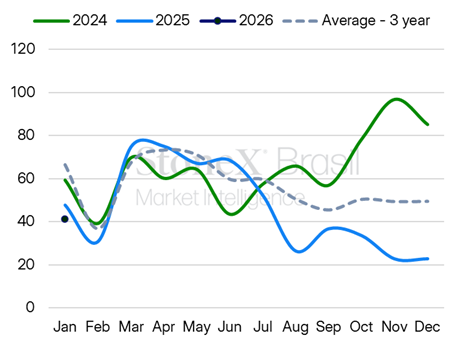
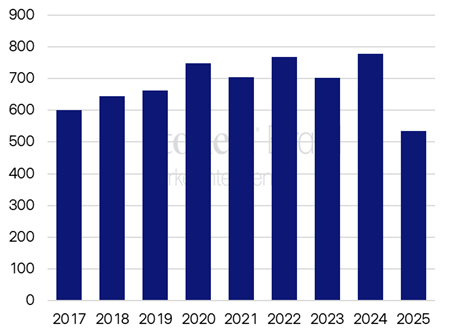
Monthly and Annual Brazilian Soluble Coffee Exports to the U.S. (in thousand sacks)
According to the National Federation of Coffee Growers of Colombia (FNC), excessive rainfall in the country’s coffee-growing regions is expected to significantly impact the 2025/26 harvest, reducing production to 12.8 million sacks.
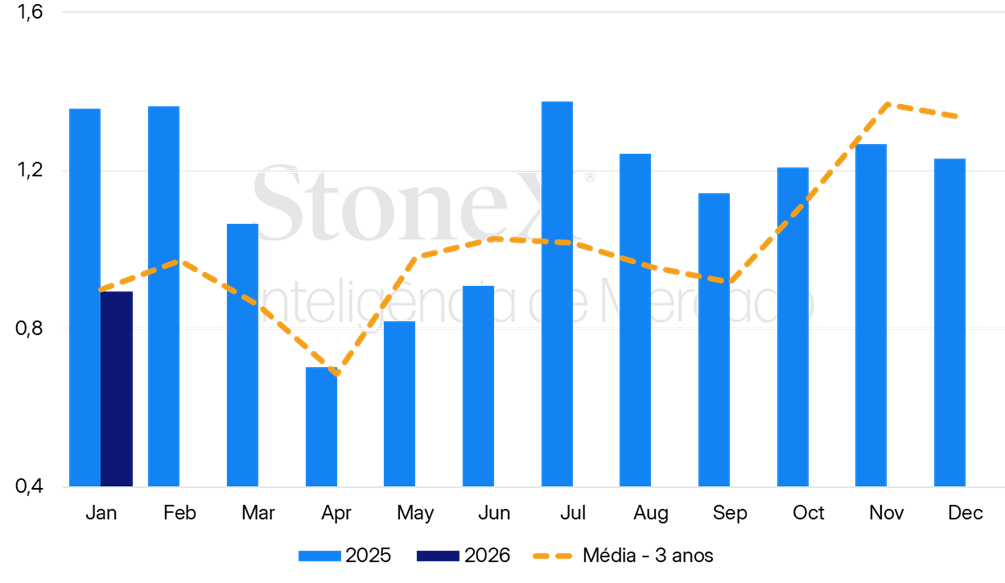
Tracking Colombian Harvest: In the first four months of the 2025/26 crop year (October to January), cumulative production fell 26.5%, dropping from 6.25 million sacks during the same period in 2024/25 to 4.6 million sacks in the current season.
Why It Matters: Lower-than-expected production in the world’s second-largest Arabica producer is likely to support international prices.
Colombian Coffee Monthly Exports (in thousand sacks)
The latest update from the International Research Institute for Climate (IRI) reinforced indications from other reports pointing to a higher likelihood of an El Niño event in the second half of 2026.
In general, El Niño refers to the warming of Pacific Ocean waters. As analyzed in the latest Weekly Weather and Climate Bulletin, climate consensus suggests that when an El Niño event materializes, regional climate anomalies tend to become more persistent and, in some cases, more intense.
This suggests that areas already showing signs of deficits or irregularities may see these conditions intensify if this projection materializes later in the year.
Projected Surface Temperature Variations in the Pacific Ocean (in °C)
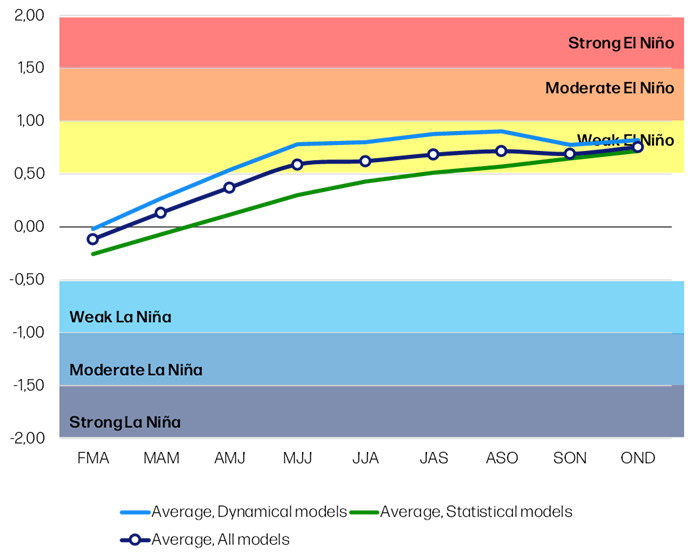
Why It Matters: While it is still early, the continued increase in probabilities is likely to draw more market attention, especially if projections also increase the expected intensity of the event.
As such, the market may begin factoring the event into prices in the coming months. Briefly summarizing the potential impacts on key producing regions:
Brazil
Southeast Asia
Colombia, Mexico, and Central America
INDICATOR TABLE
The StoneX Group Inc. group of companies provides financial services worldwide through its subsidiaries, including physical commodities, securities, exchange-traded and over-the-counter derivatives, risk management, global payments and foreign exchange products in accordance with applicable law in the jurisdictions where services are provided. References to over-the-counter (“OTC”) products or swaps are made on behalf of StoneX Markets LLC (“SXM”), a member of the National Futures Association (“NFA”) and provisionally registered with the U.S. Commodity Futures Trading Commission (“CFTC”) as a swap dealer. SXM’s products are designed only for individuals or firms who qualify under CFTC rules as an ‘Eligible Contract Participant’ (“ECP”) and who have been accepted as customers of SXM. StoneX Financial Inc. (“SFI”) is a member of FINRA/NFA/SIPC and registered with the MSRB. SFI is registered with the U.S. Securities and Exchange Commission (“SEC”) as a Broker-Dealer and with the CFTC as a Futures Commission Merchant and Commodity Trading Adviser. References to securities trading are made on behalf of the BD Division of SFI and are intended only for an audience of institutional clients as defined by FINRA Rule 4512(c). References to exchange-traded futures and options are made on behalf of the FCM Division of SFI . StoneX is a trading name of StoneX Financial Ltd (“SFL”). SFL is registered in England and Wales, Company No. 5616586. SFL is authorized and regulated by the Financial Conduct Authority [FRN 446717] to provide to professional and eligible customers including: arrangement, execution and, where required, clearing derivative transactions in exchange traded futures and options. SFL is also authorised to engage in the arrangement and execution of transactions in certain OTC products, certain securities trading, precious metals trading and payment services to eligible customers. SFL is authorised & regulated by the Financial Conduct Authority under the Payment Services Regulations 2017 for the provision of payment services. SFL is a category 1 ring-dealing member of the London Metal Exchange. In addition SFL also engages in other physically delivered commodities business and other general business activities which are unregulated and not required to be authorised by the Financial Conduct Authority. StoneX Group Inc. acts as agent for SFL in New York with respect to its payments services business. StoneX APAC Pte. Ltd. acts as agent for SFL in Singapore with respect to its payments services business. ‘StoneX’ is the trade name used by StoneX Group Inc. and all its associated entities and subsidiaries.
Trading swaps and over-the-counter derivatives, exchange-traded derivatives and options and securities involves substantial risk and is not suitable for all investors. Past performance of any futures or option is not indicative of future success. Indicators are not a trading system and are not published as a specific trade recommendation. The information herein is not a recommendation to trade nor investment research or an offer to buy or sell any derivative or security. It does not take into account your particular investment objectives, financial situation or needs and does not create a binding obligation on any of the StoneX group of companies to enter into any transaction with you. You are advised to perform an independent investigation of any transaction to determine whether any transaction is suitable for you. No part of this material may be copied, photocopied or duplicated in any form by any means or redistributed without the prior written consent of StoneX Group Inc.
© 2026 StoneX Group Inc. All Rights Reserved.
Our subscribers have access to comprehensive market analysis from StoneX spanning commodities, equities, currencies and more.
Daily coffee report

August 4 – The benchmark Dow Jones Industrial Average surged into the close yesterday to finish almost 700 points higher, at a record close of 53,178 points – easily clearing the previous top from almost a month ago. The S&P 500 is on the brink of its own record as well, while the NASDAQ index is short of June highs but working on a strong three-session rally. All three are pointing to positive openings today. Palantir (a U.S. software company) reported better-than-expected earnings yesterday afternoon post-close to boost the tech sector, though a host of other firms reported strong earnings as well. The ten-year note continues to retreat from Friday’s high, now at 4.67%, with the dollar on the high side of level-par, while the VIX index now under 16 shows reduced volatility.

Daily coffee report
Our market expertise, advanced platforms, global reach, culture of full transparency and commitment to our clients’ success all set us apart in the financial marketplace.
Reach
With access to 40+ derivatives exchanges, 180+ foreign exchange markets, nearly every global securities marketplace and numerous bi-lateral liquidity venues, StoneX’s digital network and deep relationships can take clients anywhere they want to go.
Transparency
As a publicly traded company meeting the highest standards of regulatory compliance in the markets we serve, our financials and record of accomplishment are matters of public record. StoneX’s commitment to “doing the right thing over the easy thing” sets us apart in the industry and helps us build respect, client trust and new partnerships.
Expertise
From our proprietary Market Intelligence platform, to “boots on the ground” expertise from award-winning traders and professionals, we connect our clients directly to actionable insights they can use to make more informed decisions and achieve their goals in the global markets.