After the Covid-19 pandemic put pressure on demand for fuels worldwide in 2020, 2021 has proven to be more positive for the recovery of gasoline demand and, consequently, ethanol. It is worth remembering that, except for Brazil, ethanol is usually used as an additive in the main global consumer players, i.e., the United States, the European Union and China.
Despite the progress of vaccination and increased levels of mobility around the world, high oil prices stand as an impediment to more significant growth in fossil fuel consumption. At the same time, the urgency of tackling the climate crisis, as addressed at COP26, indicates the need to invest increasingly in the biofuels and electric vehicles sector.
Ethanol stands out in this context, even though the intensification of Covid-19 in some regions may limit consumption in the short term.
In this context, the StoneX Market Intelligence team has outlined perspectives for the macroeconomic environment and, consequently, for fuel consumption in the main global players in 2022 – also highlighting expectations for fleet electrification in these countries.
United States
The latest estimates for US GDP growth have been lowered for both 2021 and 2022. Due to fiscal and monetary stimuli to aid economic recovery after the social distancing measures adopted in the wake of the Covid-19 pandemic, domestic demand has recovered quickly, especially for the durable goods sector. However, production capacity did not recover at the same speed on the supply side, which caused global disruptions in production chains, logistical bottlenecks, shortages of feedstocks, and inflationary pressures. In addition, a strong wave of the delta variant of coronavirus during the summer, together with the occurrence of hurricanes in the south of the country, led to a rate of expansion in the third quarter significantly below analysts' expectations. Such production imbalances, which have worsened this year, are expected to persist into next year and result in a moderation in the pace of economic growth.
As for fuel demand, although the beginning of 2021 registered gasoline consumption below seasonal averages, the advance of vaccination campaigns and mobility levels allowed for a recovery in its demand in the US. With this, the 2021 driving season ended with demand in line with that observed in previous years.
US gasoline consumption (kbpd)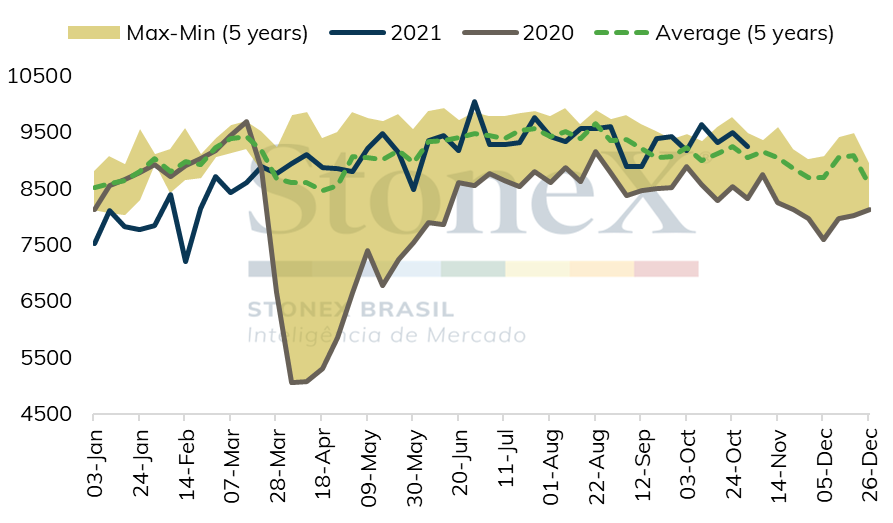
Source: EIA. Design: StoneX.
Even with the recent increase in fuel prices, it is possible to observe an increasing trend in North American consumption, exceeding the 5-year average. Despite the rally in domestic gasoline prices, the gasoline sales had the second largest monthly advance in October, at 3.9%.
Thus, concerns about inflation and pessimistic surveys regarding consumer sentiment have not yet translated into a significant deterioration in the US population's spending on fuel. Given this scenario, the expectation is that gasoline consumption will reach over 510 million m³ in 2021, representing an annual advance of 9.0%. Considering that the ethanol blending rate remains close to 10.3%, the demand for biofuel is expected to remain at 52.7 million m³ – still below the 55.1 million m³ level recorded in 2019.
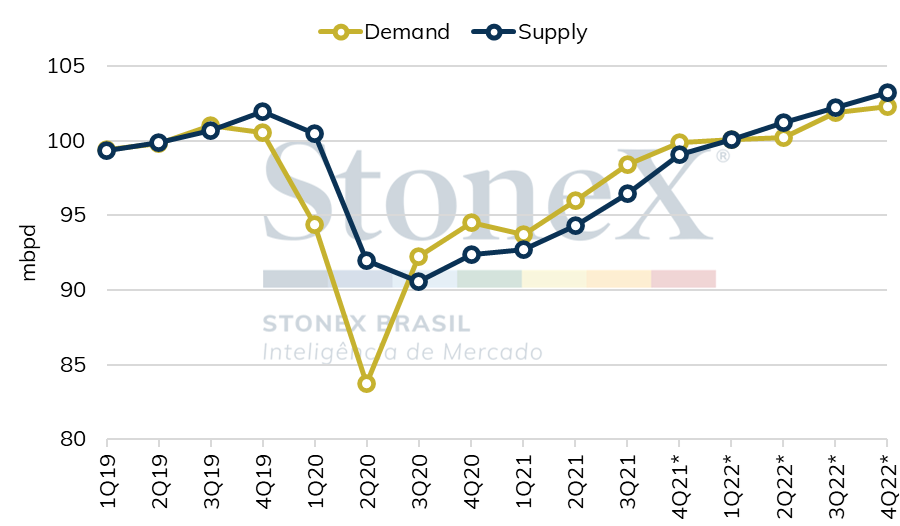
In order to outline scenarios for the behavior of fuel demand in 2022, it is necessary to analyze the trends for the oil market. According to the EIA's Short-Term Energy Outlook (STEO), the average scenario points to a drop in crude oil prices starting in the second quarter of 2022 – due to the expected surplus in its global S&D balance.
While this encourages greater gasoline consumption, it should be noted that incentives for the electrification of the US fleet may weigh on this progress. Nevertheless, between 2019 and 2022, our estimates point to a 66% growth of this fleet in the US, a trend that should gain greater strength in the long term, amid the Biden administration's incentives for half of all new vehicle sales be electric by 2030.
Ethanol consumption and blending rate in the US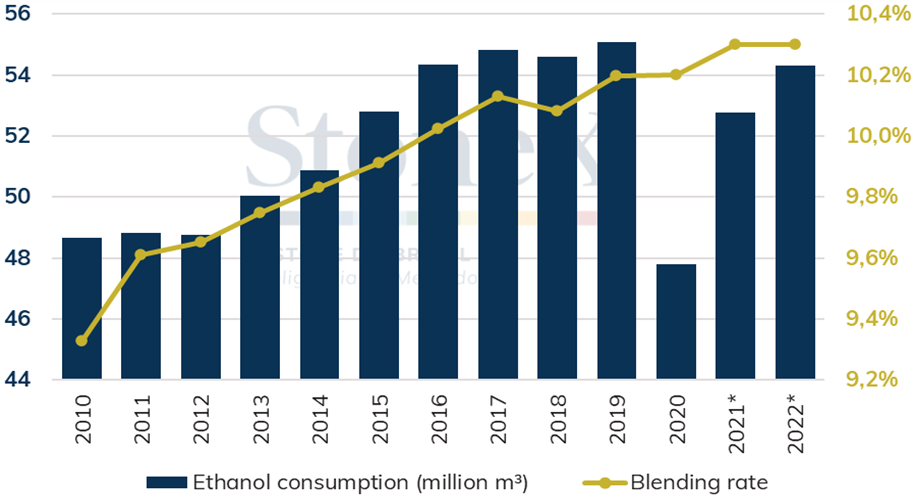
*Estimate. Sources: StoneX and USDA. Design: StoneX.
In light of these points, StoneX projects that annual gasoline consumption will increase by 3.0% in the US by 2022. Considering that the ethanol blending rate should remain relatively stable, given the obstacles faced to increase this percentage in the country, we expect biofuel consumption to reach just over 54.0 million m³ next year.
These obstacles come in the face of pressure from the oil industry on the Biden Administration regarding the blending mandates set by the RFS in 2022 and infrastructure limitations to advance the blending rate.
According to refiners, the financial situation of companies has deteriorated rapidly throughout the pandemic. Hence, reducing blending mandates is necessary to ensure that companies recover from the global economic crisis.
Still, it is worth noting that the ethanol supply should continue to grow, stimulating consumption. This is because the availability of corn, the main feedstock used in distillation, tends to increase in the 2021/22 crop (Sept-Aug).
The current season is heading for a robust production in the US, the second-largest in its history. The country's harvest occurred without major adversities and is in its final stretch, reaching 91% of the total by mid-November. On the crop condition side, the scenario was also favorable for North American grains. In its last report for the 2021/22 season, the USDA pointed out that 60% of the crop was in good or excellent condition, in line with the previous year.
The Department estimates that the 2021/22 crop yield will reach 11.0 tonnes/hectare, compared to 10.8 tonnes/hectare last season. With an estimated harvested area of 34.4 million hectares, high by 3.4% year-on-year, production should total 382.6 million tonnes (+6.7%). StoneX expects an even more positive figure for the current season, with production estimated at 384 million tonnes.
With favorable prospects for production in major players such as Brazil, Argentina and Ukraine, the trend is for the US to direct less of its production to the foreign market. As a result, the USDA estimates that shipments will total 63.5 million tonnes, 6.4 million tonnes less than the 2020/21 crop forecast.
This opens space for greater use of the grain in the domestic market, especially for ethanol production. The USDA estimates that 133.4 million tonnes of the cereal will be used for biofuel distillation, an increase of 4.4% from the previous year.
Gasoline consumption should decelerate in the coming years on a long-term horizon – as per the US commitment at COP26. Such dynamics could put pressure on ethanol demand, especially if the blending rate continues to grow at a modest pace.
European Union
In the European Union, the perspective is that the healthy pace of growth in 2021 will continue in 2022. After severe impacts on its economy due to the rapid spread of the coronavirus at the turn of 2020 to 2021, the expansion of vaccination and the resumption of stalled activities favor a more solid economic recovery this year. The bloc has also suffered from global production imbalances and feedstock shortages and a rapid acceleration in energy commodity prices. However, the European Central Bank (ECB) willingness to maintain economic stimulus should support growth next year at rates close to those observed in 2021. It remains to be seen whether rising general price levels or even the resurgence of Covid-19 cases in the region could force a revision of this trajectory and reduce potential growth.
Due to the decline in urban mobility and economic slowdown, the Covid-19 pandemic has also resulted in lower fuel consumption in the European block in 2020. However, in the year-on-year comparison, while gasoline demand retreated 13.0%, ethanol consumption retreated 10.1%, supported by national incentives for the use of biofuels. Even in an adverse context for the demand for the additive, the European Union's average blending rate increased from 5.3% in 2019 to 5.5% in 2020 - with expectations that it will end the current year at 5.7%.
In 2021, the advance of vaccination and the resumption of urban mobility is expected to have contributed to the growth of gasoline and ethanol consumption, estimated to reach 106.0 million m³ and 6.0 million m³, respectively. However, by 2022, the tendency is for fossil fuel consumption to decelerate amid the steady expansion of the electric vehicle market and incentives aimed at energy transition. Therefore, we project that the gasoline demand will be close to 105 million m³ in 2022 in the European block.
Ethanol consumption and blending rate in the EU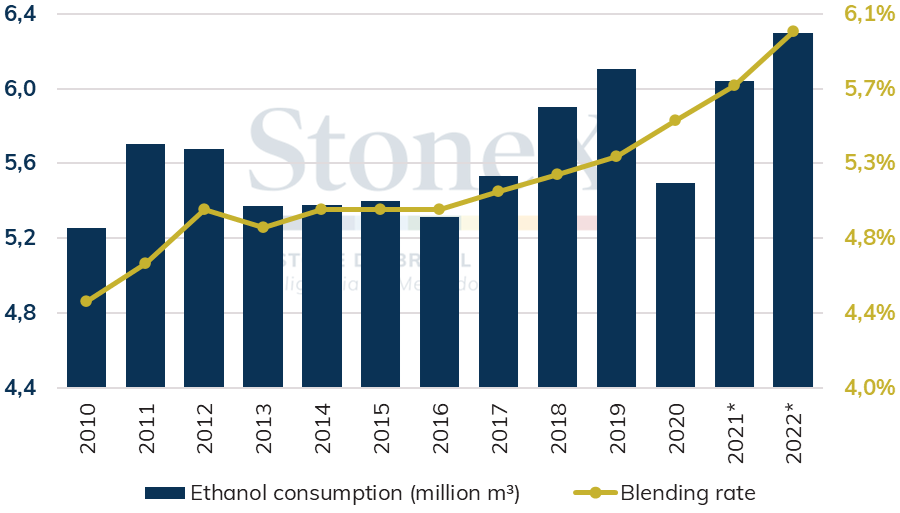
*Estimate. Sources: USDA & StoneX. Design: StoneX.
On the ethanol side, the high prices of some crops have made it less competitive against its fossil rival in the recent past. In addition, although most European ethanol is used as an additive in gasoline, in some countries, such as France, the use of E85 has increased – so that high prices mitigate the biofuel's market penetration.
Taking the product in Rotterdam (T1) as a basis, prices have appreciated by more than 30% since the beginning of August.
Next year, however, high oil prices may stimulate higher demand for flex-fuel vehicles and, consequently, for biofuel, which could rise by more than 20% in France, according to indications.
Although this scenario may enable the block to increase imports, gasoline and, consequently, ethanol consumption tends to be pressured by the firm advance in demand for electric vehicles. According to recent indications, electric and hybrid vehicles sales represented about 23% of the total commercialized in Europe in September/21, twice as much as in the same period of the previous year. In this context, data from the UN Economic Commission indicates that electric cars already represent 10% of the market in the region – a proportion that could rise to 19% by 2025, according to the International Energy Agency (IEA).
Most European countries have various benefits for purchasing electric cars, ranging from tax exemptions to government loans. With this, the continent has become one of the main poles of use of this type of vehicle, amid the goal of ending in 2035 the commercialization of combustion cars. This goal was reinforced at COP26, with the commitment of 24 countries and car manufacturers to end sales of this type of car by 2040. Therefore, our expectations are also positive for the electrification of the European fleet, which could grow by 132% between 2020 and 2022.
Although biofuels tend to gain strength in this context, first-generation ethanol, i.e., ethanol made from agricultural feedstock, is expected to have little room for expansion in the coming years. The EU's program to stimulate the use of renewable sources, known as RED II, aims to significantly expand second-generation biofuels, as discussed here, limiting the use of first-generation feedstocks to achieve the proposed targets.
The USDA estimates indicate that the greater stimulus for renewable diesel, for example, has already put pressure on the demand for ethanol in European countries. On the other hand, the expansion of the cellulosic ethanol sector is still hindered by high costs and uncertainties about EU incentives, which puts pressure on further investments.
In any case, the increase in the ethanol blending rate in gasoline in 2022, projected by us at 6.0%, acts as a factor supporting the demand for ethanol in the short term. Thus, we estimate demand for ethanol to reach approximately 6.3 million m³ in the European Union, an annual increase of 4.3%.
The Chinese economic outlook has added several challenges, limiting its economic growth projections for two years. Even though it should be among the fastest-growing countries, its expansion rate for 2021 and 2022 should be significantly below the initial projections. Among the factors that may slow it down is the cooling of domestic consumption, the occurrence of floods, a severe energy crisis, a liquidity crisis in large companies in the real estate sector, the tightening of regulatory bodies in sectors such as technology and private education, and the country's ambition to pursue the painful strategy of zero Covid-19 cases.
In parallel with the country's economic slowdown, the advance of fuel consumption in 2022 is also pressured by the expansion of electric vehicles. For ethanol, biofuel is at the center of government efforts to reduce dependence on imported energy sources and stimulate the use of renewable sources, mainly aiming to reduce air pollution.
It is worth remembering that China aims to peak greenhouse gas emissions in 2030, reaching carbon neutrality in 2060 – goals reinforced at COP26. In 2017, the government determined that the ethanol blending rate in gasoline should reach 10% by 2020, but such a level is far from being reached. Thus, although biofuels have proven to be fundamental to reducing pollutant gases, there is little clarity about the incentives for the sector in the coming years.
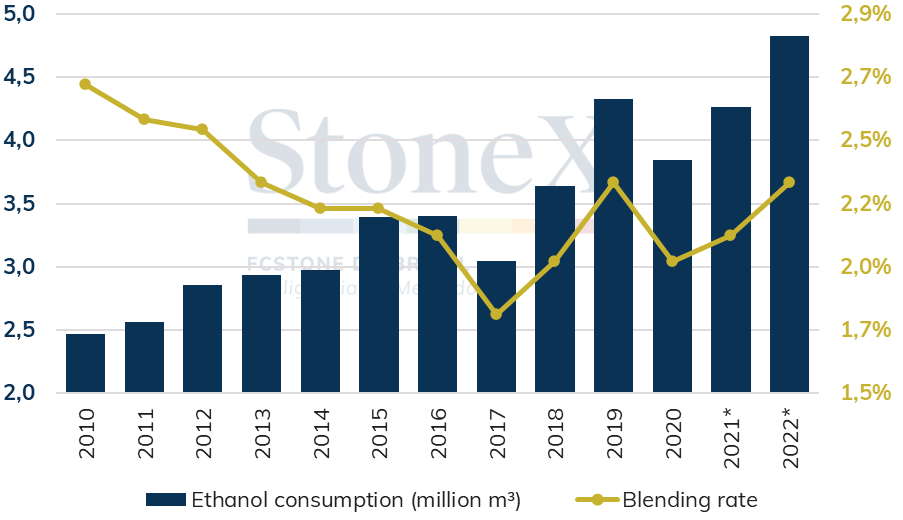
By 2021, USDA estimates indicate that the ethanol blending rate in gasoline will be only 2.1%, a proportion that has never exceeded 2.8%. This context reflects, especially, the strong dependence on corn as a feedstock for ethanol production. In 2020, for example, the shortfall in corn production raised the price of biofuel, making the 10% target unattainable.
It is clear, therefore, that any problems concerning the S&D balance of the cereal can harm the ethanol sector in the country. In parallel, gasoline consumption, and thus additive consumption, tend to be pressured by the steady advance of fleet electrification.
In recent years, Beijing has increasingly encouraged the electric vehicle sector, especially in production subsidies and infrastructure for public charging stations. The government's goal is for these vehicles to account for 40 percent of all car sales by 2030. At the same time, the share of Chinese manufacturers in sales in other regions, particularly Europe, is growing.
Ethanol consumption and blending rate in China
*Estimate. Sources: USDA & StoneX. Design: StoneX.
However, the current energy crisis is still a point of attention for the electrification of the Chinese fleet. Therefore, we expect more moderate growth in the share of electric and hybrid vehicles until 2022. Nevertheless, the increase in the country's population should still corroborate the expansion of gasoline consumption to a level close to 210.0 million m³ in 2022, which could represent an annual increase of 3.3%.
About ethanol, we expect that the blending rate will advance only 0.2 percentage points between 2021 and 2022 in China, taking the demand for the biofuel to 4.8 million m³, an annual increase of 13.1% – a growth driven mainly by expected GDP growth, although lower than that observed in recent years.
The economic outlook for Brazil has deteriorated since the first half of 2021. An inflationary acceleration with multiple sources of cost pressure associated with a constant and disorganized alternation of priorities in the federal government's economic plan has caused frequent revisions of the country's economic growth, inflation, exchange rate, and interest rate outlook. More recently, the search for an increase in the average benefit of the Auxílio Brasil basic income transfer program, which substituted Bolsa Família, through the revision of the constitutional spending limit and the extension of the payment of government debts that have become final and unappealable, led to a sensible exchange devaluation, an increase in expectations for the price level and the level of the basic interest rate (Selic) in 2022. Under this economic environment less favorable to growth, marked by loss of purchasing power and contractionary monetary policy, consumption tends to weaken, weighing in general on the demand of industry and the service sector. The positive performance of agribusiness and some service activities, on the other hand, may mitigate the weaker result of the other sectors.
As with the other players, the prospects for the electrification of the Brazilian fleet are also positive, even though such growth is hindered by limiting factors such as infrastructure and high costs. The sale of hybrid and 100% electric vehicles reached a record 14,000 units in the first half of 2021, an annual growth of 80%. Such expansion should gain strength in the long term, with electric vehicles representing 62% of the Brazilian fleet by 2035, according to Anfavea's projections.
Otto cycle consumption in Center-South Brazil
*Estimate. Sources: ANP and StoneX. Design: StoneX.
For this to materialize, however, greater investments and subsidies must be granted to the sector. Considering that the environment is still adverse to the penetration of electric vehicles, we project that this fleet will still represent 0.2% and 0.3% of all vehicles in 2021 and 2022, respectively. Therefore, although it will hurt Otto-cycle consumption in the coming years, we must ponder that ethanol should gain prominence in this context since the Brazilian market should bet on ethanol in its electrification projects, especially hybrids.
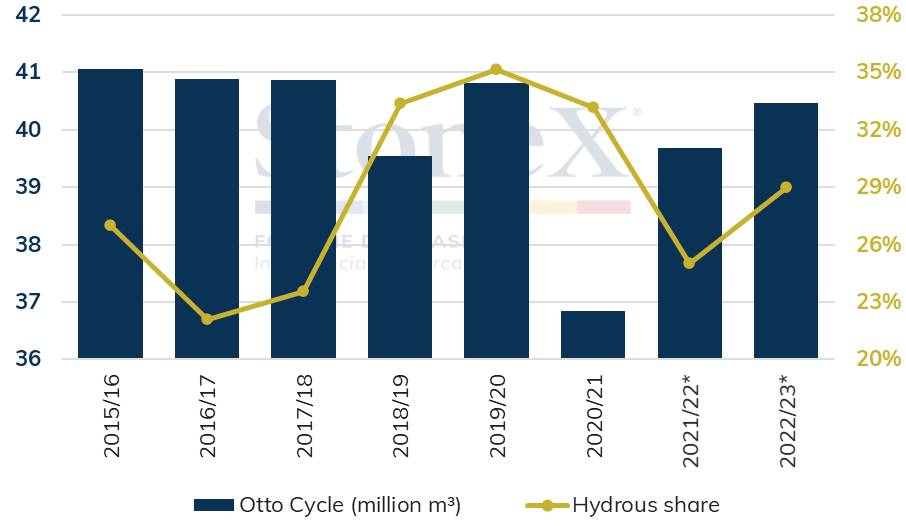
Because of these factors, we expect Otto fuel consumption to reach about 52.0 million m³ in 2021, an annual increase of 5.5%, with gasoline assuming a greater role. In Center-South, the main consumer region, the price parity between ethanol and gasoline already reaches 81.4%, a trend that should continue until March/22, given the period of the sugarcane inter-crop in the sugarcane belt – with a lower supply of ethanol.
The national demand for hydrous ethanol should be close to 17.0 million m³ this year, representing an annual decrease of about 13%. In parallel, anhydrous demand should rise to a level in line with 11.0 million m³. Even so, fuel prices at high levels may hinder the advance of urban mobility in the coming months, acting as a pressure factor on Otto Cycle demand.
*Estimate. Source and Design: StoneX.
In 2022, we project that Otto Cycle consumption in Brazil will increase by 2.2%. Of course, this perspective will still depend on the trends for fuel prices in the Brazilian market, as discussed here. In any case, it seems likely that plants will direct a greater volume of sugarcane to ethanol production, favoring its competitiveness at the pumps.
Specifically, in the 2022/23 cycle (Apr-Mar) in Center-South Brazil, we project hydrous consumption to be close to 16.7 million m³ (+18.3%), while anhydrous consumption is projected at 7.7 million m³ (-3.4%).
Conclusion
The oil market fundamentals indicate that the commodity's prices will continue to be supported until the end of the first quarter of 2022, essentially due to the deficit in the product's S&D balance in the world market, which should continue as fuel consumption accelerates and oil reserves around the globe shrink.
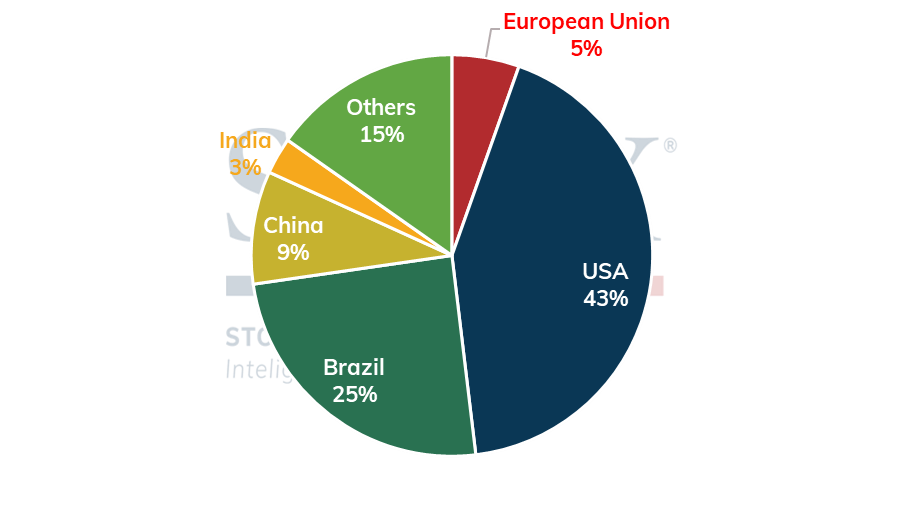
World ethanol consumption matrix in 2020
Source: FAO. Design: StoneX.
Another point of attention is the possibility of substituting natural gas with oil derivatives for power generation and room heating in Europe. The reasons behind this exchange are the low stocks of natural gas in a period close to the European winter, which starts in December and ends in March. Given this scenario, the deficit in the crude oil market will likely continue throughout the first quarter of 2022, culminating in supported prices for the commodity over this period.
For 2022, Brent prices may be pressured by the greater comfort in the crude oil S&D balance, stimulating gasoline and, consequently, ethanol consumption worldwide. Based on the macroeconomic perspectives and for the electrification of the fleet of the players previously presented, we estimate that ethanol demand will reach about 97.0 million m³ next year. It is worth noting that, together with India, these countries will represent 84.7% of the global demand for ethanol in 2020.
Finally, it is important to comment on the advance of the ethanol sector in India. This player will receive increasing attention, given New Delhi's ambitious plans to expand the dual-fuel share in its energy matrix. As a result, we expect that alcohol consumption in 2022 will be close to 3.0 million m³, following the government incentives to the sector.