- Growth prospect of supply in South America;
- US exports in 23/24 are below the 5-year average;
- USDA projects an increase in US ending stocks for 24/25.
- USDA projects a reduction in corn acreage in the US in 24/25;
- Funds are exiting their short positions;
- Russian attacks may impact Ukrainian exports.
Overview
Last week, the corn market focused on the US planting intentions report for 24/25, prepared by USDA based on surveys conducted with American farmers. Before the release, the expected planted area was 37.14 million hectares, a decrease of 3.0% compared to the crop 23/24. This is because corn depreciated more than soybean in the last 12 months, making the oilseed more attractive than the grain. However, when the data was released on Thursday (28), the decline was even more significant than expected, with the 36.44 million hectares representing a 4.9% decrease.
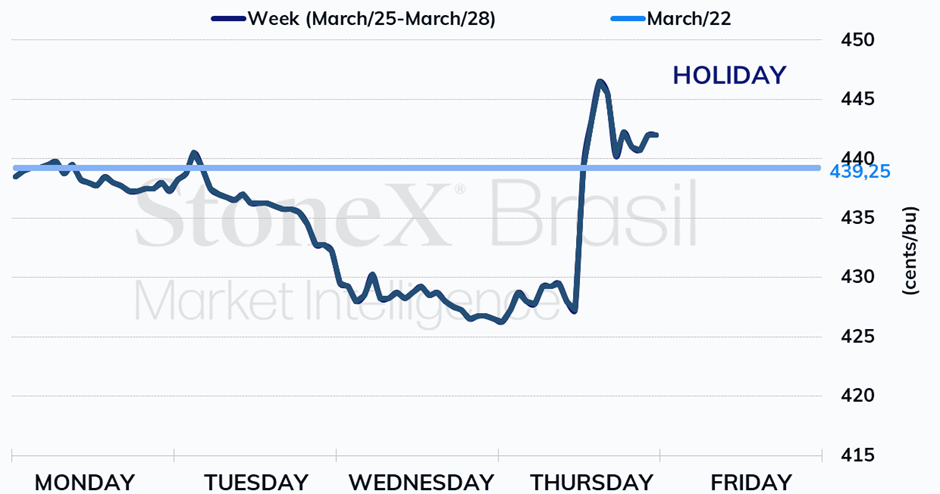
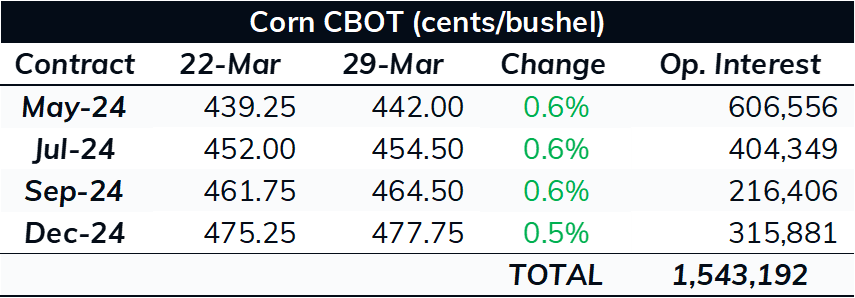
For the corn quotes on the Chicago exchange, this expectation break resulted in significant gains for the contracts. The May contract ended Thursday's session quoted at 442 cents/bu, a weekly appreciation of 0.6%. Between Monday (25) and Wednesday (27), before the planting intention report was released, investors were betting on losses for corn.
In addition to the planting intentions report, the USDA released the quarterly stock numbers for the United States on Thursday (28). For corn, the report showed that stocks were at 212 million tonnes on March 1st, a volume only 0.9% above market expectations. In this sense, the stock numbers had practically no effect on the price of corn in Chicago.
After the release of planting intention data and stock position in the United States, the corn market's attention is now focused on two factors. Firstly, the planting work in the United States, which is in the southernmost part of the agricultural belt, is set to begin on April 1, gradually rising more northerly every 5 days. Secondly, the weather in Brazil as we are entering the critical period for determining the productivity of the 'safrinha' corn crops. Currently, agricultural regions are receiving satisfactory volumes of rain, but climate models indicate a drier pattern throughout April.
Intraday (15 min) May/24 contract - CBOT
United States
The ethanol sector is demanding high volumes of corn - In the week ending March 22, the United States produced 1.054 million barrels of ethanol per day, a volume 6.7% above the average of the last five years for the period. In the average of the 12 weeks of 2024, ethanol production is 1,032 thousand barrels per day, an increase of 3.3% compared to the average of the last five years. Despite this robust production, American stocks reached 26.09 million barrels, the highest value since March 2023. For the corn market, this means that the demand from the ethanol sector is strong, helping to offset the weakness in international demand.
The pace of export sales concerns market agents - In the week ending March 21, the net of US corn export sales was 1.21 mmt, raising the sales aggregate in 23/24 to 42.8 million tonnes. This added volume is higher than that recorded in the previous crop, but it is lower than that recorded in 20/21 and 21/22. Perhaps more important than that is the fact that the pace of sales is below the necessary level to reach the USDA's estimate of 53.3 million tonnes. If this expectation is not confirmed, the carryout will be higher than expected, a phenomenon that would have a bearish impact on quotes.
US export sales (tmt)
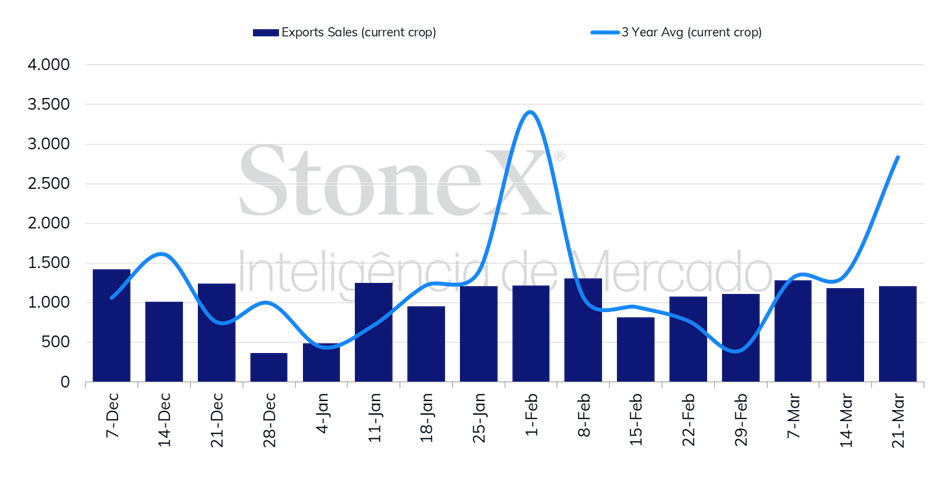
Source: USDA. Design: StoneX.
Brazil
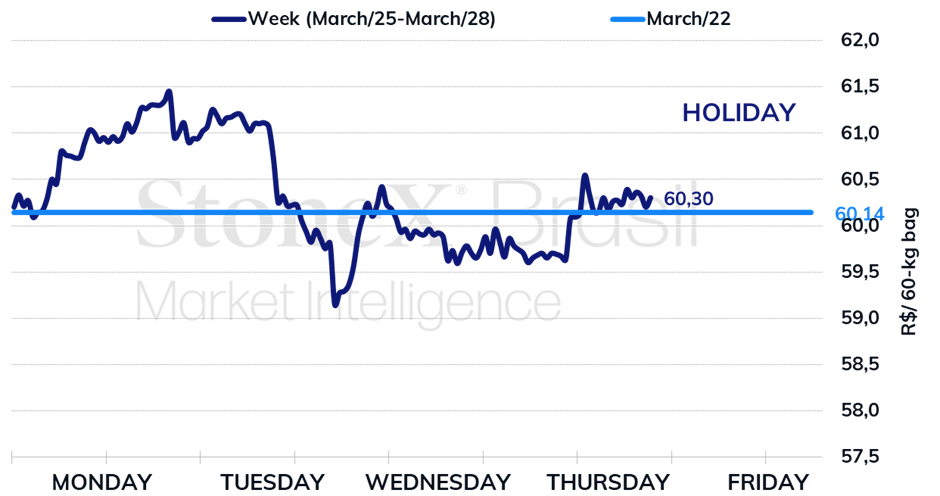
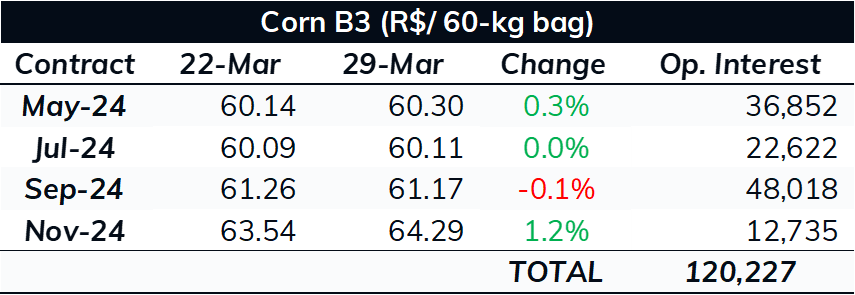
Low variation for corn on B3 - Last week, corn futures traded on B3 oscillated. Among the bearish factors, the good precipitation volumes in the Brazilian agricultural belt stand out, bringing more optimistic prospects for the productivity of the "safrinha." However, the crops still need to go through April without major adversities. Among the bullish factors, the highlight was the planting intentions report in the United States, which showed that American farmers are planning to plant a smaller area than the market expected. Amidst comings and goings, the May contract ended the week quoted at R$ 30.3/bag, with an appreciation of just 0.3%.
April will be a critical month for safrinha productivity - Despite the current rains being great for the crops, the productivity of safrinha will depend on the rainfall regime in April, a month in which a significant part of the crops will go through the pollination period. For the next two weeks, forecasts show significant volumes of rain in Mato Grosso, Goiás, Bahia, and MATOPIPA. On the other hand, Paraná and important parts of Mato Grosso do Sul may suffer from low precipitation volume. Therefore, these two states are the main points of attention.
StoneX updated its estimate for the corn crop - On April 1, StoneX updated its estimates for the Brazilian corn crop. For the 1st crop, the March estimate was maintained: 25.9 million tonnes. With 65.1% of the crops already harvested, this estimate is not expected to undergo major revisions. The estimate for the second corn crop was adjusted to 96.1 million tonnes, a decrease of 0.2% compared to the previous month. The losses were the result of productivity adjustments for Paraná and Mato Grosso do Sul, states that have been suffering from drier weather. In the aggregate of the 23/24 crop (1st, 2nd, and 3rd crops), the estimate stood at 124.23 million tonnes, a volume 11.9% lower than that recorded in the 22/23 crop. It is worth noting that the figure for the "safrinha" is still subject to revision, with April being a key month for determining the productivity of the crops.
The planting of the safrinha is practically finished - As of March 28, 98.3% of the safrinha corn crops had already been sown. Minas Gerais (70%) and São Paulo (78%) were the only states where planting was not yet completed.
The summer corn harvest continues to progress - As of March 28, 65.1% of the crops had already been harvested. In the South, the harvest is already finished, while in the North/Northeast, it is just beginning.
Intraday (15 min) May/24 contract - B3
Argentina
Buenos Aires Exchange maintains crop estimate but reduces the percentage of crops in good/excellent conditions - The Buenos Aires Grain Exchange (BCBA) maintained its estimate for corn production in Argentina in the 23/24 crop at 54 million tonnes, which represents an annual increase of 20 million tonnes. However, the weekly report from BCBA once again warned about the leafhopper's impacts, stating that new corrections in the estimate due to this pest's impacts have not been ruled out. Looking at the crop conditions, the percentage of poor has increased from 13% at the end of February to 25% now at the end of March, while the percentage of good/excellent has decreased from 30% to 22%. The crops under normal conditions decreased from 57% to 53% in the same period.
5.7% of Argentina's crops have been harvested; the average yield is at 147.2 bags/ha - With the reduction of rainfall, conditions for corn harvesting in Argentina have improved. According to data from the Buenos Aires Grain Exchange, 5.7% of Argentina's corn crops were harvested by March 26, a percentage in sympathy with the average of the last 5 years and representing a weekly advance of 2 percentage points. It is worth noting that the Argentina harvest takes place over a longer period than in Brazil or the United States, starting in mid-March and ending only in early August. Looking at productivity, it is currently at 8.83 t/ha (147.2 bags/ha), above the average volume of the last five years of 7.48 t/ha (124.7 bags/ha). In this sense, the initial productivity data is quite positive despite still being very incipient.
Futures and spot prices
Futures contracts traded on the CBOT (US¢/bu)

Futures contracts traded on B3 (BRL/bag)
Spot prices in Brazil (USD/60kg-bag)