- Supply growth prospect in South America;
- US exports in 23/24 are below the 5-year average;
- Important volumes of rain are falling over the main Brazilian producing regions.
- USDA projects a reduction in corn acreage in the US in 24/25;
- The spread of the leafhopper is impacting Argentina's productive potential;
- The ethanol and animal feed sectors in the United States are consuming high volumes of corn
Overview
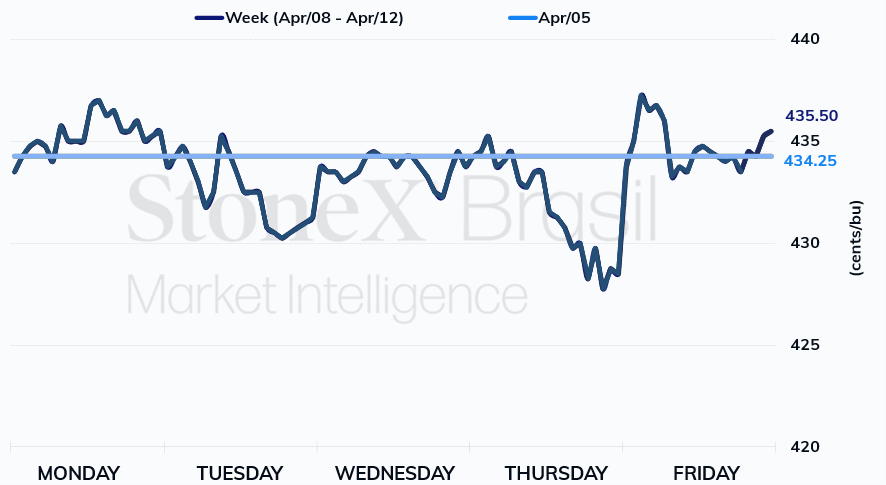
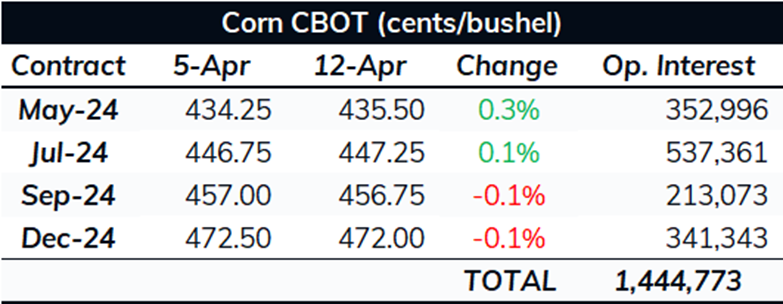
Last week, corn futures traded in Chicago did not show a clear trend: while the contracts expiring in May and July had minimal gains, those expiring in September and December recorded slight losses.
At the beginning of the week, agents lacked direction because they were waiting for the release of the USDA's supply and demand report (WASDE), scheduled for Thursday (11). The expectation was that the report would show a cut in the United States ending stocks and a reduction in the crop estimates for Brazil and Argentina.
When the report was finally released, it confirmed some expectations but disappointed others. On the one hand, the USDA actually reduced US ending stocks in 2023/24, as recent disclosures have shown that the ethanol and feed sectors consume significant volumes of corn (which consequently impacts the stocks). In addition, there was also the expected reduction in the estimate for the Argentine crop, given the recent problems with leafhoppers.
On the other hand, the USDA kept production data in Brazil unchanged at 124 million tonnes. Although this figure is close to the one estimated by StoneX (124.23 million tonnes), it is far from CONAB's, which puts the Brazilian crop for 2023/24 at only 110.96 million tonnes. In this sense, Brazilian production continues to be surrounded by uncertainties, keeping investors cautious.
Faced with these results, the final balance of the WASDE report was neutral for corn prices, with neither the downtrend nor the uptrend being able to establish itself. For the next few weeks, attention will be focused on the weather in Brazil, the start of planting in the United States, and geopolitical tensions in the Middle East.
It is worth noting that the session below about Brazil will analyze the movement of corn on B3.
Intraday (15 min) May/24 contract - CBOT
United States
The ethanol sector is consuming high volumes of corn - Last week, EIA data showed that the United States produced 1.056 million barrels/day in the week ending April 5, a volume 14.7% higher than the average of the last five years for the period. This result aligned with the market's expectations, as production in 2024 has consistently been above the average of the last five years. To be more precise, this happened in 12 out of the 14 disclosures already made in the year 2024. Consequently, USDA now estimates that the ethanol sector will consume 137.16 million tonnes of corn in 2023/24, a 0.5% increase monthly and a 4.3% increase year-on-year.
The feed sector is consuming high volumes of corn - In the March WASDE report, the USDA estimated corn consumption for feed in 2023/24 at 144.78 million tonnes. This volume represents a 0.4% monthly increase and a 3.9% annual increase, an indication that the American Department is seeing the feed sector consume significant volumes.
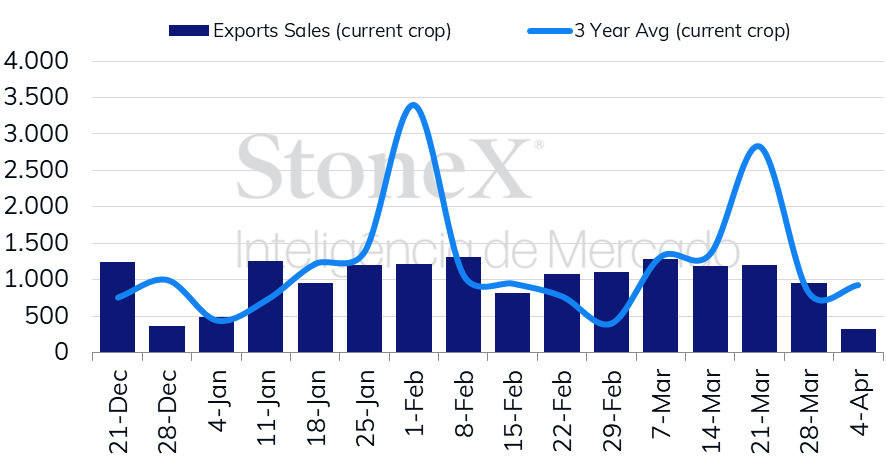
The pace of exports is below the USDA's estimate - In the 31st week of the 2023/24 crop year, the balance of US corn export sales was only 0.33 million tonnes, compared to 0.93 million on average over the last three years. Thus, the aggregate of exports in 23/24 reached only 44.1 million tonnes, still 9.3 million tonnes below USDA's estimate of 53.4 million tonnes. Over the past three years, export sales in the last 21 weeks of the crop year averaged only 4.5 million tonnes. In this sense, the USDA will have to adjust its export estimate, even though the figure was maintained in April.
USDA reduced carryout 23/24, but volume is still significant—As in the April WASDE report, the USDA maintained its estimate for corn production in the United States and increased its estimate for consumption (ethanol and feed). The carryout was reduced from 55.17 million tonnes to 53.90 million tonnes. Although, in the short term, this change has a bullish bias, a broader analysis continues to show a comfortable balance between supply and demand in the United States, a bearish factor. The stock of 53.9 million tonnes at the end of the 23/24 cycle still represents a 56% increase in stock compared to 22/23, an indication of supply exceeding demand. If the USDA corrects the export data, we may have an even more comfortable scenario.
Export sales from the United States (tmt)
Source: USDA. Design: StoneX.
Brazil
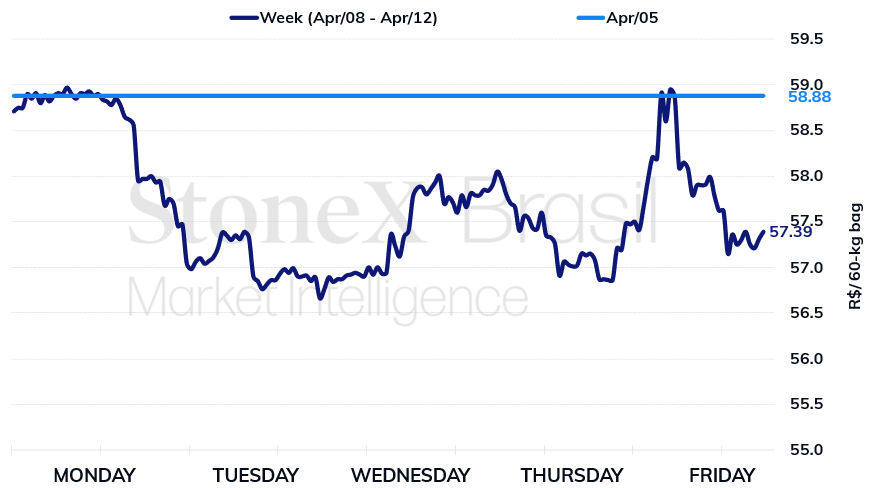
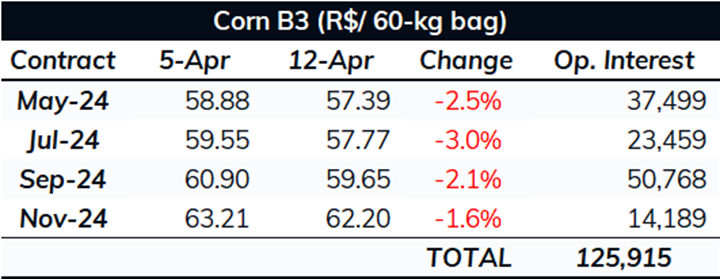
Good rain volumes result in corn devaluation on B3 - If last week, the corn futures at CBOT were stable, on B3, they showed significant drops. The May contract ended the period at R$ 57.39/bag, a weekly depreciation of 2.5%. The main factor behind the losses was the good volumes of rain that fell in key regions for the productivity of the "safrinha." In particular, the market priced in the rains in Paraná and Mato Grosso do Sul states that had been suffering from drought and needed good precipitation levels to avoid significant losses. For the upcoming week, the estimates continue to show a favorable climate for the development of corn, a bearish factor for the grain.
Discrepancies in estimates for the 23/24 crop - Last week, USDA and CONAB updated their estimates for the Brazilian corn crop: 124 million and 110.96 million tonnes, respectively. This significant difference keeps the corn scenario uncertain in Brazil, which is a bad factor for the players in the sector. It is worth noting, however, that StoneX believes that the USDA figure is the most accurate: in early April, the company estimated the Brazilian corn crop for 23/24 at 124.23 million tonnes. Other companies in the private sector also released figures closer to those of USDA. The average estimate of 12 major companies in the sector is 123.4 million tonnes.
Intraday (15 min) May/24 contract - B3
Argentina
New cut for Argentina's production estimate - The leafhopper continues to cause problems for Argentine farmers. In mid-March, just five weeks ago, the Buenos Aires Grain Exchange (BCBA) estimated Argentina's corn crop at 56.5 million tonnes; in its latest release on April 11, the BCBA estimated production at 49.5 million tonnes, a 12.4% reduction. Now, the estimate is that Argentina will have a crop greater than 22/23 but lower than all others since 18/19. From what has been commented on, in important agricultural regions, especially in the provinces of Córdoba and Santa Fé, there are areas where expected productivity has decreased by 30%, with viruses and bacteria linked to the leafhopper causing significant damage.
Harvest Data - Corn harvest continues to progress in Argentina. According to the Buenos Aires Grain Exchange, 15.3% of the acreage has already been harvested, while the Rosario Exchange estimates that 22% has already been harvested.
Future and spot prices
Futures contracts traded on the CBOT (US¢/bu)

Future contracts traded on B3 (BRL/bag)
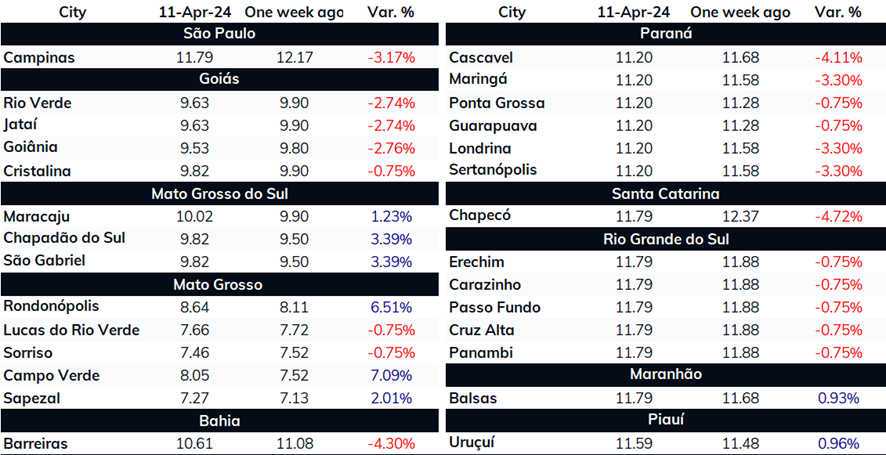
Spot prices in Brazil (USD/60kg bag)