- Supply growth prospect in South America;
- US exports in 23/24 are below the 5-year average;
- Outlook of high stocks at the end of the 23/24 crop year.
- USDA projects a reduction in corn acreage in the US in 24/25;
- The spread of the leafhopper is impacting Argentina's productive potential;
- The ethanol and animal feed sectors in the United States consume high corn volumes.
Overview
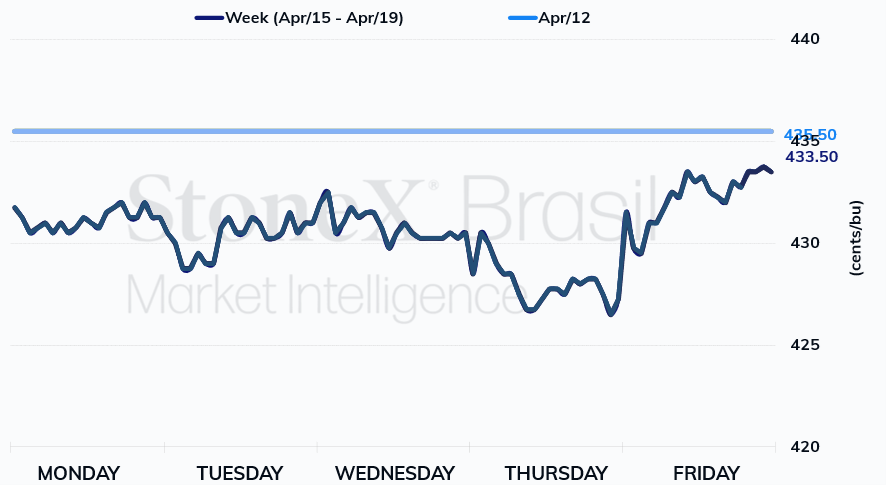
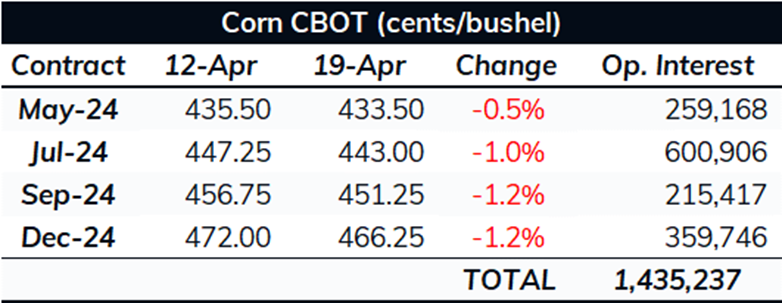
Last week, corn futures traded on the Chicago exchange recorded moderate losses. The May contract traded at 433.50 cents/bu, a weekly depreciation of 0.5%.
The main factor behind the losses was the strengthening of the dollar. The dollar index, an indicator that measures the strength of the American currency, reached 106 points, the highest level in the last 5 months. This happened due to two factors. First of all, there has been a change in the tone of the Federal Reserve members, who began to indicate that interest rates will remain high in the United States for longer than previously thought. Secondly, the escalation of geopolitical tensions in the Middle East reduced risk appetite and generated a rush to the USD. For more detailed information about exchange rates, click here.
The strengthening of the dollar ended up hurting the price of corn because this phenomenon decreases the competitiveness of the American product in the international market: the more expensive dollar implies a decrease in the purchasing power of importers. In this sense, the market understood that the price of corn in the United States, the main reference for the Chicago exchange, needed to fall to recover competitiveness.
For the week as a whole, the depreciation of corn was only not more significant because on Friday (19), the US government, through the Environmental Protection Agency (EPA), approved the sale of E15, a fuel composed of 85% gasoline and 15% ethanol, throughout the summer. Explaining in more detail, US legislation typically does not allow E15 to be sold between June 1 and September 15 due to studies indicating that this fuel is worse for air quality compared to E10 (90% gasoline and 10% ethanol). However, the Biden administration released a statement on Friday (19) allowing the sale of E15 during the ban months, indicating that the ethanol sector will consume more corn than usual for this time of year.
For the next few weeks, attention will be focused on the definition of the Brazilian crop, the planting progress in the United States, and now the dollar, which has become a relevant factor. It is worth remembering that an analysis of the movement of corn on B3 will be done in the session about Brazil.
Intraday (15 min) May/24 contract - CBOT
United States
Planting progress in the United States - On April 14, the corn planting in the United States reached 6%, a percentage slightly above the five-year average of 5%. Today (22), a new USDA update will be released, bringing the planting progress data up to April 21. Traditionally, corn planting in the United States begins in April and is already practically finished by the end of May/early June.
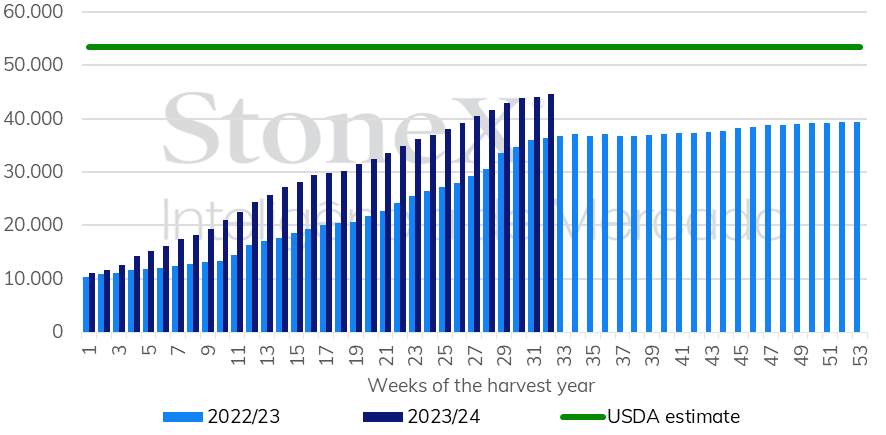
US corn exports are disappointing - In the week ending April 12, the US corn export sales balance was 501 tmt, a volume 31% lower than the average of the last three years. Thus, sales in the 23/24 crop year reached 44.6 million tonnes, 13% below the last three-year average. It is worth mentioning that USDA estimates US exports for 23/24 at 53.4 million tonnes, a volume 8.7 million tonnes higher than what has already been exported. With 20 weeks left until the end of the crop year, it doesn't seem likely that exports will actually reach that level. Historically, sales are weak in the last few weeks of the agricultural calendar, as most of the grains have already been sold. Over the past three years, export sales in the last 20 weeks of the crop year averaged 3.8 million tonnes.
Domestic consumption of corn is expected to be even higher with the approval of E15 sales throughout the summer - In its latest supply and demand report, the USDA increased its estimate for corn consumption in the North American ethanol sector by 0.5%. It may need to increase even more in the next announcement, as the US government has temporarily approved the sale of E15 throughout the summer. This change is expected to foster ethanol consumption. For more details about this measure, see this report's "Overview" section. This is an important achievement for the ethanol sector, which has long been seeking permission to sell E15 throughout the year. The official argument of the Biden Administration for the change was energy security, with the government stating that the measure reduces American dependence on oil imports from conflict areas (Middle East, Russia, etc). Behind the scenes, however, it is claimed that the decision was made to lower fuel prices in an election year.
Highly sold funds can bring volatility to the market – Currently, the funds are highly sold in the corn market, which means that most of this type of investor is betting on the grain's devaluation. This situation is dangerous because it can generate abrupt changes in the price of corn if many funds decide at the same time that they no longer want to bet on the grain's decline.
Export sales from the United States (tmt)
Source: USDA. Design: StoneX.
Brazil
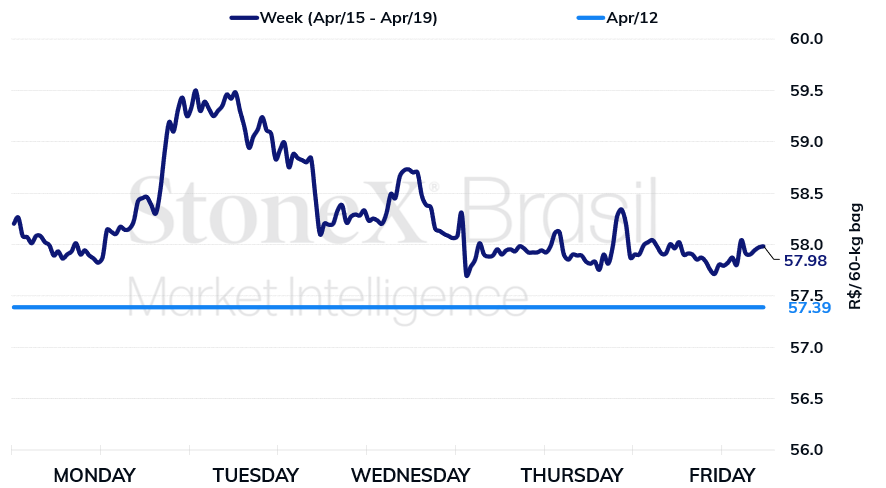
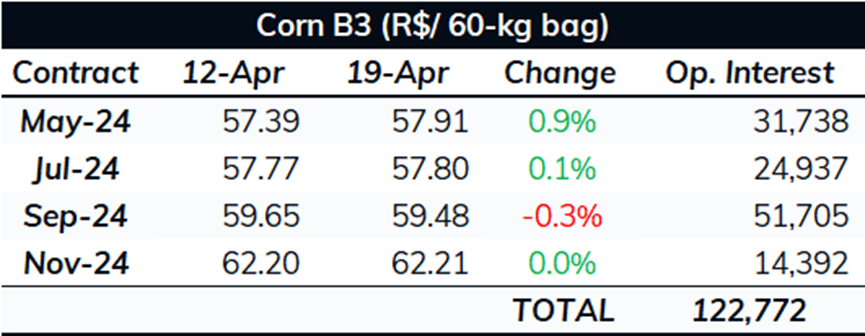
Dollar appreciation boosts gains for corn on B3 - Last week, the agents investing in corn on B3 somewhat disregarded the conditions of the crops and focused on the dollar, which ended up being the main price driver. Contrary to what happened at CBOT, on the B3, the dollar/real pair appreciation boosted gains for corn, causing May to end the week quoted at R$57.91/bag, a weekly appreciation of 0.9%. This happened because the dollar depreciation increases the competitiveness of Brazilian products in the international market. Consequently, investors understand that this means increased demand for Brazilian corn, hence the appreciation. For the next few weeks, attention should continue to focus on the dollar and the conditions of the crops.
Corn sales continue to be delayed in Brazil - Brazilian farmers are dissatisfied with the current price level of corn and are, therefore, delaying the sale of their grains. It is worth noting that this phenomenon has been happening since the last cycle, as during that period, the price of corn was already declining. Until April 19, 40.1% of the summer corn 23/24 had been marketed, compared to 52.8% on average over the last 5 years. For the safrinha corn 23/24, only 20.6% had been marketed, compared to 43.8% in the average of the last 5 years.
Intraday (15 min) May/24 contract - B3
Argentina
Rains are delaying the corn harvest - Abundant rains fell over a significant part of the Argentine agricultural belt last week. High volumes were observed in Buenos Aires, Entre Rios, southern Santa Fe, and eastern Cordoba. This phenomenon disrupted field work, causing the weekly harvest progress to be only 1.9 percentage points. Now, 17.2% of Argentine corn crops have been harvested, a delay of 8 percentage points compared to the average for the 2018-2022 period.
Grain Exchange maintains an estimate for corn production at 49.5 million tonnes - Among the corn crops already harvested in Argentina, the average yield is high: 8.79 tons/ha (146.5 bag/ha). However, the Cereals Exchange of Buenos Aires (BCBA) estimates the final productivity at 6.91 tons/ha (115.2 bag/ha), as many of the crops that suffered from the spread of the leafhopper have not yet been harvested. It is worth remembering that the BCBA estimates Argentina's corn crop for 23/24 at 49.5 million tonnes, an increase of 45.6% compared to 22/23 but a decrease of 8.8% compared to the average for 18/19-21/22.
The crop condition has deteriorated in the regions affected by the leafhopper but improved in other late planting areas - The leafhopper continues to cause damage to Argentine corn crops. In the affected regions, the condition of the crops continued to deteriorate, with areas where estimated productivity has already dropped by about 30%. However, this was offset by the improvement in quality in other areas of late planting, which benefited from the abundant rains reported throughout the week. Thus, the condition of the crops changed little in the weekly comparison, with the excellent, good, or normal area decreasing from 78% to 77%.
Future and spot prices
Futures contracts traded on the CBOT (US¢/bu)

Future contracts traded on B3 (BRL/bag)
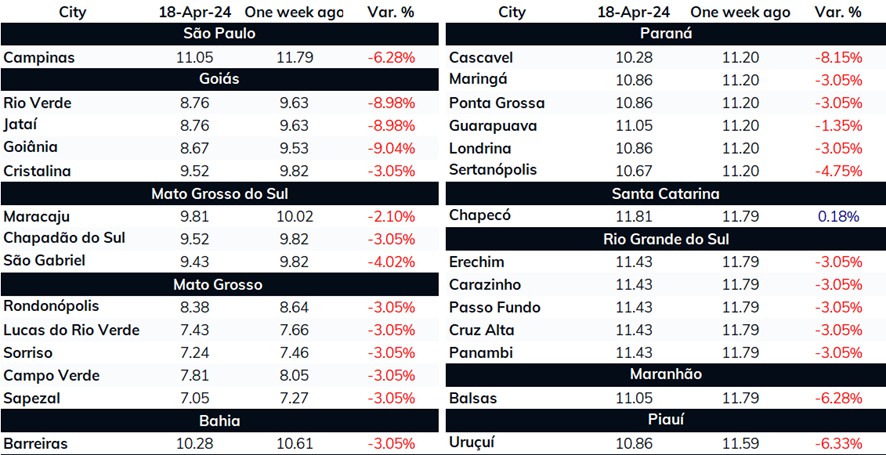
Spot prices in Brazil (USD/60kg bag)