- Bearish Factors
- Outlook of high stocks at the end of the 23/24 and 24/25 crop years;
- Possibility of USDA having overestimated the reduction in corn planting area in the US;
- USDA estimating increase in US exports for 24/25.
- Bullish factors
- Drought in Paraná, Mato Grosso do Sul, and São Paulo;
- Excessive rain in Rio Grande do Sul;
- Spread of the leafhopper in Argentina;
- Delay in planting in the United States.
Overview
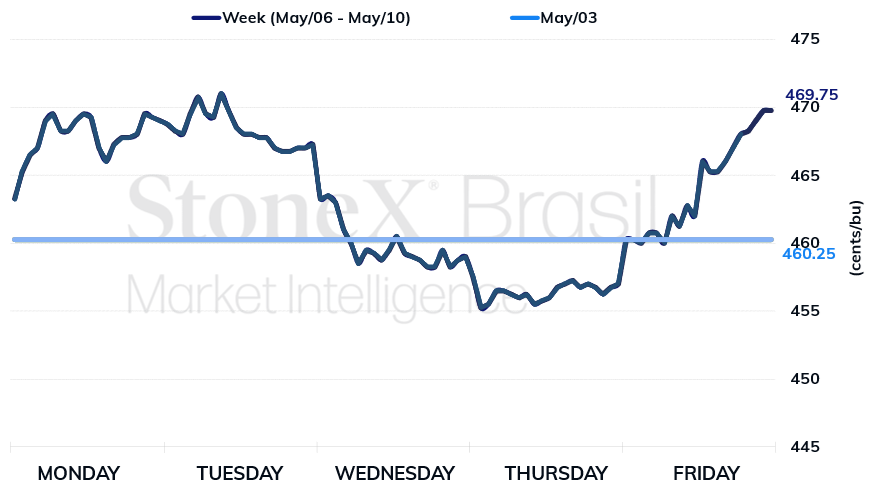
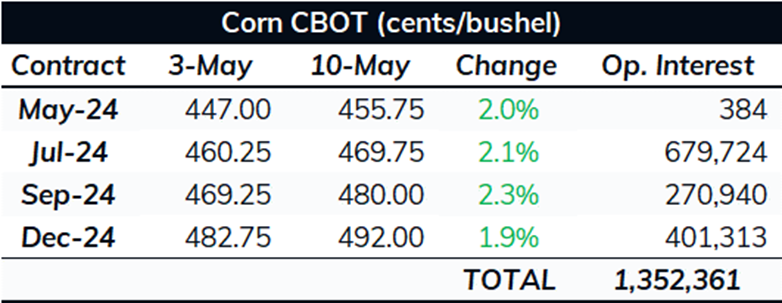
Last week, corn futures had significant gains on the Chicago exchange. The contract with expiry in July ended Friday's session (10) quoted at 469.75 cents/bu, with a weekly appreciation of 2.1%.
In addition to prices, the significant change in the position of the funds also caught attention. Now, the balance of these agents (short contracts subtracted from long contracts) in the corn market is -102,513, the least short position since August 2023. This change indicates that speculators are less willing to bet on new losses for corn.
Throughout the week, the USDA's WASDE report was the main factor behind price changes and fund positions. It was released on Friday (10) and brought some news to the corn market.
For the 2023/24 crop, the expected cuts for the Brazilian and Argentine crops occurred. In Brazil, the production estimate decreased from 124 to 122 million tonnes due to climatic problems faced by some states. In Argentina, the crop decreased from 55 to 53 million tonnes due to problems caused by the leafhopper. The market already priced both cuts, so they did not have much impact on prices.
Still, regarding the crop 2023/24, corrections have also occurred for the United States. The USDA increased the outlook for corn consumption by the ethanol sector (137.2 to 138.4 million tonnes) and raised export prospects (53.3 to 54.6 million tonnes). Consequently, there was a cut in the carryout of the United States: from 53.9 to 51.4 million tonnes. The market also already expected these factors, and StoneX's chief economist, Arlan Suderman, even anticipated them in a webinar held with Brazilian clients. In this sense, they also did not have many impacts on prices.
The factor that had the most impact on the quotes was the prospects for the crop 2024/25, especially the indicators released for the United States. This was the first estimate for the new crop, bringing a first glimpse of what USDA expects for this new cycle.
The big surprise was the United States export estimate, with 55.9 million tonnes being 6.4 million tonnes above what StoneX had estimated. Thus, the carryout for 2024/25 stood at 53.4 million tonnes, a volume lower than the expected 58.0 million, resulting in gains for corn.
It is worth considering in the medium term. Although prices rose immediately after the release, this does not necessarily mean that the USDA report will have a bullish impact on the price of corn. Although a stock of 53.4 million tonnes is smaller than imagined, it still represents a very large supply excess, which does not mean buyers will have to pay higher prices to ensure their corn needs are met.
In perspective, the size of the American crop will define the direction of corn prices throughout the rest of 2024. Therefore, it is very important to continue following the issues related to this country. At the moment, attention is focused on planting, which is slightly behind the historical average. More details about this will be provided in the section below.
Intraday (15 min) July/24 contract - CBOT
United States
Let's look at the outlook for the American crop 2024/25, brought by USDA in its May report. On the supply side, a crop of 377.5 million tonnes was estimated, an annual reduction of 3.1% due to the contraction in planting area. However, the robust crop of 2023/24 resulted in a very high carryout: 51.4 million tonnes. Thus, the total supply (stock + production) for the 2024/25 crop year stood at 428.8 million tonnes, a volume 1.1% higher than that recorded in the previous cycle. The market was expecting a figure similar to the disclosed one.
On the demand side, the figures were even more surprising. For domestic consumption, USDA estimated that the feed sector will consume 146.1 million tonnes, the ethanol sector 138.4 million tonnes, and the industrial sector another 35.7 million tonnes. All these volumes fell below what the American StoneX and a large part of the market estimated. The domestic consumption estimated by USDA stood at 320.2 million tonnes, 1.2% lower than market estimates.
With supply in line with market expectations and domestic demand falling below, the USDA supply and demand report could have a bearish impact on prices. However, this did not happen due to external demand, that is, exports. The market expected a reduction in US corn exports in 2024/25, as the United States has been losing market share to Brazil in the international market. The American StoneX, for example, estimated the export of 49.5 million tonnes. The USDA, however, was surprised and estimated exports to be at 55.9 million tonnes.
In conclusion, exports were approximately 6.4 million tonnes above what the market expected, compensating for domestic consumption of 4.0 million tonnes below. Thus, the final stock stood at 53.4 million tonnes, a volume lower than the expected 58.0 million.
Anyway, the realization or not of USDA estimates will depend on the unfolding of the American crop, which is still in its early stages. 36% of the crops had been planted by May 5, a delay of 3 percentage points compared to the average of the last five years. This delay is related to the rains that fell over the American agricultural belt during the first third of May, hindering the planting of corn.
For now, this delay is not very worrying yet. The climate models indicated that the weather was dry on Friday (10), Saturday (11), and Sunday (12), which must have allowed the fieldwork to progress. Moreover, the ideal window for planting extends until the end of May, with many days remaining to advance sowing.
If the planting has not progressed as expected last weekend, the market may start to get more nervous. In this sense, attention to the update on the planting progress in the United States will be released today (13).
Export sales from the United States (tmt)
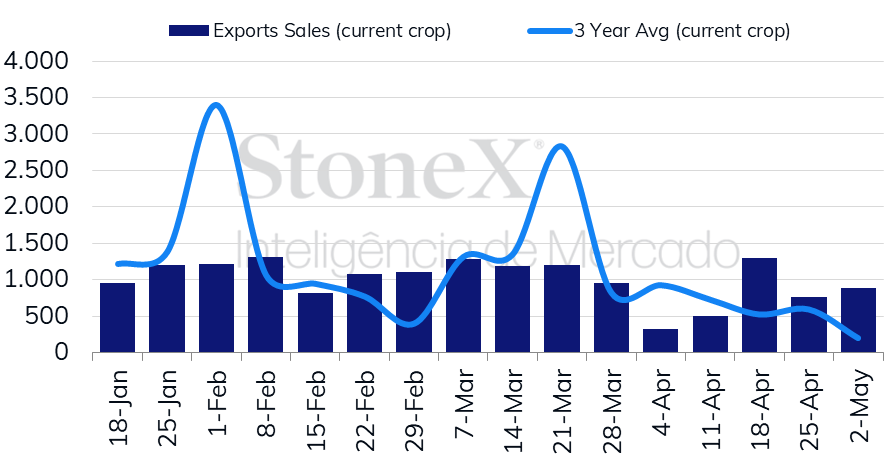
Source: USDA. Design: StoneX.
Brazil
For Brazil, the main change brought by the USDA supply and demand report was the 2023/24 crop estimate cut, which went from 124 million tonnes to 122 million. The reduction was motivated by the drought faced by some Brazilian states, especially Paraná, Mato Grosso do Sul, and São Paulo. For the rest of May, the climate models show very little rain in these regions, except for a few days in Paraná. If this forecast materializes, new production cuts are not ruled out.
On the demand side, the USDA report indicated a 1.3% increase in Brazilian domestic consumption (from 78.5 to 79.5 million tonnes) and a 3.8% reduction in exports (from 52 to 50 million tonnes). The final Brazilian stock for the 2023/24 year was reduced by 2.4 million tonnes, a bullish factor for corn.
In addition to the USDA report, attention was paid to the Brazilian corn market, especially in Rio Grande do Sul. When the sharp rains began, the summer corn harvest was already finished. Therefore, StoneX kept its estimate for the Rio Grande do Sul corn crop at 5.0 million tonnes. However, measuring the floods' impact on the stored corn is still impossible, so production cuts are not ruled out. It is worth mentioning that the climate of Rio Grande do Sul does not allow for the planting of safrinha corn.
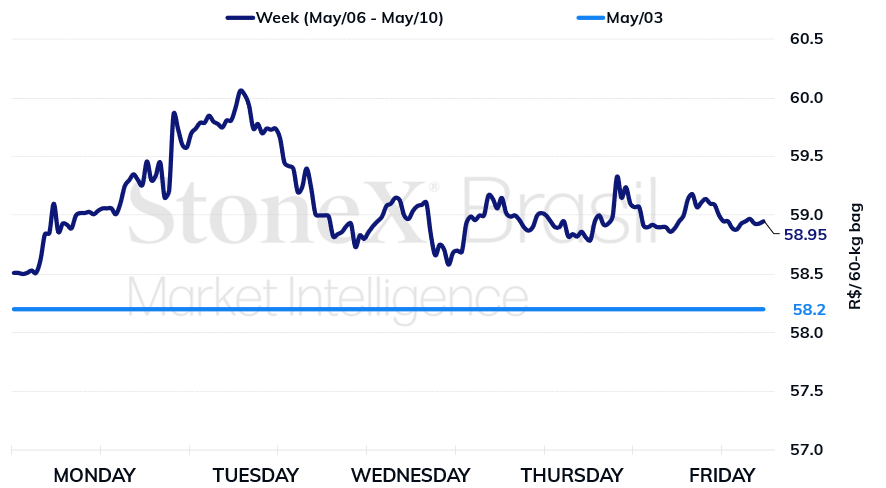
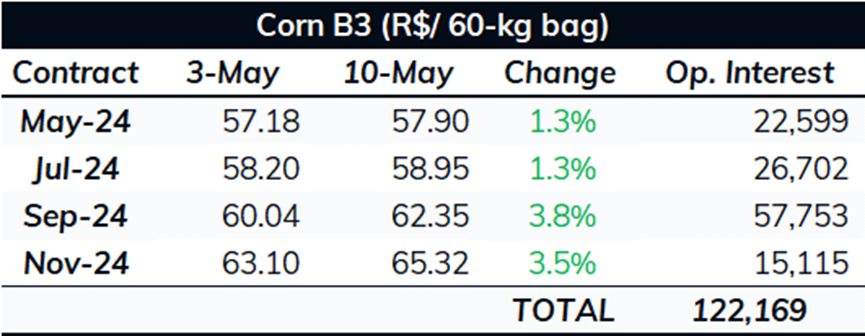
The cut in production brought by the USDA report, the drought in central Brazil, and the rains in Rio Grande do Sul caused corn to appreciate on B3. The July contract was quoted at R$ 58.95/bag, with a weekly appreciation of 1.3%.
For the next few weeks, attention should be focused on the weather in Brazil, specifically the drought in Paraná, Mato Grosso do Sul, and São Paulo and the excess of rain in Rio Grande do Sul.
Intraday (15 min) July/24 contract - B3
Argentina
The USDA now estimates the Argentine corn crop at 53 million tonnes, a monthly reduction of 3.6% due to problems brought by the leafhopper. This cut brought by the USDA was quite conservative. In its latest updates, the Buenos Aires Grain Exchange estimated Argentina's crop at 46.5 million tonnes, and the Rosario of Trade estimated production at 47.5 million tonnes. Therefore, USDA must continue to reduce its estimate in the upcoming releases, following the institution's typical path of gradual cuts.
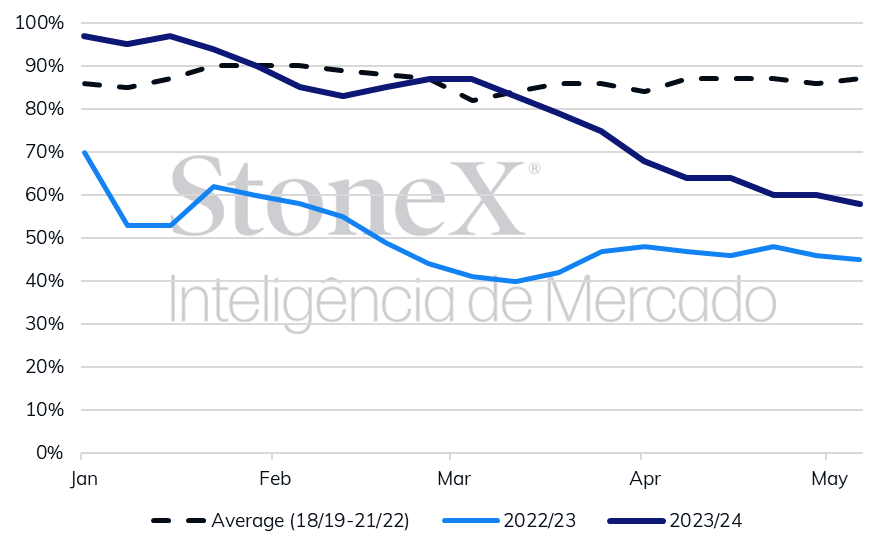
Giving a little more details about the problems caused by the leafhopper, we had the Rosario Exchange reducing the productivity of the Argentine crop by about 20% since the spread of the pest began. In provinces further north of the country, estimated productivity was cut by more than 50%, which exemplifies the damage caused by the leafhopper. Only 58% of Argentina's crops are in normal, good, or excellent conditions, compared to an average of almost 90% in the four cycles between 2018/19 and 2021/22.
Harvest continues to advance slowly, as about 70% of Argentine corn crops are late planting and usually only start to be harvested at the end of May. Until May 8, 23.4% of the corn had been harvested, a weekly advance of only 1.2 percentage points. However, we may see a pick-up in fieldwork in the coming days. This is because it has been reported that farmers in regions affected by the leafhopper are beginning the harvest early, aiming to minimize the damage caused by the pest.
Argentinian corn crops under normal, good or excellent conditions
Source: Buenos Aires Grain Exchange. Design: StoneX.
Future and spot prices
Futures contracts traded on the CBOT (US¢/bu)

Future contracts traded on B3 (BRL/bag)
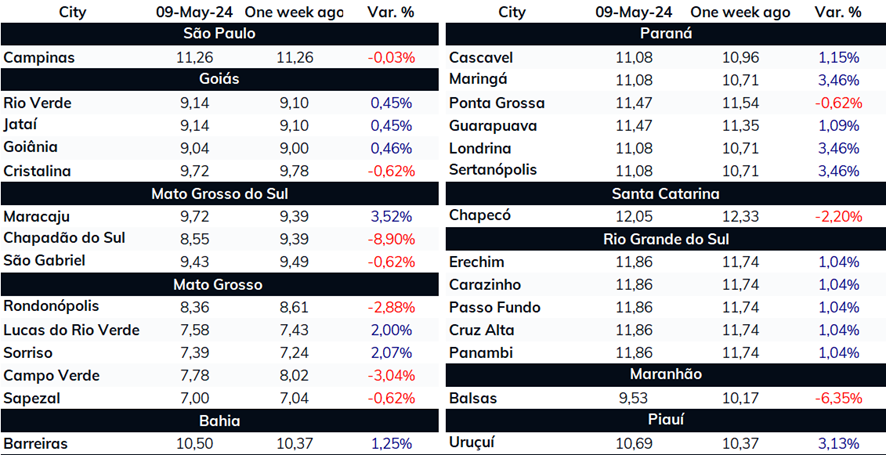
Spot prices in Brazil (USD/60kg bag)