- Bearish Factors
- Outlook of high stocks at the end of the 23/24 and 24/25 crop years;
- Possibility of USDA having overestimated the reduction in corn planting area in the US;
- Planting in the USA happening within the ideal window;
- Good condition of US crops.
- Bullish factors
- Drought in Paraná, Mato Grosso do Sul, and São Paulo;
- Spread of the leafhopper in Argentina;
- Funds exiting their short positions;
- Appreciation of wheat due to weather problems in Russia and Ukraine;
- Changes in the PIS/COFINS legislation may impact the Brazilian export price.
Overview
Since mid-May, bearish fundamentals have gained strength in the corn market. This is because planting in the United States has advanced significantly and is no longer a major concern, a condition that reinforces the USDA's estimate of supply surpassing demand throughout the 24/25 cycle. In this scenario, corn depreciated on the Chicago exchange in seven of the last eight sessions.
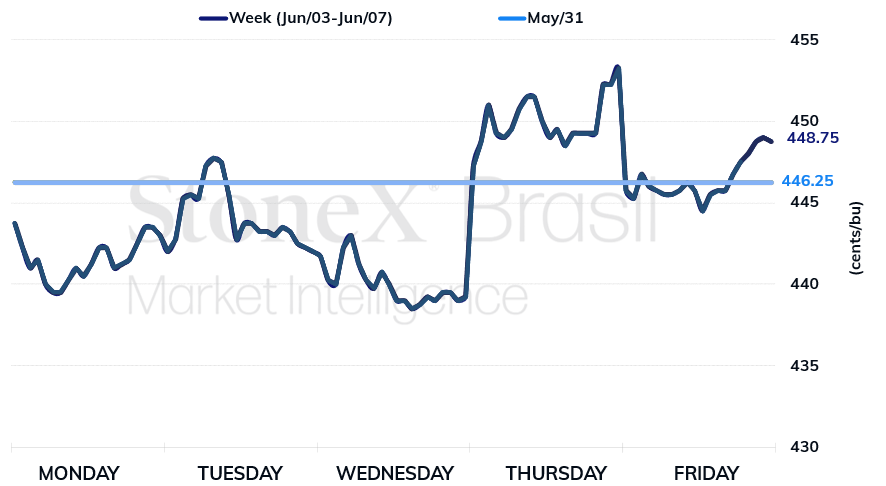
Even so, corn appreciated on the CBOT last week (June 3 to 7). This is because the gains on the last Thursday (6), the only day of increase in the last two weeks, were very significant, offsetting the losses of the other days.
The factor behind the appreciation was the change in Brazilian legislation related to PIS/COFINS, mainly regarding the use of PIS/COFINS credits. This credit system works as follows: when a company purchases inputs from a supplier, it earns credits equivalent to the PIS/COFINS tariff, currently set at 9.25%. So, if it is paid R$ 100.00, it is earned R$ 9.25 in credit.
Before the edition of the new PM, this credit could be deducted from the payout of any federal tax, be it PIS/COFINS itself or another, with emphasis on the CSLL (Social Contribution on Net Income), the IRPJ (Corporate Income Tax) and social security debts. With the new legislation, the credit can only be deducted from the payout of the PIS/COFINS itself.
This change was very poorly received by agribusiness and other exporting sectors because PIS/COFINS does not apply to export operations. This means that trading companies will not be able to offset the credits acquired in the purchase of INPUT, resulting in a significant increase in costs. Consequently, there was speculation about the possibility that tradings would need to pay less to producers for the grain or would have to increase the selling price in the international market. As tradings stopped buying grains, stating that they needed to evaluate the impact of the measure before disclosing a purchase price.
According to Brazilian rules, Provisional Measures have immediate effect, but they need to be approved within 120 days by Congress. If approval does not occur, the measure loses validity. In this sense, the next few months will be a time of intense competition within the Legislature. On the one hand, agribusiness entities and opposition congressmen will fight to overturn the PM or postpone the vote for more than 120 days. On the other hand, the government will negotiate to get approval within the deadline or edit a Bill that validates the measure, even if the 120-day period has passed.
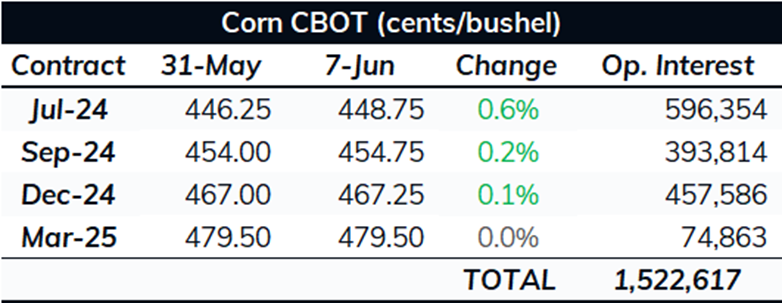
After exposing the main issues that affected the price of corn throughout the week, it can be seen that the fundamentals of supply and demand became more bearish, but factors external to the market ended up resulting in gains for the contracts in Chicago. The July contract ended the period quoted at 448.75 cents/bu, a weekly appreciation of 0.6%.
In the coming weeks, attention will continue to focus on the development of the American harvest and the change in Brazilian legislation. The first one should have significant impacts on prices in Chicago, while the second one should affect the basis more here in Brazil.
Intraday (15 min) July/24 contract - CBOT
United States
On June 2, corn planting in the United States was at 91%, 2 percentage points above the five-year average for the period. This percentage indicates that the majority of the American crop was able to be planted within the ideal window, a positive factor for the development of the crop. It also indicates that most producers planted within the period stipulated by agricultural insurance, which is an indication that the planted area will not be smaller than initially estimated. The planting progress, therefore, exerted slightly bearish pressure on prices.
In addition to planting data, the USDA released crop condition data for the first time. For those betting on the devaluation of corn, these data were also positive, as they showed 75% of the crops in good/excellent conditions, a value that is 4 percentage points above the historical average for the period and 5 percentage points above market expectations.
On the demand side, last week's disclosures were more bullish. Export sales showed a balance of 1.18 million tonnes, a high volume that points to US exports in 2023/24 reaching the current USDA estimate. Regarding the corn-based ethanol sector, it continues to produce record volumes, which implies high corn consumption. It is worth mentioning that the summer in the Northern Hemisphere coincides with the peak of fuel consumption in the United States, which points to months of high corn-based ethanol production.
US export sales (tmt)
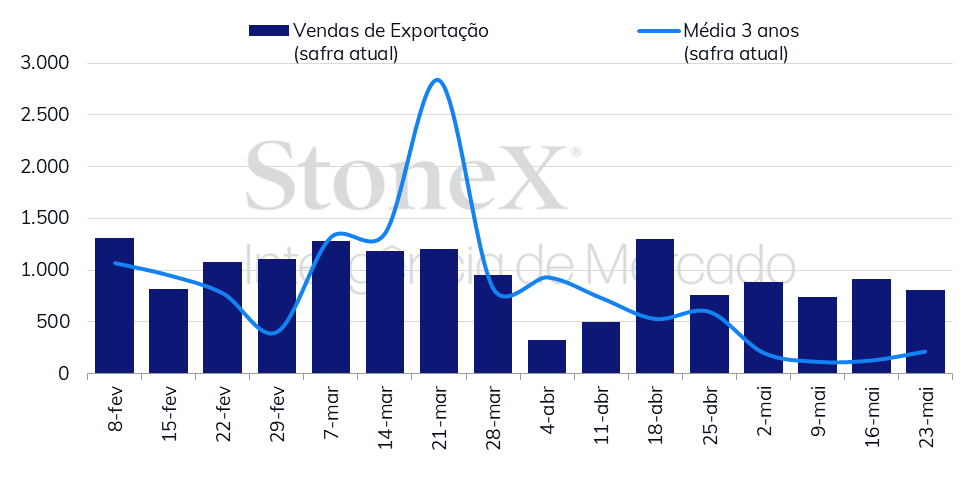
Source: USDA. Design: StoneX.
Brazil
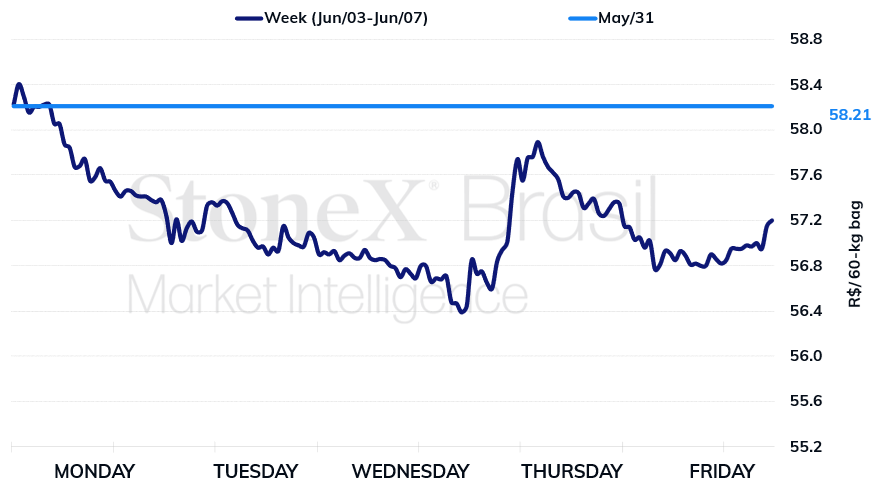
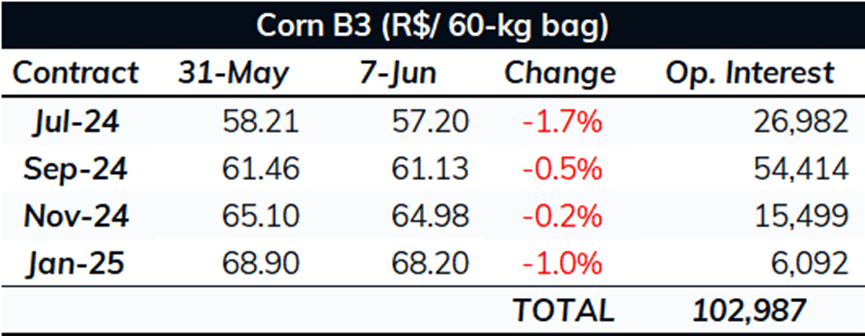
Last week, corn futures traded on B3 followed the movement of Chicago. In other words, contracts depreciated for most of the period due to the improvement in prospects for the North American crop and appreciated on Thursday (6) due to the edition of the MP that modifies Brazilian legislation. In the aggregate of the period, the contracts depreciated, with Thursday's increase not being able to offset the losses of the other days. The July contract ended the period quoted at R$ 57.20/bag, a weekly depreciation of 1.7%.
In addition to B3 prices, last week StoneX updated its sales estimate. For summer corn, only 55% of the 2023/24 crop has been sold, the lowest percentage since the 2017/18 season. For the "safrinha" corn, only 30.7% was sold, the lowest percentage since the 2017/18 season.
These percentages indicate that Brazilian farmers are not satisfied with current price levels, preferring to hold onto their supplies. This phenomenon has affected the corn basis here in Brazil, which is increasing due to the need for tradings to pay higher prices to obtain the products they need. At the moment, the basis at the port of Santos for shipment in July is 75 cents/bu; one month ago, it was 53 cents/bu.
Regarding the second corn crop, StoneX estimates that it reached 9.8% on June 7, a percentage higher than that recorded in any of the last three years. The states where the harvest is most advanced are Paraná (15.0%), Mato Grosso (13.5%), Rondônia (5.9%), and São Paulo (4.0%). The progress of the second corn harvest is a bearish factor for the basis in Brazil.
Intraday (15 min) July/24 contract - B3
Argentina
The corn harvest in Argentina finally gained traction, with a weekly increase of 5 percentage points which brought the harvest to 35.1%. This percentage is above the one recorded in the same period last year (32.6%), but below the average of the last five years for the period (41.5%).
Regarding the crop estimate, the Buenos Aires Grain Exchange maintained the estimate of 46.5 million tonnes for the sixth consecutive week, an indication that the damages caused by the leafhopper have already been fully estimated. It is worth noting that the 46.5 million tonnes indicate an increase of 12.5 million tonnes compared to the previous crop.
Argentinian corn crops under normal, good, or excellent conditions
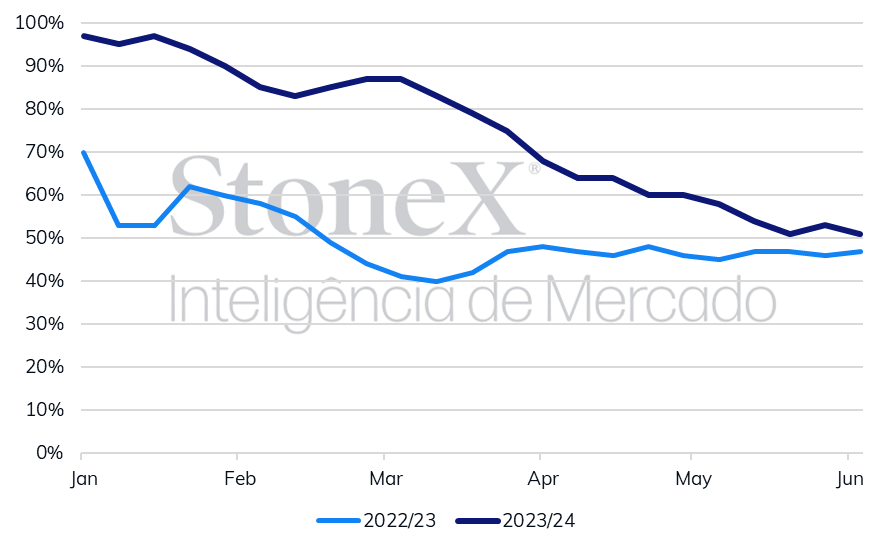
Source: Buenos Aires Grain Exchange. Design: StoneX.
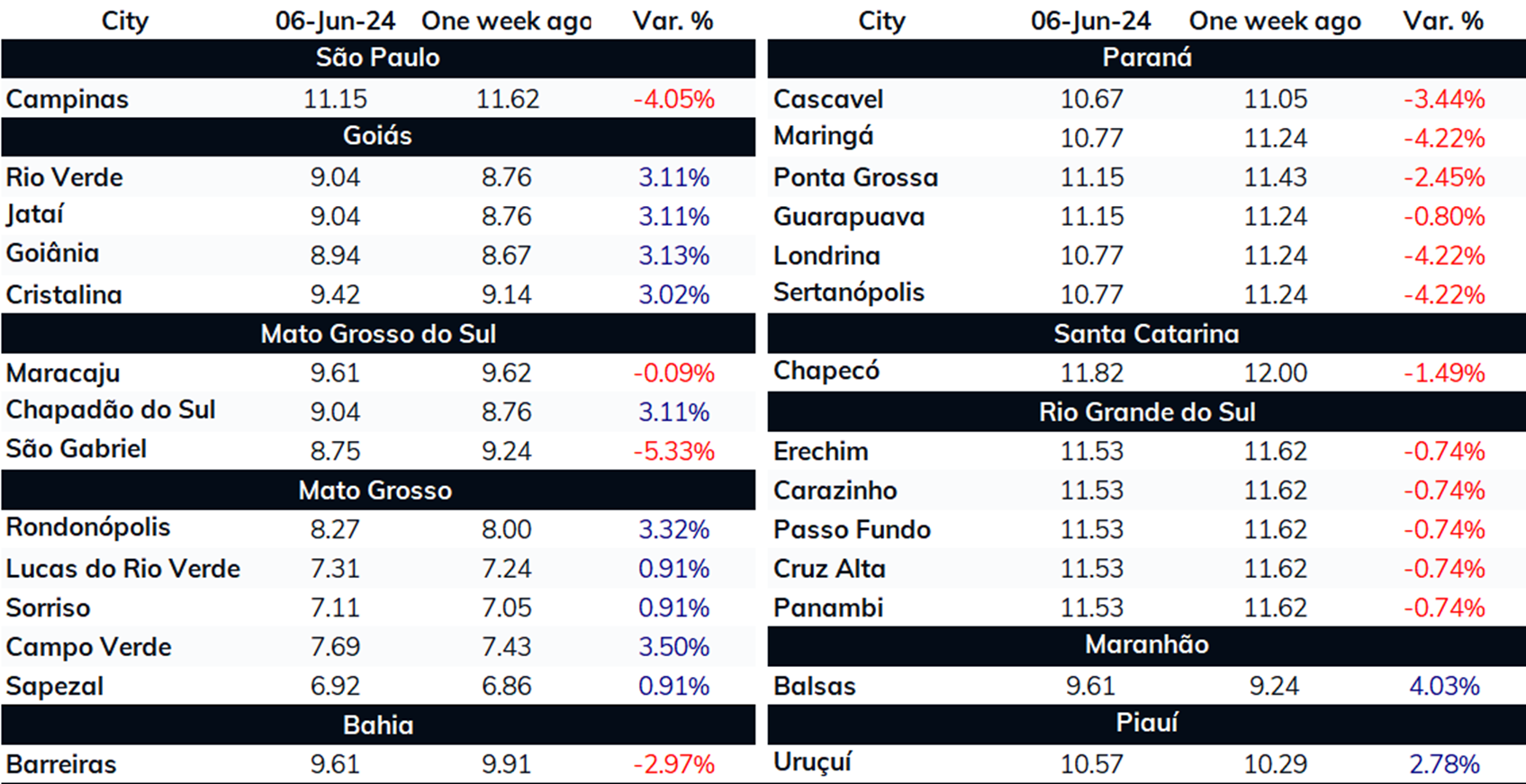
Future and spot prices
Futures contracts traded on the CBOT (US¢/bu)

Future contracts traded on B3 (BRL/bag)
Spot prices in Brazil (USD/60kg bag)