- Bearish factors
- Expectation of high stocks at the end of the 23/24 and 24/25 crop years;
- Good condition of US crops;
- Harvest progress in Brazil (safrinha) and Argentina.
- Bullish factors
- Delay in the marketing pace in Brazil and the United States;
- Drought in Ukraine impacting the development of the 24/25 crop.
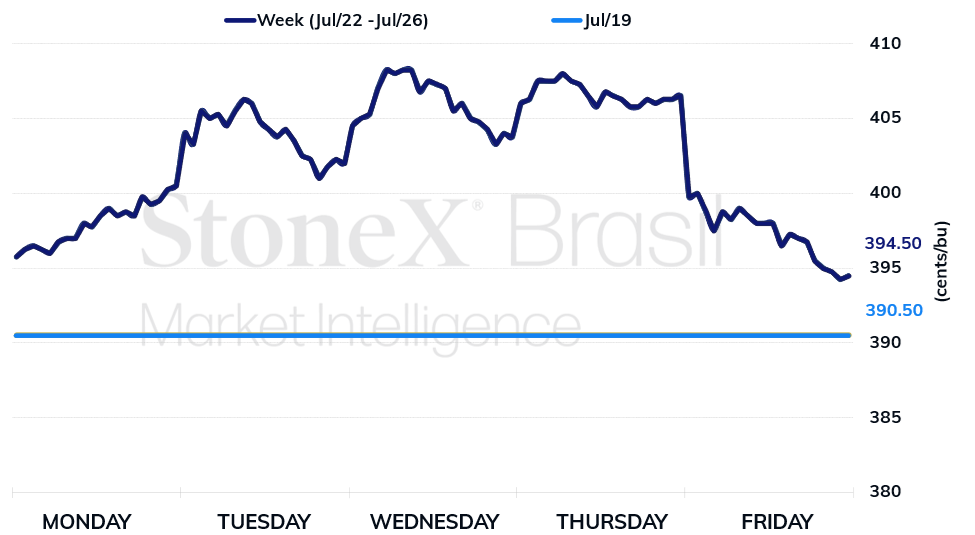
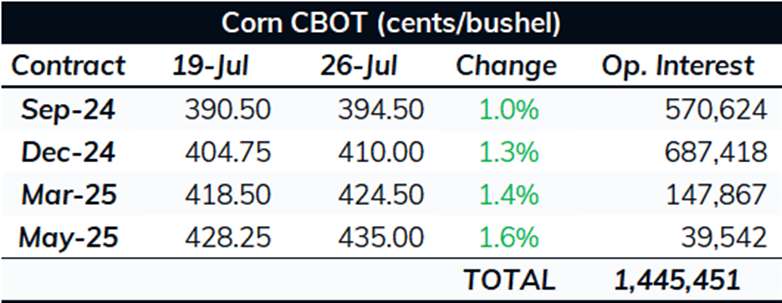
Last week (July 22-26), corn futures traded on the Chicago exchange attempted a rebound. In the first four days of the week, the contracts appreciated by about 4%, moving away from the price floor. On Friday, however, corn gave back a large part of the gains, minimizing the increase. September/24 ended the period quoted at 394.50 cents/bu, with a weekly appreciation of 1.0%.
The main factor behind the highs was the update of the weather outlook for the agricultural belt of the United States. For the current week (07/29-08/04), the forecast does not indicate serious threats to the corn crop, but the low rainfall in the western region of the belt brings some concern. For the week of August 5 to 11, the models indicate that there will be virtually no rain in the Midwest, which could affect corn crop productivity.
In the coming days, the market's focus will continue to be on forecast updates. The depreciations seen on Friday indicate that the market is still not convinced that the possible drought next week will impact corn productivity. Because most of the crop will have already gone through the pollination phase. Even so, it is something that must continue to be monitored.
Regarding productivity prospects, StoneX will release its first official estimate next Thursday, August 1, based on primary data collection conducted with clients. At the moment, StoneX's chief economist, Arlan Suderman, estimates yield at 11.45 ton/ha, against USDA's estimate at 11.13 ton/ha. It will be necessary to wait until Thursday to see if the StoneX survey shows a figure closer to Arlan's or USDA's. In any case, if next week's drought is confirmed, we may have changes in yield prospects.
Turning our attention to crop conditions, the USDA estimates that 67% of corn fields were in good/excellent condition on July 21, a percentage that remains above the five-year average for the period. On the same date, 61% of the crops were in the pollination phase, against 56% on average in the last five years. Both data will be updated today. The expectation is that the percentage of crops in good/excellent conditions will remain at similar levels and that crops in the pollination phase have reached values close to 80%.
Intraday (15 min) September/24 contract - CBOT
Source: CBOT. Design: StoneX.
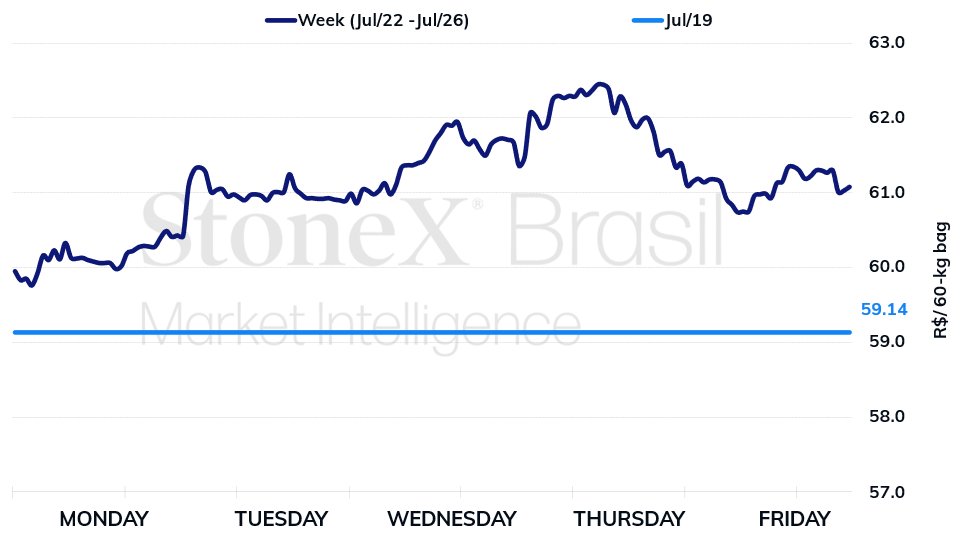
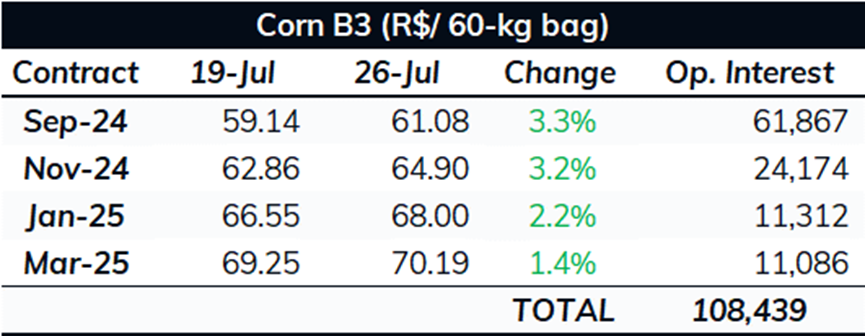
In Brazil, corn futures traded on B3 also appreciated last week, and even more intensely than on the CBOT. In the aggregate of the period, the September contract traded at BRL 61.08/bag, a weekly appreciation of 3.3%. Last week, the continuous price of corn on B3 reached the highest value in more than four months.
The delay in the commercialization of the second crop of corn is an important factor behind the rise, with trading companies and cooperatives needing to offer higher values in order to convince farmers to sell their production. In the last few weeks, however, it is possible to argue that the corn appreciation in Brazil has been mainly driven by the USDBRL rise. From the end of May to now, the USDBRL bounced from BRL 5.10 to BRL 5.65, gains of over 10% that increase the competitiveness of Brazilian corn in the international market.
Looking at the premiums at the ports, however, they show that Brazil has lost competitiveness since the end of May. In other words, the 10% appreciation of the real/dollar pair was not enough to offset the increase in corn prices in Brazil (in reais), combined with the depreciation of corn in the CBOT. At the moment, corn basis at the port of Santos for shipment in August is 95 cents/bu; at the end of May, it was 51 cents/bu.
Regarding the safrinha crop, StoneX estimates that it reached 89.5% last Friday (26), against only 63.8% on average over the last five years, which shows that the cycle is quite advanced. In Mato Grosso and Rondônia, the harvest is practically finished, exceeding 98%. In the other states, farmers are entering the final stretch, having exceeded 80% in Goiás, Mato Grosso do Sul, Paraná and São Paulo. Only Minas Gerais still has a long way to go, still at 30%.
Intraday (15 min) September/24 contract - B3
Source: B3. Design: StoneX.
Giving a brief update on the situation in Argentina, the harvest is also well advanced: 86.6% compared to 68.4% in the same period last year. The trend yield is 6.49 ton/ha and the production estimate of the Buenos Aires Grain Exchange is still 46.5 million tonnes.
In Ukraine, for a few weeks now, extreme heat and the lack of adequate rainfall have been observed by the market. Corn planted during the spring harvest may have been particularly affected by the fact that the adverse weather occurred during a period of pollination of the cornfields. During the period when the hot weather was reported, the impact on the crop was still unclear and some estimates pointed to a decrease of 20% to 30% in grain production in some regions. However, the latest information from the Ukrainian Ministry of Agriculture indicates that productivity is expected to decline by an average of 5% across the country, a figure that worries the market less. In the last week, some crops in Ukraine benefited from milder weather. However, the eastern region of the country, as well as the southern region of Russia, continued to report warmer temperatures, a fact that still puts a point of attention on the productivity of the Black Sea crop.
Finally, China was hit last week by Typhoon Gemei. The most affected area was southern China, a region with few hectares of corn. Even so, impacts on crop productivity are not ruled out, as the typhoon caused rains throughout China, including in corn-producing areas that are at risk of flooding.
Tables of future and spot prices
Futures contracts traded on the CBOT (US¢/bu)

Futures contracts traded on B3 (BRL/bag)
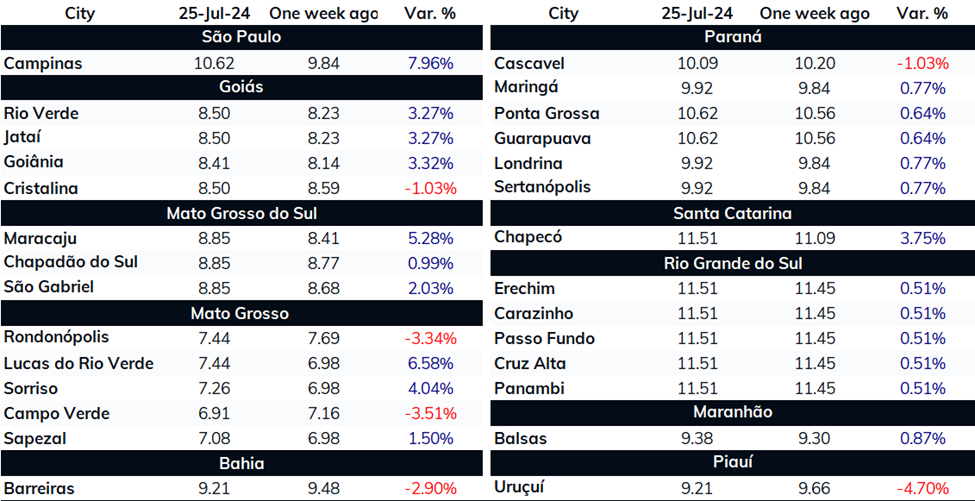
Spot prices in Brazil (USD/60kg bag)