- Bearish Factors
- Expectation of high stocks at the end of the 23/24 and 24/25 crop years;
- Good condition of US crops;
- Harvest progress in Brazil (safrinha) and Argentina.
- Bullish Factors
- Delay in the marketing pace in Brazil and the United States;
- Drought in Ukraine impacting the development of the 24/25 crop.
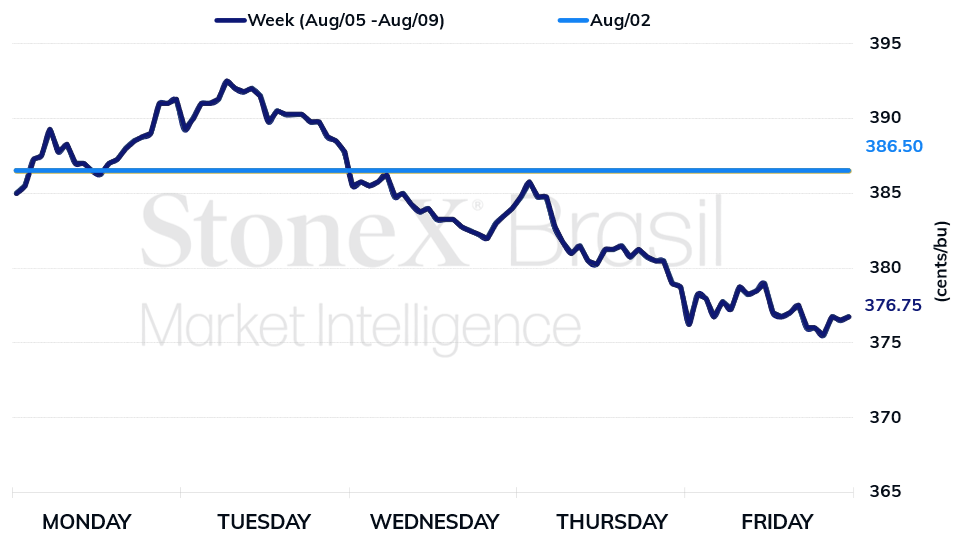
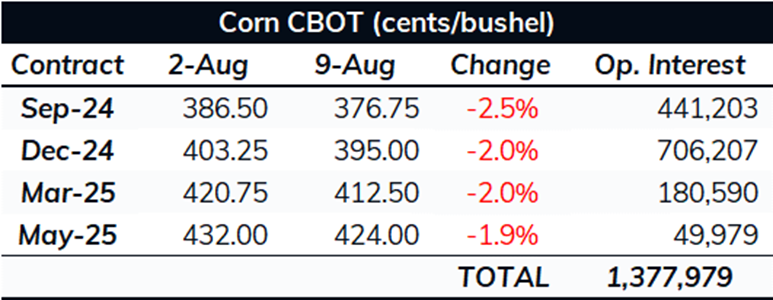
Last week (08/05-08/09), corn futures once again operated lower on the Chicago exchange. At the end of the period, the September contract was quoted at 376.75 cents/bu, a weekly depreciation of 2.5%.
The positive outlook for the North American crop continues to be the main factor behind the devaluation of corn. The USDA's weekly update for August 4 showed 67% of crops in good/excellent conditions, a 1 percentage point decrease compared to the previous week, but still 5 percentage points above the historical average for the period. And for the next few weeks, the outlook is for corn to maintain this condition, as climate models are indicating mild temperatures in most of the agricultural belt. It is worth mentioning that temperature, not moisture, is the main determinant of yields in August, the month when most corn crops enter the maturation phase.
Speaking of yield, this is the most anticipated data from the USDA's supply and demand report that will be released today (12). The market expects the estimate to be 11.44 ton/ha, an identical value to that disclosed by StoneX and representing an increase of 0.08 ton/ha compared to the productivity disclosed in July. As the record yield in the United States is 11.36 ton/ha, we have the market working with the prospect of record yield in the United States, which explains why corn in Chicago is being traded at the lowest value since September 2020. If the weather in August remains favorable for the crops, the possibility of productivity reaching values even higher than 11.44 ton/ha is not ruled out.
In addition to the yield, investors will also be paying attention to the area data released by the USDA. Normally, corrections to area estimates only begin to be made in September or October but for this year it was said that the Farm Service Agency - USDA agency that collects data from farmers - processed the collected data faster than usual, allowing changes to happen already in the August report. With that, the market expects the USDA to reduce corn harvested area by 190,000 hectares, going from 33.77 million hectares to 33.58 million.
Intraday (15 min) September/24 contract - CBOT
Source: CBOT. Design: StoneX.
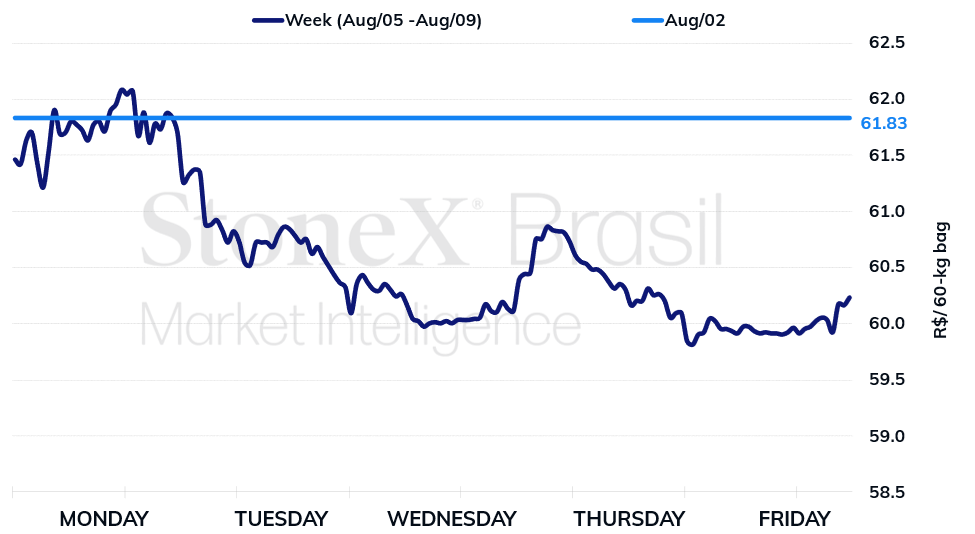
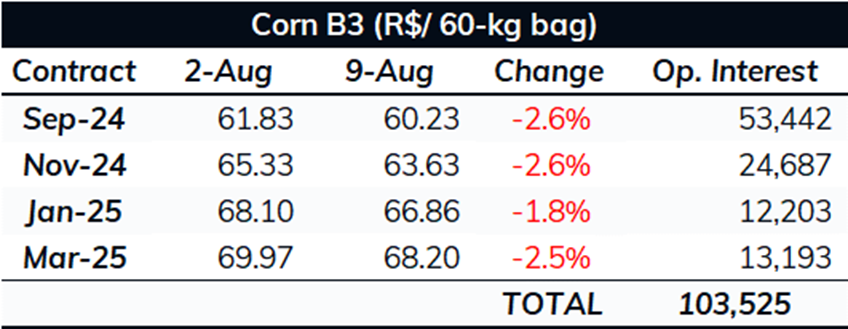
Turning our attention back to Brazil, corn depreciated on B3, contrasting with the gains that had been dominating the market since mid-July. The main factor behind the depreciation was the retreat of the USDBRL, which went from BRL 5.75 to BRL 5.50, a phenomenon that reduces the competitiveness of Brazilian corn in the international market. The September contract traded at BRL 60.23/bag, a weekly depreciation of 2.6%.
In the spot market, the fluctuations of the dollar did not significantly impact the quotes, which, on average, remained practically unchanged throughout the week. With that, the basis at the port of Paranaguá also changed little: for shipments planned for September, the premium went from 104 cents/bu to 108 cents/bu.
Finally, the Brazilian harvest. According to StoneX's estimate, it reached 96.7%, being completed or nearly completed in all Brazilian states except Minas Gerais. This is an important bearish factor, but at the moment it is being counterbalanced by the delay in commercialization.
Intraday (15 min) September/24 contract - B3
Source: B3. Design: StoneX.
In addition to the United States and Brazil, another producing country that the corn market is eyeing is Ukraine. Over there, about half of corn planted area is facing drought, which some entities estimate will result in losses of 6 million tonnes. This volume should not be enough to impact prices in Chicago, but it should redirect trade flows.
Looking at the North American demand, export sales were up, reaching 485.4 thousand tonnes in the week ended on 08/01. The volume was primarily due to new sales to Mexico, which, by purchasing just over 300,000 tonnes, caused the figure to exceed the analysts' estimates ceiling of 400,000 tonnes. In the same vein, the loadings were high, as the US showed 1.3 million tonnes shipped.
On the other hand, ethanol production in the country decreased in the weekly comparison. Still, the weekly production of biofuel, which was 1.06 million tonnes, maintains a robust production pace this year, positioning production levels above the average of previous years. In addition, US ethanol stocks fell, demonstrating that, even with slightly higher production this year, demand continues to rise.
Even so, the bullish fundamentals on the demand side were overshadowed throughout the week as agents continue to react to the American climate. In addition, as has been mentioned for a few weeks, it is worth noting that North American producers are still behind in their commercialization. Thus, as the harvest period for the new crop approaches, the likelihood of stored corn from the previous crop entering the market will continue to increase, a factor that is expected to continue putting downward pressure on prices.
Brazilian exports in July were once again lower in the annual comparison. The country exported 3.55 million tonnes, a decrease of 16% compared to the same month last year. It is the second consecutive month of exports below 2023 and is the second lowest value for a month of July in the last 6 years. The explanation for this movement is diverse: to some extent, the relatively lower volume must be associated with the smaller crop, as well as a lower interest in selling corn abroad compared to the price levels that have been practiced in the international market.
Future and spot prices
Futures contracts traded on the CBOT (US¢/bu)

Futures contracts traded on B3 (BRL/bag)
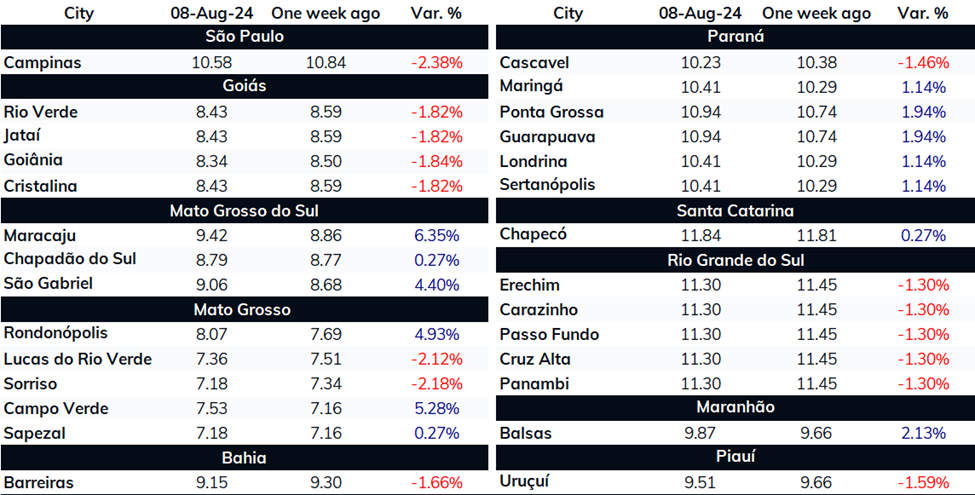
Spot prices in Brazil (USD/60kg bag)