- Bearish Factors
- Expectation of high stocks at the end of the 23/24 and 24/25 crop years;
- Good condition of US crops;
- Harvest progress in Brazil (safrinha) and Argentina.
- Bullish Factors
- Delayed marketing pace in Brazil and the United States;
- Drought in Ukraine impacting the development of the 24/25 crop;
- Reduction in the estimated area for the US
Chicago began last week on a high note, with the market reacting to the figures presented in Monday's WASDE report. The market had already been pricing in higher productivity for American crops, as the harvest has been developing under better-than-average conditions, as reported in recent months. The big surprise, which led to a more than 2% increase in the September contract by the end of Monday's trading session, was a revision to the planted area in the US. The USDA now estimates 36.71 million hectares sown for the 2024/25 crop, nearly 300,000 hectares less than estimated in July. This smaller area could result in a loss of more than 3 million tonnes if the trend yield from July is maintained. However, the revision in productivity more than offset the area losses, leading to an estimated production of 384.75 million tonnes, 1.2 million tonnes more than the previous estimate.
The August estimate for US productivity was 11.49 tonnes per hectare, surpassing market expectations, which were closer to StoneX's estimate of 11.44 tonnes per hectare. As mentioned in last week's corn report, if August weather remains favorable in the producing regions, productivity could exceed 11.44 tonnes per hectare, and the USDA believes this scenario is already consolidated. With the US crop development heading into the final stretch and the percentage of Good/Excellent crops remaining at 67%, above the five-year average, high productivity in North American fields is increasingly likely.
On a global scale, the increase in estimates for the North American crop was offset by reductions in the European Union and Ukraine, where weather problems have impacted the spring crops.
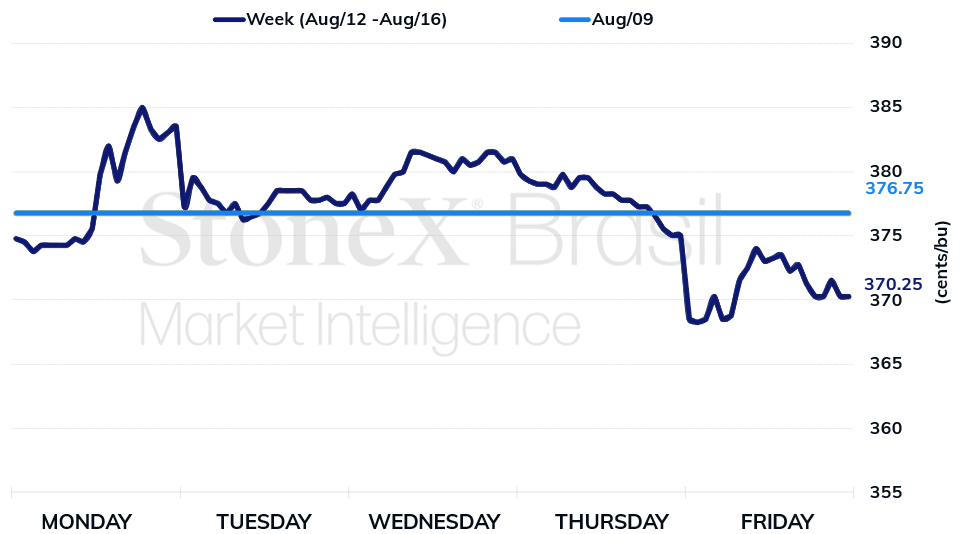
Despite Chicago's positive reaction to the events of Monday, August 12th—mainly concerning the revision of the US planted area—contracts traded mostly in the green throughout the week. However, with the crop development progressing and a bumper crop already priced in, the market is now focused on whether this corn will find sufficient demand.
Turning to demand, the USDA report brought some notable updates. For the 2023/24 crop year, which ends in late August, the USDA increased its export estimate from 56.52 million tonnes to 57.15 million tonnes. This marks the third upward adjustment in the last four months, signaling that US corn sales abroad have been surprisingly strong. As for ethanol and feed sector consumption, the USDA kept its estimates virtually unchanged, with domestic consumption remaining at 320.43 million tonnes (a slight monthly decrease of 0.1%).
For the 2024/25 crop year, the USDA also increased its export estimate, now expecting shipments of 58.42 million tonnes. Meanwhile, domestic consumption was slightly reduced from 322.08 million tonnes to 321.7 million tonnes.
Despite all these changes in supply and demand estimates, the overall outlook continues to point to high stock levels in the United States at the end of both the 2023/24 and 2024/25 crop years, which is a bearish factor for corn prices.
Intraday (15 min) September/24 contract - CBOT
Source: CBOT. Design: StoneX.
In Brazil, the USDA did not revise its estimates from the July figures, maintaining the 2023/24 crop projection at 122 million tonnes and the 2024/25 crop at 127 million tonnes. However, last week, Conab released its figures for Brazil's corn crops, showing a slight reduction in production for the 2023/24 crop, which now stands at 115.65 million tonnes—200,000 tonnes less than the previous estimate. StoneX's estimates are more optimistic, projecting 2023/24 production at 121.8 million tonnes. Notably, Brazilian export estimates saw a significant increase, with Conab revising them upward by 2.5 million tonnes, bringing the total to 36 million tonnes.
Regarding corn exports, data from Comex Stat indicate that current export levels are weaker than last year. In August 2023, exports reached 9.363 million tonnes, whereas in August 2024, only 1.938 million tonnes were exported in the first seven business days. Lineup data suggests that by the end of the month, shipments will likely total only 4.281 million tonnes.
The primary factor explaining this decrease in exports is the reduction in the 2023/24 corn crop compared to the 2022/23 crop, which was the largest in Brazilian history. Additionally, the significant increase in demand from corn-based ethanol plants and the steady growth in feed sector consumption also contribute to this reduction.
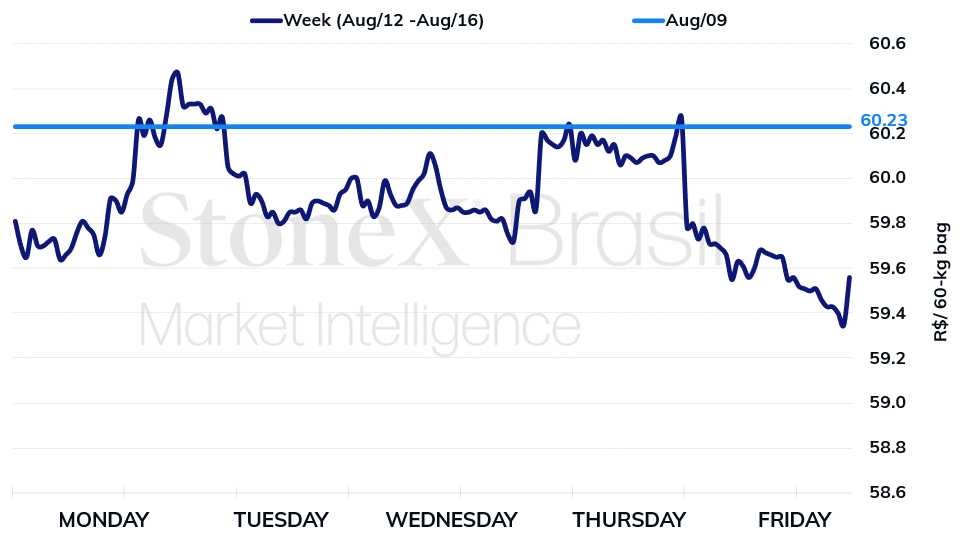
Intraday (15 min) September/24 contract - B3
Source: B3. Design: StoneX.
Lastly, when it comes to China and the European Union, the largest corn importers in the world, the USDA did not forecast any changes in their imports for the 2024/25 crop year, keeping purchases at 23 and 18 million tonnes, respectively.
Future and spot prices
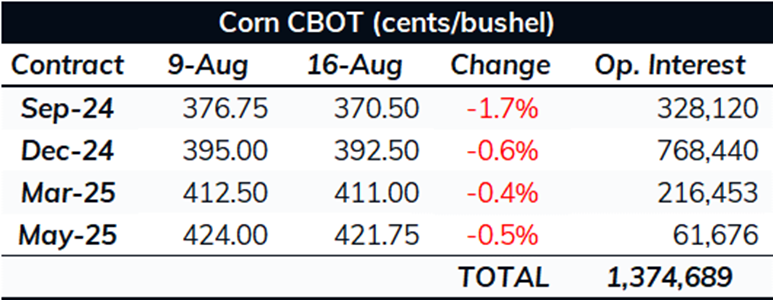
Futures contracts traded on the CBOT (US¢/bu)

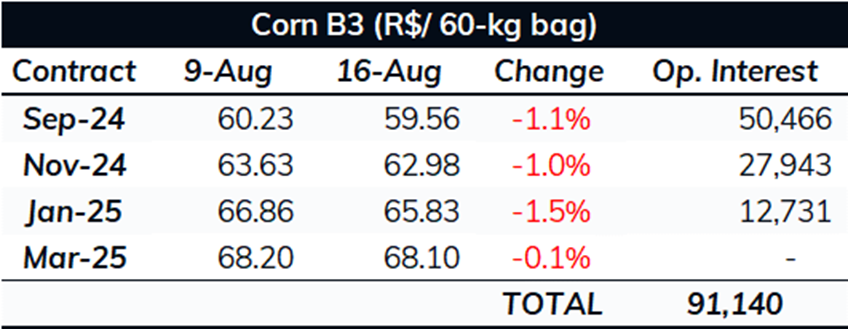
Futures contracts traded on B3 (BRL/bag)
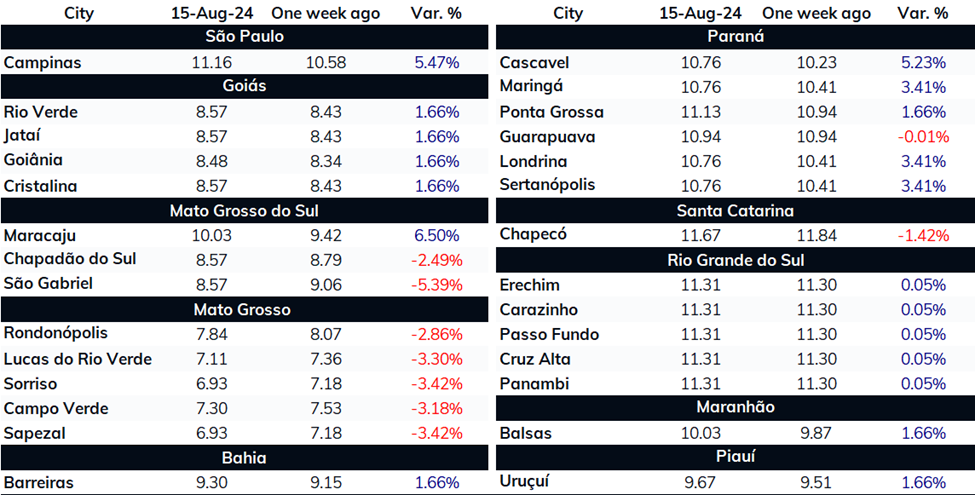
Spot prices in Brazil (USD/60kg bag)