- Bearish drivers
- Prospect of high stocks at the end of crop years 23/24 and 24/25;
- Good condition of US crops;
- Harvest progress in Brazil (safrinha) and Argentina.
- Bullish drivers
- Delay in the pace of sales in Brazil and the United States;
- Drought in Ukraine impacting the development of the 24/25 crop.
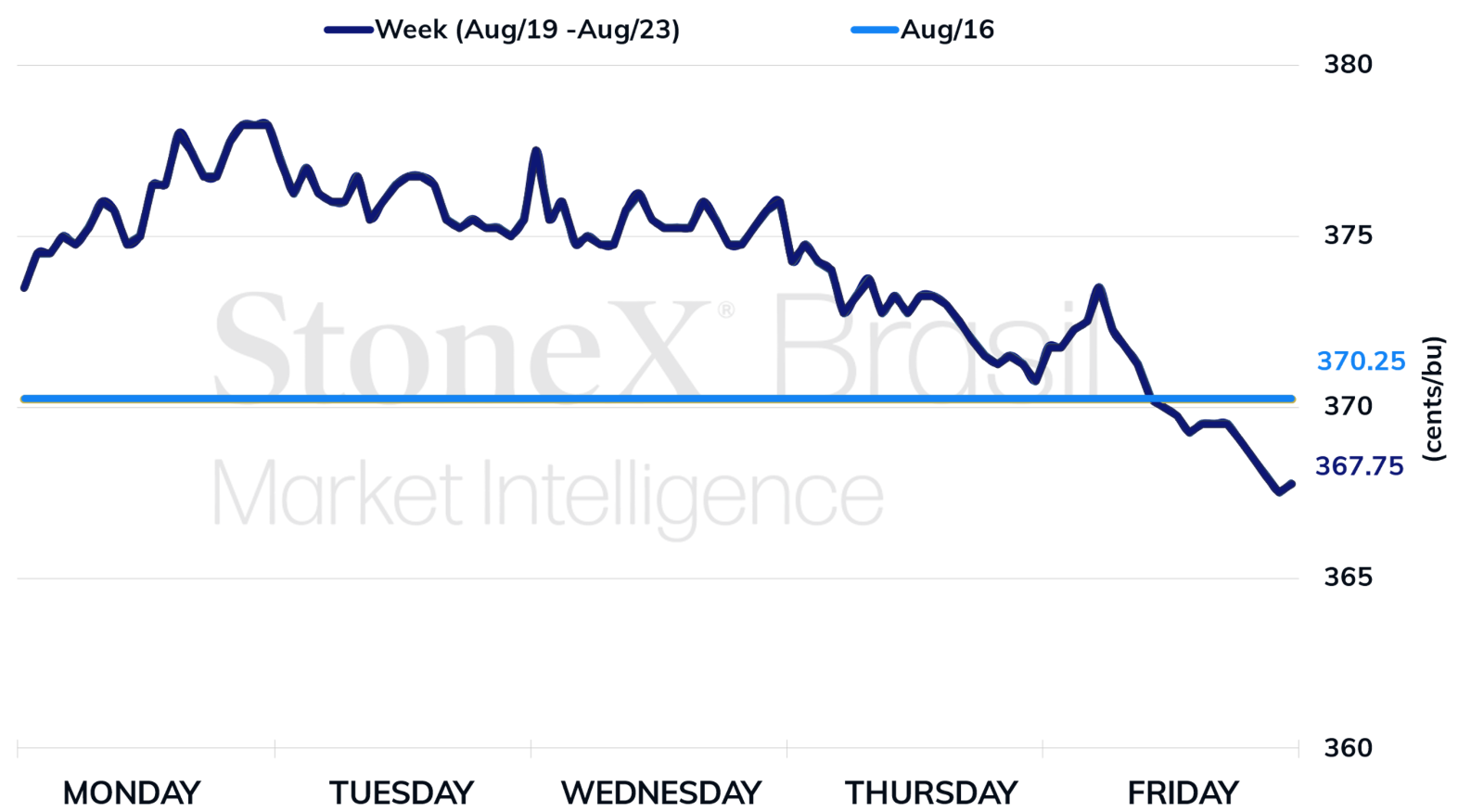
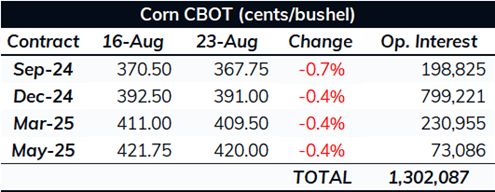
Last week (Aug 19-23), corn futures traded on the Chicago Mercantile Exchange had a fall. The September contract was quoted at 367.75 cents/bu, a weekly change of -0.7%. The main factor behind the devaluation was Pro Farmer's crop tour, which indicated a robust corn crop in the United States.
Providing more details, Pro Farmer estimated the average yield of US corn crops at 11.37 tonnes/ha, resulting in a production of 380.48 million tonnes. These figures were lower than those estimated by the USDA: 11.49 tonnes/ha and 384.75 million tonnes. However, since in 9 of the last 12 years Pro Farmer's national estimates have been lower than the USDA's final figures, the market interpreted the crop tour figures as confirming expectations of a robust crop in the United States.
Although the market constantly compares Pro Farmer's figures with the USDA's, the most interesting thing is to compare Pro Farmer's figures with the institution's own data from previous years, since the numbers from the private consultancy and the government department do not always match. In doing so, the results again have a downward bias. In 2023, the year in which the United States produced its largest corn crop in history, Pro Farmer's crop tour estimated national productivity at 10.80 tonnes/ha, 5% lower than the 11.37 tonnes/ha recorded this year. For the states, in six of the seven monitored, productivity in 2024 was higher than in 2023.
It is important to remember that more hectares were planted with corn last year than this year, a factor that mitigates the downward bias in productivity figures. Even so, the yield being higher than in the year when US production hit a record is still a significant factor. So much so that the 380.48 million tonnes estimated for 2024 are slightly higher than the 380 million recorded in 2023.
To conclude the comments on Pro Farmer's crop tour, it is important to point out that some analysts believe that productivity will be even higher than estimated by the institution because the weather in the United States in August is mild, a phenomenon that slows down the ripening process and therefore favors seed growth, a factor not considered by Pro Farmer's analysts.
Intraday (15 min) September/24 contract - CBOT
Source: CBOT. Design: StoneX.
In addition to the crop tour, the corn market was also attentive to movements in the macroeconomic field. Jerome Powell, chairman of the Fed, said that “the time has come for [US monetary] policy to be adjusted”. The speech was all that was needed to seal the prospect of an interest rate cut in the US economy. In the moments following the speech, optimism took hold of the US stock market, as well as delivering gains for some commodities. In any case, the corn market did not seem to be too affected by Powell's statement, as the September expiration in Chicago fell by around 1% on Friday. Even so, investors should be aware of the fact, as it could have an impact on corn consumption and the dollar.
Once the interest rate cut in September has been priced in, the debate will now turn to how deep the cut will be. The most likely scenario at the moment is that the basic interest rate will be cut by 25 basis points at the September meeting, but the cut could be as much as 50 if the labor market proves to be weaker.
Apart from the possibility of changes in monetary policy, other demand factors drew little attention in the corn market last week. Even so, some news is worth highlighting, such as the increase in corn ethanol production in the US, which rose by 26,000 barrels/day last week. In terms of exports, sales of the current US crop are slower than usual, but still within the USDA's estimate. Even so, sales of the new crop remain strong, at 1.3 million tonnes, well above the average of recent years.
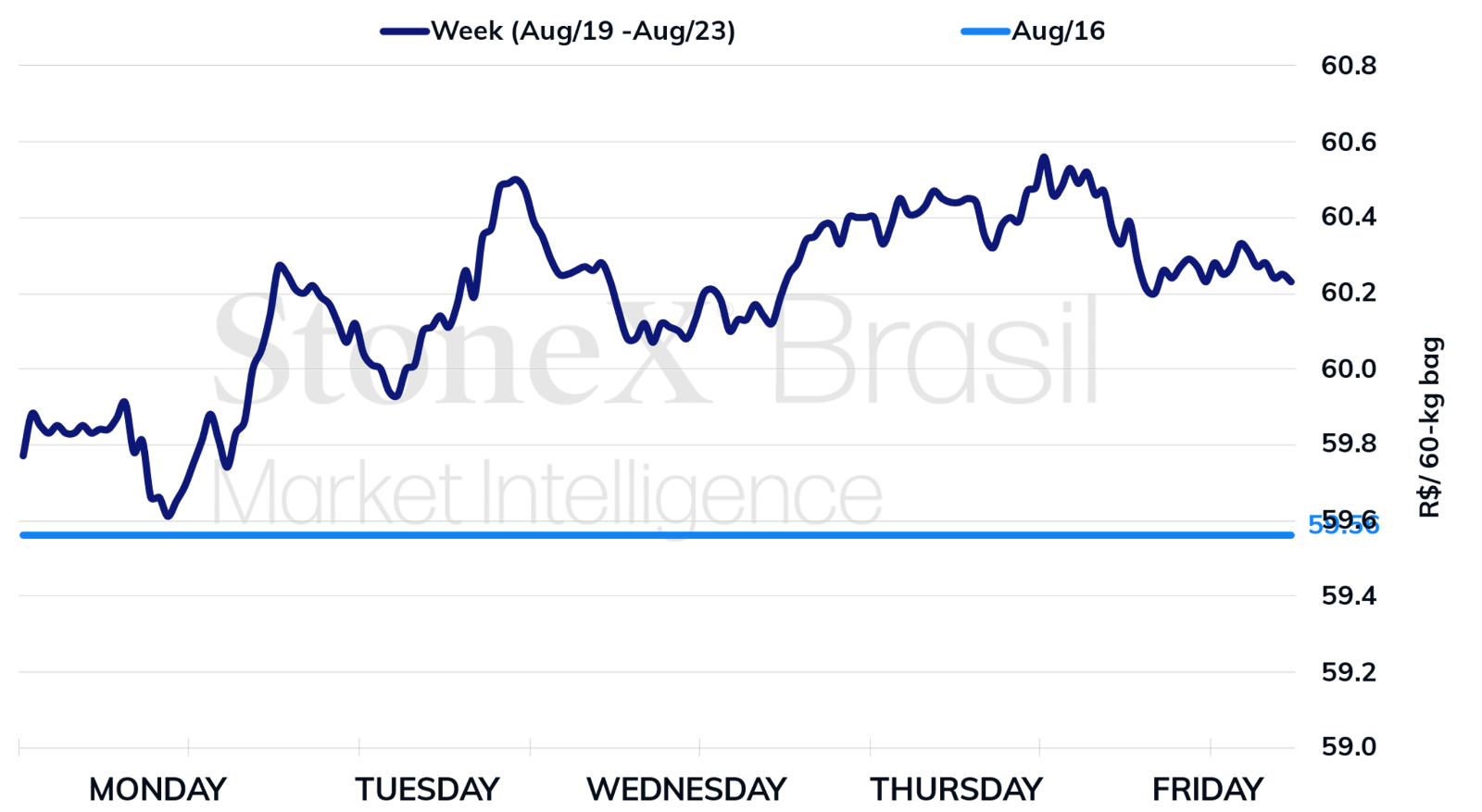
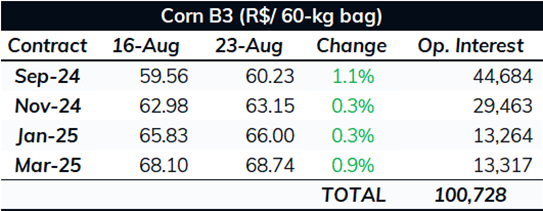
In Brazil, corn had an bullish week on the B3 exchange. In short, the contracts rose significantly on Monday and then alternated gains and losses, fluctuating in tandem with the dollar. At the close of the period, the contract expiring in September was quoted at BRL 60.23/bag, a weekly increase of 1.1%.
In terms of news, this is a weak period for Brazil. The safrinha crop has been practically finished since the beginning of August and planting of the 2024/25 summer crop has not yet begun. The only updates are on marketing. For safrinha corn, the StoneX survey detected an acceleration, with the 49.3% sold representing a monthly advance of 16.6 percentage points. Now, marketing of the 2023/24 crop is no longer the slowest of the last five years, as was often the case, having surpassed the speed of the 2022/23 crop. On the other hand, marketing is still lagging behind the five-year average of 63.6%.
For the coming week, attention will continue to be focused on the United States and the outlook for production and productivity. StoneX will update its figures next Monday, September 1st.
Intraday (15 min) September/24 contract - B3
Source: B3. Design: StoneX.
Future and spot prices
Futures contracts traded on the CBOT (US¢/bu)

Futures contracts traded on the B3 (BRL/bag)
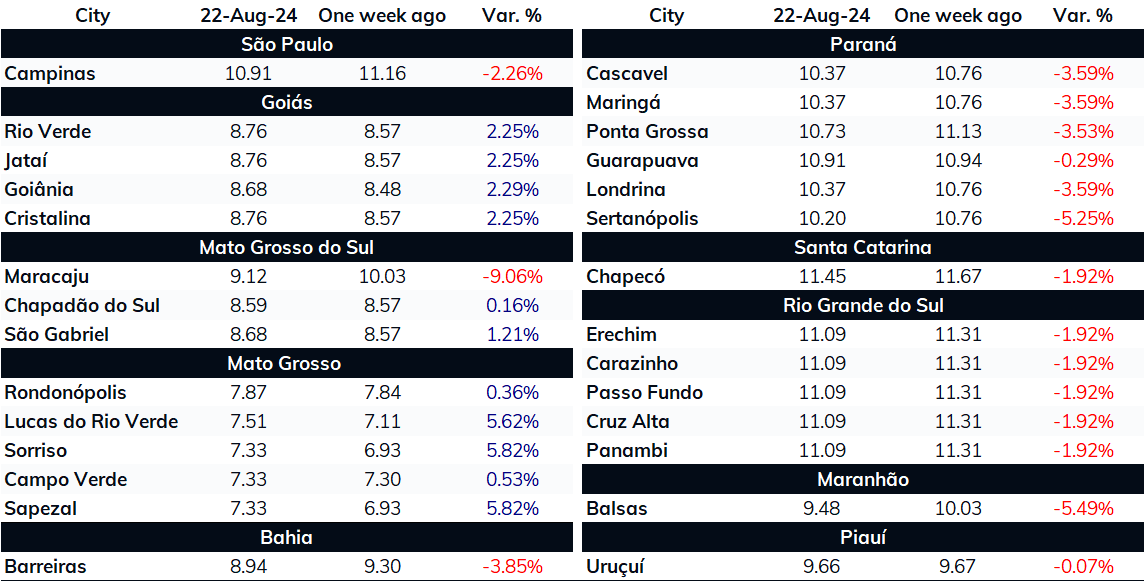
Spot prices in Brazil (BRL/bag)