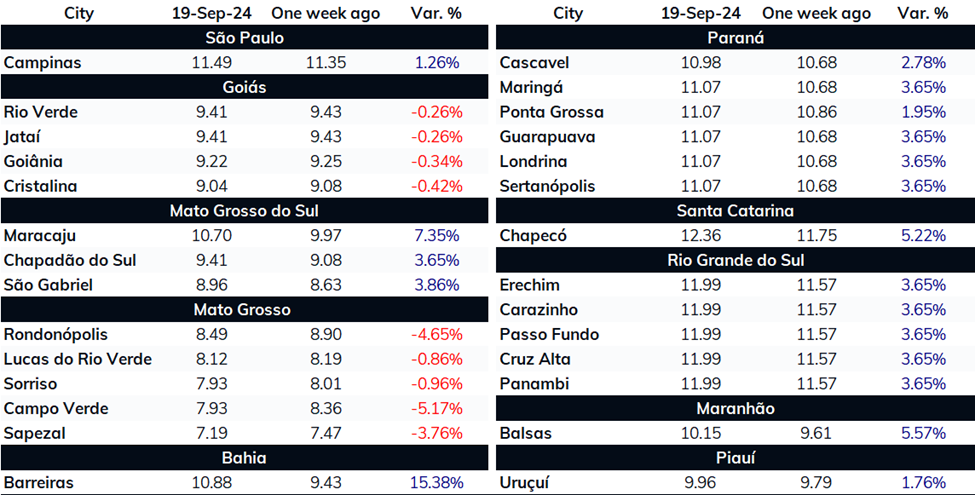
- Bearish Factors
- High stock expectations for both the 2023/24 and 2024/25 crop years;
- A higher-than-average percentage of crops rated as good/excellent;
- USDA forecasts record productivity for the US;
- The BRL (Brazilian Real) is appreciating due to interest rate differentials, which could pressure corn prices on B3.
- Bullish Factors
- Dry weather in Brazil is expected to delay the planting of first-crop soybeans, potentially impacting the safrinha corn planting;
- Interest rate cuts in the US could strengthen demand in the medium term;
- Short covering in the market;
- Geopolitical risks in the Black Sea region.
Weekly Overview | Corn futures retreated in Chicago last week, with the December contract closing at US¢401.50/bu (-2.8%). After a relatively stable start to the week, futures faced pressure on Thursday as the release of an export sales report, which fell below expectations, dampened the outlook for global demand for US corn. Additionally, short covering may have contributed to the market movements, as the strong US harvest continues. Attention is also shifting to South America, where dry weather is raising concerns about future crop conditions. Even so, the ongoing US harvest remains a bearish factor for corn prices. It's important to note that drought conditions in the rivers used for waterway transport of the crop may lead to logistical bottlenecks, a situation that will require close monitoring. The volume of corn expected to enter the market is projected to be unusually high, making it crucial for the US to manage transportation efficiently for this large harvest.
US Export Sales | The losses in corn prices last week were largely driven by export sales data, which came in below 900,000 tonnes, falling short of the average seen in recent weeks. Mexico remained the primary destination for US corn exports, while China’s purchasing activity was notably subdued. This trend with China, a key importer of corn, should remain a focus moving forward, as its demand could significantly impact market dynamics.
Interest Rate Cut in the US | Last Wednesday, after two days of meetings, the US Federal Open Market Committee (FOMC) announced a 50 basis point cut in the interest rate of the world's largest economy. The fact helped to boost several markets since there was still discussion about the proportion of the cut that would be promoted by the monetary authority. The most aggressive action was chosen to attack a possible recessionary context. Even so, the consequent heating of the economy is projected to be monitored as the effects of the cut begin to be felt in the economy. If on one hand the 50 basis points reduction helps to strengthen the labor market in the medium term, a pick up in inflation - which remains above the target - is not ruled out, which could lead to a change in the Fed's tone throughout 2025. It is still expected that there will be two more cuts of 25 basis points in the two meetings that the FOMC will hold in 2024.
Intraday (15 min) contrato de dezembro/24 - CBOT
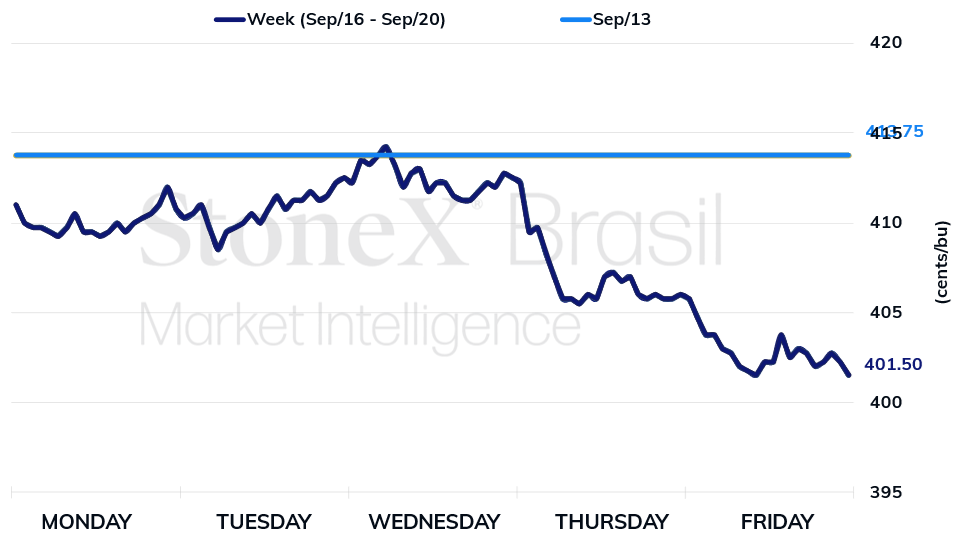
Source: CBOT. Design: StoneX.
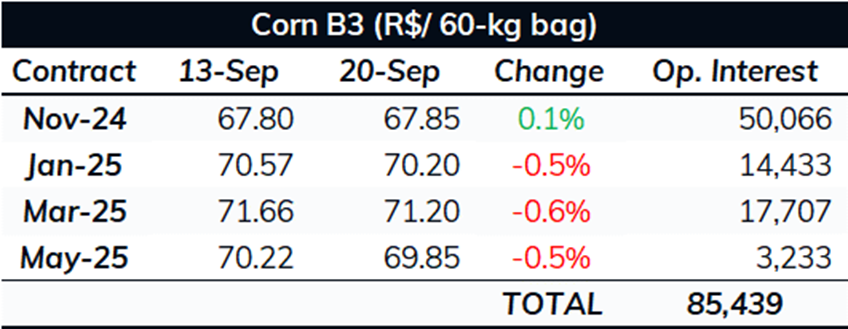
B3 and FX | Corn futures in Brazil saw little change last week. After trading in negative territory for most of the week, a recovery on Friday left the November/24 contract on B3 nearly flat, closing at R$67.85/bag (+0.1%). This movement occurred despite the pressures from Chicago—where the devaluation was discussed earlier—and currency fluctuations. On the exchange rate front, an increase in the interest rate differential between Brazil and the US, following "Super Wednesday" (when the FOMC cut US interest rates by 50 basis points, and the COPOM raised Brazilian rates by 25 basis points), led to an appreciation of the BRL. This currency appreciation tends to make Brazilian exports less competitive.
Despite the strong bearish pressures on contracts, the domestic market could be supported by weather-related risks. The ongoing drought in Brazil’s interior is raising concerns of delays in planting the first soybean crop, which could subsequently delay the second corn crop as well.
Planting – Brazil | The planting progress data for the first crop, published by StoneX last Friday, indicated a relatively normal pace for corn planting, with the southern states leading the way. So far, 21.6% of the first-crop corn area has been planted. As expected, the delay has been seen in soybean planting, with only 1.5% of the area sown. Paraná is the only state that has started planting in a more substantial manner. Some initial planting has also occurred in Mato Grosso, but on a much smaller scale compared to the same period last year.
Intraday (15 min) November/24 contract - B3
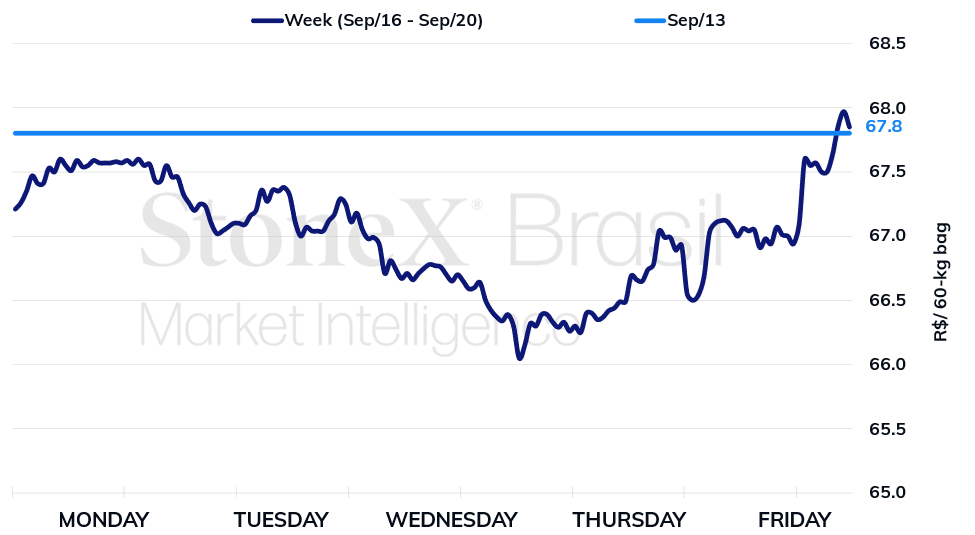
Source: B3. Design: StoneX.
Outlook | This week, with a lighter calendar of events, the market is expected to focus on weather conditions in Brazil. At the start of the week, grain prices are trending higher as a wave of optimism spreads through international financial markets, driven by the potential continuation of the short-covering trend. Additionally, the USDA's crop progress report, set to be released today, is expected to reveal the harvest pace for the world’s largest corn producer, the US..
Future and spot prices
Futures contracts traded on the CBOT (US¢/bu)
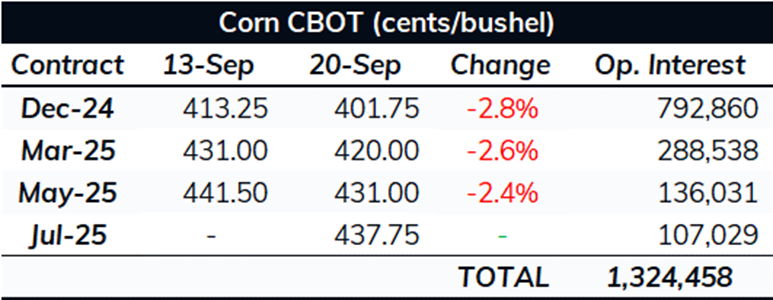

Futures contracts traded on B3 (BRL/bag)
Spot prices in Brazil (USD/60kg bag)