- Bearish Factors
- Expectation of high stock levels at the end of the 23/24 and 24/25 crops;
- Strong harvest continues in the US;
- Interest rate differential drives appreciation of the Brazilian Real, which may pressure corn prices on B3.
- Bullish Factors
- Dry weather in Brazil is expected to delay first-crop soybean planting, which could impact second-crop planting;
- The cycle of interest rate cuts in the US is expected to strengthen medium-term demand;
- Covering of short positions;
- Economic stimulus in China.
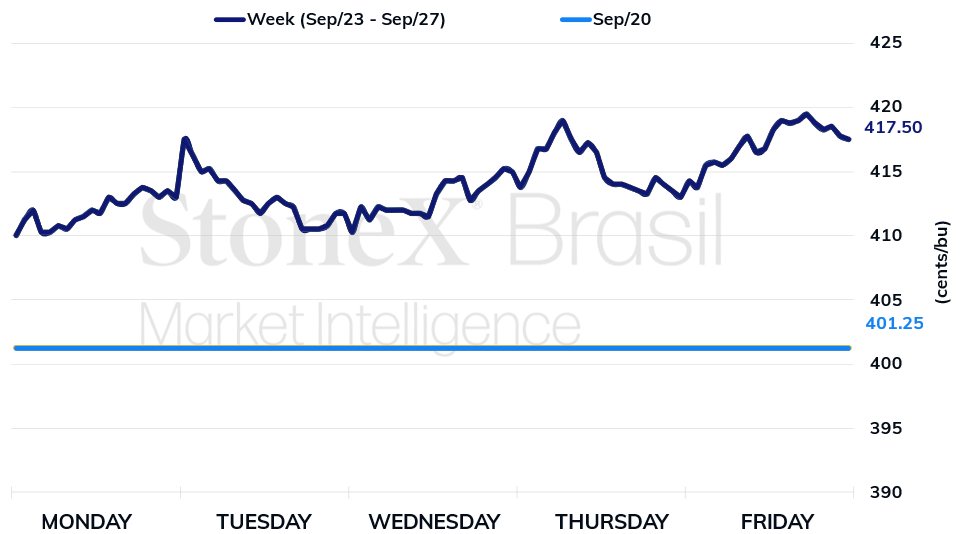
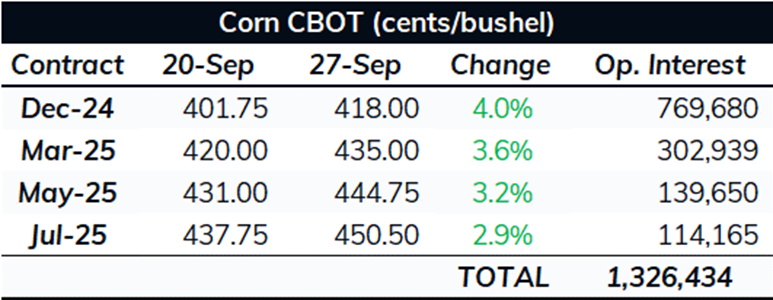
Weekly Summary | Corn futures rebounded last week, with the December contract closing at US¢ 418/bu, up 4.0%. Bearish arguments in the commodity market have been weakening in recent days as international geopolitical conflicts, monetary stimuli in China, weather uncertainty, and US interest rate cuts have guided commodities upwards. This shift is also reflected in the positions of funds, which are increasingly less short in the grain market.
Intraday (15 min) December/24 Contract - CBOT
Source: CBOT. Design: StoneX.
Stimulus Packages - China | Last Tuesday (Sept 24), the Chinese government announced a package of measures to stimulate economic activity in the country to meet the 5% growth target. First, the country's monetary authority reduced bank reserve requirements, increasing the space for these institutions to implement their credit policies. Additionally, there was a cut in the interest rate for repurchase agreements and the average mortgage interest rate. Financial tools—such as a swap program and loans—were also introduced to inject money into the capital market, resulting in a substantial appreciation of Asia's major stock indices. In layman's terms, this stimulus package consisted mainly of monetary policy measures to encourage domestic consumption and demand to improve the country's growth prospects.
The day after these measures, the People’s Bank of China made another announcement, reducing the medium-term lending rate. On Thursday, Reuters and Bloomberg reported that China's Ministry of Finance is expected to issue sovereign bonds worth 2 trillion yuan (USD 283.43 billion), with expectations for fiscal stimulus to be announced in the coming days.
This series of measures by the Chinese government, delivering a more expansionary monetary policy, makes sense given the current state of the country's economy. The official target is for the Asian giant to grow by 5% in 2024. However, analysts almost unanimously agree that the country is likely to grow less this year. With the start of the US interest rate cut cycle last week and the prospect of continued cuts (expected to end the year at 4%-4.25% according to the CME's FedWatch Tool), China’s monetary authority has more room to pursue a more suitable monetary policy to achieve its growth target with more cushioned exchange rate impacts. Nonetheless, it is commonly stated that to effectively stimulate the Chinese economy, economic policies must also come from the fiscal front, not just the monetary front, which will remain on the market's radar in the coming days. In any case, the Chinese government's signal of commitment to being more active in economic policy to encourage the country's growth has already served to strengthen risk assets and commodities and weaken the dollar.
Looking specifically at corn, strengthening domestic demand in China could boost the country's import appetite. In August, for example, China imported the smallest volume of corn for the month since 2019. However, this effect will only be felt if the government's measures affect the real income of the Chinese people, which, if it happens, will still take a few months.
Port Strikes - US | In the US, concerns about the imminent strike by longshoremen at East Coast ports are increasing. Although the direct impact on grain exports is smaller, as they are not shipped through containers, the economic impact will be felt throughout the economy, particularly considering that the strike could cost the US economy USD 5 billion per day. The East Coast port workers' union demands a 77% wage increase over six years.
Political authorities are hesitant to take drastic measures amid the tight electoral scenario shaping up in the country. US President Joe Biden has indicated he will not intervene. However, six weeks before a presidential election, the economic impacts of the strike could provide the Republican Party with ammunition to criticize the Democrats' economic approach, which would be undesirable for the president.
If a consensus is not reached by today (Sept 30), the strike will start tomorrow (Oct 1), which will prompt urgent political efforts to find resolutions, an issue that will continue to be monitored.
Demand | Last week, the EIA reported the lowest weekly ethanol production volume in the US since May. While a volume drop this time of year aligns with trends seen in recent years, it was the first time this semester that weekly volume was below 2023 levels for the same reference weeks. Moreover, US export sales data were also lackluster, falling below the minimum estimate, totaling 535,000 tonnes for the current season. Nonetheless, shipments increased.
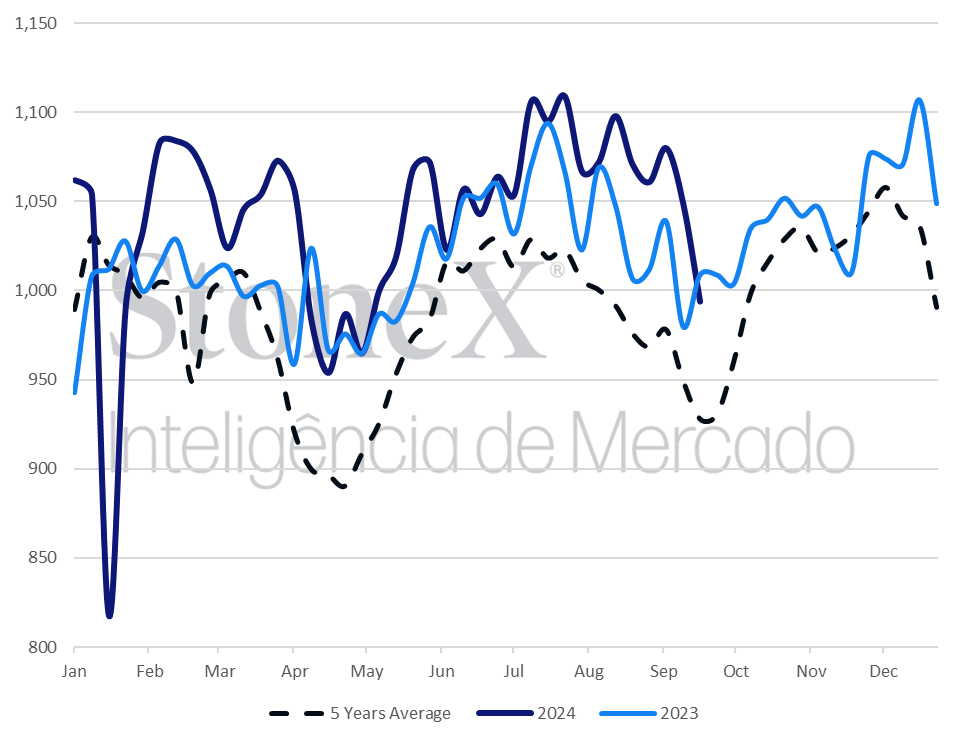
Source: EIA. Design: StoneX
Commitment of Traders | The CFTC’s COT report showed another reduction in the net short position of speculative funds, which are now net short by around 130,700 contracts (-4,100 compared to the previous week). Funds have been reducing their short positions in the commodity market in recent weeks as bearish arguments have lost strength. If this trend continues, further position coverage may sustain corn price gains. However, this will depend on a series of factors, such as the US's ability to export its grains, the strengthening of the Chinese economy in response to monetary stimuli, weather uncertainty in South America, and the continuation of the US interest rate cut cycle.
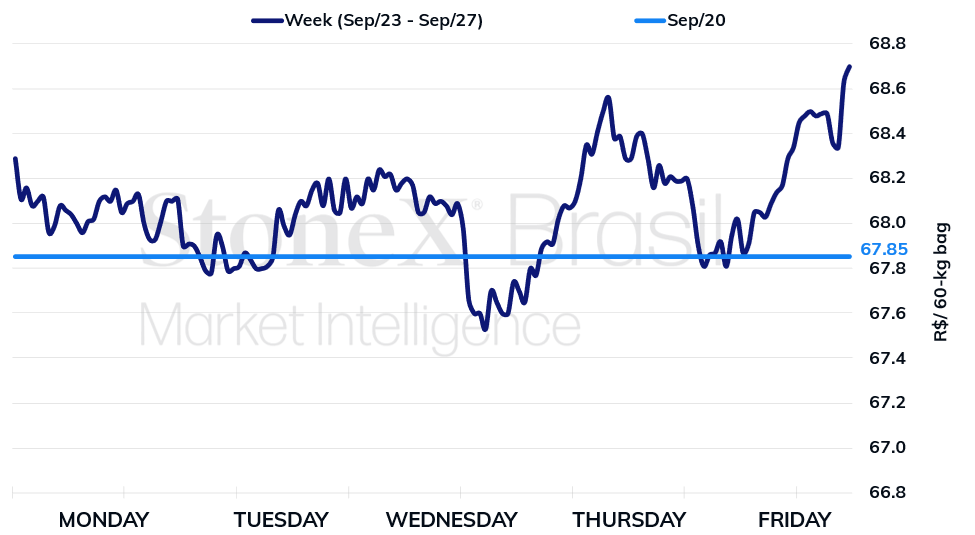
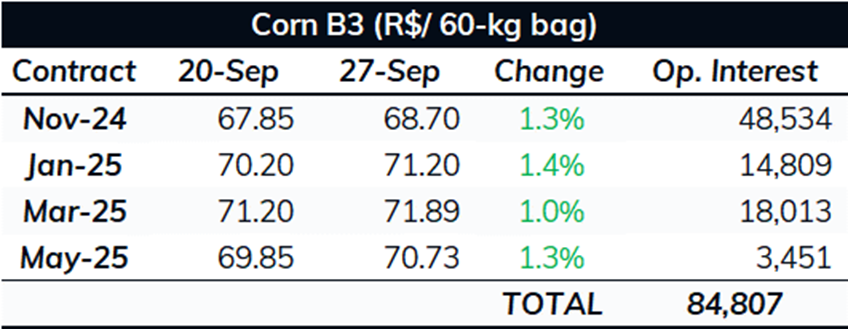
B3, Brazilian real and Weather | In Brazil, corn futures traded on B3 also recorded gains, albeit of smaller magnitude, with November/24 closing at BRL 68.70/bag last Friday, up 1.3% for the week. Additionally, spot prices also rose last week.
Intraday (15 min) November/24 Contract - B3
Source: B3. Design: StoneX.
Here, the dry weather continues to be monitored by the market. While a slight delay in first-crop planting in Brazil is expected, as extensively discussed by agricultural commentators, it is also true that a greater presence of rain over the next two weeks in the Brazilian Midwest could accelerate planting in these regions. According to the latest crop monitoring report from StoneX, first-crop corn planting is actually faster than last year (28.1% versus 25.3%), driven by southern states, which are wetter than the Midwest. Soybeans remain slightly delayed.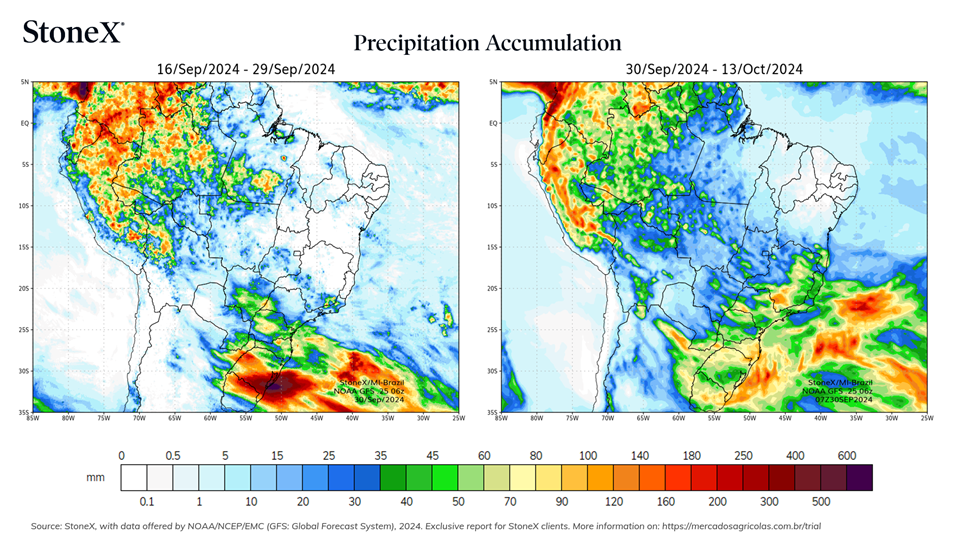
Last week, the exchange rate saw little movement, strengthening the Brazilian real amid expectations of an increase in the interest rate differential following US inflation data indicating more controlled prices. Additionally, economic stimulus packages in China have strengthened risky assets, such as the Brazilian currency.
Upcoming Days | The market will continue to focus on weather conditions in Brazil. Attention will also be on the increased precipitation in the eastern US following Hurricane Helene hitting the southeastern part of the country, which may delay fieldwork in the coming days. Additionally, new monthly data for the US labor market will be released on Friday, potentially providing clearer insights into the Fed's interest rate cut path in upcoming meetings, which could introduce volatility into the market. Today, at 1:00 PM (Brasília time), the US Department of Agriculture (USDA) will release stock data for the 2023/24 corn crop.
Futures and Spot Prices
CBOT Futures Contracts (US¢/bu)

B3 Futures Contracts (BRL/bag)
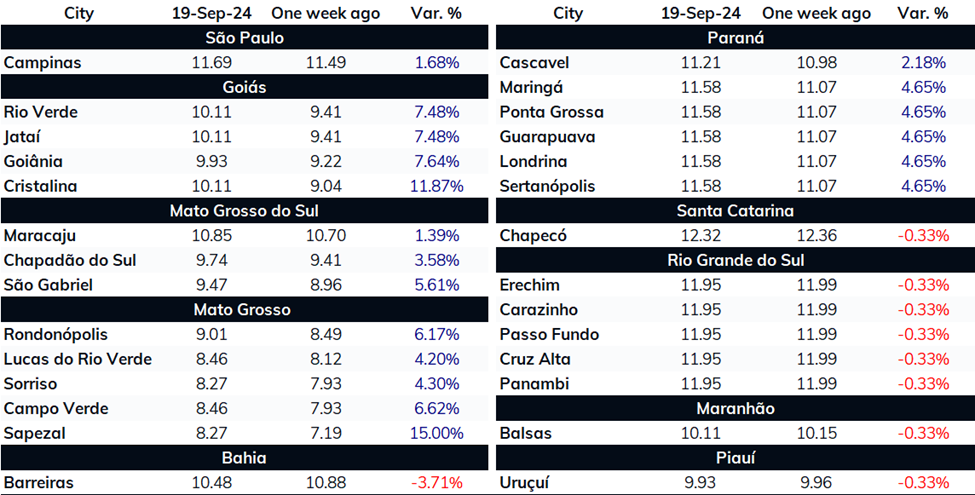
Spot prices in Brazil (USD/60kg bag)