BEARISH FACTORS
-
Creation of food export corridors in Ukraine;
-
Concern about new Covid-19 cases and lockdown measures in China;
-
Reduced concerns for planting in the US.
Bullish factors
-
Advancing vaccination roll out against Covid-19;
-
Expectations of a record grains crop in South America;
-
Conflict between Russia and Ukraine and expectation of lower planting in Ukraine.
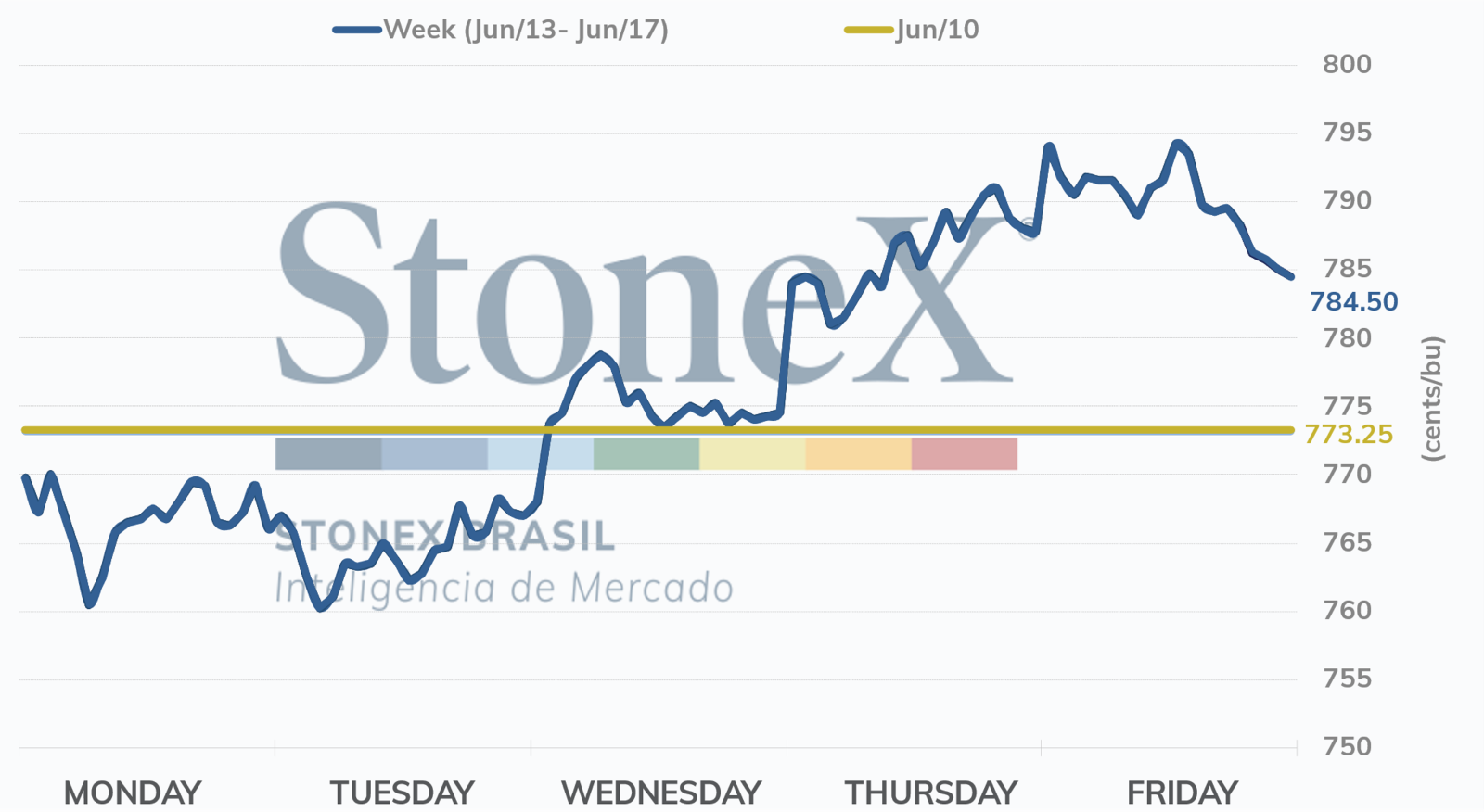
After the significant rallies observed in the week closed on June 10, corn futures started last week in decline, motivated both by a typical profit-taking movement and by the downward trend observed in the soybean, wheat, and stock markets as a whole. July/22 closed Monday with 4 cents/bushel worth of losses from the previous session.
According to the USDA’s weekly export inspections report, the US shipped 1.2 million tonnes of corn in the week ended June 9, which was 259,000 tonnes below the previous week’s exports and 411,000 tonnes less than in the same period of 2021. As such, accumulated shipment reached 44.96 million tonnes, 9.26 million below the same period of the previous season.
Also on Monday, the USDA updated its crop progress report. By June 12, corn planting in the US had reached 97%, a weekly progress of 3 points. With this, the rate of sowing in the country is below that observed in the last year, when fieldwork had already been completed, but in line with the five-year average for the same period.
Intraday (15 min) - July/22 (CBOT)
Source: CME. Design: StoneX.
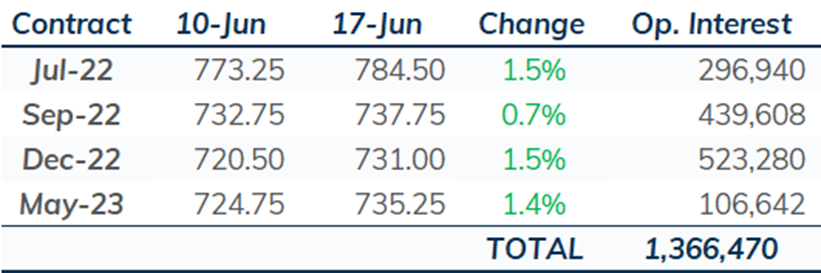
Corn Prices - CBOT (cents/bushel)
Source: CME. Design: StoneX.
On Tuesday, futures had another day of decline in Chicago, following the trend observed in the wheat market. July/22 ended the day losing 1 cent/bushel. The conflict in the Black Sea continues to be an important driver of corn prices. Discussions about the possibility of Russia providing a corridor for the safe passage of Ukrainian grains are still taking place. If the talks are successful, we could see an increase in Ukrainian corn exports, reducing the tightening for global supply. However, there is still nothing concrete. Furthermore, the risk of a recession continues to haunt the market, generating concerns about corn consumption.
On Wednesday, corn contracts did not point to one single direction. While the nearby rose 5.75 cents/bu in the intraday, the most distant contracts had slight setbacks.
The Energy Information Administration (EIA) reported that US ethanol production rose to 1.060 million barrels per day in the week ended June 10, a weekly increase of 21,000. Ethanol stocks dropped, to 23.20 million barrels, down 439,000 compared to the previous week.
On Thursday, the July/22 had another close in the positive field in Chicago, accumulating a significant increase of 14.25 cents/bu in the daily comparative.
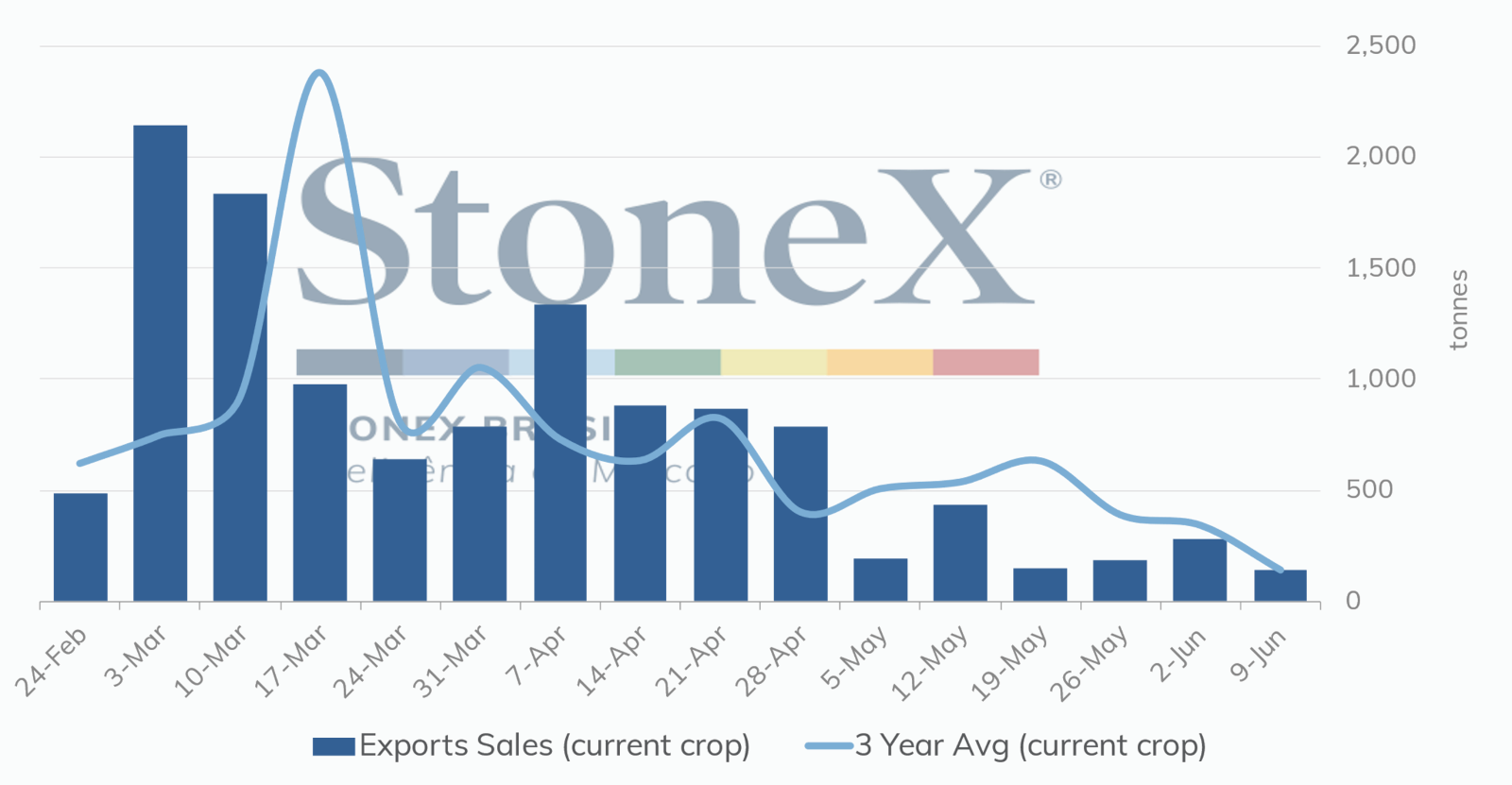
The USDA reported that net sales for the 2021/22 crop totaled 140,9400 tonnes in the week ended June 9, which is 139,500 tonnes less than in the previous week, but122,900 above the same week of 2021. The volume surpassed the ceiling of market expectations, which ranged from 100,000 to 500,000 tonnes.
Weekly US export sales - 2021/22
Source: USDA. Design: StoneX.
On Friday, corn quotes fell lower, mainly following the increase in the US interest rate (but also in other countries, as this has been a common policy globally), and an incentive to redirect applications in less secure assets, such as futures, to safer ones. In the last session of the week, July/22 accumulated a daily contraction of 3.75 cents/bu. With this, the contract closed the week quoted at 784.5 cents/bu, accumulating an 11.25 cent/bu appreciation (+1.5%).
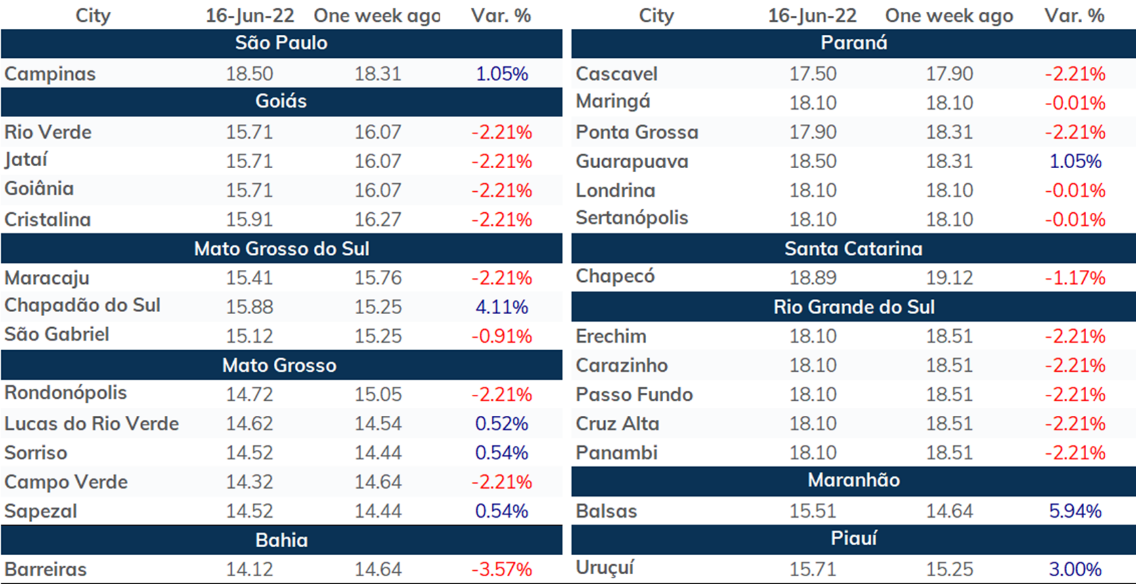
SPOT PRICES (USD/60kg-bag)
Source: StoneX, Agrolink and IMEA. Design: StoneX.