BEARISH FACTORS
- Slower-than-expected recovery of the Chinese economy;
- Fears about global recession;
- Reduced weather-related concerns about Central and Western US corn belt.
Bullish factors
- Restriction on grain supply due to conflict in the Black Sea;
- Dryer weather in Eastern US corn belt.
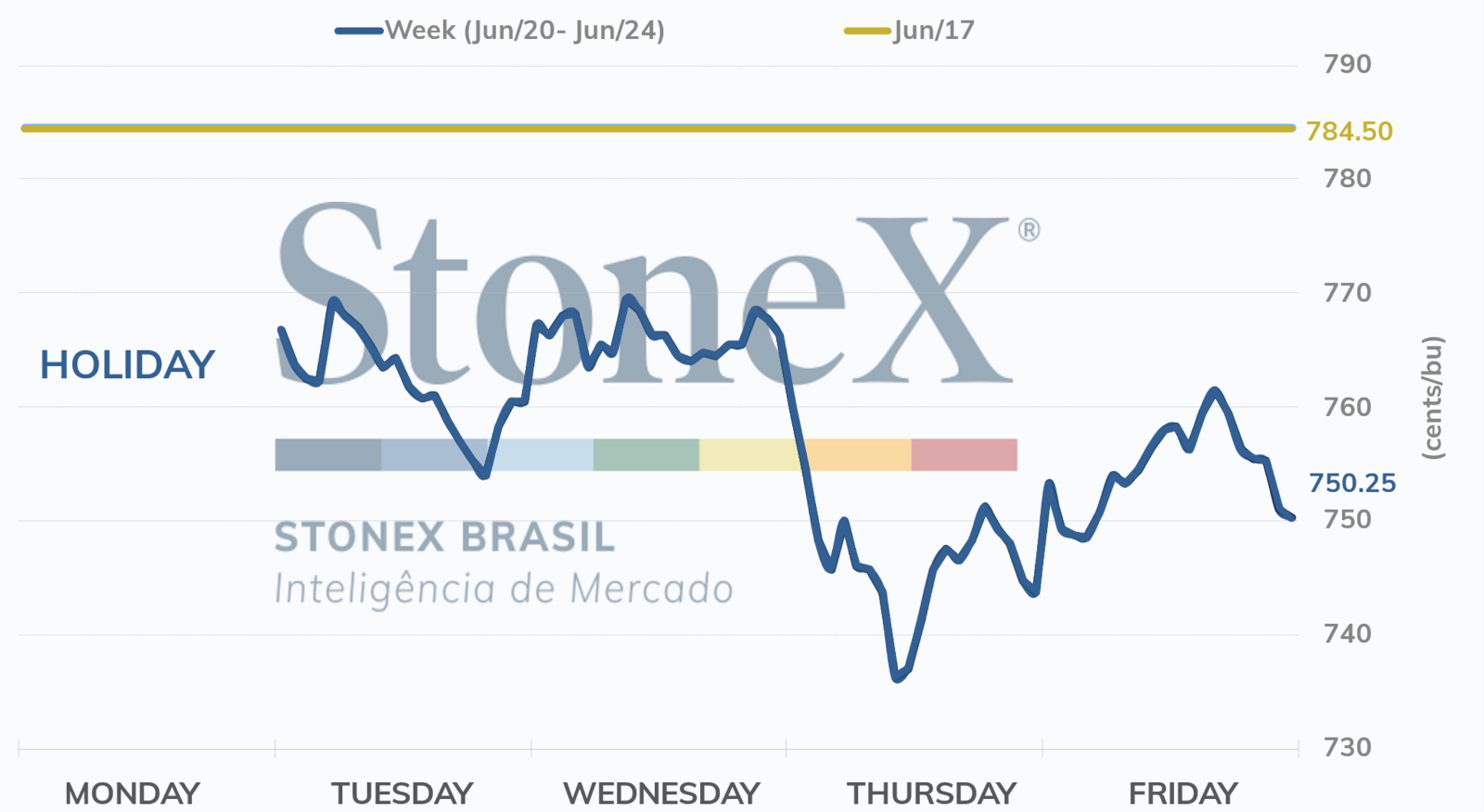
Due to Juneteenth in the US on Monday (20), the first trading session of last week in Chicago took place on Tuesday (21). At the week’s opening, corn futures posted strong declines, following the downward trend observed in the grains and financial markets. On the day, forecasts of more favorable weather for corn development in the US contributed to the observed contractions. In addition, growing concern about a recession also played a big part in Chicago prices. The contract maturing in July/22 ended the session with a contraction of 23.75 cents/bu from the previous day.
According to USDA data, the US exported 1.2 million tonnes of corn in the week ended June 16, in line with the volume shipped in the previous week, but 591,000 tonnes lower than in the same period last year. Cumulative exports totaled 46.16 million tonnes, 9.83 million tonnes less than at the same time of last season.
Later in the day, the USDA released its weekly crop progress report. According to data, 70% of US crops were in good or excellent condition as of June 19, 2 points less than a week earlier and in line with market expectations, as drier-than-usual weather was recorded in the week ended June 17. In the same period of 2021, 65% of the crop was in good or excellent condition.
Intraday (15 min) - July/22 (CBOT)
On Wednesday, the corn market showed mixed movements in Chicago. While the nearby contract ended another trading session in the positive field, accumulating an increase of 7.25 cents/bu on the intraday, more distant contracts retreated. Forecasts of warmer and drier weather for the US Midwest helped support prices.
On Thursday, prices had another day of widespread declines. Once again, more favorable weather forecasts for the US crop and macroeconomic issues pressured corn prices. July/22 accumulated a drop of 21.25 cents/bu in the day. In addition, the grain was also affected by the drop in soybeans, which in turn has reflected the contractions observed in its byproducts’ markets.
Indonesia has once again allowed the export of palm oil, which has been pressuring vegetable oils as a whole and, consequently, also affecting soybean prices. Another important point to be mentioned is that the recovery of Chinese economic activity has taken place slowly, raising questions about the country's demand for grains, especially soybeans, since in recent weeks there has been an increase of soybean meal stocks in the country.
Weekly US export sales - 2021/22
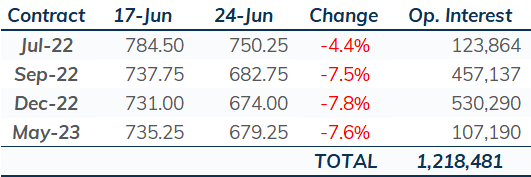
On Friday, corn futures rose higher again in Chicago, on a typical move of technical purchases, with agents taking advantage of the sharp drops recorded recently. July/22 accumulated an appreciation of 3.5 cents/bu in the daily comparison. With that, the contract in question ended the week quoted at 750.25 cents/bu, posting a decline of 34.25 cents/bu (-4.4%) in the period.
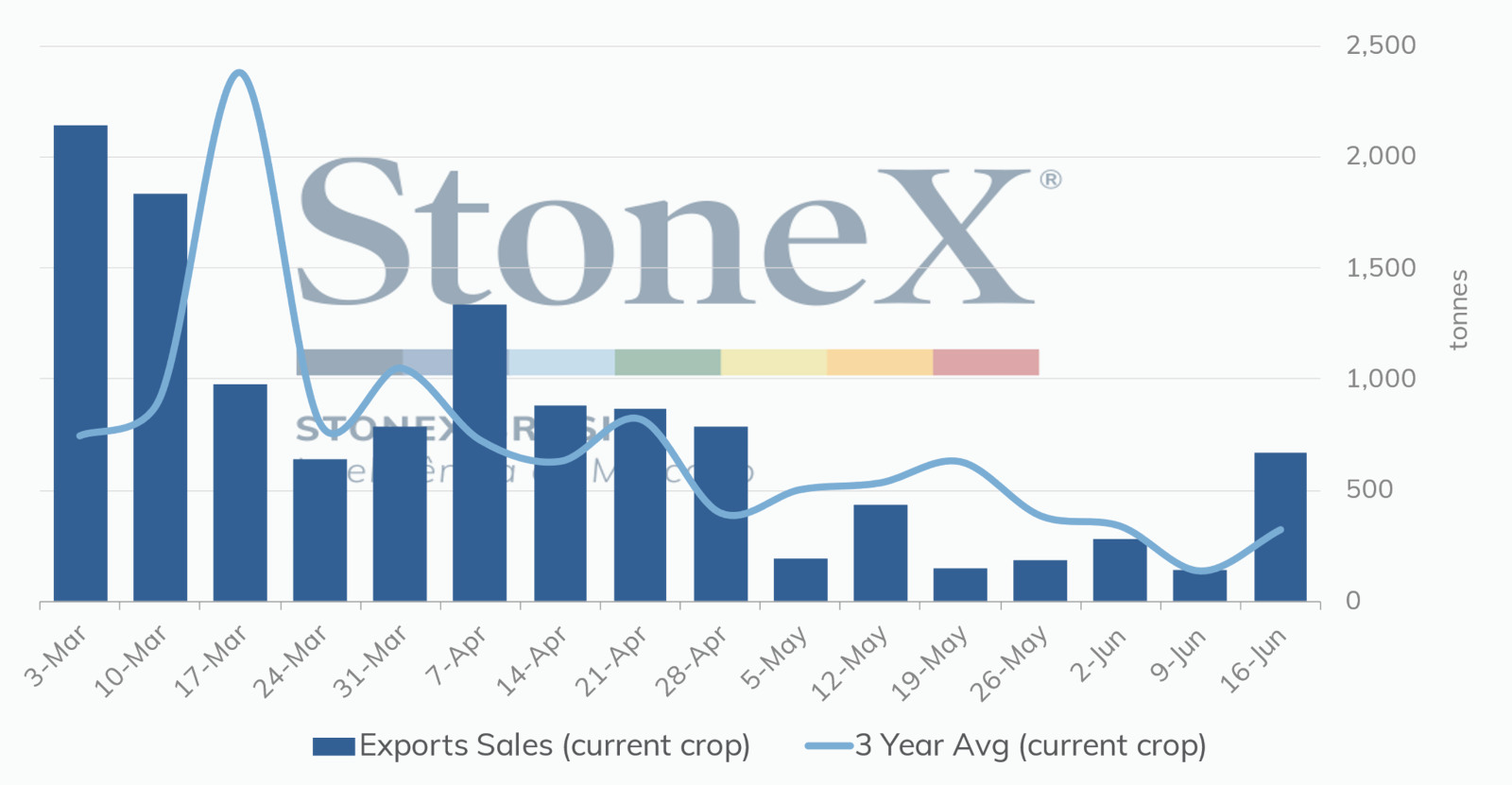
The USDA reported that net sales for the 2021/22 crop totaled 671,900 tonnes in the week ended June 16, 531,000 tonnes more than the previous week and 456,000 higher than the equivalent week of 2021. The volume was above the range expected by the market, which varied between 300,000 and 600,000 tonnes, which, even so, was not enough to offset the bearish fundamentals. Commitments from all destinations advanced to 60.3 million tonnes, against 69.5 million in the same period last year.
This week, macroeconomic fundamentals will remain on the agents' radar. Concern about inflation is something observed across the globe and many countries have adopted policies aimed at fighting the increase of prices, such as raising interest rates. And this rise is closely linked to growing concerns about a recession, as it could discourage the growth of economic activity and, consequently, negatively impact grain consumption. In addition, rising interest rates also encourage capital flight from riskier assets, such as commodity futures, to safer ones, such as government bonds.
As grain crops enter major stages of development, the weather will be a pivotal point for corn prices in the coming weeks.
Next Thursday (30), the USDA will release its quarterly inventories and acreage report. Average market estimates point to a final planted area of 36.4 million hectares of corn in the US, against the 36.2 million hectares brought in March, while agents expect a planted area of 36 6 million hectares for soybean, against the last figure of 36.8 million. If these changes materialize, and keeping the latest USDA yield estimate, there would not be a radical change in the US S&D balance.
On Friday (1), StoneX will release updated estimates for the Brazilian grains crop. In early June, StoneX estimated production for the 2021/22 soybean crop at 124.4 million tonnes and corn at 116.8 million.
SPOT PRICES (USD/60kg-bag)