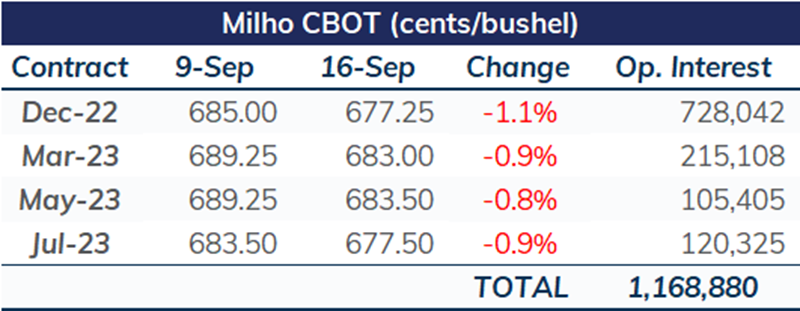
Inflation continues to rise in the US. The US CPI figure showed that inflation remains high in the country, which increases the chances of further interest rate hikes by the Federal Reserve and a redirection of capital from futures and other riskier markets to safer alternatives, such as government bonds. Furthermore, even though corn is a food commodity, which makes its demand less susceptible to such sudden variations in times of crisis, it is also majorly used for ethanol production, an activity that is more likely to be impacted by a possible recession.
Possible rail system strike stirs up the market. In addition to inflation, another issue that moved the market a lot in recent days was uncertainty about a possible strike in the US rail system. Much of the country's grain logistics depends on the rail system, and fears related to flow interruption put great pressure on the grain market. The strike was scheduled to start last Friday, but was delayed after a series of negotiations, which resulted in an interim agreement that has yet to be voted on.
Early harvesting in the US. On September 12, the USDA released its weekly crop monitoring report, showing its first harvest progress figures for the 2022/23 crop. According to the report, by September 11, 5% of the crop had been harvested in the country, against 3% in the same period last year.
US crop conditions worsen further. On September 11, 53% of the crop was in good or excellent condition, 1 percentage point less than a week earlier and 5 points below the same period last year.
USDA surprises the market with its revisions for the US crop. On September 12, the USDA released its monthly supply and demand report, much awaited due to possible adjustments in the 2022/23 US crop, in addition to revisions in Ukraine's numbers, given the uncertainty regarding the conflict context. Average market estimates pointed to a decrease of 11 t/ha in August to 10.8 t/ha in September, which was confirmed with the release of the report.
Despite a revision in productivity that was in line with market expectations, the cut in production surprised agents. That is because the Department reduced its estimate of harvested area by 421,000 hectares, to 32.7 million, while average estimates pointed to an area of 33.06 million hectares, very close to the figure presented in the August report. As a result, the USDA production estimate for the 2022/23 US crop dropped from 364.7 million to 354.2 million tonnes, below average market estimates of 357.8 million tonnes.
Despite concerns about the level of activity in China, expectations remain favorable for the country's corn consumption. Still in relation to WASDE, it is worth mentioning the increase of 3 million tonnes in Chinese 2022/23 production, to 274 million and the maintenance of imports and domestic consumption at, respectively, 18 million and 295 million tonnes, since it would not be It is a surprise to see cuts in these variables amid the negative impacts on the Chinese economy caused by the Covid-zero policy in the country.
More favorable prospects for Ukrainian crop. It is also worth emphasizing the changes in estimates for the 2022/23 Ukrainian crop. Despite all the uncertainties amid the current conflict, the country's production was raised from 30 to 31.5 million tonnes, a revision that was accompanied by an increase of 1 million tonnes in domestic consumption, to 12.7 million, and of 500,000 tonnes in exports, to 13 million.
US ethanol stocks and weekly production decline again. The Energy Information Administration (EIA) reported that US ethanol production fell to 963,000 barrels per day for the week ended September 9, which was 26,000 lower than a week earlier. Stocks, in turn, retreated to 22.84 million barrels, against 23.14 million in the previous week.
USDA re-releases US export sales data. After weeks without releasing new data, the USDA reported that net sales for the 2022/23 crop totaled 583,100 tonnes in the week ended September 8, against 816,000 tonnes in the previous one. In the same period of 2021, US net sales stood at 246,600 tonnes. The volume was within the range expected by the market, which was between 300,000 and 900,000 tonnes. Commitments of all destinations rose to 12.4 million tonnes, against 24.6 million in the same period last year.
Weekly US export sales - 2021/22

Source: USDA. Design: StoneX.