- Favorable prospects for Brazilian production;
- Weakened pace of US sales and cancelled shipments to China;
- Favorable prospects for US production.
- Poor conditions for the Argentine corn crop.
- Weather models point to low rainfall in most of the corn producing regions in Brazil;
- Weather models point to drier weather in the US Midwest.
Pace of US shipments is stable in the weekly comparison, but deficit in relation to last season increases once again. According to the USDA's Export Inspection Report, the US shipped 1,313,400 tonnes in the week ended May 25, just 12,900 tonnes less than a week earlier, but 98,800 below the same period of the previous year. As a result, accumulated shipments in the 2022/23 season totaled 28.7 million tonnes, 13.6 million less than in the same period of the previous cycle, with a deficit of 13.5 million tonnes a week earlier.
Corn planting in the US approaches the final stretch. On May 30, the USDA released its crop progress report showing that corn planting in the US reached 92% through May 28, a weekly advance of 11 percentage points, 8 points above one year before and the five-year average for the same period (84%). Progress in the country as a whole has paced well over the last few weeks, with the exception of North Dakota, which has raised concerns about prevent planting in the state.
Ethanol production rises in the week. According to data released by the Energy Information Administration (EIA), US ethanol production advanced to 1,004 thousand barrels per day in the week between May 20 and 26, an increase of 21,000 in the weekly comparison. Production was 18,600 barrels higher than the five-year average for the same period, but 67,000 lower than a year earlier. Ethanol stocks also rose to 22.33 million barrels, 291,000 more than a week earlier.
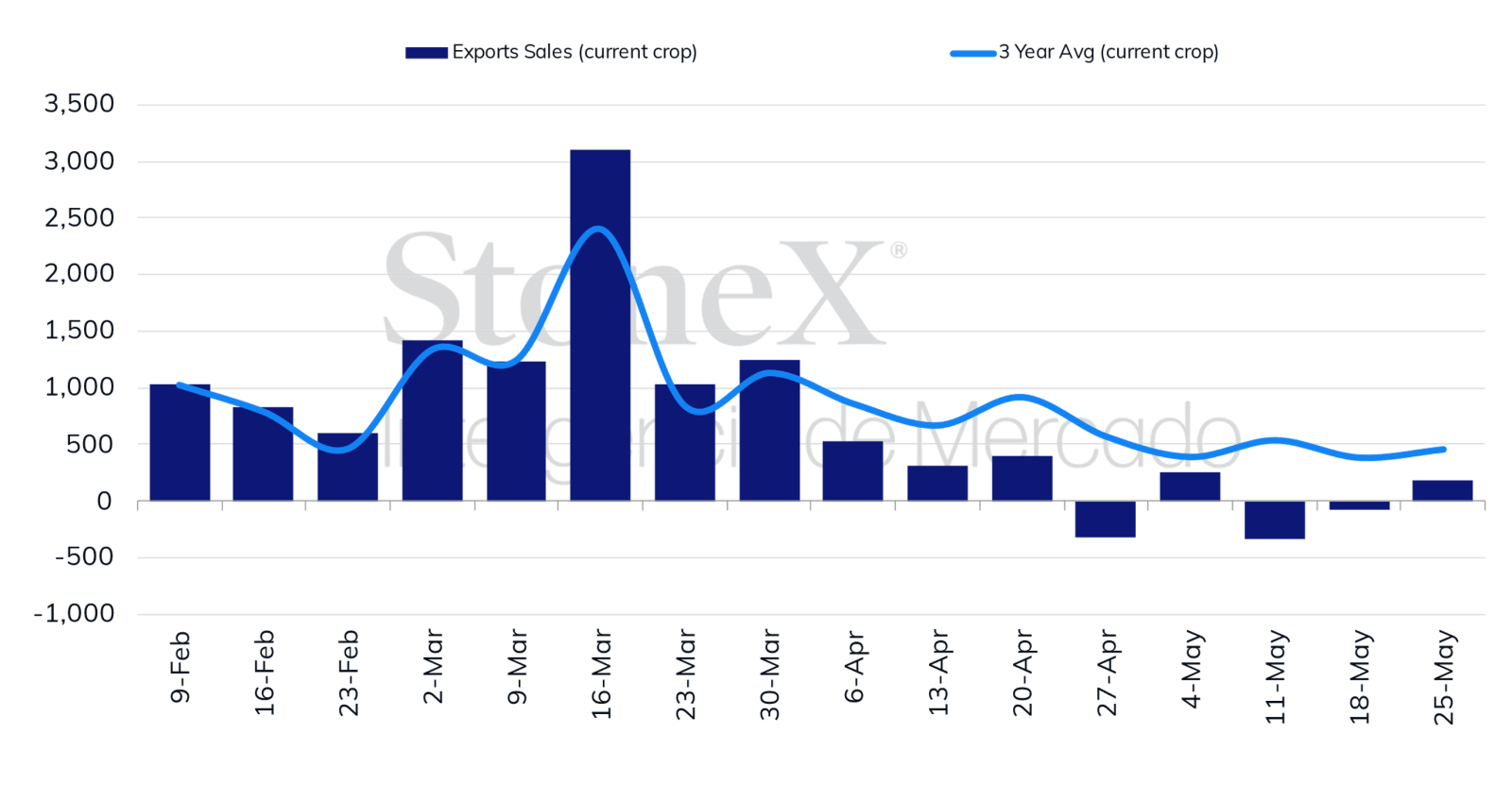
US records net sales again, but pace remains weakened and delay in relation to the previous crop persists. In its Export Sales Report, the USDA reported that US net sales totaled 186,700 tonnes for the week ended May 25, 261,800 tonnes more than a week earlier, but just 900 tonnes above that recorded in the same period of 2022 and 463,400 below the five-year average. With that, cumulative sales rose to 38.2 million tonnes, but the deficit compared to the 2021/22 season remained at 21.1 million tonnes.
Pace of corn harvest in Argentina is delayed. The Buenos Aires exchange reported that 4% of Argentine cereal crops were in good/excellent condition on June 1, a decrease of 1 point on a weekly basis, but 11 points below the same week of 2022. The corn harvest in the country reached 28.6%, 3.4 points a year earlier and 11.6 points below the five-year average. The BCBA continues to estimate the Argentine crop at 36 million tonnes, 16 million less than in the 2021/22 cycle.
StoneX raises production estimate for the 2nd 2022/23 crop. On June 1, StoneX updated its estimates for the 2022/23 corn crop. The first corn crop is estimated at 28.6 million tonnes. With the harvest of the summer crop approaching its final stretch, the production number is less subject to further changes. However, changes still cannot be completely ruled out, as the harvest continues to take place in the Brazilian Northeast. Regarding the second crop, StoneX made another positive adjustment in its production estimate. The 2022/23 winter crop received an increase of 2.1% compared to the previous report, rising to 102.9 million tonnes. More favorable perspectives for the yield in Mato Grosso allowed production above previously expected at national level. As a result, total corn production in Brazil (considering the three crops) increased to 133.75 million tonnes.
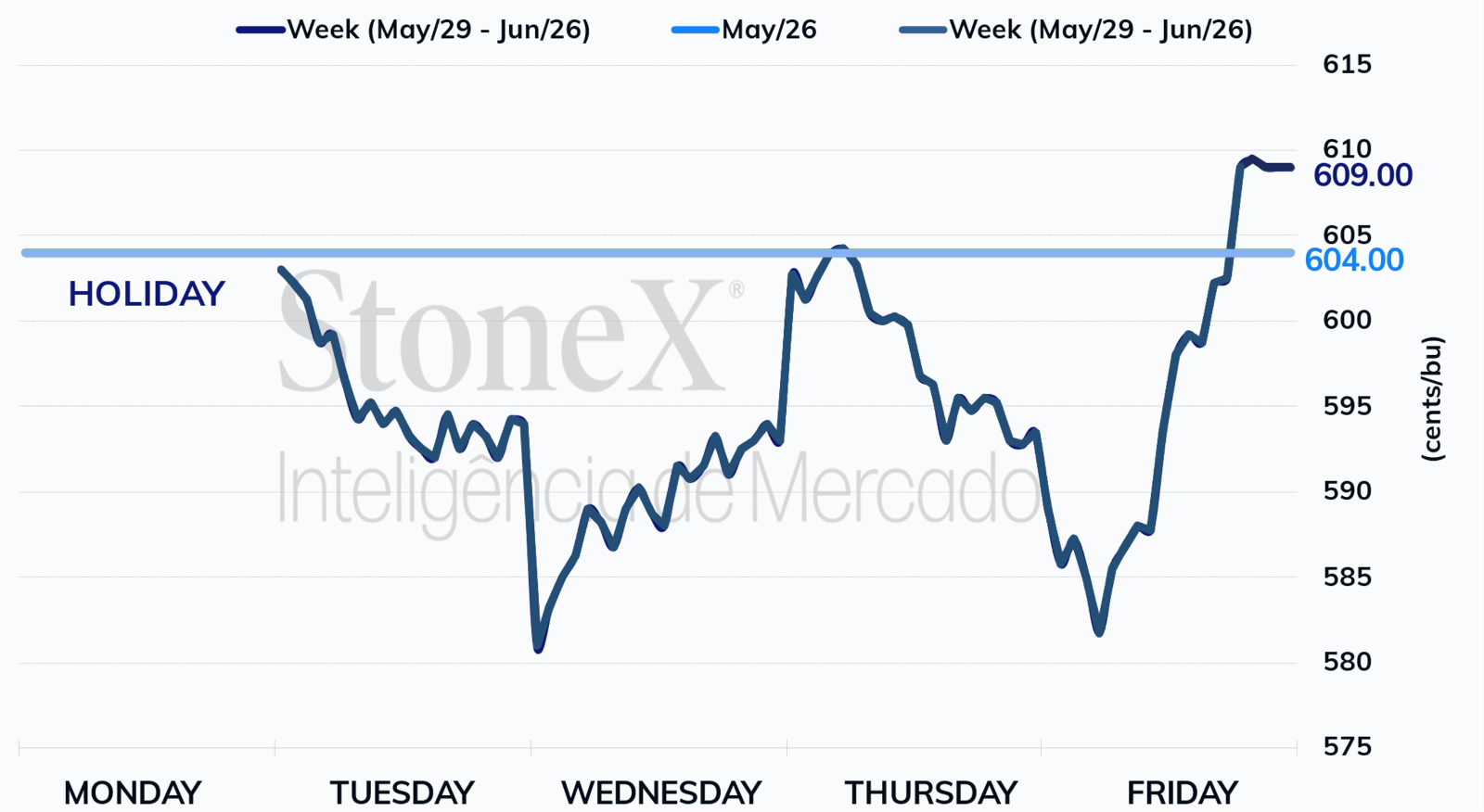
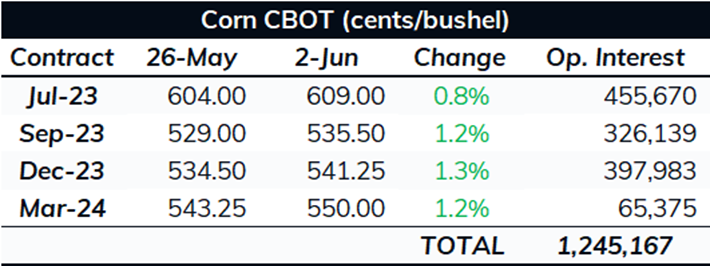
Midwest drought concerns support prices. As commented, corn futures accumulated losses until the end of last week, which were largely recovered by concerns about the weather in the US. The NOAA Drought Monitor points out that a significant part of the Midwest has a pattern of drought. This residual water deficit would not necessarily imply a problem for the US crop, since good rains in June could compensate for the current situation. However, NOAA warned of the development of drought in the eastern Midwest region during the month of June and the continuation of a dry pattern in regions already affected. This may be an indication that El Niño may have a limited effect over the next month and that the increase in moisture normally linked to the phenomenon (when it reaches the US) should take a little longer to be seen. It is important to point out that one cannot yet speak of losses, but this is already moving the market and should remain in the spotlight.