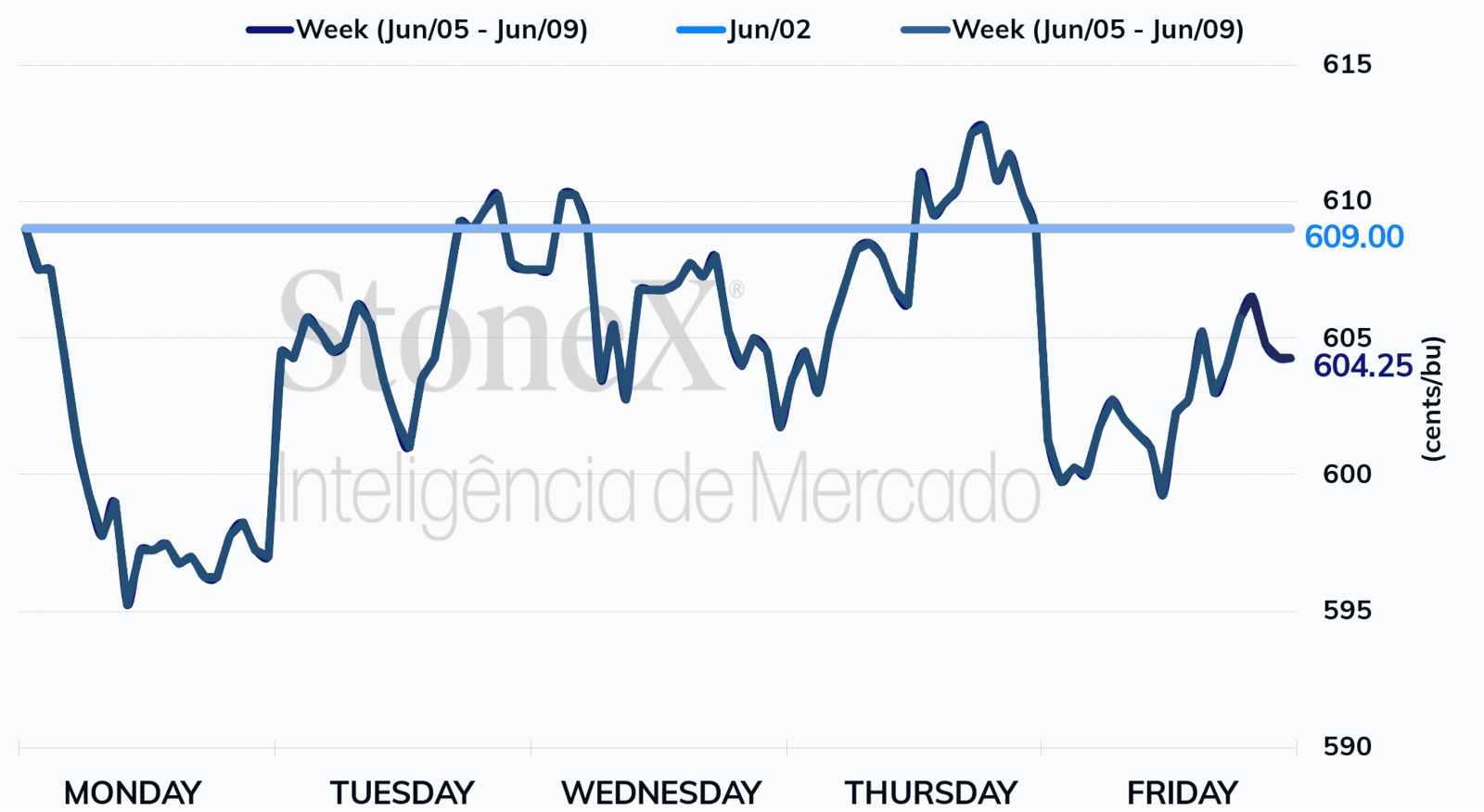
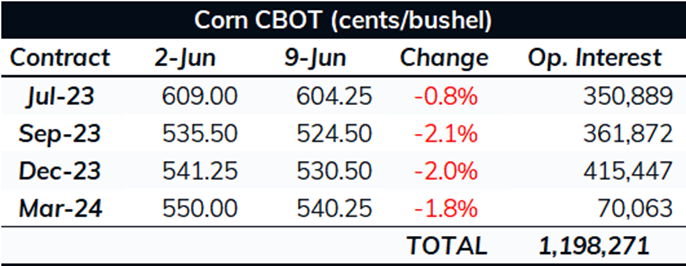
- Favorable prospects for Brazilian supply;
- Weakened pace of US sales and shipments;
- New cut in US export estimate for 2022/23 by USDA;
- Positive revision in Brazilian production by USDA.
- Poor conditions and delayed harvest of the Argentine corn crop;
- Intensified tensions between Russia and Ukraine and fears about grain shipments through the Black Sea;
- Concern about the development of a drier pattern in parts of the US Midwest.
NOAA Drought Monitor shows that a significant portion of the Midwest is experiencing drought. The weather has been a supportive factor for the market and, even though it still does not really have an impact on yield, a low volume of rainfall throughout June and July could result in production losses. Last week, models pointed to expressive volumes of rain in the final half of June, with some areas of the corn belt receiving sufficient amounts to alleviate water deficits, which contributed to the drop in corn prices. However, the models currently show the return of a drier pattern in the coming days, which may support prices.
Ethanol production rises for the second consecutive week. According to data released by the Energy Information Administration (EIA), US ethanol production rose to 1,036 million barrels per day in the week between May 27 and June 2, a growth of 32,000 in the comparative weekly. Production was 3,000 below the five-year average for the same period, but 44,800 above last year. Ethanol stocks also rose, to 22.95 million barrels, 616,000 barrels more than a week before and 843,600 above the five-year average for the period.
Pace of US shipments and sales remains below that of last season. According to the USDA Export Inspection Report, the US shipped 1,169 million tonnes of corn in the week ended June 8, which was 37,700 less than a week before and 52,700 less than in the same period of the previous year. As a result, accumulated shipments in the 2022/23 season totaled 31.1 million tonnes, 13.9 million less than in the same period of the previous cycle.
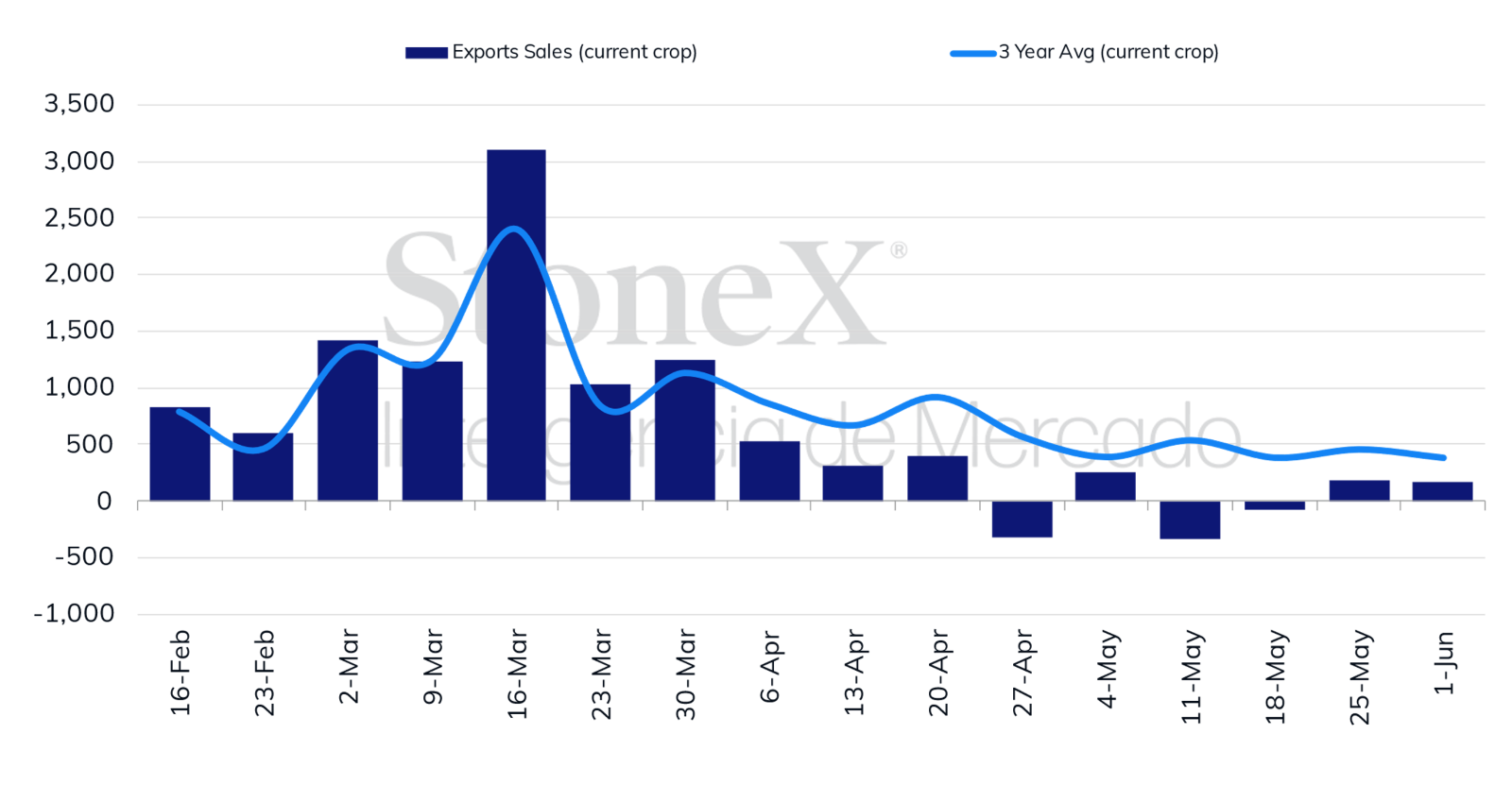
In its Export Sales Report, the USDA informed that US net sales totaled 172,700 tonnes in the week ended on June 1, which was 14,000 tonnes less than a week before, 107,700 below the same period of 2022 and 219,400 below the five-year average. With that, cumulative sales rose to 38.3 million tonnes, but the deficit compared to the 2021/22 season grew to 21.2 million tonnes.
USDA makes few changes to the 2023/24 crop figures and revisions to South American supply and US exports in 2022/23 stand out. The only change to the US corn balance was the reduction in exports in 2022/23, to 43.8 million tonnes. As a result, ending stocks for the current season increased to 36.87 million tonnes, while those for the 2023/24 season increased to 57.32 million. In South America, the highlight was the increase in 2022/23 corn production in Brazil, to 132 million tonnes, around 1.75 million less than estimated by StoneX. On the other hand, the Department reduced Argentine production to 35 million tonnes, 1 million less than the BCBA number. Another important change was the Ukrainian balance sheet. Despite all the uncertainties surrounding the conflict in the Black Sea, the USDA raised the country's shipments in 2022/23 by 1.5 million tonnes, to 27 million, and those of 2023/24 by 2.5 million, to 19 million. The greater optimism in relation to the Brazilian supply and the reduction in the estimate of US shipments contributed to the drop in prices last week.
Escalated tensions in the Black Sea. Last week, the fear that the grain export agreement through the Black Sea may be interrupted gained strength again. Russia has reportedly informed the United Nations Joint Coordination Center that it will continue to block the registration of ships wishing to move to Ukraine's port of Pivdennyi, the largest of the three previously approved ports, until Ukraine allows the movement of ammonia through the pipelines that cross its territory towards the export terminals on the Black Sea. This comes at a time when Ukraine's overland exports to Eastern Europe have also been hit by resistance from its neighbors seeking to protect local farmers from the influx of significantly cheaper Ukrainian corn. Furthermore, Russia has stated that it has no prospect of renewing the agreement after its expiration on July 17.