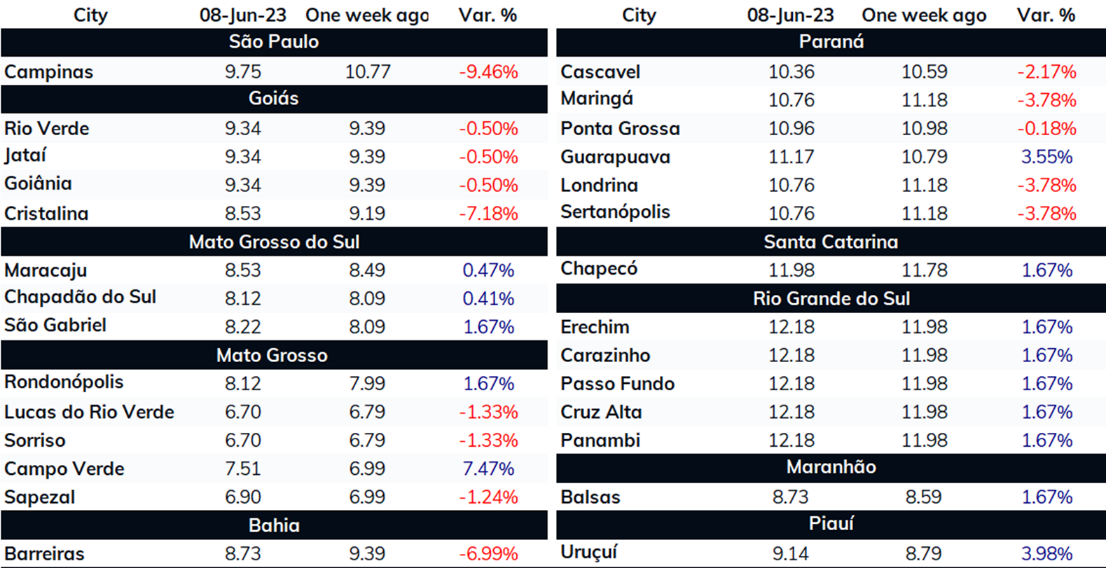
- Favorable prospects for Brazilian supply;
- Weakened pace of US sales and shipments.
- Intensified tensions between Russia and Ukraine and fears about grain shipments through the Black Sea;
- Concern about the development of a drier pattern in parts of the US Midwest.
- Fears that the development of a drier pattern in China could impact local production.

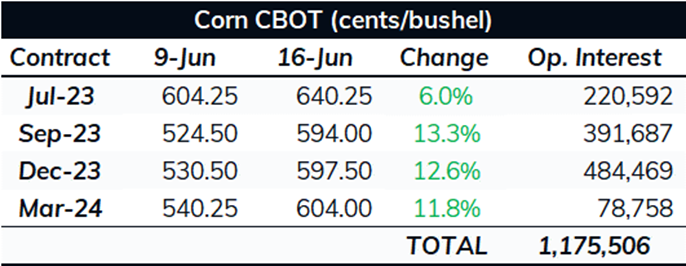
US crop condition worsens again and concern about drought in the US supports corn futures. In its weekly crop progress report, the USDA showed that 61% of corn crops were in good/excellent condition, down 3 percentage points week over week, 11 points down from a year ago and 9 points below the five-year average for the same period. The worsening conditions were already expected, since, although some areas in the south of Illinois and Indiana were benefited by the rains, precipitations were generally lower than expected. Weather models have fluctuated a lot, resulting in great volatility in the market. The NOAA Drought Monitor shows that the drought covers 57% of the corn area, which has made the market question whether the US will really be able to reach the average productivity of 11.39 t/ha estimated by the USDA. Earlier this week, models pointed to high rainfall in the northern part of the corn belt, but low rainfall in Iowa and Illinois, the main producing states. It is still early to say anything about US production, but it can be said that high fluctuations should occur in the coming weeks, especially if there are changes in weather models.
Weekly US ethanol production drops again. According to the US Energy Information Administration (EIA), US ethanol production fell to 1018 million barrels per day in the week between June 3 and 9, a contraction of 18,000 week-on-week and 42,000 below the five-year average for the same period. Ethanol stocks also dropped to 22.23 million barrels, 722,000 barrels less than a week earlier, but 310,600 above the five-year average for the period.
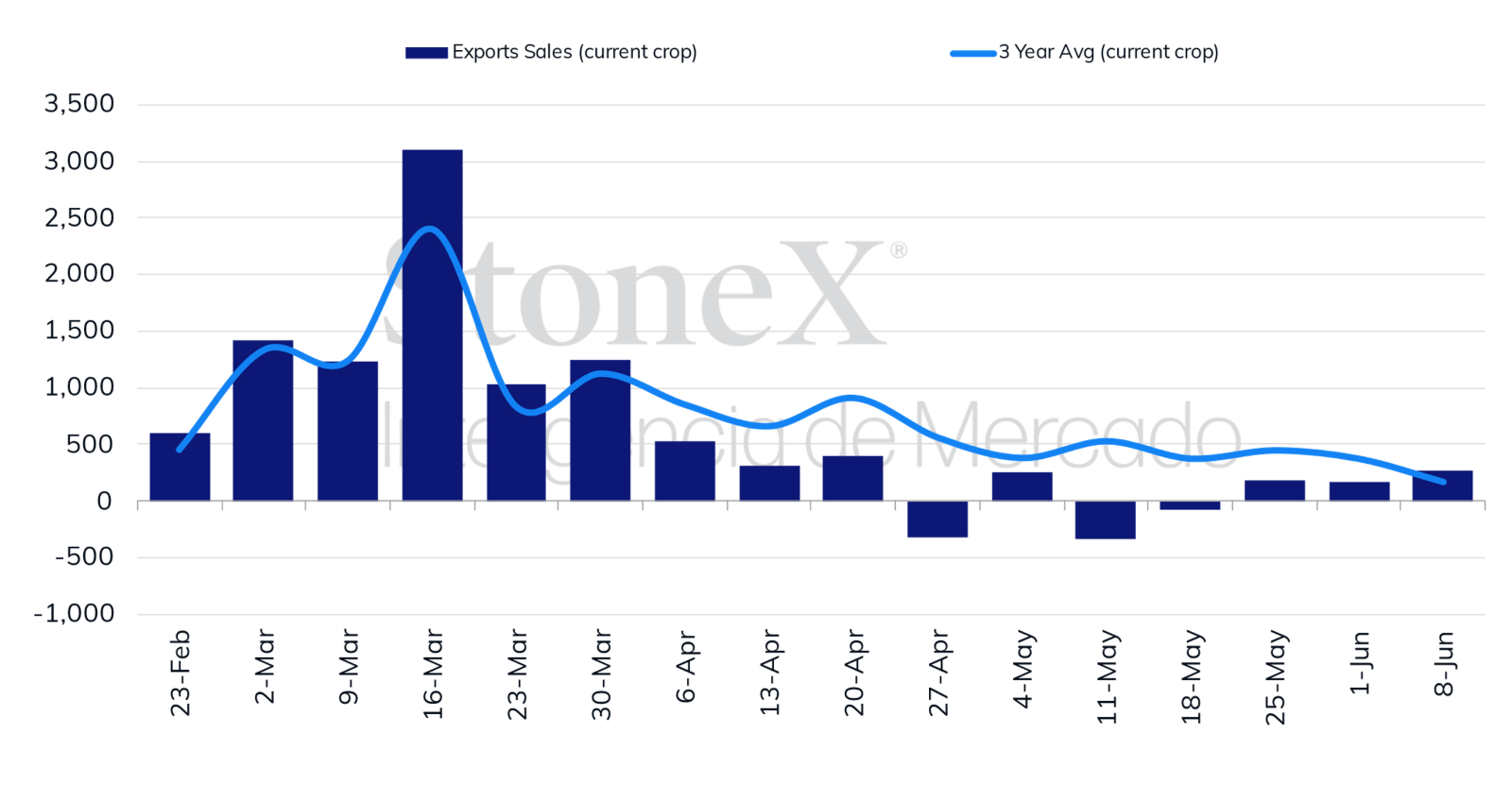
US export sales improve year-on-year and slightly narrow the deficit from last season. In its export sales report, the USDA reported that US net sales totaled 273,300 tonnes for the week ended June 8, 100,500 tonnes higher than a week earlier and 132,300 tonnes above the same period of 2022, but 51,100 tonnes below the five-year average. With that, accumulated sales rose to 38.6 million tonnes, which is 21.1 million tonnes less than in the same period last year.
Corn harvest in Argentina reaches 37.5%. The Buenos Aires exchange reported that 7% of Argentine cereal crops were in good/excellent condition on June 15, an increase of 2 points on a weekly basis, but 10 points below the same week in 2022. Corn harvest in the country reached 37.5%, which was 0.5 point below that seen a year earlier and 11.6 points below the five-year average.
El Niño has raised concerns about Chinese production. El Niño could make put the Chinese crop in risk, as the phenomenon could result in a warmer than normal weather pattern in the north of the country in July and August, which may negatively affect the corn crop, as a large part of Chinese production is concentrated in the northeast.
Despite having already been assimilated by the market, tensions in the Black Sea continue to support prices. Once again, Russia threatened to withdraw from the Black Sea Grain Initiative. The Kremlin has reported that the UN has not followed through on its promise to assist Russia with food and fertilizer exports. It is true that Russian threats are nothing new, but an increase in the difficulty of transporting grain through the region would affect the availability of products and, consequently, prices.