- Favorable outlook for the Brazilian supply;
- Weakened pace of US sales and shipments;
- Weather models indicating increased moisture in July in the corn belt;
- US planted area above market expectations.
- Statement that Russia will leave the Grain Initiative after its expiration;
- Concern over the development of a drier pattern in portions of the US Midwest;
- Fears that a drier pattern in China could impact local production.
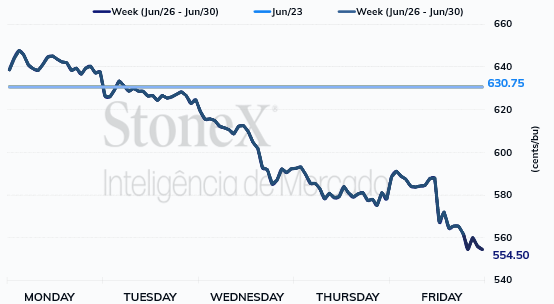
US crop conditions deteriorate, but weather models indicate higher moisture in July. The good/bad US corn crop index declined five percentage points (p.p.) in the weekly comparison, reaching 50% on June 25, a sharper drop than the 3 points expected by the market. The current level is 17 points lower than in the same week last year and the 5-year average for the same period. NOAA's Drought Monitor showed that on June 27, drought covered 70 percent of corn crops, up from 64 percent the previous week and 22 percent a year earlier. Despite the current scenario bringing fears about the yield of the 2023/24 crop in the US, the occurrence of rains in parts of the US Midwest over the last week brought some relief to agents since increased moisture in the last week should enable some improvement in crop conditions in the country. On Monday, the weather models pointed to rains over the next fifteen days in much of the belt, which, if materialized, should act as a bearish factor in the grain market.
US ethanol production is stable in weekly comparison. According to data released by the Energy Information Administration (EIA), US ethanol production was 1,052 thousand barrels per day (mbpd) between June 17 and 23, stable in weekly comparison. The observed production is in line with that seen in the same period last year but exceeded the 5-year average for the same period by 22.8 mbpd. Biofuel stocks advanced to 23 million barrels, 175,000 barrels more than a week earlier and 1.3 million more than last year.
The Pace of US shipments strengthens the idea of weaker external demand for the country's grain. According to the USDA's Export Inspection Report, the US shipped 542,700 tonnes in the week ended June 22, 288,300 tonnes less than a week earlier and 704,200 tonnes less than the same period a year earlier. With this, the accumulated shipments in the 2022/23 season totaled 32.5 million tonnes, 15 million less than in the same period of the previous cycle.
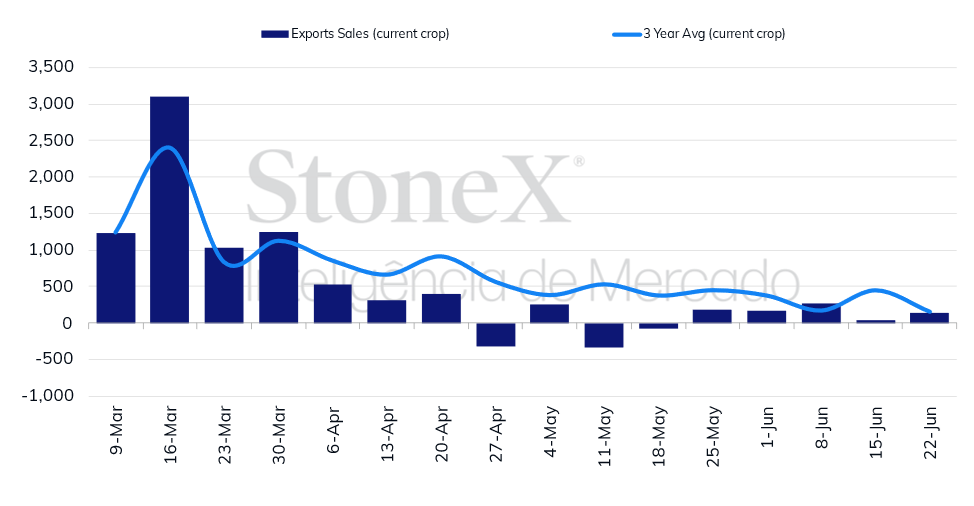
US net sales advance and allow for a slight reduction in the lag from the previous crop. In its Export Sales Report, the USDA reported that US net sales totaled 140,400 tonnes in the week ended June 22, 104,400 tonnes more than a week earlier, 51,600 tonnes higher than the same period in 2022, but 181,500 below the 5-year average. With this, cumulative sales advanced to 38.8 million tonnes, allowing for a slight pullback in the deficit compared to the 2021/22 season to 21.6 million tonnes from 21.7 million a week earlier.
Argentina's corn harvest pace is in line with that recorded a year earlier. The Bolsa de Cereales de Buenos Aires reported that 7% of Argentina's corn crops were in good/excellent condition on June 29, unchanged in the weekly comparison but ten p.p. below that recorded in the same week of 2022. The country's cereal harvest reached 46.5%, in line with that observed a year earlier, but 11.9 p.p. below the 5-year average.
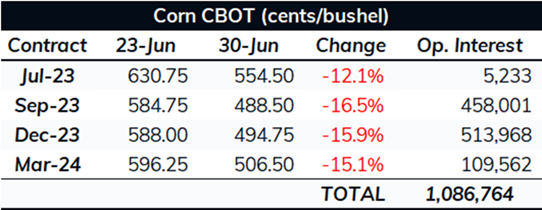
USDA planted area report surprises the market. Last Friday (30), the release of the long-awaited USDA planted area report took place, which brought big surprises and caused significant oscillations in Chicago. Agents did not expect much change compared to the number of corn planted area brought in March (37.23 million hectares) since the average of market expectations pointed to a planted area of 37.17 million. However, this latest report from the Department pointed to a planted area of 38.1 million hectares. Maintaining the same June WASDE figures for US productivity, domestic consumption, and exports, this increase in the planted area would allow for an increase of more than 10 million tonnes in ending stocks in 2023/24. With the signaling of a more comfortable S&D balance in the US, grain prices retreated 4.6% on Friday alone.
On Friday (30), the USDA released the quarterly stocks position report, which indicated that US corn stocks were at 104.29 million tonnes on June 1, 2023, versus average market estimates of 108.08 million. The lower number of stocks implies that the weakened pace of exports has been offset by higher use for feed. However, these figures were put aside because of the great surprise caused by the number of planted area.