- Favorable outlook for Brazilian supply;
- Slower pace of US sales and shipments;
- USDA’s estimate for US production higher-than-expected by market participants;
- US planted area higher than expected by the market.
- Expiration of the Grain Initiative Agreement;
- Concerns about the impact of drought conditions in parts of the US Midwest;
- Meteorological models indicating lower rainfall in the corn belt in July than previously expected;
- Concerns that a drier pattern in China may impact local production.
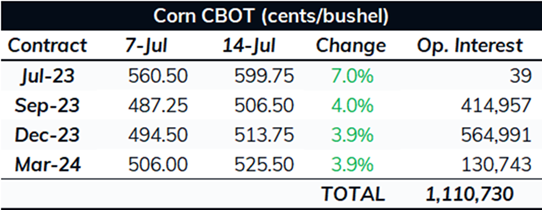
USDA indicates higher-than-expected yield in the US, and WASDE pressures corn prices. One of the major drivers of the market last week was the WASDE report. The significant change in the US corn balance sheet was a 1.4 million tonnes increase in production to 389.14 million tonnes, reflecting the increase in the planted area indicated in the June 30 report. The increase in area was partially offset by a reduction in yield, which decreased from 11.39 to 11.14 tonnes/ha. Nevertheless, the production figure exceeded market estimates by 2.1 million tonnes. With the increase in production, the ending stocks for the 2023/24 season stood at 57.46 million tonnes, a relatively more comfortable volume than the previous season. Last week, StoneX released a special article with more details on the latest USDA Supply and Demand report. Click here to access it.
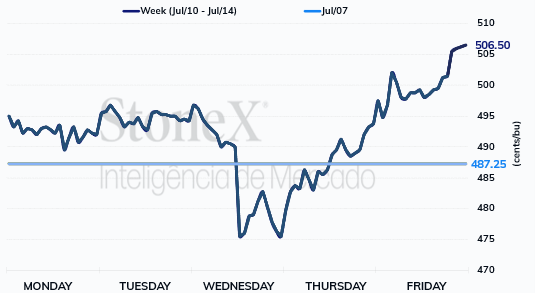
Weather remains a concern in the US. After initially exerting a bearish effect on prices – September 2023 futures declined about 3.7% on Wednesday, July 12 – the direction of prices changed on Thursday, accumulating strong gains since then, as agents' doubts about USDA yield figures gained strength. The rainfall observed in early July indeed had a positive impact on crop conditions. The US corn crop's good/excellent rating reached 55% on July 9, 4 percentage points higher than a week before and is expected to show further improvement in the report released today (July 17). Additionally, the Drought Monitor indicated that as of July 11, drought covered 64% of the corn crops, a three percentage point decrease compared to the previous week.
However, despite alleviating the water deficit by the rainfall observed earlier in the month, current crop conditions are considerably worse than last year and below the average. Moreover, high volumes of rainfall were expected throughout the month, which, according to weather forecasts, are no longer likely to occur. The coming weeks will be crucial in determining the corn yield; therefore, weather conditions will continue to be a major market driver. Current models indicate significantly lower rainfall in the second half of this month compared to the first half of July, which could result in yields lower than those estimated by the USDA. This factor contributed to the recent price increases.
US ethanol production decreases from the previous week, but stocks increase. According to data released by the Energy Information Administration (EIA), US ethanol production was 1,032 thousand barrels per day (tbpd) on July 1-6, a decrease of 28 tbpd compared to the previous week. Despite the contraction, observed production was 27 tbpd higher than last year and 24 tbpd above the 5-year average for the same period. On the other hand, ethanol stocks increased to 22.66 million barrels, an increase of 398 thousand barrels compared to a week earlier.
US export shipments decline from the previous week, and the deficit increases compared to the previous crop. According to the USDA's Export Inspection Report, the US shipped 341 thousand tonnes in the week ending July 6, slightly more than half of the shipments observed the previous week and nearly 600 thousand tonnes less than the same period last year. As a result, cumulative shipments for the 2022/23 season reached 33.5 million tonnes, widening the deficit compared to the previous cycle to 15.7 million tonnes.
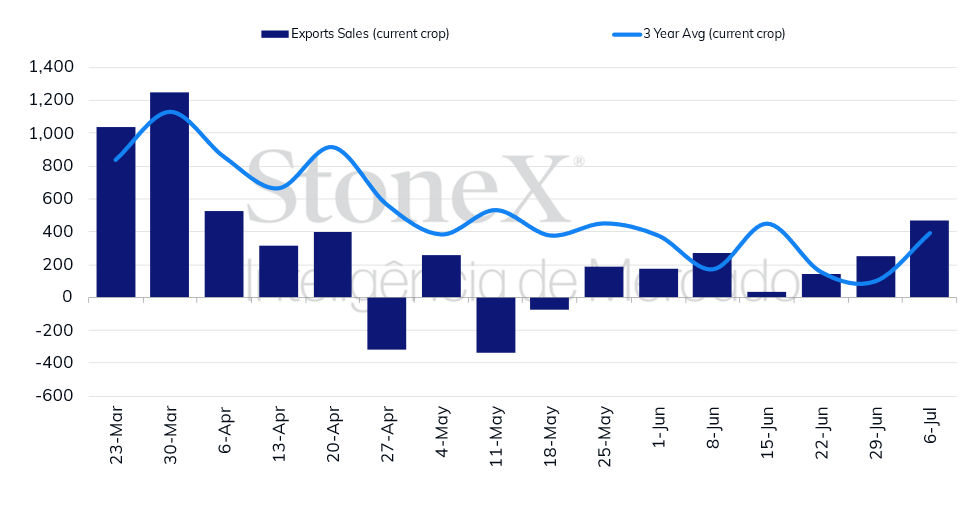
US net export sales increase, reducing the lag compared to the previous crop. In its Export Sales Report, the USDA reported that US net sales totaled 468.4 thousand tonnes in the week ending July 6, an increase of 216.7 thousand tonnes compared to the previous week and 409.4 thousand tonnes higher than the same period in 2022. As a result, cumulative sales advanced to 39.5 million tonnes, significantly reducing the deficit compared to the previous season, but still high at 20.9 million tonnes.
Expiration of the Black Sea Grain Initiative supports the market. In addition to the supply and demand balance in the US, another factor that greatly influenced the grain market last week was the Grain Initiative Agreement. In recent days, the likely end of the agreement was a significant supportive factor for grains. Russia made several statements indicating a high probability of withdrawal, and even with leaders from the European Commission and the United Nations seeking solutions, an extension seemed unlikely. Today (July 17) is the last day of the agreement enabling the safe flow of agricultural products shipped by Ukraine. However, with Russia's exit, officials have stated that the Kremlin will no longer follow the agreed rules, which has raised great concerns about the flow of Ukrainian products. According to United Nations data, nearly 33 million tonnes of agricultural products were shipped under the agreement, with almost 17 million of those shipments being corn.
Corn harvest pace in Argentina is in line with last year. The Buenos Aires Cereals Exchange reported that 11% of Argentine corn fields were in good/excellent condition on July 13, a two percentage point increase compared to the previous week but four percentage points lower than the same week in 2022. The corn harvest in the country reached 58.1%, in line with the same period last year but 11.5 percentage points below the 5-year average.
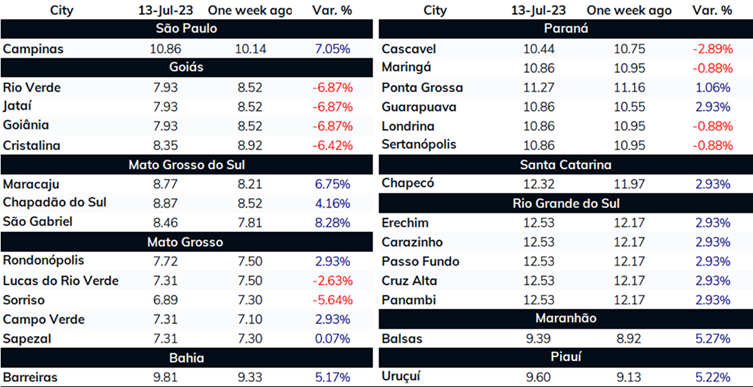
Conab raises production estimates for Brazil. Conab has once again increased the total corn production estimate for 2022/23 to 127.77 million tonnes, with positive adjustments in all three corn crops, supporting market expectations of a record harvest in the country.