- Favorable outlook for Brazilian supply;
- Weakened pace of US sales and shipments;
- USDA's estimate for US production higher than expected by market participants.
- Expiration of the Grain Initiative Agreement and Russian attacks on Ukrainian ports;
- Concerns about dry weather in the US;
- Forecast of lower rainfall in the coming weeks in the US belt.
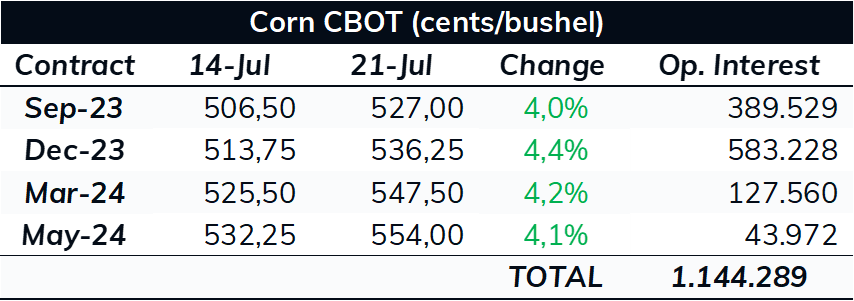
Last week, with Russia withdrawing from the Grain Export Agreement and conducting attacks on Ukrainian ports, the focus of market participants shifted primarily to the situation in the Black Sea. Following the increased regional tensions, corn futures also experienced an upward movement. The September 2023 corn contract ended with a 4% increase, trading at 527 cents/bu.
Concerns about Ukrainian supply boost corn on the CBOT. The expiration of the Grain Initiative Agreement marked the beginning of last week. Given the Kremlin's frequent complaints about the damage caused to Russian exports by Western sanctions, it was expected that Russia would officially withdraw from the agreement. In addition, the number of ships inspected at Ukrainian ports under the agreement has declined since March, indicating that the initiative might be interrupted.
Although there was not much optimism about the renewal of the agreement, such a rapid escalation of the conflict surprised the market. Just a few hours after Russia officially withdrew from the initiative, Ukrainian ports were targeted in attacks by the Kremlin, damaging grain terminals and port structures. According to United Nations data, nearly 33 million tonnes of agricultural products were shipped under the agreement, with nearly 17 million of those shipments being corn alone.
Ukraine claims to have alternatives for grain shipment, but it is uncertain whether these alternatives would fully compensate for the volumes shipped through the Black Sea ports. Current conditions indicate that the scenario should not be as restrictive as seen after the onset of attacks in 2022. Still, tension in the region is expected to remain an important supportive factor.
At the beginning of this week, these alternatives for Ukrainian exports were also threatened by the first attack on a grain facility on the Danube River, the main "alternative" route used since the beginning of the conflict. As a result, doubts about the impacts on Ukrainian exports have increased significantly.
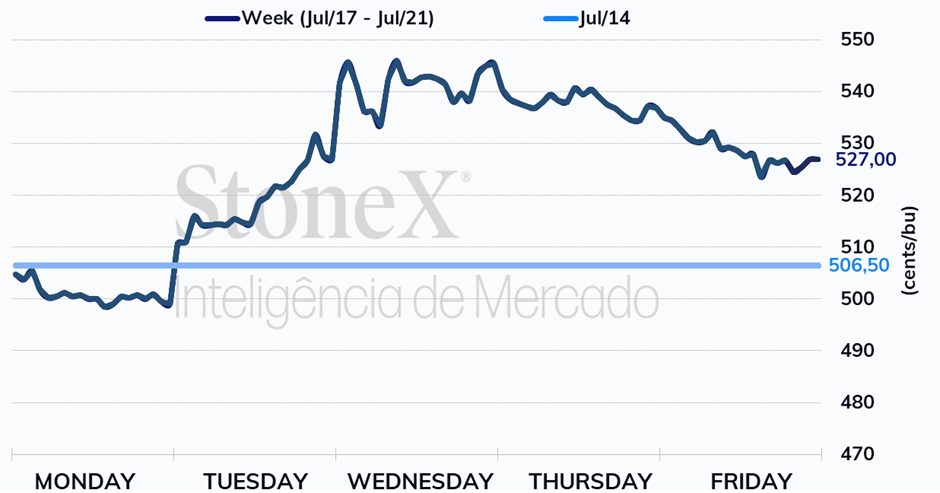
Weather conditions continue to provide support to the corn market. As in recent weeks, weather conditions in the US continue to affect corn prices. The rains observed in the first half of July improved the condition of US crops. The good/excellent index for US corn crops reached 57% on July 16, 2 percentage points higher than a week before. However, weather models again point to a drier pattern in the second half of July, which could negatively affect US productivity. The next few weeks will be crucial in determining US productivity, and the weather will be monitored even more closely due to the high concerns about the shipment of Ukrainian grains.
Ethanol production in the US resumes growth. According to data released by the Energy Information Administration (EIA), US ethanol production was at 1,070 thousand barrels per day (tbpd) between July 8 and 14, an increase of 38 tbpd compared to the previous week. In addition to the weekly growth, observed production was 45.4 tbpd higher than in the same period last year and 36 tbpd above the 5-year average. Ethanol stocks increased to 23.17 million barrels, 508 thousand more than a week before.
US export pace remains slow, increasing the deficit compared to the previous crop. According to the USDA's Export Inspection Report, the US shipped 363.8 thousand tonnes in the week ending on July 13, almost 15 thousand tonnes more than the previous week but more than 700 thousand tonnes below the same period last year. As a result, accumulated shipments in the 2022/23 season reached 33.9 million tonnes, widening the gap compared to the previous cycle to 16.45 million tonnes.
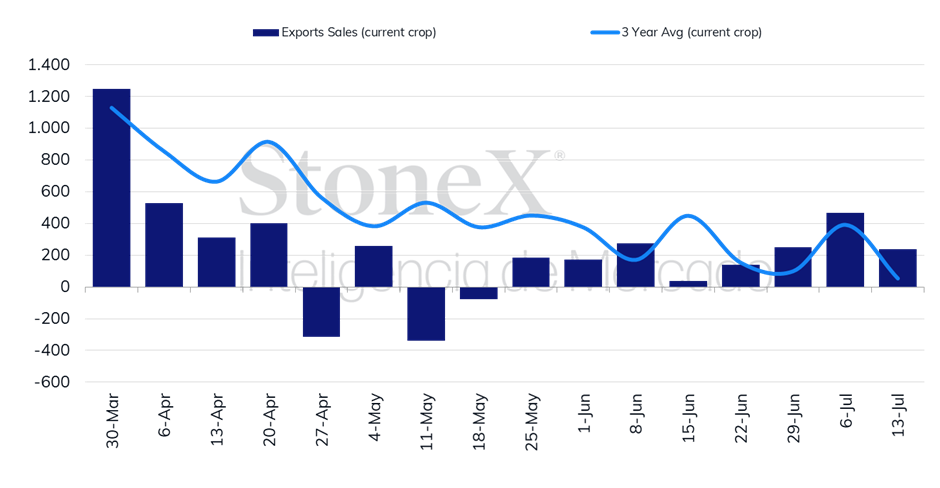
US weekly export sales meet market expectations but remain low for the 2022/23 crop. In its Export Sales Report, the USDA reported that US net sales for 2022/23 totaled 236.8 thousand tonnes in the week ending July 13, 216.7 thousand tonnes at the lower end of market estimates. As a result, accumulated sales advanced to 39.75 million tonnes, compared to 60.5 million tonnes in the same period last year.
Average productivity of the Argentine corn crop is currently at 4.97 tonnes per hectare. The Buenos Aires Cereals Exchange reported that 66.1% of the corn crops had been harvested by July 20, an increase of 8 percentage points from the previous week. So far, 22.5 million tonnes of corn have been harvested, with the total production estimated at 34 million tonnes, 18 million tonnes lower than the previous season. Argentina was heavily affected by La Niña between the end of last year and the beginning of 2023.