- Favorable outlook for Brazilian supply;
- Slow pace of US shipments;
- Weather models indicate a cooler and wetter pattern in a considerable part of the Corn Belt.
- Expiration of the Grain Initiative Agreement;
- Russia's attacks on Ukrainian ports;
- Concerns about the impact of drought in parts of the US Midwest;
- Fear that a drier pattern in China may impact local production.
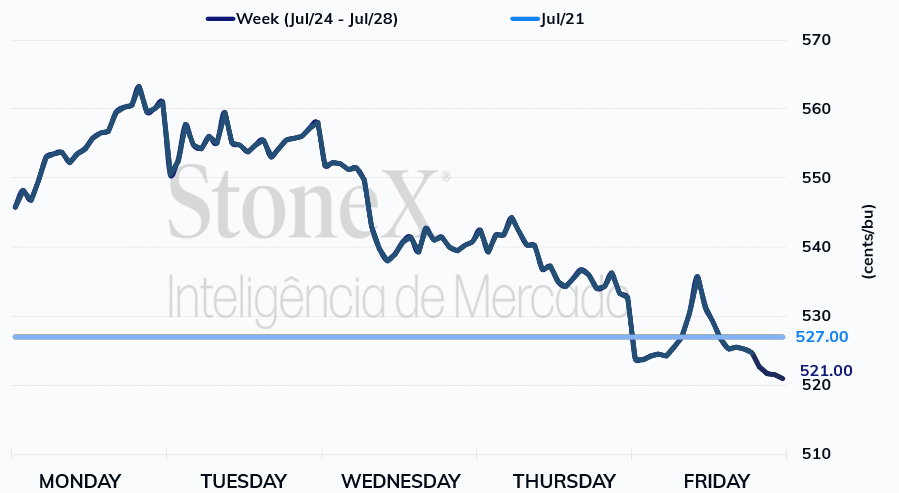
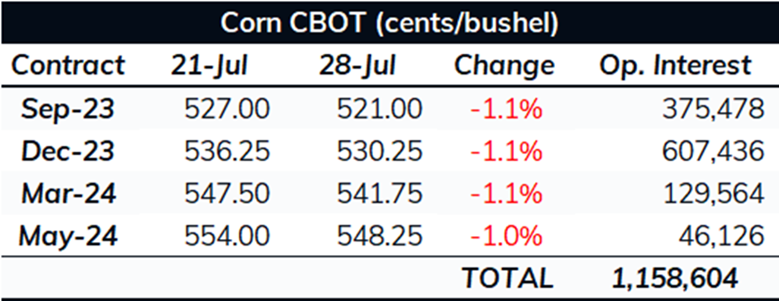
During the beginning of the previous week, bullish pressure from the tensions in the Black Sea continued to dominate over other fundamentals. As a result, on Monday (24), the September/23 contract advanced 6.4% daily, extending the uptrend from the previous weeks. However, for the rest of the week, the lack of significant new developments regarding the Russia-Ukraine conflict caused the support provided by the uncertainties caused by the war to lose strength. Additionally, predictions of cooler and wetter weather in much of the Corn Belt and the weakened pace of American shipments pressed corn futures down, causing the contracts to give up the gains observed on the week's first trading day. The September 2023 corn contract ended the period with a depreciation of 1.1%, trading at 521 cents/bu.
The Russia-Ukraine conflict still supports prices, but amid the lack of major developments, this factor was not enough to end the week on a positive note. Even with frequent news about Russia's attacks on Ukrainian ports and the discovery of explosive residues on a grain ship during an inspection by Russia, potentially providing reasons for the Kremlin to halt exports, these updates did not bring significant surprises to the market. While the situation in the region still brings uncertainties regarding Ukrainian supply, the most impactful news had already been reported by the last Monday (24), and by the end of the week, the market had already assimilated much of this information, causing the support provided by the situation in the region to lose intensity. However, it is important to note that the ongoing damage to Ukrainian ports and Russian efforts to discourage shipments through the Black Sea is still concerning and could have a greater influence on prices in the coming days.
The weather in the US is expected to continue as one of the main market drivers in the upcoming weeks. As anticipated, weather conditions in the US continued to drive the international corn market. Due to recorded rains in parts of the Midwest during the third week of July, the market expected the USDA to report a one percentage point increase in the good/excellent conditions in the US, reaching 58%. However, the department kept the rating at 57% good/excellent. Despite falling below expectations, weather models now point to a cooler and wetter pattern in much of the Corn Belt, which, if realized, could relieve American crop conditions.
In the US, ethanol production and stocks are increasing. According to data released by the Energy Information Administration (EIA), US ethanol production reached 1,094 thousand barrels per day (tbpd) in the week between July 15 and 21, a 24 tbpd increase on a weekly basis. Moreover, the observed production was 73 tbpd higher than in the same period last year and 83 tbpd above the 5-year average for the same period. Ethanol stocks also increased to 23.23 million barrels, 62 thousand more than a week before and the third consecutive increase.
The pace of US shipments continues to promote a bearish influence on prices in Chicago. According to the USDA's Export Inspection Report, the US shipped 310 thousand tonnes in the week ending on July 20, about 100 thousand tonnes less than the previous week and almost 450 thousand tonnes below the same period last year. As a result, accumulated shipments for the 2022/23 season reached 34.2 million tonnes, expanding the difference compared to the previous cycle from 16.4 million tonnes in the previous week to 16.85 million.
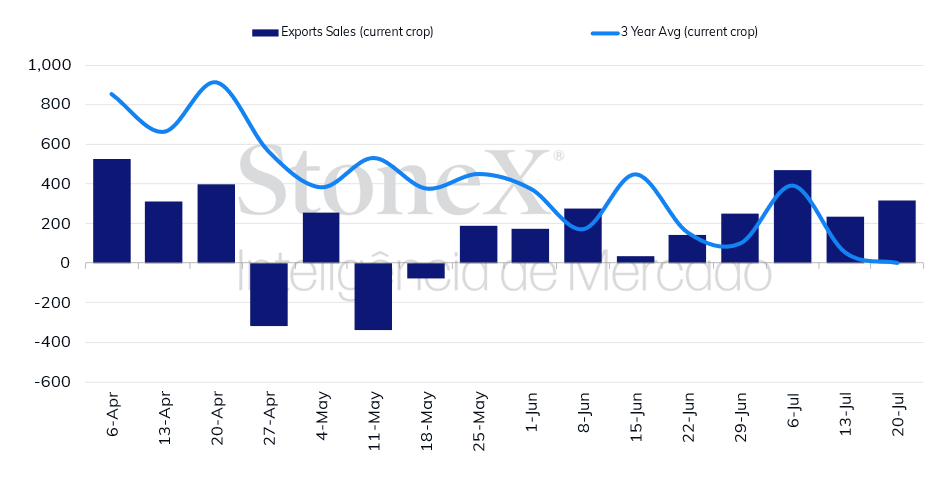
US weekly export sales increased, slightly reducing the deficit compared to the previous crop. In its Export Sales Report, the USDA informed that US net sales totaled 314.2 thousand tonnes in the week ending on July 20, an increase of 77.4 thousand tonnes from the previous week and 163.9 thousand tonnes above the same period in 2022. With this, accumulated sales advanced to 40.1 million tonnes, and the deficit was reduced compared to the previous season but remains high at 20.5 million tonnes.
Corn harvest reaches 68.4% in Argentina. The Buenos Aires Grain Exchange reported that 68.4% of corn crops were harvested as of July 27. So far, 23.3 million tonnes of corn have been harvested, with the total production estimated at 34 million tonnes, 18 million tonnes below the previous crop. In the same period last year, 74.2% of the crop had been completed, while the 5-year average for the same period is 82.3%.