- Slow pace of shipments in the US;
- Concern about river levels in the US and impacts on grain flow;
- US harvest progress.
- Tensions between Russia and Ukraine;
- Logistical problems at ports in Northern Brazil;
- Corn crushing for ethanol production above the average of the last five years.
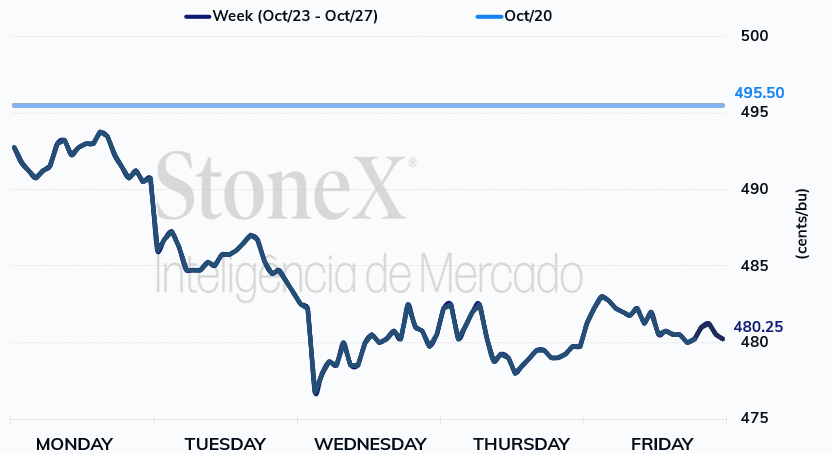
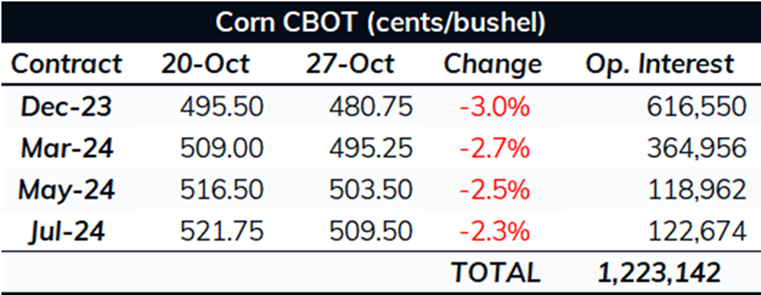
Last week, corn futures showed a strong bearish trend in Chicago. December/23 ended Friday's session (October 27) at 480.25 cents/bu, a contraction of 3% in the period. The still low levels of rivers in the USA, the progress of the American harvest, and prospects of increased moisture in productive regions of South America contributed to the movement.
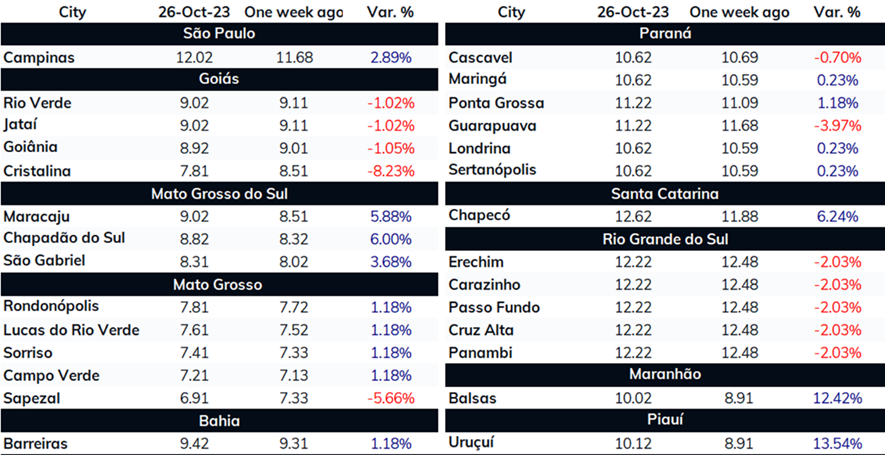
US crop progress: According to the USDA weekly crop follow-up report, 59% of corn crops had been harvested by October 22, a weekly increase of 14 percentage points (p.p.), in line with market expectations. The pace aligns with last year's five p.p. ahead of the 5-year average. The good pace of fieldwork was one of the factors that led to the contraction of prices over the past few days. The weather models indicate a high volume of rainfall in the US Midwest, which may slow down the harvest progress but does not threaten production. Click here to access the full report.
Corn ethanol production: According to data released by the Energy Information Administration (EIA), US ethanol production totaled 1,040 thousand barrels per day (tbpd) in the week ending October 20, up five tbpd from a week earlier and 25.6 tbpd above the 5-year average for the same period. The attractive margins of ethanol in the Midwest have been contributing to biofuel production. On the stocks side, there was also an increase in volume to 21.4 million barrels, 286 thousand more than a week before.
Mississippi River Level: River conditions in the US continue to be closely monitored by the market. According to NOAA data, the levels in Memphis were at -2.6 meters this Monday morning (30), above the recorded one week before (-3.0 m). Amidst the forecast of a higher volume of rainfall throughout the next week in regions where the Mississippi River passes, NOAA projects a reading of -2.0 m in Memphis by the end of the first week of November. Despite the improvement, the scenario is still a cause for concern, as the river level would still be classified as low (below -1.5 m).
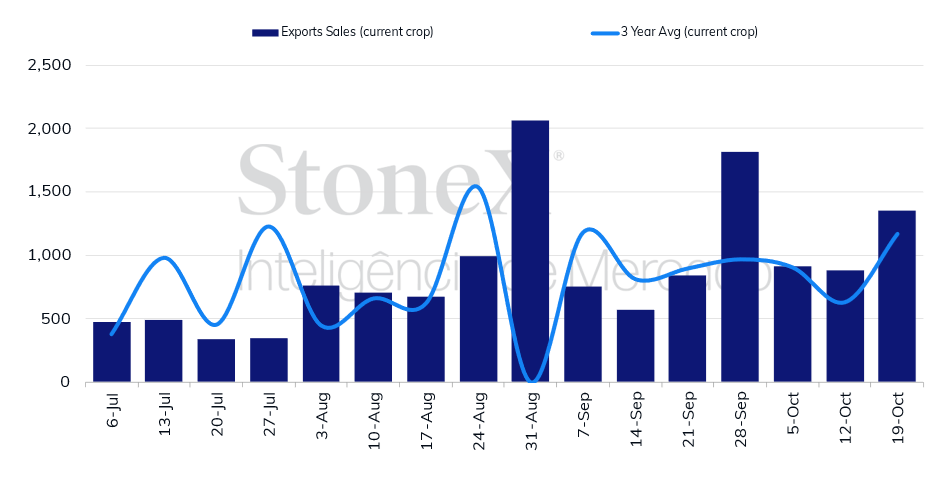
Weekly export sales - US (thousand tonnes)
US export inspections: As observed in the USDA's Weekly Export Inspection Report, the US continues to show a weakened pace of shipments. In the week ending on October 19, the country shipped 437.5 thousand tonnes of corn, a volume lower than the one observed in the previous week (466.6 thousand tonnes) and the one recorded in the same week last year (472.6 thousand tonnes). Despite the drop, the pace is still ahead of last year by 631 thousand tonnes, totaling 4.4 million tonnes since the beginning of the 2023/24 cycle.
US export sales: Despite still weak shipments, export sales showed a little more warmth in the week ending October 19th. Net sales for the US 2023/24 season totaled 1.35 million tonnes in the referred week, about 1.1 million tonnes more than in the same week last year and above the upper limit of the market's expectations range, which ranged from 600,000 to 1.2 million tonnes. The country traded 17.5 million tonnes in 2023/24, compared to 14.1 million in the same period of the previous season.
Weather in South America: The dry weather pattern in Argentina continues to be a cause for concern. The planting reached 22% by October 25, in line with last year's period but nine p.p. below the 5-year average. Despite the delay, productive areas of the country recorded a considerable volume of rainfall last week, which can assist in sowing progress. In addition, the models indicate good precipitation volume in the coming days, which, if realized, would help reduce the water deficit in the region. The planting of Brazil's first corn crop is also delayed, reaching 43.3% at the end of last week, compared to 55.7% in the same period last year. Despite the slower pace, the main concern is the pace of soybean sowing, as its delay could reduce the window for planting the second corn crop. The planting of the oilseed reached 43.2%, compared to 50.2% in the same period last year. On the other hand, just like for Argentina, the models indicate good rainfall in the main producing regions of Brazil, especially in the second week of November, which can contribute to the progress of fieldwork.