- Lagging pace of shipments in the US;
- More positive USDA estimates for US production and global stocks;
- Good rainfall volume was recently recorded in Brazil and Argentina's main grain-producing regions.
- Tensions between Russia and Ukraine;
- High volumes of export sales in the week ending on November 23;
- Despite registering a more favorable weather pattern, concern about weather conditions in South America persists.
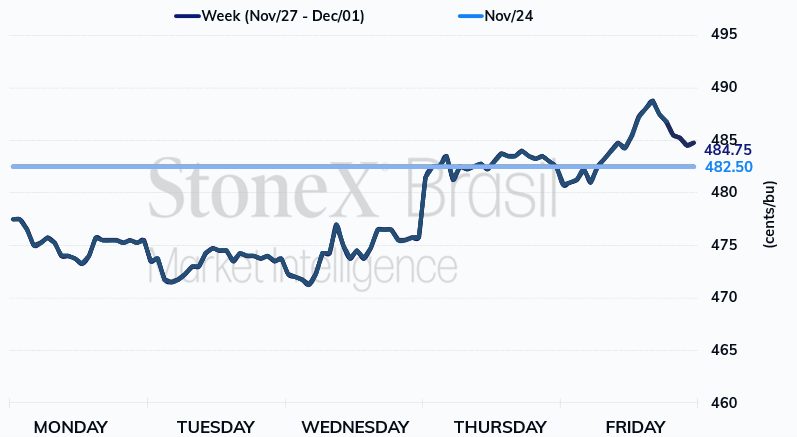
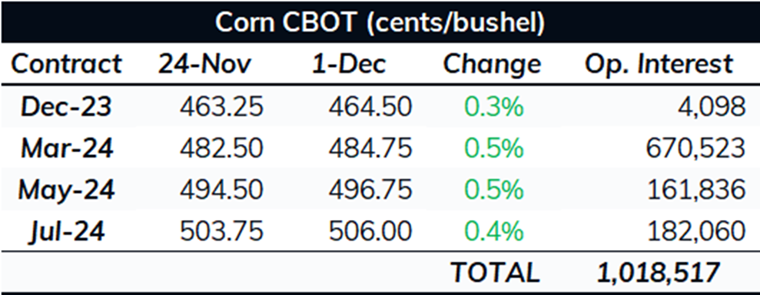
In the last week in Chicago, cereal futures started the period on a low note. Still, a bullish movement prevailed from Wednesday (29), allowing cereal contracts to finish the week in positive territory. The March/2024, currently the most active contract, ended last Friday (Dec 1), priced at 484.5 cents/bu, an appreciation of 0.5% compared to the previous week. Data above expected for US export sales, concerns about the South American crop, and a significant appreciation in wheat prices moved the corn market.
Corn ethanol production in the US: According to data released by the Energy Information Administration (EIA), US ethanol production totaled 1,011 thousand barrels per day (tbpd) in the week ended Nov. 24, down 12 tbpd from a week earlier and 19 tbpd below the 5-year average for the same period. The stocks also fell by 273 thousand barrels to 21.38 million.
US export inspections: The USDA Export Inspections Report brought somewhat discouraging data about American shipments, reporting that 406.7 TMT of corn left the US in the week ending on November 23, a decrease of 194.4 TMT (-32.3%) on a weekly comparison. On the other hand, the recorded volume was above that observed in the same week of last year (311.7 tmt). The accumulated shipments totaled 7.3 million tonnes, 1.45 million above the recorded in the same period of the previous season.
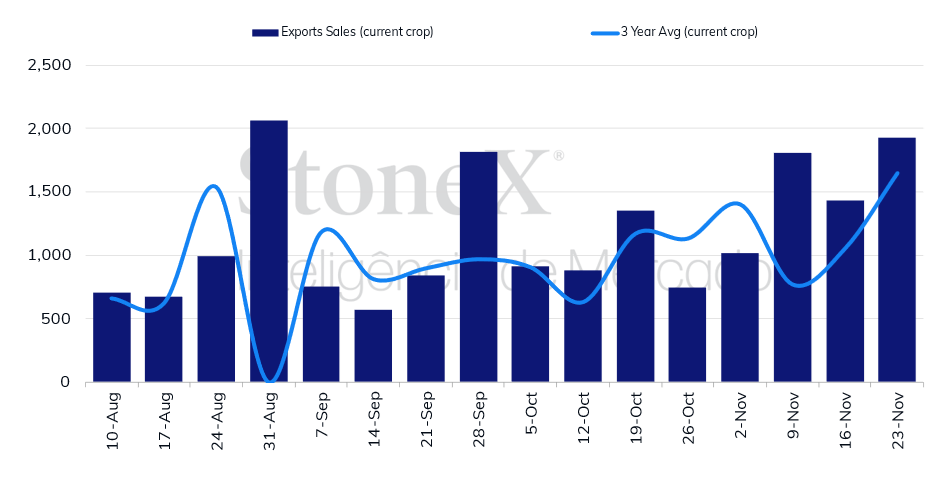
US export sales: After unimpressive shipment data, USDA brought more exciting figures on the export sales side. The USDA reported that 1.9 million tonnes of corn were traded in the week of November 23, a figure well above the upper range of market estimates, ranging from 600,000 to 1.2 million tonnes. In the weekly comparison, sales ramped up 495.4 tmt while exceeding the same week of the previous year by 1.3 MMT. The country traded 24.5 million tonnes in 2023/24, 6.1 million tonnes above the amount recorded in the same period of the previous season.
Weekly export sales - USA (tmt)
The wheat market appreciation also supported corn: The corn received support from strengthening wheat prices. Rumors that China would buy some SRW and HRW wheat motivated a hedging movement of short positions by spec funds. So far, China's buying interest has exceeded projections, and new confirmed purchases would signal a crop of lower quality in China or smaller in size than forecasted by USDA. In the last week, the contract with expiry in March 2024 for wheat advanced 4.4%, ending the quoted period at 602.75 cents/bu.
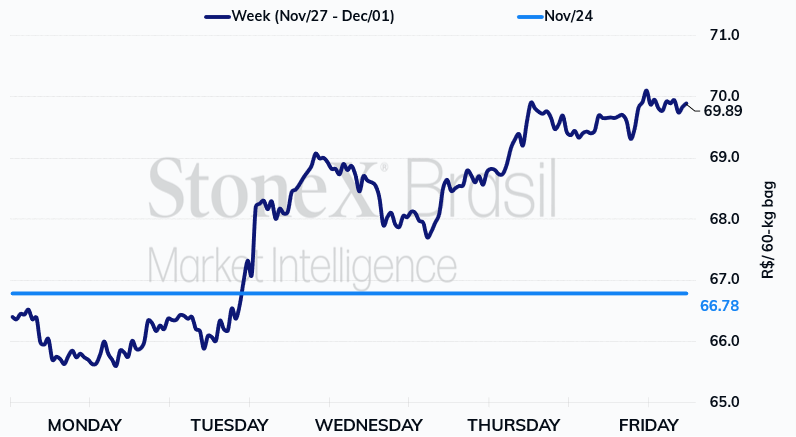
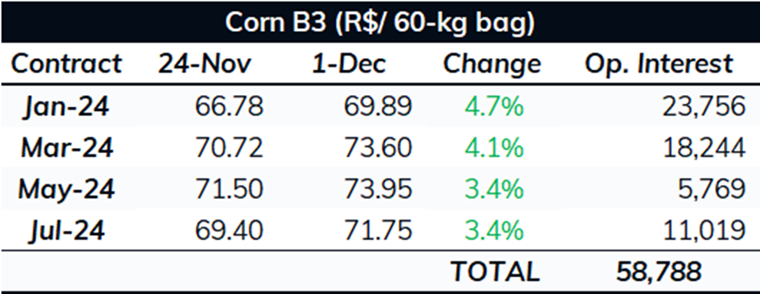
On the B3, corn futures also had a week marked by appreciations, but much more significant than on the CBOT. The January 2024 contract ended last Friday at BRL 69.89/bag, a 4.7% increase every week. Uncertainties related to the weather in Brazil and high shipments in November contributed to the observed rise.
Brazil exports 7.4 million tonnes of corn in November. According to data from MDIC, Brazil exported 7.4 million tonnes of corn in November, a figure in tandem with the one intended by Anec (7.35 million). In the 2022/23 season, from Feb/23 to Jan/24, shipments totaled 43.7 million tonnes. Click here to access the full report.
StoneX crop estimate: Last Friday, StoneX released new estimates for Brazil's soybean and corn 2023/24 crops. The production of the first corn crop in 2023/24 was reduced from 26.8 million to 26.45 million tonnes, a contraction of 1.2% versus the report released in November. StoneX also reduced its figure for the winter crop 2023/24 to 97.3 million tonnes, a decrease of 1.6% compared to its previous figure. The adverse weather observed in the last few months in a large part of the producing region has hindered the pace of soybean planting, increasing concerns that a larger portion of the safrinha may be planted outside the ideal window, which would make the crop riskier and could discourage corn planting. Click here to access the full report.
Crop Commentary | Brazil and Paraguay: To better monitor crops, risk management consultants from StoneX have prepared comments on the situation of soybeans and corn in Brazil and Paraguay. Click here to access the full report.
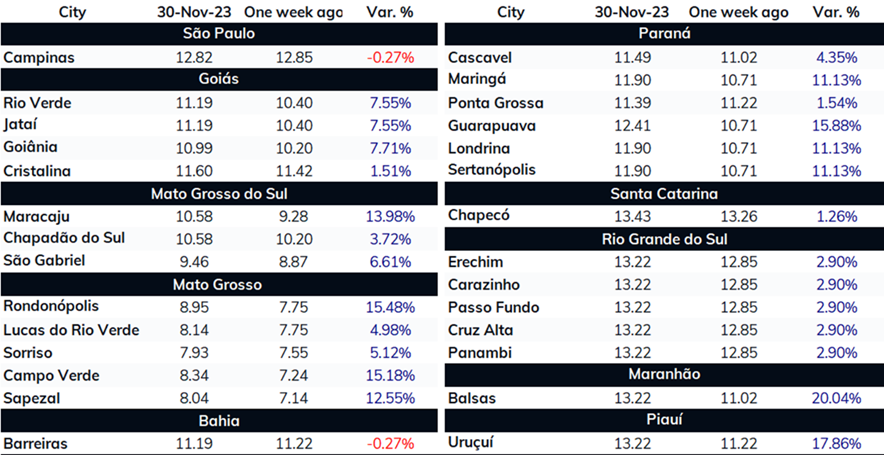
Crop follow-up in Brazil: According to the Crop Progress Report for Brazil conducted by StoneX, planting the first corn crop continues to be behind schedule, reaching 72.5% at the end of last week, compared to 84.3% in the same period last year. The planting of the soybean reached 82.7%, compared to 89.5% in the same period last year. In recent days, there have been good rains in the Center-West of Brazil, which had been suffering from drought, and a reprieve in precipitation in the Southern region, which had been experiencing excessive moisture, bringing some relief to agents. Forecasts show good rainfall volumes over the next two weeks, and the expectation is that in this last week of November and the first week of December, more abundant rains will occur in the region throughout the entire belt. Nonetheless, monitoring the forecast's realization will be necessary since if the rain's irregularity persists, the corn's productive potential can be affected.
Crop conditions in Argentina: According to data from the BCBA, a fall was observed in the weekly comparison of crops in good/excellent conditions, which went from 29% to 26% on November 30. On the other hand, crops in poor/very poor condition also decreased by 2 points to 2%. Approximately 32.3% (or 2.3 million hectares) of the estimated 7.1 million hectares have already been planted.