
CBOT falls with correction in a week marked by uncertainties; Argentina abolishes export taxes
- Bullish
- Heated consumption globally;
- USDA estimates lower stocks for the 2025/26 crop at the global level;
- Stronger exports in the United States;
- Slow Brazilian sale and strong domestic consumption.
- Bearish
- Completion of the safrinha corn harvest in Brazil;
- Record crop in the United States;
- End of Argentine retentions, making the global market more competitive.
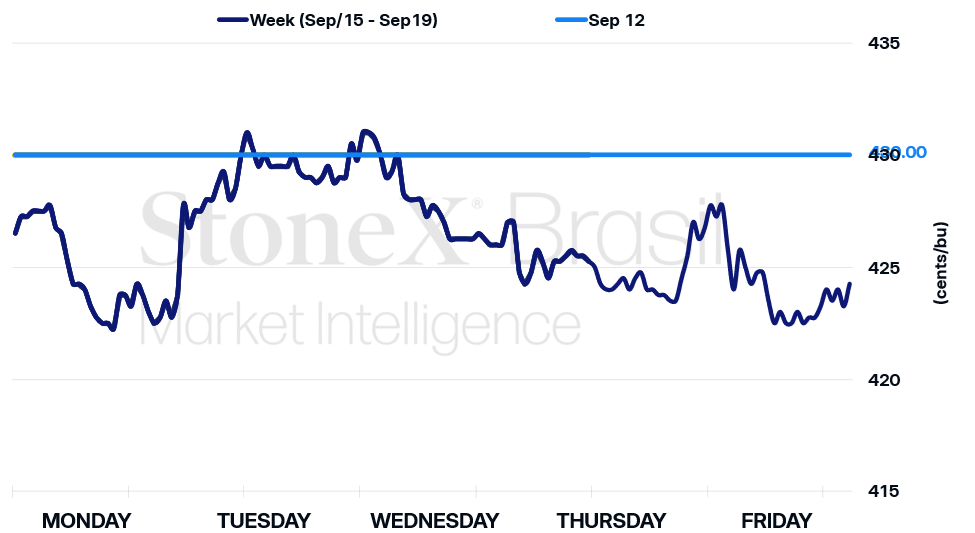
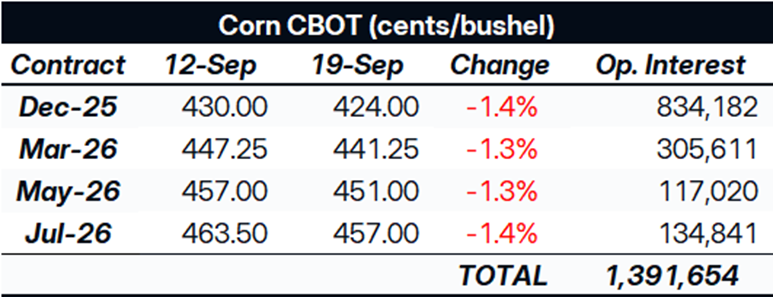
CBOT | Corn futures fell again last week. The US¢430/bu level seems to provide some resistance for corn futures, being tested between Tuesday and Wednesday. As a result, corn futures ended the week trading at US¢424.00/bu (-1.4%).
The conditions of the American crop turned out to be better than analysts expected last week; still, they fell by 6% over the past six weeks. The fact is that the crop has shown some degree of deterioration in the final stage of development. Since this is a fact, it is up to the market to try to understand how this will impact American production and what the size of the surplus will be in this crop. So far, bets continue to point to record production, which will consolidate stocks at high levels, thus limiting the potential for more significant increases in the short term.
Thinking about demand, the market follows the decisions in the biofuel policy in the United States. The Environmental Protection Agency will receive public comments on the reallocation of the exemption from renewable fuel targets in the country, but left open what percentage of this target would be reallocated, as well as signaling the possibility of accepting intermediate proposals. Not reallocating would be bearish for RINs in the U.S. market, which would discourage the production of biofuels such as ethanol. While the agency does not announce a decision, which should only appear in November, the market speculates with some anxiety about the future of biofuels in the country. Last week, StoneX published a special article on the subject, which can be accessed clicking here.
In the export market, we have still seen the United States as a cheap source of corn, a fact that has gained strength with the weakening of the dollar in the last few weeks. Still, Argentina will be a point of attention from now on. In addition, as is already expected at this time of year, a logistical concern emerges in the United States, since there is an expectation that the levels of the Mississippi River may reach low volumes by the end of the month. The fact, if realized, will affect navigation on this route and increase freight costs, which has the potential to be very negative for American exports, which have been the main dynamic driver of the American corn balance in recent months.
Intraday (15 min) Dec/25 contract - CBOT
Source: CBOT. Design: StoneX.
Argentina | Last week, we could see business being done in Argentine ports, very much supported by more competitive corn in the country. Argentina's FOB corn prices are the lowest among the main origins of the grain worldwide through the end of the year – in fact, they are even more competitive than the FOB prices at the U.S. Gulf ports.
This fact draws even more attention when considering the news from Monday morning (22) that the Argentine government will zero out grain export tariffs until October 31. The measure aims to accumulate international currencies at a time of strong weakening of the peso, in the face of weaker economic data and a victory for the opposition in the provincial elections in Buenos Aires, which may be an indication of a weakening of Milei's popularity – and, therefore, of his pro-market economic policy. The measure is likely to speed up the sale of grains by Argentine producers, creating a scenario of pressure on international prices in the coming weeks.
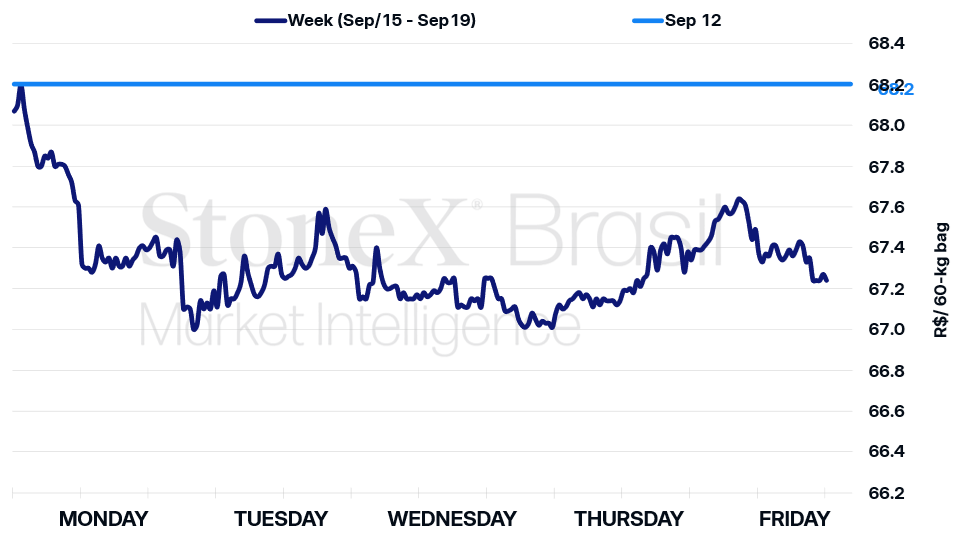
Intraday (15 min) Sep/25 contract - B3
Source: B3. Design: StoneX.
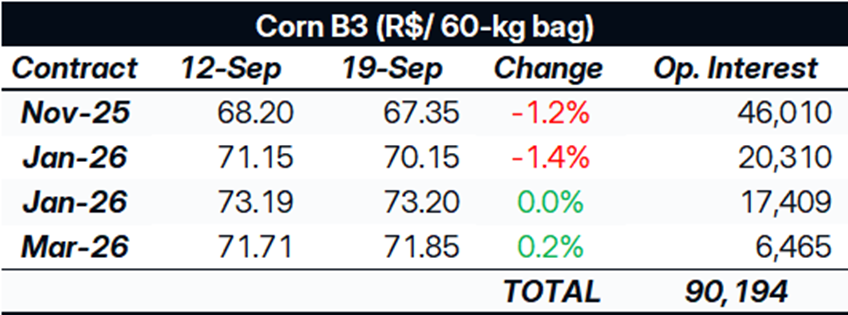
Brazil | In Brazil, corn prices have also weakened. In addition to the pressure on international markets, a weakening of the dollar also weighed on corn quotes for Brazilian corn. Exports continue to fall short of their potential, and the market still regards the performance of shipments with a certain degree of uncertainty until next year. Meanwhile, the domestic market remains very strong regarding the demand for corn for ethanol production. The expectation is that six new ethanol plants will begin operations this year, beyond several others in the first half of next year, before the 2025/26 safrinha harvest.
USDBRL | Last week, there was a significant appreciation of the real versus the dollar, reinforcing the trend that has been observed since the beginning of the year. The widening of the interest rate differential after monetary policy decisions in the US and Brazil was the main factor behind this movement. But, beyond that, there has been an influx of foreign capital into Brazilian assets as agents anticipate a possible electoral rally starting next year. The more expensive real is negative for exporters and, at a time of already high corn prices at ports, we may see even less interest from some destinations for Brazilian corn in the short term.
Futures contracts traded on the CBOT (US¢/bu)

Source: CME. Design: StoneX.
Futures contracts traded on B3 (BRL/bag)

Source: B3. Design: StoneX.
Spot prices in Brazil (USD/60kg bag)
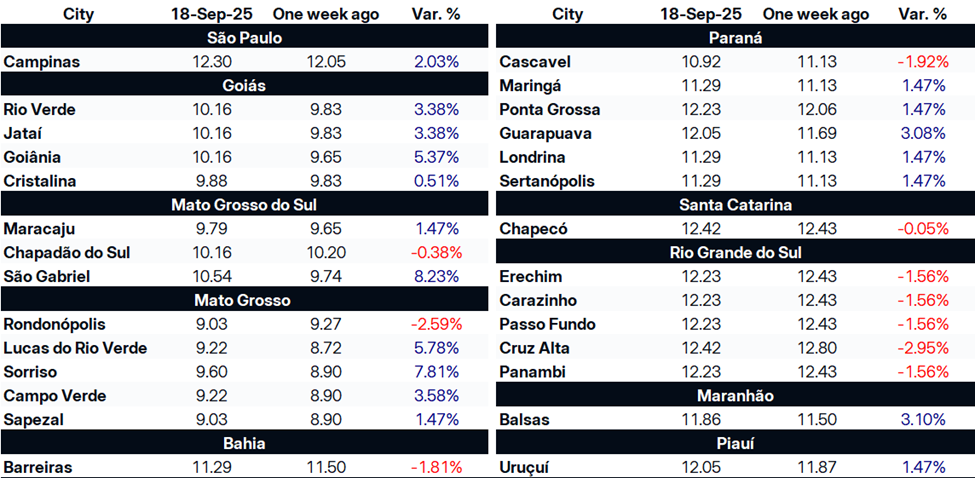

Source: StoneX.
INDICATORS




