
Corn market on the rise with positive outlook for US-China relations
- Bullish factors
- Strong global consumption;
- USDA projects lower stock levels globally for the 2025/26 season;
- Strengthened US exports;
- Improved US-China relations.
- Bearish factors
- Expansion of planted area for the 2025/26 season in Brazil;
- Potentially record-breaking crop in the US;
- Higher stock levels in the US.
CBOT
The week saw gains for corn traded in Chicago. The December/25 contract closed Friday at US¢422.50/bu (+0.2%).
Market optimism is driven by the easing of trade tensions between the US and China. Significant anticipation surrounded Sunday’s (26) meeting between US Treasury Secretary Scott Bessent, US Trade Representative Jamieson Greer, and Chinese Vice Premier He Lifeng. Throughout the week, signs pointed to a productive meeting, which was confirmed yesterday when Bessent revealed discussions about the framework of a trade agreement between the two nations. The agreement could potentially include a commitment not to limit exports of rare earth metals.
Intraday (15 min) December/25 contract - CBOT
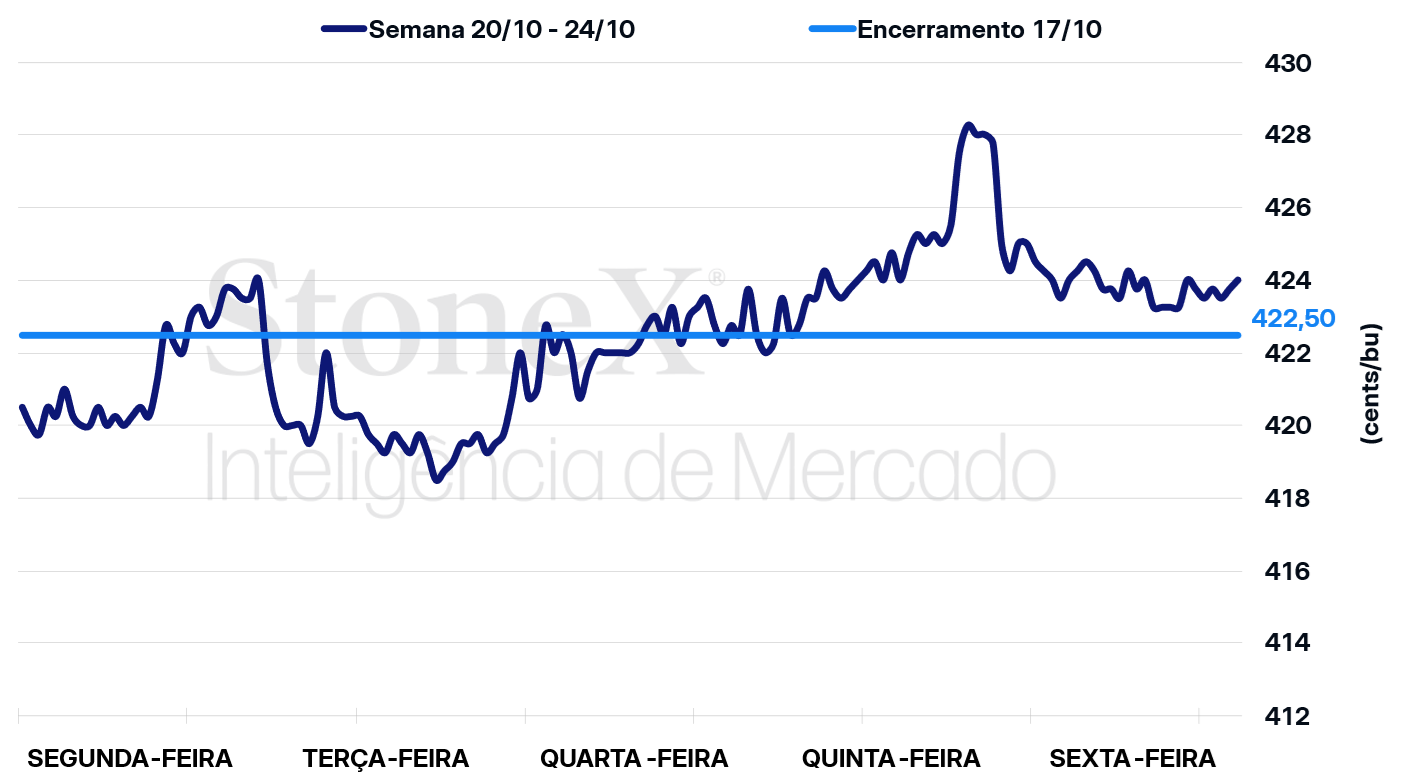
Source: CBOT. Design: StoneX.
The Secretary also stated that China has pledged to purchase “substantial” volumes of US soybeans. This announcement was highly anticipated by the US grain market, and soybeans have already risen by approximately 2% in early Monday trading as a result.
All indications suggest a temporary resolution of trade conflicts, providing some relief to the market. Attention now turns to the upcoming meeting between Donald Trump and Xi Jinping on Thursday, as well as the progression of trade agreement negotiations following the meeting.
During his Asia trip, Trump is currently in Japan, where new trade agreements are being discussed. Newly appointed Japanese Prime Minister Sanae Takaichi has hinted that the country may expand its soybean imports from the US. However, Japan’s import potential extends beyond soybeans, including increased purchases of corn and rice.
On the fundamentals side, the US harvest continues. However, due to the US government shutdown, market updates on harvest progress remain limited. Additionally, ethanol production has increased in the US in recent weeks, boosting optimism regarding corn consumption this season and strengthening futures prices in Chicago.
On the fundamentals side, the US harvest continues. However, without major updates due to the government shutdown, the market sees few changes in harvest outlooks.
Regarding demand, despite the lack of export data, the market anticipates robust corn shipment flows, although concerns about drought conditions along the Mississippi River remain in focus.
Moreover, ethanol production has been increasing in the US in recent weeks, further supporting optimism about corn consumption this season and reinforcing futures prices in Chicago.
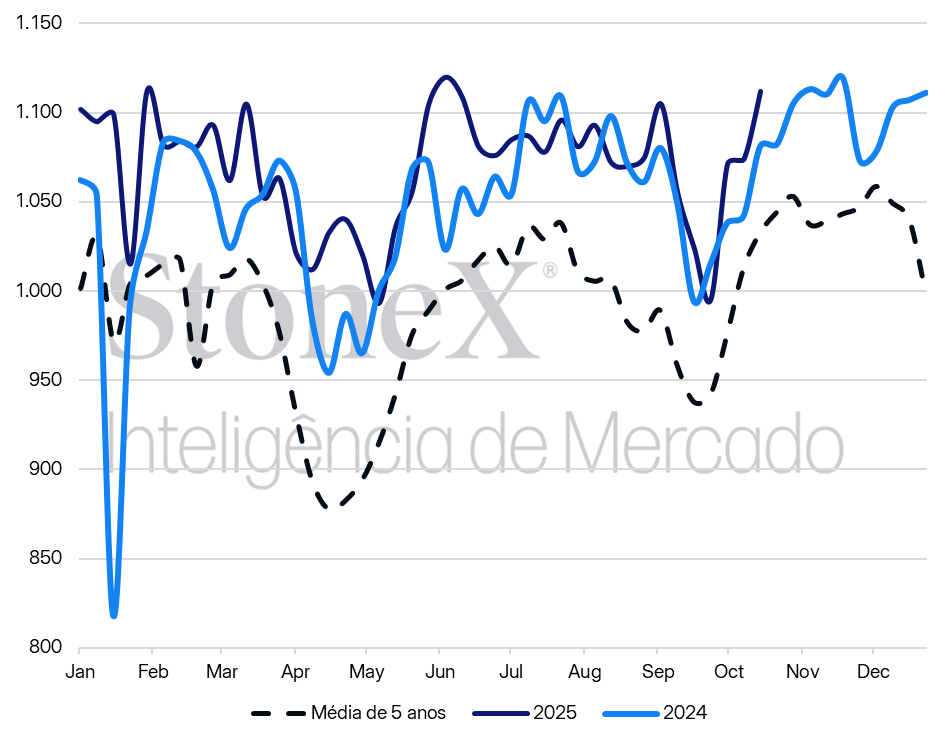
US | Weekly ethanol production (tbpd)
Source: EIA
Brazil
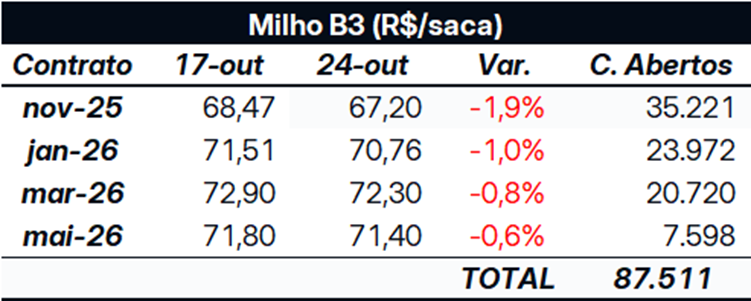
Corn prices on B3 saw a sharp decline last week, with the November/25 contract closing at BRL 67.20/lb (-1.9%). Recent weeks have shown relatively stable market fundamentals, with price movements largely driven by technical market factors and currency fluctuations, as will be explored further ahead.
Regarding summer crops, there’s little new to report. Planting is generally progressing well for both soybeans and summer corn, increasing optimism around Brazil’s production for 2026. October exports have also been advancing at a healthy pace, with shipments totaling 3.6 million tonnes in the first half of the month. This points to October potentially surpassing the 4.7 million tonnes of corn exported in October 2024.
Intraday (15 min) November/25 contract - B3

Source: B3. Design: StoneX.
Exchange rate
Last week, the foreign exchange market responded to inflation data from the US and Brazil, both of which came in below market expectations. In the US, weaker CPI data paves the way for further interest rate cuts, likely to occur during the next two FOMC meetings before year-end. In Brazil, although controlled inflation also supports the case for rate cuts, monetary authorities have emphasized that inflation remains above target, suggesting a more conservative approach by COPOM until prices stabilize further.
As a result, the widening interest rate differential is expected to continue strengthening the Brazilian real in the coming months.
Additionally, President Lula met with Donald Trump in Malaysia on Sunday (26). The meeting appears to have been positive, with Brazilian and US officials likely to continue negotiating a trade agreement, which would further support the real.
-
Special | Argentina
-
Argentina is projected to plant 7.8 million hectares of corn in the 2025/26 season, a 700,000-hectare increase compared to 2024/25. Assuming similar productivity levels to last year’s crop, this expansion could deliver a production of approximately 54 million tonnes next year. So far, planting has reached 33.8% of the total area, a notably faster pace compared to last year, when only 28.9% of the crop had been planted during the same reference week.
While accelerated planting strengthens the outlook for a robust crop in Argentina, producers remain cautious about the potential impact of La Niña this year, which typically brings drier weather to Argentine fields and may affect productivity.
In the short term, however, a weather system forming in the southern region of the continent is expected to bring more unstable conditions to fields in Buenos Aires province, followed by cooler temperatures, which could impact crop development.
If Argentina achieves a strong crop, it could become a key supplier to meet Brazil’s corn demand in the first half of next year, especially if domestic consumption continues to grow.
-
Corn planting progress in Argentina (%)
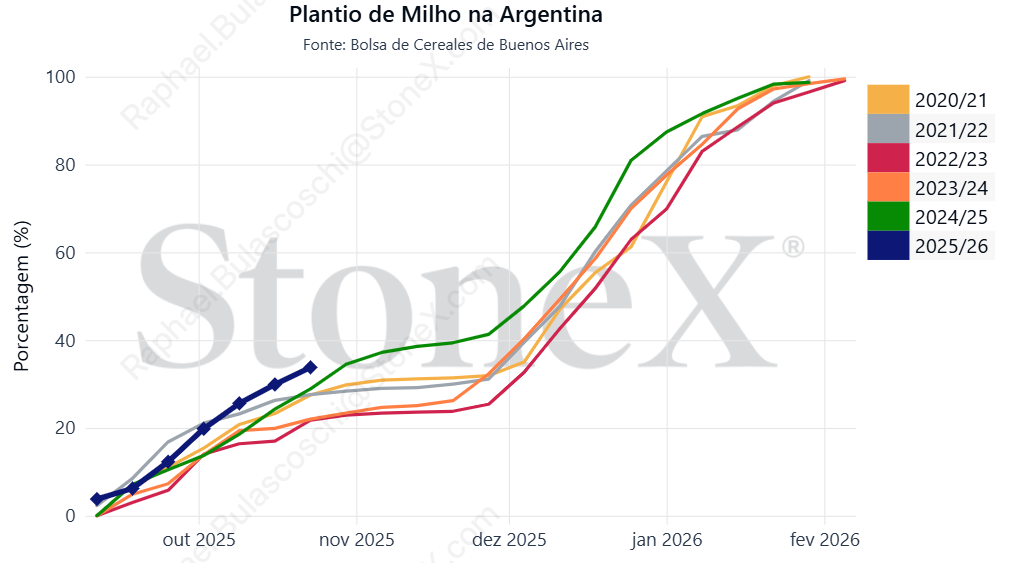 Source: StoneX.
Futures contracts traded on CBOT (US¢/bu)
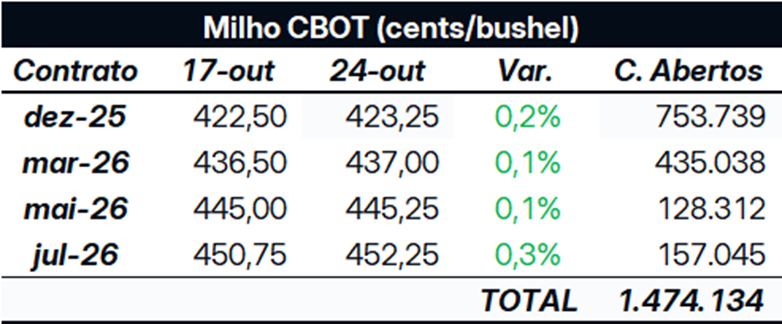
Source: CME. Design: StoneX.
Futures contracts traded on B3 (BRL/bag)

Source: B3. Design: StoneX.
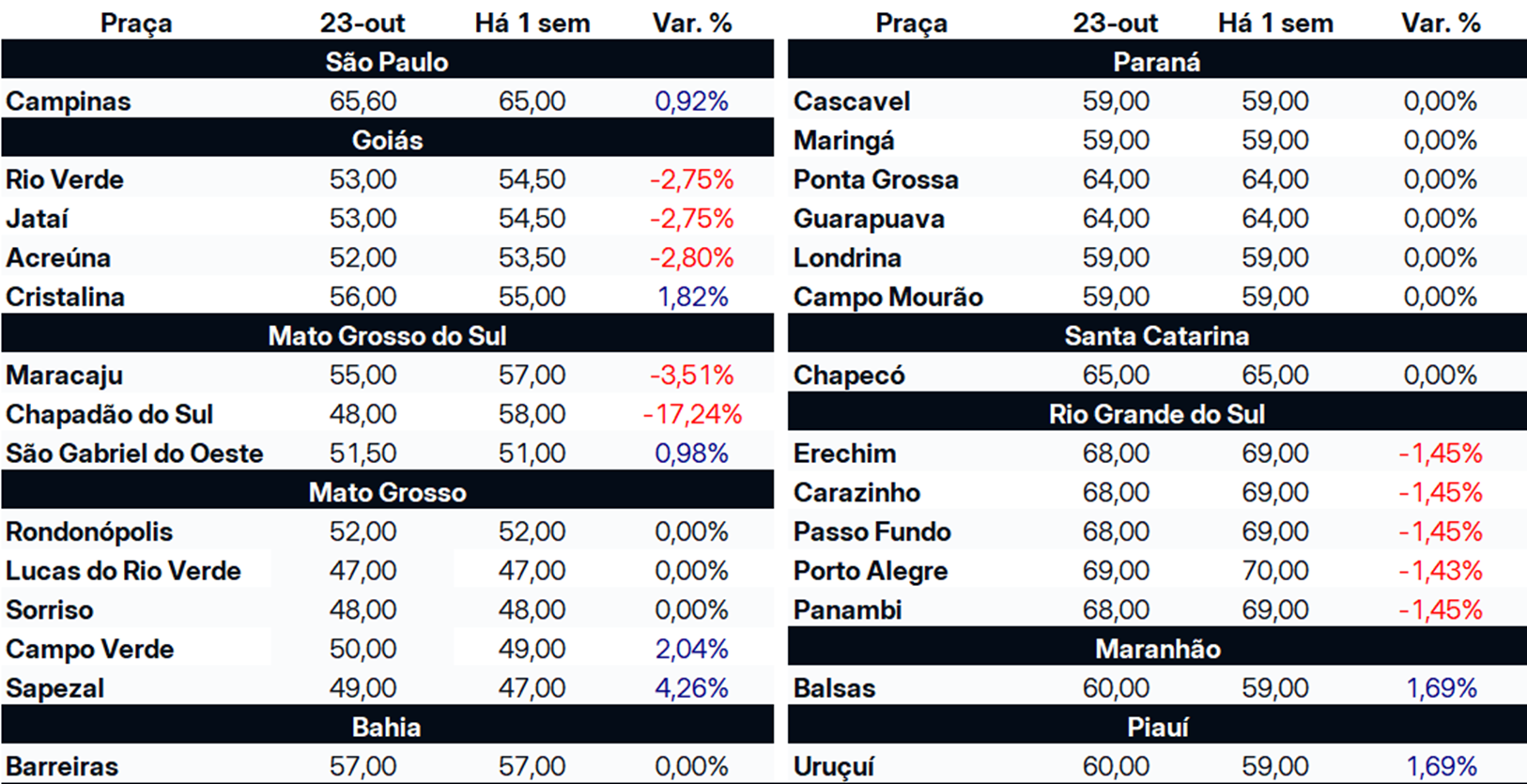
Spot prices in Brazil (BRL/bag)

Source: StoneX.





