
Corn sees losses following bullish WASDE; market awaits final figures in January report
- Bullish
- Heated global consumption;
- USDA estimates lower stocks for the 2025/26 season globally;
- Exports remain strong in the United States;
- Outlook for smaller planted area in the US in 2026;
- Bearish
- Advance in planted area for 2025/26 in Brazil;
- Larger ending stocks in the United States.
CBOT
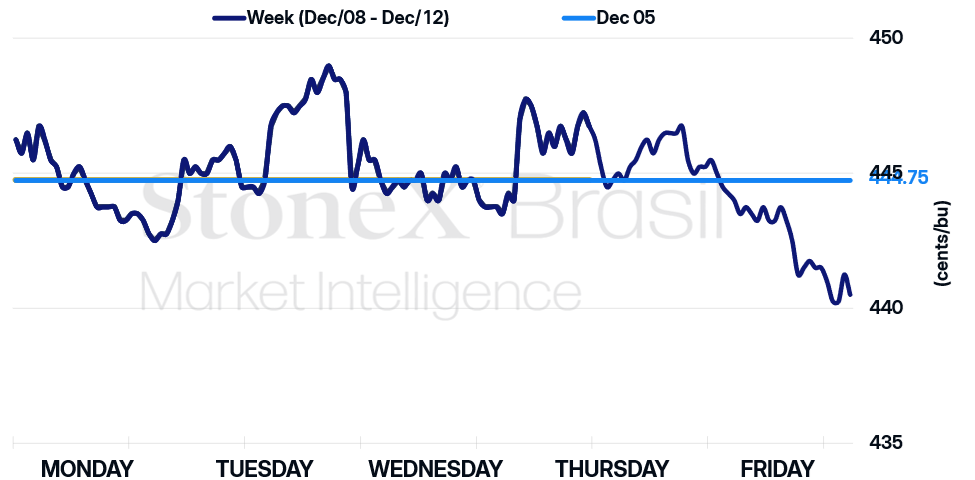
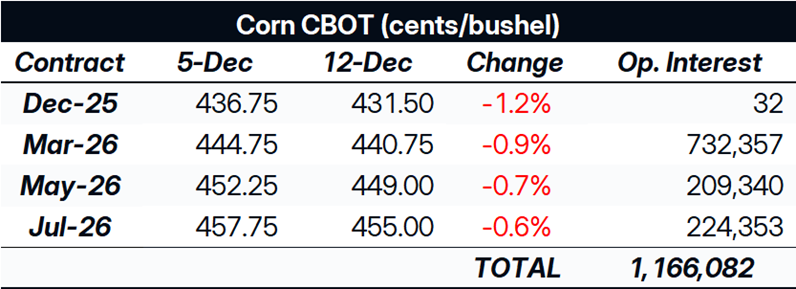
Over the last week, the corn contract maturing in March/26 at CBOT accumulated losses, ending the week at US¢440.75/bu (-0.9%).
Intraday (15 min) Mar/26 contract - CBOT
Source: CBOT. Prepared by: StoneX.
The main highlight of the week was the publication of the new World Agricultural Supply and Demand Estimates (WASDE) by the USDA on Tuesday. Commonly, the December report shows few changes in global supply and demand numbers. And this time was no different.
Looking at the American crop, the main highlight was the country's corn exports, which were revised positively, standing at 81.3 million tonnes, a record level and 3.2 million tonnes above the November estimate. This update was not a major surprise, as we have been monitoring for some weeks that the pace of US corn sales and shipments is quite heated.
The release of the next WASDE, on January 12th, will be accompanied by the quarterly US stocks report. This report, along with field surveys conducted by the department, tends to make the January revision a much more precise figure regarding both the size of the crop from a supply standpoint and regarding demand. The signs of what has happened from September until now point to real numbers lower than those estimated so far by the USDA for both production and consumption.
Looking globally, a cut of 3 million tonnes for the Ukrainian crop stands out – which faced more adverse weather at times –, leading to lower exports. This cut in Ukrainian corn supply in the international market was offset by a cut of 1 million tonnes in European Union corn imports.
Looking at China, the WASDE maintained the production number at 295 million tonnes, below the 301.7 million tonnes estimated by the Chinese government. The USDA maintains estimates of imports at 8 million tonnes this crop year, while China remains less optimistic, expecting 6 million tonnes imported. This mismatch could result in a revision of international corn flows in the January WASDE. China buys corn mainly from Brazil and Ukraine. Thus, revisions to its imports could result in revisions to the export estimates of these countries.
Brazil
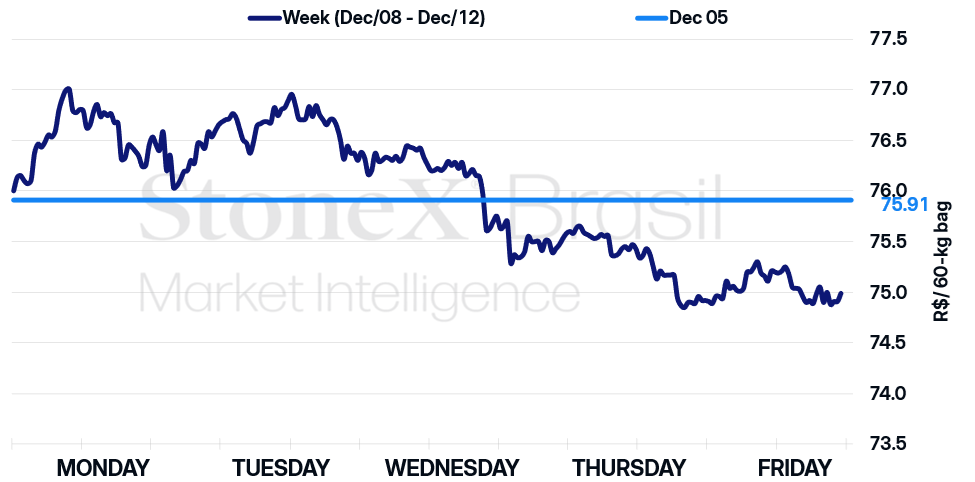
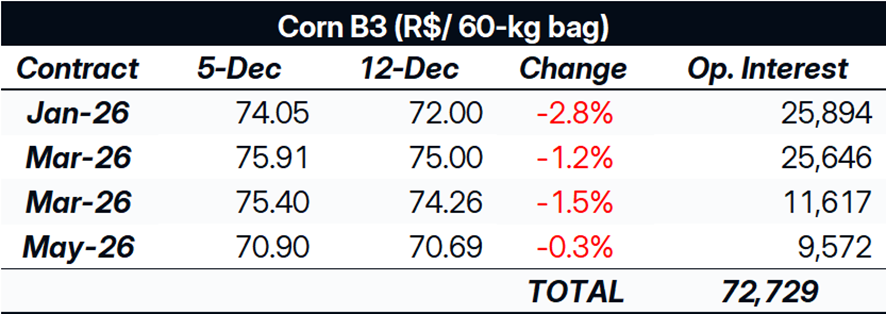
In Brazil, corn futures also retreated, with the March/26 contract marking BRL 72.00/bag (-1.9%) at the close of the week on B3.
Intraday (15 min) Mar/26 contract - B3
Source: B3. Prepared by: StoneX.
The movement is related to a technical pullback after a sequence of highs in recent weeks. Additionally, as we approach the new year, the market begins to operate with lower liquidity.
From a crop standpoint, there is no major news. The return of rains in the Center-West raises hope for a normal cycle for soybeans in most regions, which is positive for the volume outlook of the second corn crop (safrinha). Still, there is much to happen in the coming weeks.
The market also remains quite attentive to the exchange rate, as a devaluation of the Real has been observed in recent weeks while the market speculates about next year's electoral cycle. In any case, the widening of the interest rate differential continues to be a factor anchoring the Brazilian currency.
Futures contracts traded at CBOT (US¢/bu)
Source: CME. Prepared by: StoneX.
Futures contracts traded at B3 (BRL/bag)

Source: B3. Prepared by: StoneX.
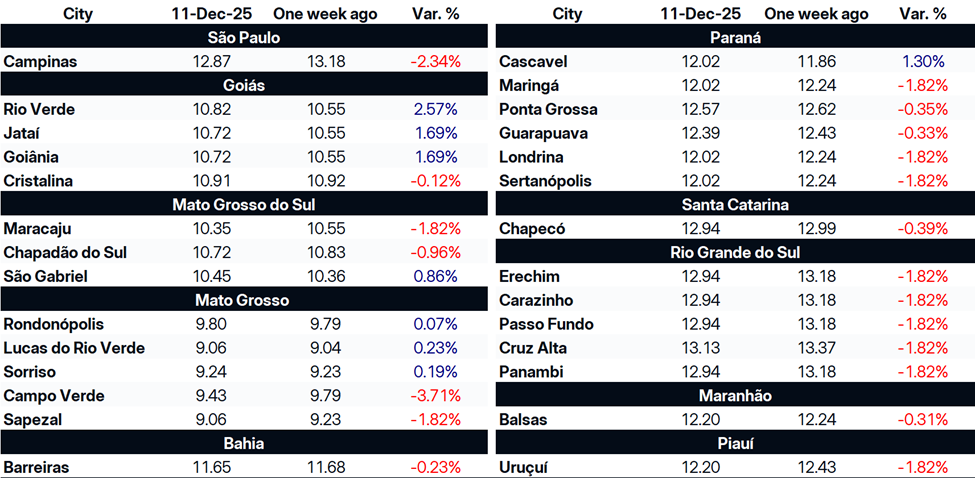
Spot prices in Brazil (USD/60 kg bag)

Source: StoneX.




