
Corn Drops Following WASDE Report; Market Shifts Focus to 2026 Crop Outlook
- Bullish
- Strong global consumption;
- U.S. exports remain robust;
- Smaller planted area expected in the U.S. for 2026;
- High domestic demand in Brazil.
- Bearish
- Expanded planting area for Brazil's 2025/26 crop;
- Record-breaking productivity in the U.S.;
- Higher ending stocks in the U.S.;
- Potential downward revision for U.S. corn consumption.
CBOT
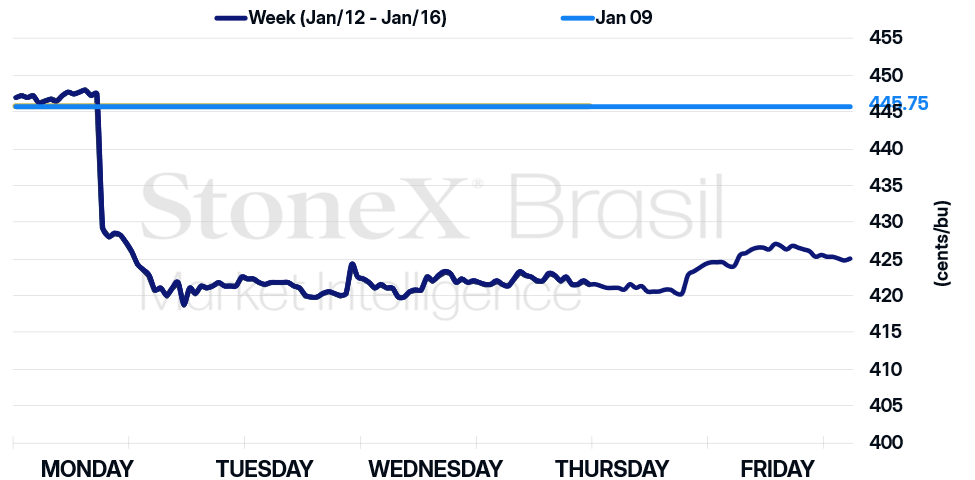
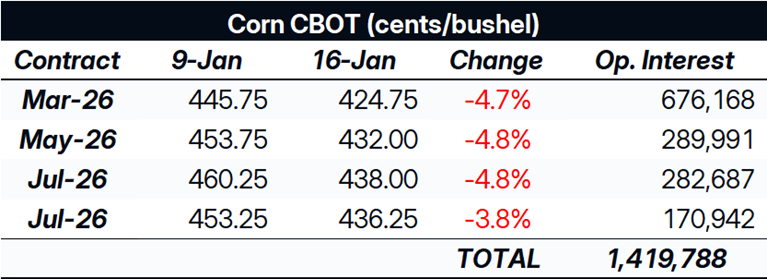
Corn prices traded in Chicago fell 4.3% last week. Following an initially bearish shock triggered by a highly pessimistic WASDE report, the March contract found support at US¢420/bu, closing the week at US¢424.75/bu.
Intraday (15 min) March 2026 Contract - CBOT
Source: CBOT. Design: StoneX.
WASDE | Last Monday, the USDA released an update to its World Agricultural Supply and Demand Estimates (WASDE). The market was anticipating a bullish report, expecting a cut in average yield estimates for U.S. crops. However, not only did the report show an increase in yields, but it also revised the planted area upward. Combined, these factors resulted in a crop forecast of 432.3 million tonnes, up 1.6% from December's report.
On the demand side, the USDA raised feed usage to 334.5 million tonnes, contrary to market expectations of a cut. This positive revision helped partially offset the impact of record crop production on ending stocks. However, the market remains skeptical of this figure, suggesting potential bearish surprises in future consumption reports.
Figures for corn usage in ethanol production and exports remained unchanged. In ethanol, a slight downward revision was anticipated, but plants are operating actively, justifying the USDA's decision to hold off on adjustments, as discussed in another section of this report. Export numbers are already at record levels, and shipments and sales are currently exceeding the pace needed to meet the target of 81.3 million tonnes, suggesting possible increases in future reports.
U.S. corn ending stocks were reported at 56.6 million tonnes, the highest volume of the decade. As a result, the market enters the next crop season well supplied, partially explaining a smaller area dedicated to corn. Other factors supporting this scenario include: 1) higher soybean competitiveness in terms of price; 2) elevated input costs that weigh more heavily on corn; and 3) natural crop rotation given the high planted area seen in 2025.
Ethanol | Last week, the EIA reported record ethanol production in the U.S., with weekly average output reaching approximately 1.2 million barrels per day for the week ending January 9. This supported corn futures, as it indicates strong domestic demand amid the massive crop.
Following Monday's WASDE release, there was increased pressure on the U.S. Environmental Protection Agency (EPA) to approve year-round sales of E15 (gasoline with a 15% blend of anhydrous ethanol).
Although this may provide long-term support for prices, its short-term impact is likely limited. The U.S. ethanol production capacity is already highly utilized, with few projects for new plants or expansions planned in the coming months. Nevertheless, it remains critical for U.S. farmers to identify new demand sources, given the ongoing upward trend in average corn productivity in recent years.
Looking ahead, discussions around E15 will be key for the market and will be closely monitored.
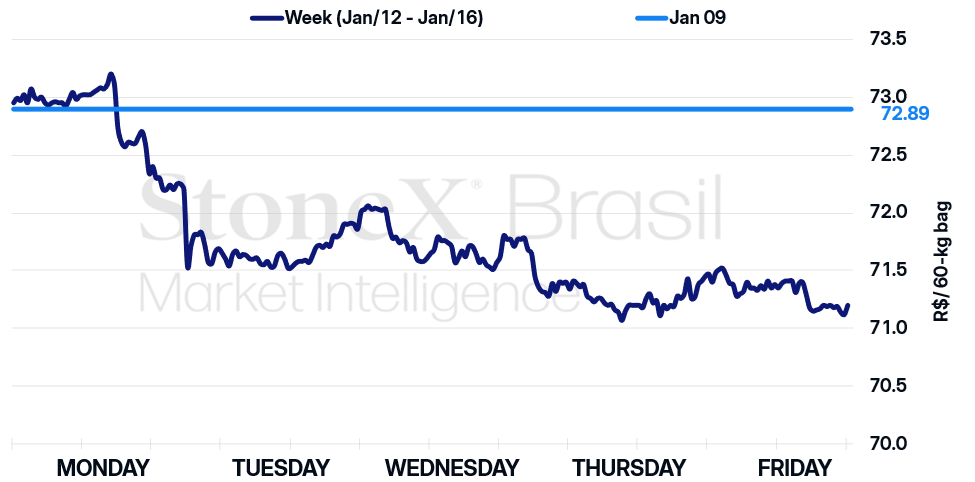
Intraday (15 min) March 2026 Contract - B3
Source: B3. Design: StoneX.
Brazil
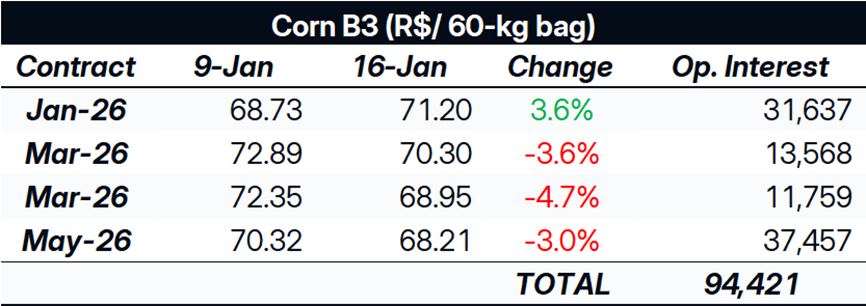
Corn prices on the B3 also declined overall. The March 2026 contract ended the week trading at R$70.30 per sack (-3.6%). With no significant news concerning Brazilian crops, the domestic market followed Chicago's trends. U.S. corn has been highly competitive in recent months, and with the recent price drops, it will remain competitive, negatively impacting Brazilian exports.
Soybean harvesting has begun in Brazil, with positive productivity forecasts. As the soybean season wraps up, the need to clear storage space for soybeans and the start of the second-crop corn planting are factors likely to bring greater market activity in the coming weeks.
Futures Contracts Traded on CBOT (US¢/bu)
Source: CME. Design: StoneX.
Futures Contracts Traded on B3 (R$/bag)

Source: B3. Design: StoneX.
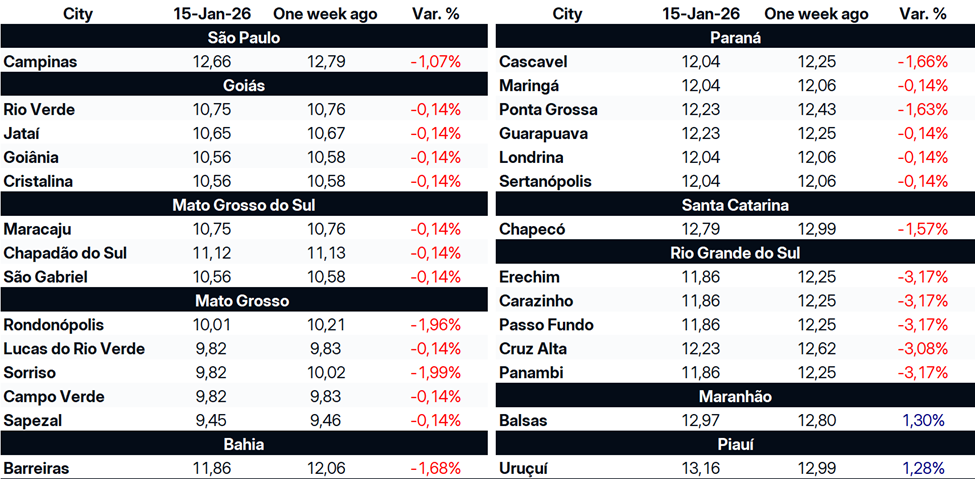
Spot Prices in Brazil (USD/60kg bag)
Source: StoneX.




