Crude Oil Outlook: OPEC Supply, Fed Cuts & Geopolitics in Focus
Crude oil has extended its bearish consolidation for four months since June 2025, trading within a larger down-trending channel that has persisted since 2022. This structure keeps the outlook tilted toward bearish dominance, with limited upside potential unless a decisive breakout beyond the $70 resistance and three-year channel emerges.
Q4 Headlines
- Will OPEC’s supply unwinds succeed in restoring market share and revenue for its members?
- Can the Fed’s monetary policy strike a balance between inflation control and labor market growth?
- Will geopolitical tensions ease, or will supply disruption risks intensify?
- US OIL Technical Analysis: Weekly, Monthly, and 3-Month Charts
Global Backdrop
The World Bank’s latest Global Economic Prospects (June 2025) paints a difficult environment for Q4. After repeated shocks between 2020 and 2024, the global economy now faces fresh headwinds: rising trade barriers and heightened policy uncertainty. Growth in 2025 is projected at just 2.3%, the weakest pace since 2008 outside of recessions.
At the core of this slowdown are sharp tariff increases — now at their highest effective level in nearly a century in the United States — combined with geopolitical frictions that have disrupted trade and investment. Business and consumer confidence remain fragile; the latest figures show U.S. consumer confidence slipped to 55.40 in September 2025, down from 58.20 in August. Yet, even against this backdrop, U.S. equity indices continue to push to record highs, driven by strong appetite for tech and AI stocks, while gold is climbing toward all-time records near $3,800. This unusual mix of equity exuberance and safe-haven demand underscores deep market uncertainty and may limit the potential for a sustained crude oil recovery from the 2025 lows near $55.
OPEC+ Supply Unwinds
Oil prices dropped sharply in April as OPEC+ announced the restoration of supply into an uncertain demand environment. The first batch of 2.2 million barrels per day has already been released, contributing to the decline toward $55 per barrel. A second batch, about 1.6 million barrels per day, is scheduled to start unwinding in October at a slower pace of roughly 137,000 bpd per month.
OPEC has indicated that this path could pause or reverse if demand and growth conditions deteriorate. Still, the group’s determination to regain market share is evident, raising the stakes for supply-demand balance in Q4.
Monetary Policy and Inflation
Despite slower growth, inflation remains elevated relative to pre-pandemic averages and has even ticked higher in some advanced economies. U.S CPI rose about 2.9% year-on-year as of August 2025. This leaves central banks with a difficult balancing act between controlling inflation and supporting growth.
In the U.S., markets had been pricing in up to 75 basis points of Fed rate cuts in 2025. However, Chair Powell’s recent remarks emphasized that sticky inflation, coupled with labor market weakness, will likely prevent the Fed from cutting too aggressively — particularly with tariff developments adding another layer of uncertainty. For now, expectations are still at 50 bps of cuts by year-end (including the latest 25 bps cut already delivered), which would bring the federal funds rate down to around 3.75%, according to the CME FedWatch Tool.
Geopolitical Pressures
Geopolitical risks remain a persistent shadow over major markets and crude oil. The Russia–Ukraine conflict continues to weigh on Eurozone growth while raising the risk of supply disruptions through sanctions and potential strikes. Meanwhile, trade dynamics between the U.S., China, and India remain in focus, as any policy shifts or changes in relations could significantly shape global oil demand.
Seasonal winter demand, which typically rises for heating, may provide an additional tailwind if supply risks persist. Together, these factors could create conditions for a stronger recovery that would support OPEC members through higher revenues and regained market share.
This fragile global backdrop sets the stage for crude oil in Q4, where supply risks, geopolitical uncertainty, and shifting demand expectations will continue to drive volatility. From a technical perspective, crude oil remains capped by a three-year down-trending channel since the 2022 highs, now compressed into a tighter consolidation since June 2025 — weighing on breakout potential and reinforcing market indecision.
Technical Analysis: Quantifying Uncertainty
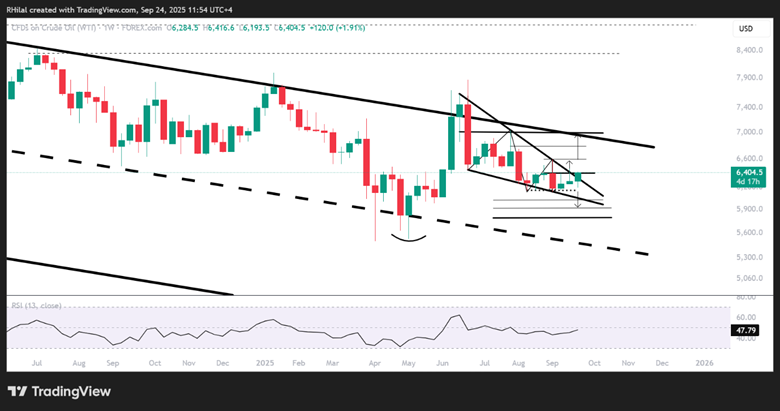
Crude Oil Outlook: Weekly Time Frame – Log Scale
Source: Tradingview
Consolidations are generally considered neutral patterns until a decisive breakout occurs. The broader three-year down-trending channel remains the key framework for crude’s short- and long-term direction until a confirmed break takes place.
Currently, price action is squeezed into a contracting consolidation since the June 2025 highs, with the weekly Relative Strength Index (RSI) still holding below the 50 neutral level. A slight bullish bias is emerging with an attempted penetration to the upside, and the key scenarios are:
- Upside: A clean hold above $64.50 may extend gains toward $66.00, $67.80, and $70.00 — the upper boundary of the descending channel.
- Downside: A break below $61 may extend declines toward the 2025 lows, aligning with $60.20, $59.20, and $57.90.
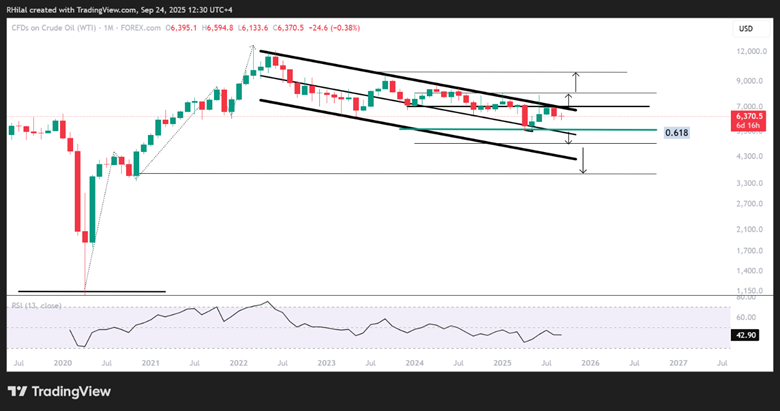
Crude Oil Outlook: Monthly Time Frame – Log Scale
Source: Tradingview
The three-year channel is clearly visible on the monthly time frame, with price action respecting its upper, lower, and mid-bounds. Crude has spent more time testing the upper side of the channel, suggesting ongoing bullish breakout potential. A confirmed hold above $70.20 would shift the narrative toward a more constructive outlook.
Key levels in sight:
Upside: A clean hold above $70.20 may extend gains beyond the dominance of the three-year downtrend, targeting $80.20 in the medium term and up to $98 in the longer run, once resistance levels are decisively cleared. Typically, this would require strong weekly and monthly closes above these resistance zones.
Downside: Near-term support lies around the mid-zone of the channel, aligning with the 0.618 Fibonacci retracement of crude’s 2020–2022 uptrend at $55. Current prices remain above $61, but a confirmed close below this level could extend declines to $60 and $58, before retesting the 2025 low at $55 — a level that could revive long-term bullish positioning unless broken.
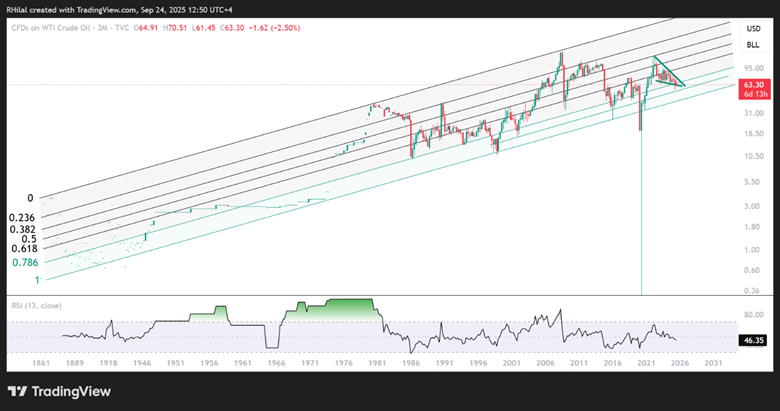
Crude Oil Outlook: 3Month Time Frame – Log Scale
Source: Tradingview
From a three-month perspective, crude oil can be analyzed within a Fibonacci channel extending from the 1800s lows. Price action is currently hovering slightly above the lower end of the channel, between the 1 and 0.786 retracement levels, holding above the $55 support.
This structure suggests downside risk may be limited as long as prices stay above $55. A decisive break below that level could align crude with a long-term trendline spanning more than 160 years — breached only once during the COVID crash, when crude briefly fell below zero before rebounding. That historic trendline points to potential support near $49.
On the upside, price action since 2022 resembles a possible pennant or triangle formation following the 2020–2022 uptrend. A breakout above $70–80 could realign prices with the broader bullish narrative, opening the way toward the $120 per barrel peak.
Written by Razan Hilal, CMT
Follow on X: @Rh_waves