StoneX logo

Daily Petroleum Report

By: Bruno Santos, Market Intelligence Analyst

Banner Currencies

Crude oil advances amid renewed attacks between the US and Iran

Yesterday (09), the most liquid Brent contract ended down 3%, reaching USD 91.45/bbl. WTI closed at USD 88.2/bbl (-3.4%).

The movement reflected the relief in the futures market after confirmation by both Iran and Israel that attacks between the two countries would be temporarily halted. Meanwhile, rumors regarding progress in negotiations between Tehran and Washington also exerted negative pressure on crude futures.

In the early hours of this morning, Brent is trading up 1%, quoted at USD 91.24/bbl around 08:30 AM, tracking renewed exchanges of attacks between the US and Iran in the Gulf region and signs that diplomatic discussions are advancing sluggishly.

Logistical restrictions at the Strait of Hormuz and US-Iran escalation limit visibility for supply normalization

The resumption of cross-bombardments between the US and Iran, with Iranian attacks on US bases in Bahrain, Kuwait, and Jordan and US offensives against Iranian positions near the Strait of Hormuz, has increased operational uncertainty in the main maritime routes for crude oil. Iran maintains a significant blockade on navigation in the region, even after international mediation reiterated calls for a ceasefire, and has stated it will impose conditions and potential transit tariffs with Oman for partial release of flows.

Why does this matter: In the short term, renewed attacks between Tehran and Washington impede the rebalancing of the global oil balance and necessitate further withdrawals from strategic inventories, as expectations for reopening the Strait of Hormuz become increasingly remote. In the medium term, it amplifies the risk of abrupt price movements in the event of military intensification, within an already strained environment marked by a broad global structural deficit and limited OPEC+ response.

What to expect? While the partial blockade of the Strait of Hormuz and intermittent attacks persist, crude futures are likely to maintain an elevated floor, sustaining price differentials between Asian and European markets.

  • If diplomatic discussions move forward and a memorandum of understanding is formalized — which is unlikely at this moment — there is potential for a partial retreat in the current risk premium. Nonetheless, expectations remain for weakened inventories in the long term, even with an eventual full reopening of the Strait of Hormuz.

Global inventories at 20-year lows intensify structural price pressure

According to the EIA, crude oil inventories among OECD economies are projected to fall below 2.3 billion barrels by December, the lowest level since the beginning of the historical series in 2003. This movement is driven by the need to offset the Middle East supply deficit, with consumers burning reserves to ensure full availability of energy commodities. The agency projects that inventories will continue to decrease sharply at least through 2027 as long as flows in the region remain disrupted.

Why does this matter: The reduction in inventories acts as a structural basis for maintaining Brent prices above USD 90/bbl in the coming months, even as diplomatic progress brings occasional relief to risk premiums. The depletion of inventories imposes limits on the market's capacity to cushion additional supply shocks, increasing vulnerability to further production losses or unexpected restrictions. For Brazil, any eventual need for emergency diesel or other refined product purchases may find persistently elevated price conditions and reduced international availability.

What to expect? Should flows through the Strait of Hormuz remain restricted and alternative exporters maintain limited response, global inventories are expected to decline throughout the second half of the year, sustaining elevated spot price levels. A more robust resumption of transit in the region is necessary for reversal of this scenario, with risk of aggravation should additional sanctions or interruptions increase logistical and production deficits.

Global demand weakens with elevated prices, but constrained supply maintains Brent support

The EIA has also revised its outlook, projecting a decrease of 1.1 million bpd in global oil consumption for 2026 relative to the prior year, reversing expectations for growth. This trend reflects the impact of elevated prices on industrial activity and government rationing measures, especially in developed and Asian markets. Chinese imports remain below expectations, limiting upside for prices, but downward adjustment in supply continues to dominate.

Why does this matter: The forced decline in demand does not immediately normalize the market balance, as the reduction in supply exceeds consumption softening, deepening the risk of refined product deficits, especially in import-dependent markets. This phenomenon heightens the importance of strategic reserves and underscores the need for emergency supply plans, including for markets such as Brazil.

What to expect? If elevated prices and constrained supply persist, global demand tends to register a further retreat in the second half, with potential for broader cuts in importing countries. Should flows in the Persian Gulf reopen, there may be a marginal downward adjustment in prices, but full rebalancing is expected only with inventory replenishment starting in 2027.

Daily Table - Price Variation in the Previous Session
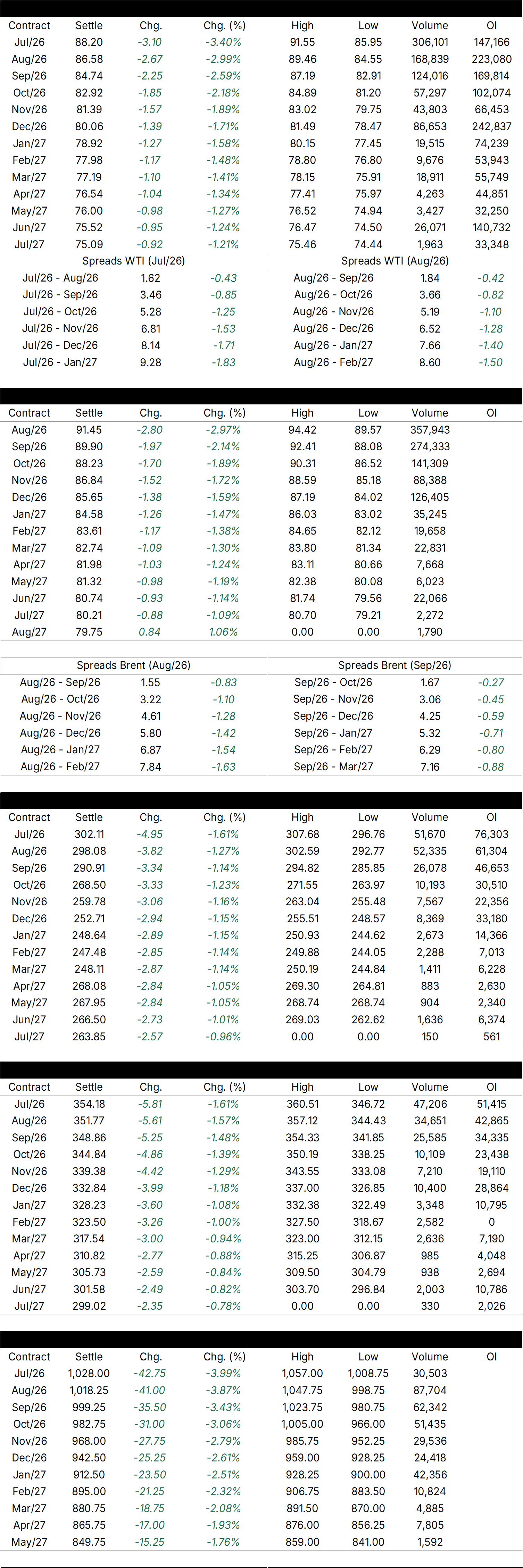
image 132546

Source: ICE, NYMEX. Preparation: StoneX.

  • Energy

The StoneX Group Inc. group of companies provides financial services worldwide through its subsidiaries, including physical commodities, securities, exchange-traded and over-the-counter derivatives, risk management, global payments and foreign exchange products in accordance with applicable law in the jurisdictions where services are provided. References to over-the-counter (“OTC”) products or swaps are made on behalf of StoneX Markets LLC (“SXM”), a member of the National Futures Association (“NFA”) and provisionally registered with the U.S. Commodity Futures Trading Commission (“CFTC”) as a swap dealer. SXM’s products are designed only for individuals or firms who qualify under CFTC rules as an ‘Eligible Contract Participant’ (“ECP”) and who have been accepted as customers of SXM. StoneX Financial Inc. (“SFI”) is a member of FINRA/NFA/SIPC and registered with the MSRB. SFI is registered with the U.S. Securities and Exchange Commission (“SEC”) as a Broker-Dealer and with the CFTC as a Futures Commission Merchant and Commodity Trading Adviser. References to securities trading are made on behalf of the BD Division of SFI and are intended only for an audience of institutional clients as defined by FINRA Rule 4512(c). References to exchange-traded futures and options are made on behalf of the FCM Division of SFI . StoneX is a trading name of StoneX Financial Ltd (“SFL”). SFL is registered in England and Wales, Company No. 5616586. SFL is authorized and regulated by the Financial Conduct Authority [FRN 446717] to provide to professional and eligible customers including: arrangement, execution and, where required, clearing derivative transactions in exchange traded futures and options. SFL is also authorised to engage in the arrangement and execution of transactions in certain OTC products, certain securities trading, precious metals trading and payment services to eligible customers. SFL is authorised & regulated by the Financial Conduct Authority under the Payment Services Regulations 2017 for the provision of payment services. SFL is a category 1 ring-dealing member of the London Metal Exchange. In addition SFL also engages in other physically delivered commodities business and other general business activities which are unregulated and not required to be authorised by the Financial Conduct Authority. StoneX Group Inc. acts as agent for SFL in New York with respect to its payments services business. StoneX APAC Pte. Ltd. acts as agent for SFL in Singapore with respect to its payments services business. ‘StoneX’ is the trade name used by StoneX Group Inc. and all its associated entities and subsidiaries.
 
Trading swaps and over-the-counter derivatives, exchange-traded derivatives and options and securities involves substantial risk and is not suitable for all investors. Past performance of any futures or option is not indicative of future success. Indicators are not a trading system and are not published as a specific trade recommendation. The information herein is not a recommendation to trade nor investment research or an offer to buy or sell any derivative or security. It does not take into account your particular investment objectives, financial situation or needs and does not create a binding obligation on any of the StoneX group of companies to enter into any transaction with you. You are advised to perform an independent investigation of any transaction to determine whether any transaction is suitable for you. No part of this material may be copied, photocopied or duplicated in any form by any means or redistributed without the prior written consent of StoneX Group Inc.
 
© 2026 StoneX Group Inc. All Rights Reserved.

Satellite view of Earth at night showing illuminated cities across Asia and the Middle East

Discover more insights

Our subscribers have access to comprehensive market analysis from StoneX spanning commodities, equities, currencies and more.

Related articles for Energy

WTI and Brent Crude Are Now Reading the Strait of Hormuz Differently

WTI and Brent crude are moving to different beats as a possible U.S. Iran deal reshapes the oil market. The two benchmarks are pricing Strait of Hormuz risk in their own ways, and the gap between them says a lot about where crude goes next.

Editorial Team
Editorial Team
  • Energy

Perspective: Morning Commentary for August 7

August 7 – The U.S. economy unexpectedly lost 23k jobs in July, dramatically below market expectations of an 80k increase and marking the worst Non-Farm Payrolls print since February. Furthermore, May and June were both revised sharply downward, with combined revisions showing 103k fewer jobs than previously reported. Outside of the healthcare sector, which added 22k jobs in July, the losses were very broad-based. Government payrolls saw the largest decline, shedding 53k jobs in July, the largest seen since October 2025, while June was revised down to show a loss of 10k jobs as well. The private sector at least saw growth, adding 30k jobs in July, now matching the month prior after it was revised down from the 49k initially reported, and substantially missing forecasts of 78k jobs being added. This is a sharp reversal in course from the largely better than expected U.S. labor data seen earlier this week.

Mike Castle
Mike Castle
  • Grains & Oilseeds
  • Energy
  • Dairy
  • Renewable Fuels
  • Cocoa
  • Coffee
  • Cotton
  • Sugar
  • Meats & Livestock
  • Forest Products

Diesel Supply Faces Three Fresh Risks Before the Winter Heating Season

The oil market keeps watching the Strait of Hormuz, but the tighter pressure on fuel is building in refining. With a large share of global capacity offline and unplanned outages carrying no repair timeline, diesel supply faces three fresh risks before winter.

Editorial Team
Editorial Team
  • Energy
StoneX: We open markets

Our market expertise, advanced platforms, global reach, culture of full transparency and commitment to our clients’ success all set us apart in the financial marketplace.

Reach

With access to 40+ derivatives exchanges, 180+ foreign exchange markets, nearly every global securities marketplace and numerous bi-lateral liquidity venues, StoneX’s digital network and deep relationships can take clients anywhere they want to go.

Transparency

As a publicly traded company meeting the highest standards of regulatory compliance in the markets we serve, our financials and record of accomplishment are matters of public record. StoneX’s commitment to “doing the right thing over the easy thing” sets us apart in the industry and helps us build respect, client trust and new partnerships.

Expertise

From our proprietary Market Intelligence platform, to “boots on the ground” expertise from award-winning traders and professionals, we connect our clients directly to actionable insights they can use to make more informed decisions and achieve their goals in the global markets.