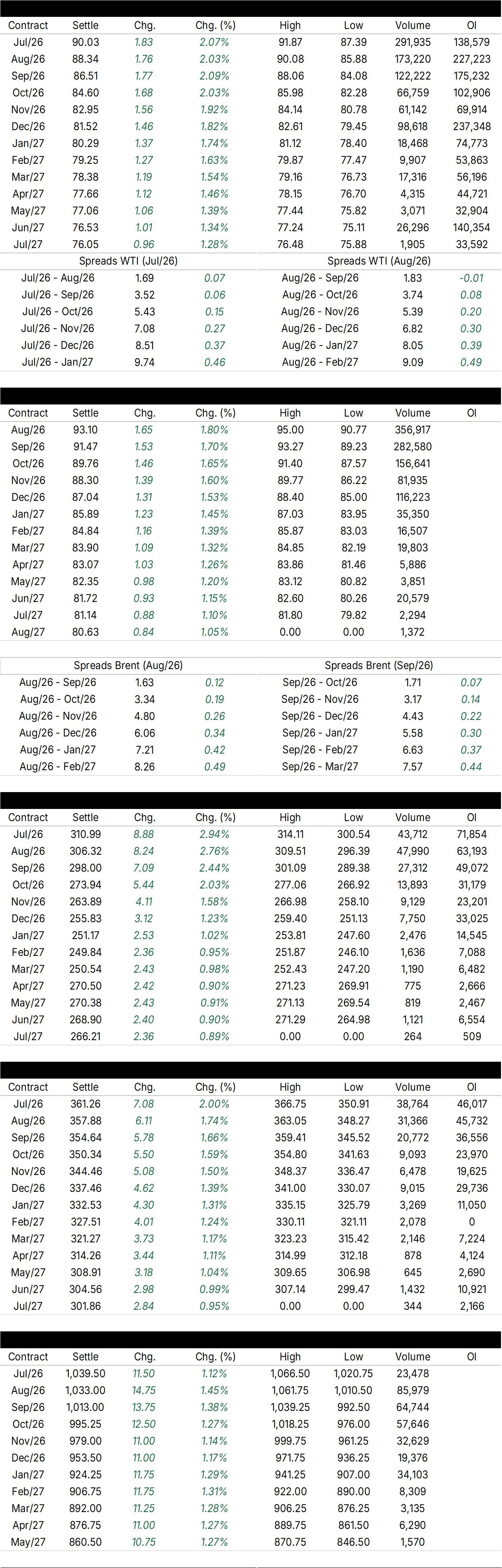
Yesterday (June 10), the most active Brent futures contract closed higher, ending the session at USD 93.10/bbl (+1.8%), while WTI advanced to USD 90.03/bbl (+2.0%). Both contracts accumulated gains of up to USD 3.0/bbl during trading, before partially retreating following statements from President Trump regarding a covert military operation escorting vessels through the Strait of Hormuz.
The market movement was driven by Trump’s threats to strike Iran “very hard” if no agreement is reached, with the conflict registering one of the most intense exchanges of fire since the April ceasefire. Concurrently, the DOE reported a decline of 7.2 million barrels in U.S. inventories for the week ending June 5—nearly twice the expectations—with refinery utilization at 95.3%, signaling increasing pressure on the domestic balance and fragility of global inventories.
This morning (June 11), around 8:30 a.m., Brent retreated to USD 92.1/bbl (-1.1%) and WTI to USD 89.1/bbl (-1%), after both accumulated gains of over USD 2.0/bbl at the start of the session. The market is simultaneously pricing the formal closure of the Strait of Hormuz by Iran and indications that negotiations between Washington and Tehran have intensified, reducing the risk premium relative to the opening.
Iran announces total closure of the Strait of Hormuz
Iran announced the formal closure of the Strait of Hormuz, with the Persian Gulf Strait Authority signaling that vessels attempting passage will be attacked. The closure was declared after new U.S. attacks against Iranian targets, including a strike on a ship in the Gulf of Oman carrying Iranian oil, resulting in a diplomatic incident with India, which reported three sailors killed. Despite the rhetoric, the U.S. confirmed that commercial vessels remain in transit and that no U.S. warship was hit; simultaneously, three LNG tankers left the Strait with transponders off, bound for Asia.
Why does this matter: The divergence between the formal closure announcement and ongoing partial transit is the main factor containing the risk premium, with the market betting that a total blockade is yet to materialize. In the medium term, maintaining restrictions limits Persian Gulf exports (Saudi Arabia, UAE, Kuwait, Iraq) and further compresses the already deficit global balance. The real possibility of a total blockade, which would eliminate the rest of the physical flows transported through the strait, should result in a more significant advance in commodity futures.
What to expect? As long as partial transit persists and negotiations progress, Brent tends to remain within the USD 90–100/bbl range, albeit with significant volatility. If Iran effectively prevents the passage of commercial vessels or a new large-scale military episode occurs, bullish repricing may be abrupt, with investors demonstrating less optimism regarding a potential memorandum of understanding between the parties.
China reduces imports; structural demand shift limits bullish pressure
Chinese oil imports in May fell 29% compared to the same period last year, to 7.8 mbpd—the lowest level in eight years—following a 20% drop in April. This movement combines the use of accumulated inventories from periods of lower prices with a surprising drop in fuel consumption: Sinopec gasoline sales declined by 8% and diesel by 6% year-over-year in April. The acceleration of fleet electrification and migration to electric rail and collective transportation indicate a behavioral shift with lasting potential, especially for gasoline.
Why does this matter: The cyclical reduction in Chinese demand for liquid derivatives—due to lower oil supply from the Persian Gulf—acts as a price ceiling for the commodity, partially offsetting the supply contraction from the Middle East. In the medium term, if the decline in Chinese imports consolidates below 8.5 mbpd in a sustained manner, the rebalancing of the global balance will occur at a lower price level than pre-conflict models projected. The risk is that, once Chinese strategic inventories are depleted, a resumption of imports will increase pressure on the physical market simultaneously with any eventual resolution of the conflict.
What to expect? While China maintains consumption of accumulated inventories and demand behavior remains subdued, oil prices should remain below USD 100/bbl. If China resumes imports at volumes close to pre-war levels (above 10 mbpd), the already fragile global balance would undergo significant bullish repricing.
U.S. inventories in sharp decline, with SPR at lowest level since 2023
U.S. commercial inventories dropped 7.2 million barrels in the week ending June 5, to 426.5 million barrels. Since the start of the conflict on February 28, total U.S. inventories, including the Strategic Petroleum Reserve (SPR), have accumulated a decline of 79 million barrels, with the SPR reaching its lowest level since August 2023. Refinery utilization rates reached 95.3%, a historically elevated level, reflecting efforts to offset the contraction of physical flows from the Persian Gulf.
Why does this matter: The acceleration in commercial inventory drawdowns, combined with the SPR at recent historical lows, narrows the U.S. margin to cushion further supply shocks. The increase in net imports and the decline in U.S. oil exports by 1.03 mbpd suggest that the role of the U.S. as a global exporter is being temporarily reversed. The fragility of the global balance increases the sensitivity of prices to any further deterioration in the Strait of Hormuz and other regions, with the decline in Russian exports contributing to this tightening of the global balance.
What to expect? The current scenario is one of inventories under continuous pressure while the conflict limits Persian Gulf exports and refineries operate at maximum capacity in the U.S. and Europe. If SPR transfers to commercial inventories are insufficient to offset weekly declines, pressure on domestic U.S. prices tends to intensify—potentially impacting inflation and Federal Reserve monetary policy. It is worth noting that the current period is critical, with the approach of the driving season potentially resulting in a worsening scenario for the gasoline balance in the country—depending, of course, on the geopolitical context in the coming weeks.
Daily table - Price variation in the previous session
Source: ICE, NYMEX. Prepared by: StoneX.




