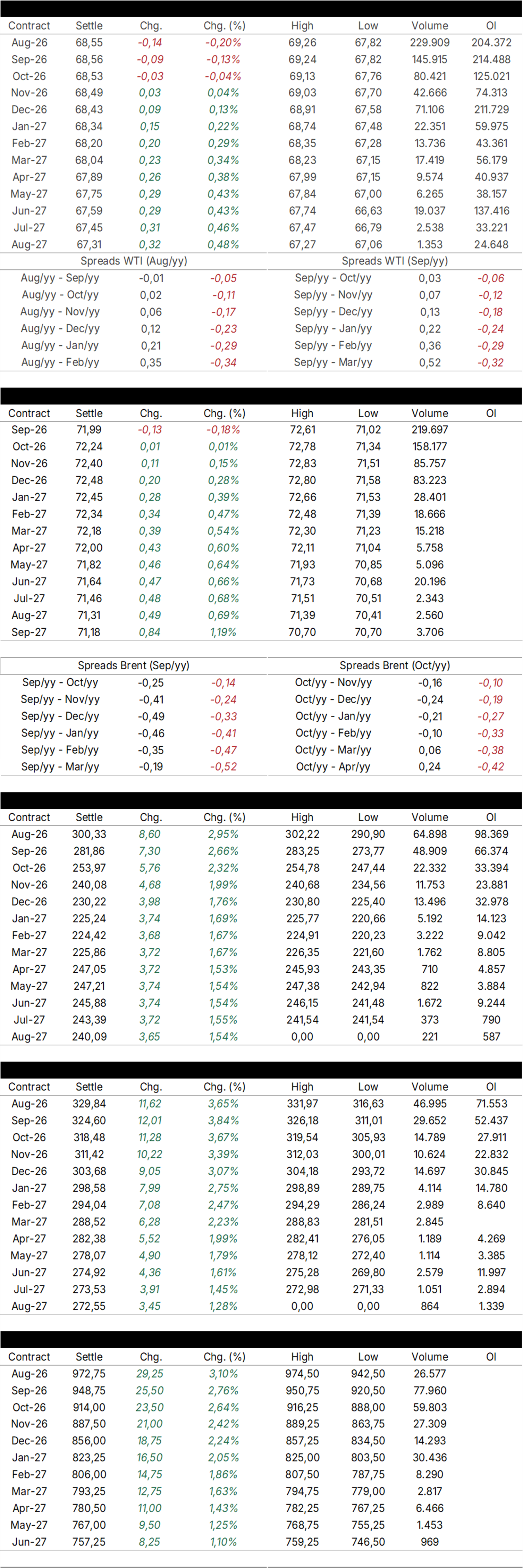
Yesterday (07/06), the most active Brent contract closed lower, priced at USD 71.99/bbl. WTI settled at USD 68.55/bbl, mirroring the bearish movement.
The dominant driver was the combination of Aramco's largest price cut in over two decades and the OPEC+ decision to raise production quotas by 188 kbpd starting in August, totaling nearly 800 kbpd in increases since April. The market interpreted these moves as signals of a potential structural surplus in the coming months, accelerating the observed declines.
This morning (07/07), Brent traded up 0.96% at USD 72.68/bbl by approximately 8:30am, following reports of attacks on tankers near the Strait of Hormuz, reintroducing a geopolitical risk premium. In parallel, increased Ukrainian offensives against Russian ports are once again raising concerns about Russia’s ability to export crude oil from Eastern Europe.
Attacks in the Strait of Hormuz restore risk premium after relative stabilization
A Saudi-owned tanker was damaged near the Strait of Hormuz, after a Qatari LNG tanker was struck in the same area, with maritime security sources pointing to missiles deployed by Iran’s Revolutionary Guard as the likely cause. This event comes amid statements from the Iranian foreign minister that negotiations with Washington will not continue under threat, increasing uncertainty regarding the sustainability of the 60-day ceasefire agreed in June.
Why it matters: Any new closure of the Strait of Hormuz would abruptly reverse the surplus narrative compressing Brent towards the USD 70/bbl range. The combination of a fragile truce and isolated attacks keeps freight rates elevated for cargos within the Gulf—a factor already dampening Asian demand for Saudi crude despite the historic price cut.
What to expect? As long as attacks remain sporadic and the ceasefire operational, Brent should fluctuate between USD 71 and USD 75/bbl, with a limited risk premium. In the event of renewed military escalation or closure of the Strait of Hormuz, prices may swiftly return to USD 80/bbl or above, reversing the prevailing bearish trend. If US-Iran negotiations progress toward a final agreement, the movement would be in the opposite direction, intensifying selling pressure.
Aramco cuts OSP by USD 11/bbl, yet Saudi crude still loses competitiveness
Aramco set the official selling price (OSP) of Arab Light for August in Asia at USD 1.50/bbl below the Oman/Dubai benchmark—a USD 11/bbl reduction versus July, the largest since 2003, with the reference price hitting the lowest level since June 2020. Nonetheless, Asian refiners report that competing grades, such as UAE’s Upper Zakum and Iraqi crude, are offered at discounts of USD 6–8/bbl relative to Dubai, making Saudi crude comparatively expensive when factoring in the elevated freight for cargos within the Persian Gulf—estimated up to USD 15/bbl higher than parcels shipped outside the strait.
Why it matters: The loss of competitiveness for Arab Light compresses Aramco’s market share in Asia—which absorbs roughly 80% of its exports—at a time when Chinese imports have dropped to 5.84 mbpd in June, the lowest level in over a decade. Competition intensifies with the sanctions waiver enabling Iranian crude to return to the Asian market at lower costs.
Outlook: Saudi crude exports reached 4.53 mbpd in June, versus 3.74 mbpd in May, marking the historic minimum since 2013. For July, projections indicate a significant recovery, totaling 6.4 mbpd,
- Chinese imports of Saudi crude are estimated at 0.71 mbpd in July—a partial recovery from the 12-year low of 0.63 mbpd in June, but still less than half the pre-war average of 1.48 mbpd.
What to expect? The current scenario is a price war among Gulf producers, with Saudi Arabia resisting further discounts to avoid eroding additional revenues. Independent Chinese refiners are expected to gradually resume purchases as prices fall, though the return of major state-run refiners remains uncertain. If Saudi Arabia deepens discounts to compete directly with UAE and Iraq, Brent would face further selling pressure, with risk of new declines relative to the current price level.
Omsk refinery struck by Ukrainian drones
Ukrainian drones targeted the Omsk refinery in Siberia, with processing capacity of approximately 0.46 mbpd—the largest refinery in Russia and one of only two in the nation’s top ten never previously attacked. The strike represents the longest recorded range for Ukrainian drones (about 2,700 km), and coincided with attacks on the Ust-Luga and Vysotsk petroleum export ports in the Baltic Sea.
Why it matters: The Omsk refinery served as one of Russia's strategic refining reserves to offset the fuel shortages caused by Ukraine’s campaign against the nation’s energy infrastructure. Its disruption—even partial—further tightens Russia’s domestic refined product balance. For the global market, the most important impact is the potential reduction in Russian diesel exports, which are already facing supply constraints internationally. Concurrently, simultaneous strikes in Ust-Luga and Vysotsk threaten Russian crude exports via the Baltic Sea, an alternative route after Western sanctions.
What to expect? Should the damage to the Omsk refinery be confirmed as substantial, Russia will face renewed pressure on domestic fuel availability, with a possible rise in prices for Russian end users. Globally, constraints in Russian diesel exports may support refining margins in Asia and Europe, with the Heating Oil-Brent differential persisting above USD 60 bbl. Brazil, dependent on diesel imports, would be exposed to additional price pressure should Russian supply contract sustainably.
Intraday price variation in the energy sector
Source: ICE, NYMEX. Prepared by: StoneX.