Yesterday (July 8), the most active Brent contract closed up 5.2%, quoted at USD 78.02/bbl — the highest level since June 19. WTI settled at USD 73.52/bbl (+4.4%), with both benchmarks experiencing intraday advances near 9% before paring gains after President Trump dismissed a full-scale conflict with Iran.
This price movement was triggered by Trump’s statement that the memorandum of understanding with Iran was "terminated," alongside U.S. strikes against Iranian military assets and Iranian offensives on U.S. bases in Bahrain and Kuwait, reigniting risk premiums over oil flows from the region. Simultaneously, Russia banned diesel exports following Ukrainian attacks on refineries, with the Heating Oil–Brent spread hitting USD 75/bbl — the highest value since early April.
This morning (July 9), around 08:40, Brent was up 0.76% at USD 78.6/bbl. Market focus remains on the fragile diplomatic environment in the Middle East, as continued hostilities between the U.S. and Iran in the region sustain risk premiums, albeit at lower intensity compared to the previous session.
Strait of Hormuz: flows fall to 71% of pre-war levels amid renewed escalation
Iranian armed forces today attacked U.S. military infrastructure in Kuwait and Bahrain, in response to U.S. offensives in coastal provinces of southern and eastern Iran — exerting further pressure on an already fragile three-week truce. War insurance providers began recommending that shipping companies suspend routes through the Strait of Hormuz, and Persian Gulf oil flows dropped to 71% of normal levels, compared to 83% reached in the first ten days after the partial reopening in June.
Why it matters: The Strait of Hormuz accounts for one fifth of global oil and LNG supply, and every contraction in flows represents a tangible restriction in available supply for Asian and European refiners. Full resumption would require an increase of 6.6 mbpd in flows — a volume dependent on negotiations, sanction waivers for Iran, and security guarantees for navigation, none of which are currently secured.
What to expect? The current scenario points to pronounced volatility within the USD 75–85/bbl range while negotiations between the U.S. and Iran remain inconclusive or until a definitive collapse. Should talks progress and insurance providers lift route suspension recommendations, relief in risk premiums could push Brent toward the lower end of the range. Conversely, if attacks on tankers and regional military assets intensify, Persian Gulf flows may retreat further, contributing to a widening supply deficit currently observed in the market.
Russia bans diesel exports as refineries come under Ukrainian attack
Russia prohibited diesel exports on Wednesday to contain domestic shortages resulting from ongoing Ukrainian drone attacks on refineries, including the nation’s largest in Omsk, whose operations were halted this week. U.S. diesel (ULSD) surged 11.6% at Wednesday’s close, marking the largest daily gain in more than four years, and the 3-2-1 crack spread reached historic highs since 2001.
Why it matters: With U.S. diesel inventories already 7% below the five-year average (103.6 million barrels in the week ending July 3), the Russian ban removes supply from a global market already compressed by low reserves and subdued output in Asia and Europe. Countries that rely on Russian diesel will seek alternatives in the Atlantic Basin, driving up consumer prices in the U.S. and opening arbitrage opportunities for American refineries — but reducing volumes available for importers such as Brazil.
Overview: U.S. diesel exports reached 1.7 mbpd in the week ending 7/3 — an all-time record for early July. Meanwhile, inventories of the fossil fuel derivative fell by 5 million barrels, against expectations for a 0.6 million barrel increase.
What to expect? As Ukrainian attacks on Russian refineries persist and global diesel inventories remain below historical averages, refining margins should stay elevated and fuel prices under bullish pressure. It is important to note that the ban on gasoline and jetfuel remains in effect, adding pressure to the balance of those fuels — with greater impact on aviation kerosene. Should Russian refineries resume operations ahead of expectations — which is unlikely — the risk premium would likely decline but at a slow pace, as the current global balance does not support lower crack spreads.
Intraday price variations in the energy sector
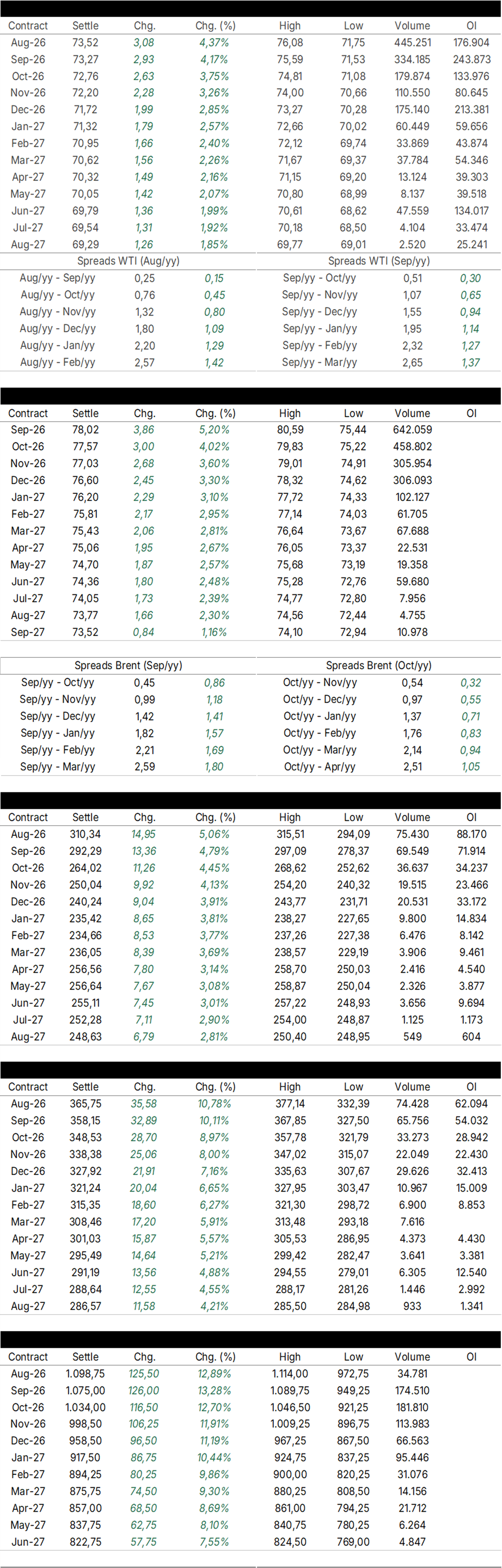
Source: ICE, NYMEX. Analysis: StoneX.