Yesterday (July 20), the most active Brent contract closed up 1.3%, quoted at USD 89.2/bbl. WTI followed the bullish movement, ending at USD 83.2/bbl (+0.9%).
The central driver was the announcement by the Yemeni Houthi group of a naval blockade against Saudi Arabia — potentially closing the Bab el-Mandeb Strait and threatening 4.5 mbpd exported via the Yanbu port. Conversely, confirmation from Tehran regarding the receipt of a ten-day ceasefire proposal rekindled expectations of reopening the Strait of Hormuz, capping the observed gains.
As of around 09:00AM on Tuesday (July 21), Brent was trading up 1.8% at USD 90.8/bbl, while the most active WTI contract advanced 1.7% to USD 83.9/bbl. The market is pricing in the possibility of an effective blockade in Bab el-Mandeb, which would result in even more significant disruptions to global crude supply.
Houthi Blockade of Yanbu Threatens Alternative Route to Hormuz Strait
The Houthis announced yesterday a naval blockade against Saudi Arabia, directly targeting the port of Yanbu—Saudi Arabia's main logistical alternative to the Hormuz Strait since the closure of the Persian Gulf. Saudi Arabia has shipped over 4.5 mbpd via Yanbu since April, with approximately 70% destined for Asia; closure of the Bab el-Mandeb Strait would force a rerouting via the Cape of Good Hope, adding roughly one month of transit time for Asian refineries.
Why does this matter: Yanbu served as the logistical cushion that contained the risk premium even with partial closure of the Hormuz Strait; its disruption would eliminate the main alternative route, exposing more than 3 mbpd of Saudi crude bound for Asia to severe delays and triggering bottlenecks in VLCC vessels, which do not cross the Suez Canal fully loaded.
What to expect? As long as the Houthi blockade of Bab el-Mandeb remains a tangible threat, the risk premium will likely widen, with potential for pronounced spot price adjustments. The current scenario is one of mounting pressure on Asian importers, who may migrate toward Atlantic-origin products, opening arbitrage opportunities. Should the blockade become operational, Brent is expected to quickly seek the USD 100/bbl range.
Diesel Spreads Remain Supported, Especially in Asia
Asian diesel markets extended gains, with refining margins for the fuel surpassing USD 85/bbl and holding at three-month highs, while regional buyers for August began to emerge, increasing demand for the fossil derivative amid tight global inventories and low expectations for new supply entering the market.
Why does this matter: The logistical bottleneck at the Hormuz Strait restricts physical flows of derivatives, sustaining backwardation and driving refining margins higher. If attacks in the Persian Gulf intensify, jetfuel and diesel destined for Asia will be rerouted, potentially impacting Brazil's import costs.
What to expect? While traffic through the Hormuz Strait remains reduced—only four commodity vessels crossed on Monday versus seven the previous day—the first-dated diesel contract spread relative to others is expected to remain elevated. The ten-day ceasefire, if confirmed, would temporarily ease spreads but would not reverse the structural short-term tightness. If the Bab el-Mandeb blockade materializes, delivery times for crude to the Asian continent would increase, also extending periods required for derivative production and raising the risk of new supply disruptions in certain countries.
Intraday Price Variation in the Energy Sector
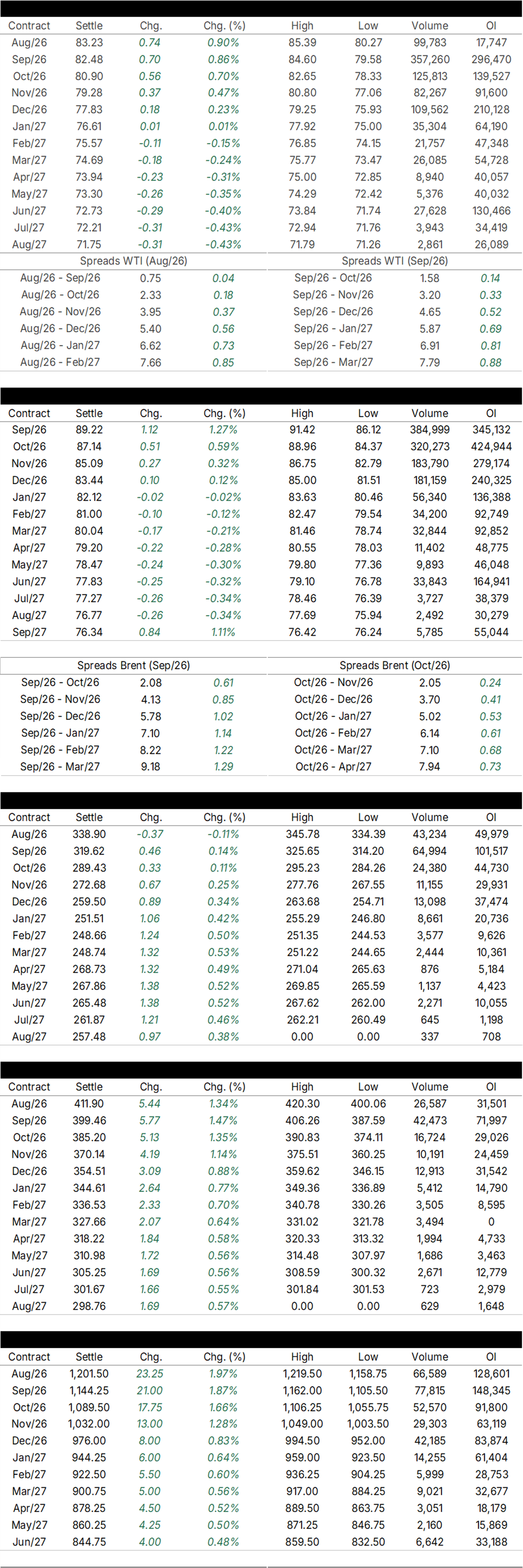
Source: ICE, NYMEX. Prepared by StoneX.