Yesterday (31), the most active Brent contract closed down 3.2%, quoted at USD 103.4/bbl. WTI futures followed the same path, ending the day at USD 101.4/bbl, down 1.5%.
Rumors regarding the Iranian regime considering ending the war in the Middle East resulted in strong bearish pressure on oil prices, which returned to trading close to USD 100/bbl.
This morning (01), the Brent contract with maturity in June 2026 is trading down 2.6%, quoted at USD 101.3/bbl (-2.6%) at 09:20. The market is pricing in a possible reduction in tensions in the Middle East amid recent remarks by Trump about a potential withdrawal of military assets from the Persian Gulf.
Trump reiterates possibility of an end to the conflict
In an interview yesterday, U.S. President Donald Trump confirmed that the country may conclude its military campaign in the Persian Gulf without a ceasefire agreement with Iran over the next three weeks, which would contribute to a sharp reduction in geopolitical risks associated with the continuation of the conflict.
Why it matters: The confirmation, made for the second time this week, regarding the possibility of withdrawing part of the military assets in the Middle East signals to the market that the White House intends to reduce tensions and the risks associated with maintaining the conflict, which helped push oil prices lower between yesterday and today.
- Additionally, rumors about Iranian President Masoud Pezeshkian’s intention to end the war contributed to boosting the bearish momentum in the market, with investors pricing in a possible return of oil flows through the Strait of Hormuz.
Overview: In recent days, Washington has signaled greater interest in ending the war, with the submission of a new peace proposal to Tehran and Trump’s recent remarks highlighting this movement.
- At the same time, the Iranian regime has escalated its rhetoric against the U.S., denying negotiations and maintaining its policy of attacking ships attempting to cross the strait without prior Iranian authorization, as in the case of a Kuwaiti tanker.
- In parallel, some sources confirmed that Iran has been applying a fee policy for vessels wishing to cross — similar to what occurs in the Suez Canal, for example. At the same time, Tehran has been limiting the passage of ships from certain origins, mainly U.S. allies.
What to expect: U.S. moves should now remain at the center of market attention. Investors appear to have “bought the rumor,” without official confirmation from Tehran regarding its intention to end the conflict.
- In this sense, if Iran continues to deny negotiations or the U.S. carries out ground invasions, oil prices should return to an upward trajectory.
- On the other hand, a potential move to withdraw military assets from the region should sustain the observed downward trend.
Surveys point to a sharp drop in OPEC production
According to a survey conducted by Refinitiv, oil production by OPEC-12 recorded a drop of 7.3 mbpd in March, operating at the lowest level since June 2020.
Why it matters: The production decline among group countries located in the Persian Gulf highlights the significant impact caused by the suspension of flows through the Strait of Hormuz, with a large portion of producers opting to reduce commodity extraction amid storage limitations.
Overview: Survey data indicate that Iraq was the most impacted, reducing its supply from 4.1 mbpd to 1.4 mbpd between February and March. During the month, the country confirmed an approximate 80% reduction in oil production, with the lack of alternative routes weighing on export capacity.
- Saudi Arabia and the United Arab Emirates also experienced production declines, although both countries operate larger alternative routes to transport the commodity.
- Bloomberg data indicate that Saudi Arabia shipped around 3 mbpd in March through the port of Yanbu, on the Red Sea, compared to 0.9 mbpd transported in February.
- Even so, the country’s total exports fell by around 3.3 mbpd last month, as volumes shipped through the Strait of Hormuz dropped from 5.3 mbpd in February to 0.1 mbpd in March.
Saudi Arabia oil exports – mbpd
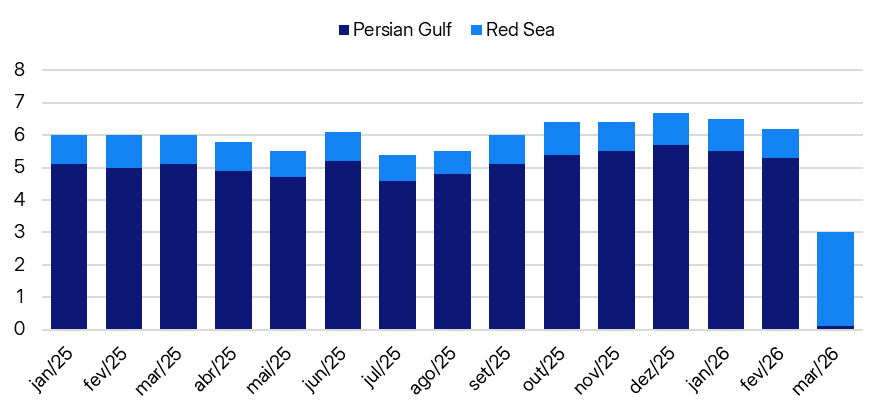
Source: BBG. Prepared by: StoneX.
What to expect: The resumption of production by OPEC countries concentrated in the Persian Gulf is directly linked to the reopening of the Strait of Hormuz. Despite the existence of alternative routes, the main logistics infrastructure of these producers is located in the Gulf, making them dependent on the reopening of the strait.




