Global
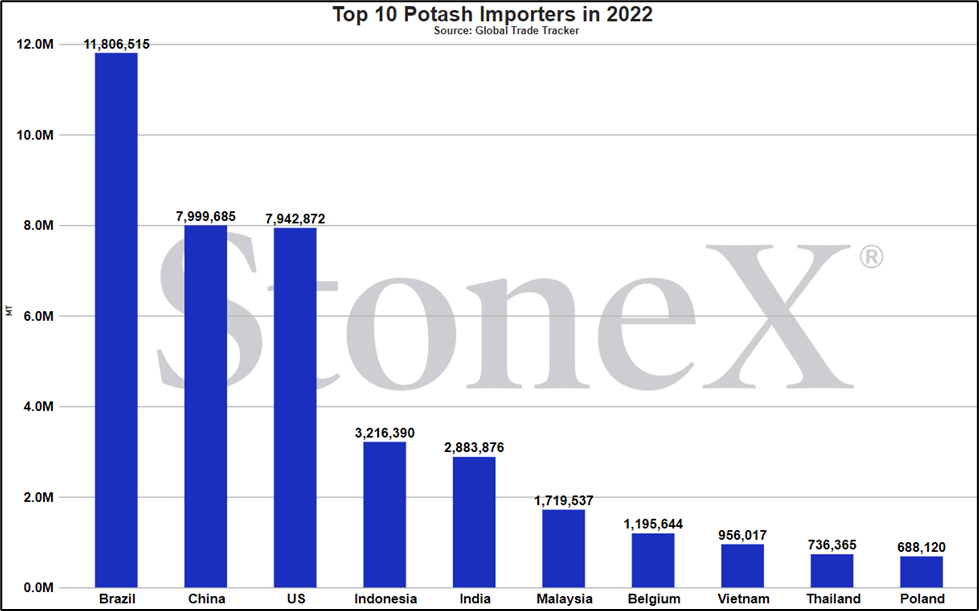
Long story short, our outlook remains relatively unchanged in the near term. It feels as though the global S&D is fairly well balanced. Not hearing anything in terms of over or under supply situations. There just isn't a standout reason for values to breakout substantially from where they are...but do not let that lull you to sleep.
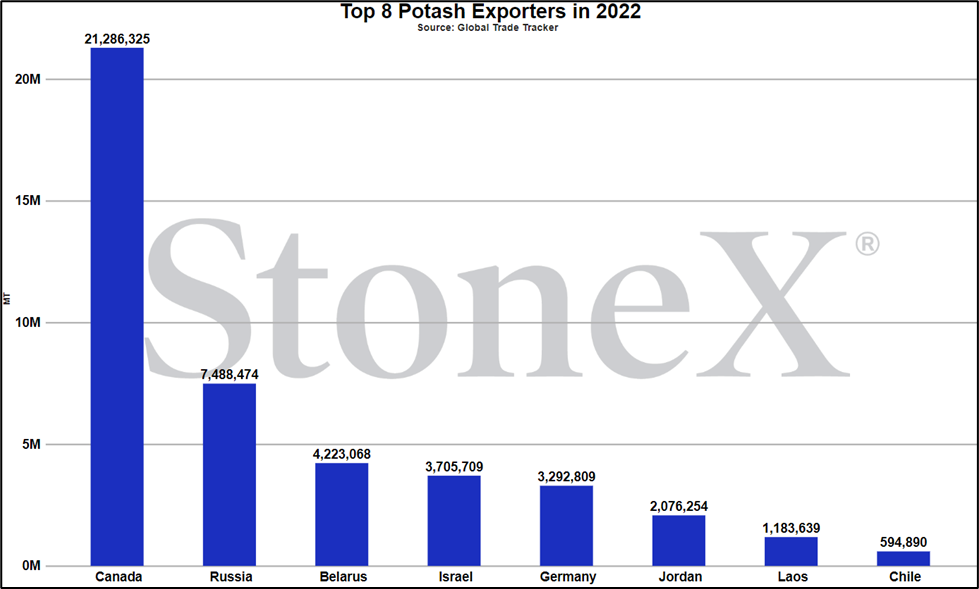
We are still watching the Israel/Hamas war with bated breath. Right now, there are prisoner/hostage exchanges as well as short term cease fires. Unfortunately, many of us know how delicate those can be. It takes one rocket, one shooting, etc. and the flames of war will resume. If that happens, we could see potash operations targeted and damaged/destroyed. While not likely, we could lose the 4th largest exporter in the world.
It is very much a "low probability/high impact" situation...but shows not to sleep on it.
North America
Like the world outlook, it is hard to see values changing substantially from where they are today. However, there are some things lining up against it that could push higher.
Transportation and carry costs are higher than they have been in the past. Those costs naturally flow to the end user (farmer). Also, N.A. had a great fall run which means plenty of warehouse space to refill in a short amount of time.
I/we are not expecting prices to skyrocket, but could see a slight appreciation going into spring.
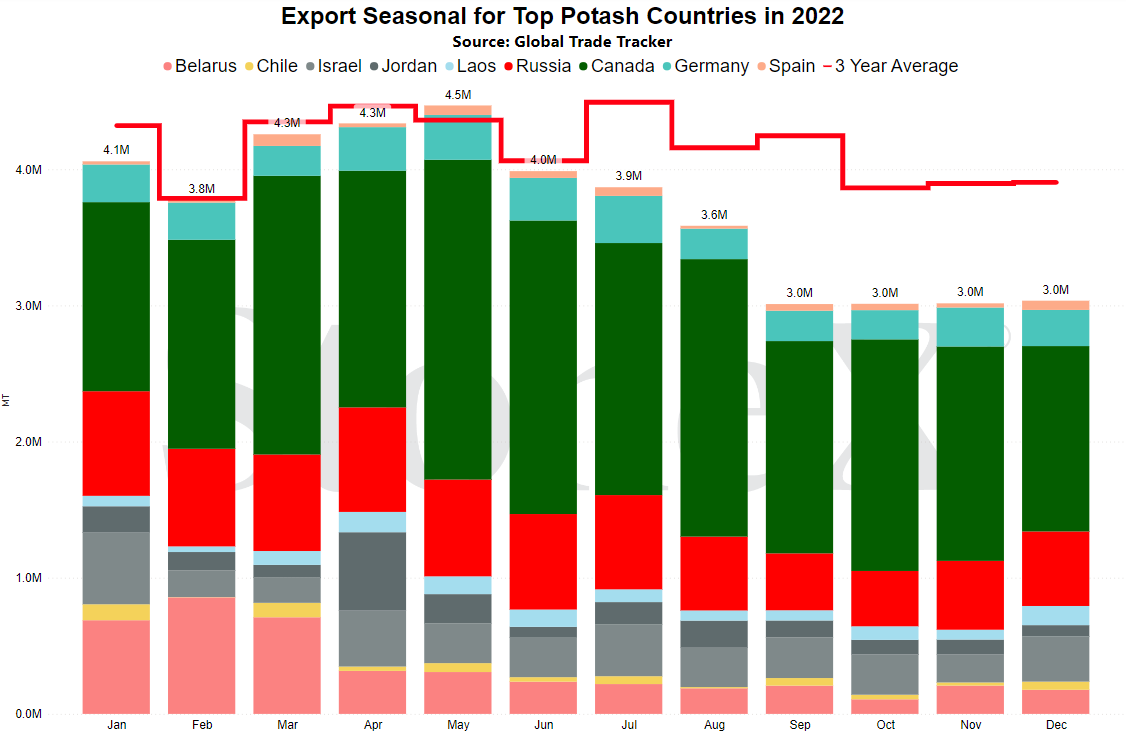
North American fall application coming to completion
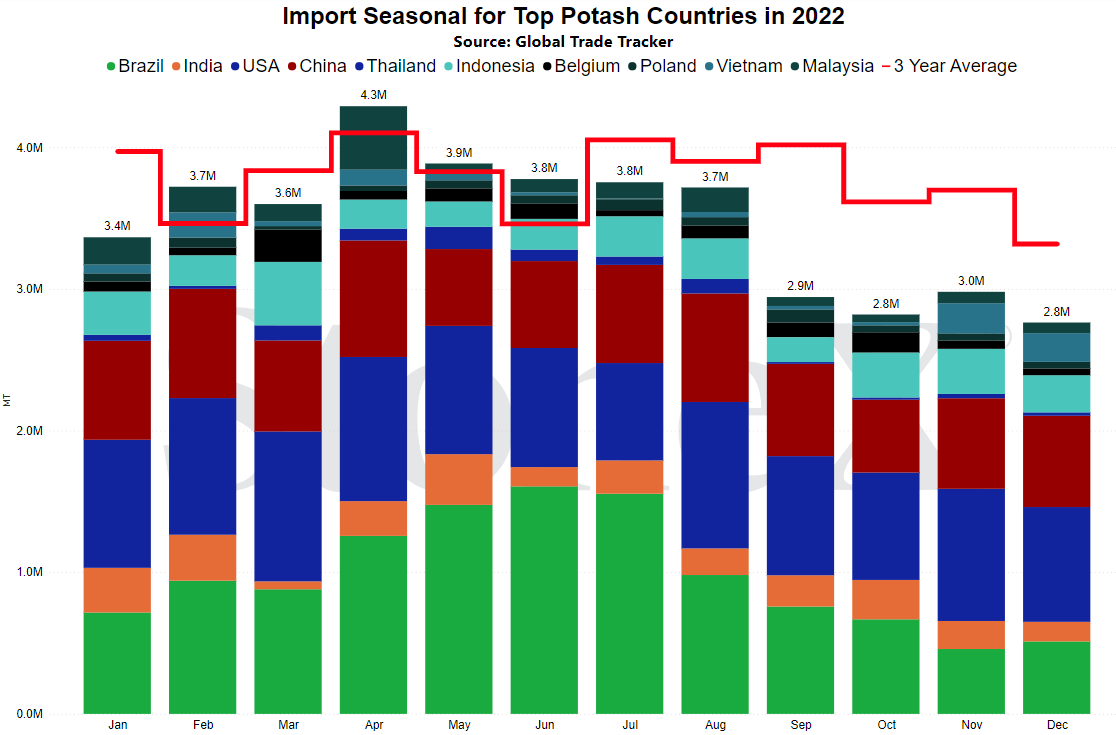
Is the North American fall run completely finished? No, but it is getting close and a lot of the signs are pointing to a really good run.
"Great, so what does that mean?"
Well, a couple things.
- It does not mean there will be no demand for the spring, but it might have lessened the load. Long and short, it means supply and logistics shouldn't be overwhelmed next spring by logistical strains like a poor fall run would have.
- However, if we emptied the system, there isn't much time to work with. I'm about as bad as they come to not liking the winter. It seems to drag on forever. However, that really isn't the case. We only have 3 months to refill the system and get ready for the spring run that can start in early March.
Yes, yes I did just make two points that contradict each other!!!
What I'm saying is that we removed the worst case scenario which would have been a really poor fall run because that would have pushed so much demand to the spring that we would have struggled. Still, that doesn't get us completely out of the woods. If you have needs for the spring, it is not to early to be having those discussions today with your retailer to make sure everyone is prepared.
Hopefully we will start putting the final touches on fall in the coming weeks and be able to tell what it was...and what we can expect.
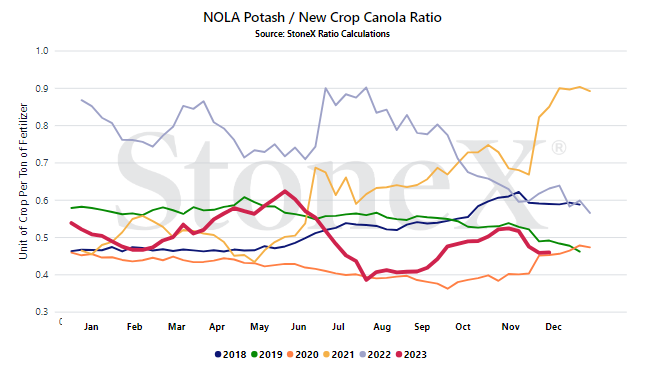
Potash values flat...why is ratio worsening?
I've gotten this question a decent amount recently. Potash values do not appear to have really moved...but the ratios have. Why?
This is the beauty of looking at the relationship between the two...and why I always say that flat prices can lie to us.
Looking at it from the NOLA/Chicago corn perspective (it is more important that you look at it from your area but I'm covering a wide audience):
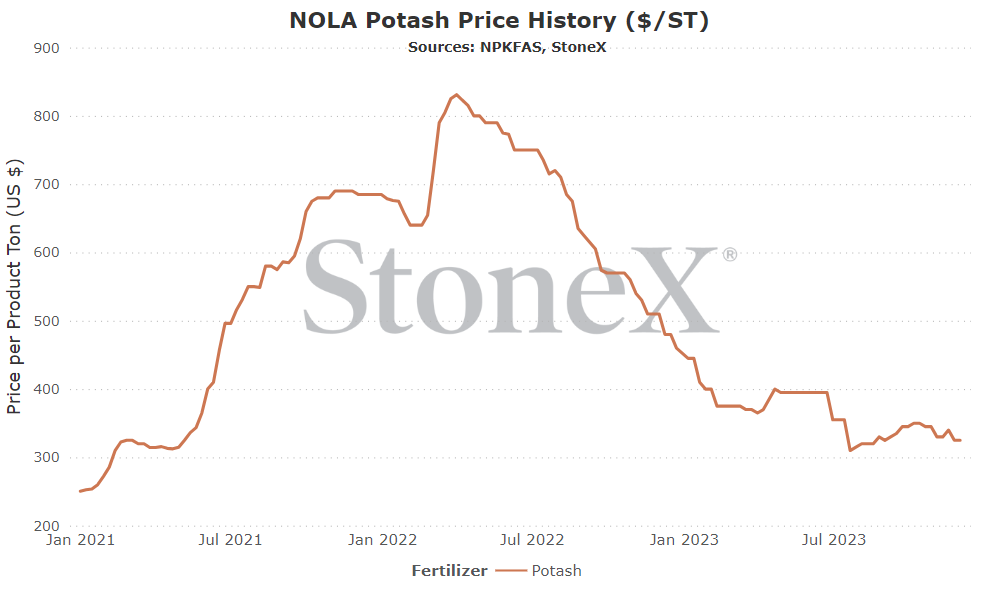
- NOLA potash has risen from $317.50 to a current $325
- Dec '24 corn has dropped from $5.35/bushel to the current $5.10/bushel
Fortunately, today the ratio is much better than it was several weeks ago when it hit near 70 (today we are 63 - 64) but it should show why we approach as we do. It is important to take note of both sides of your equation.
Values today vs summer low's
This was suggested as an addition for December (thank you Chet!!) and I thought a great add...especially because potash has been so slow!
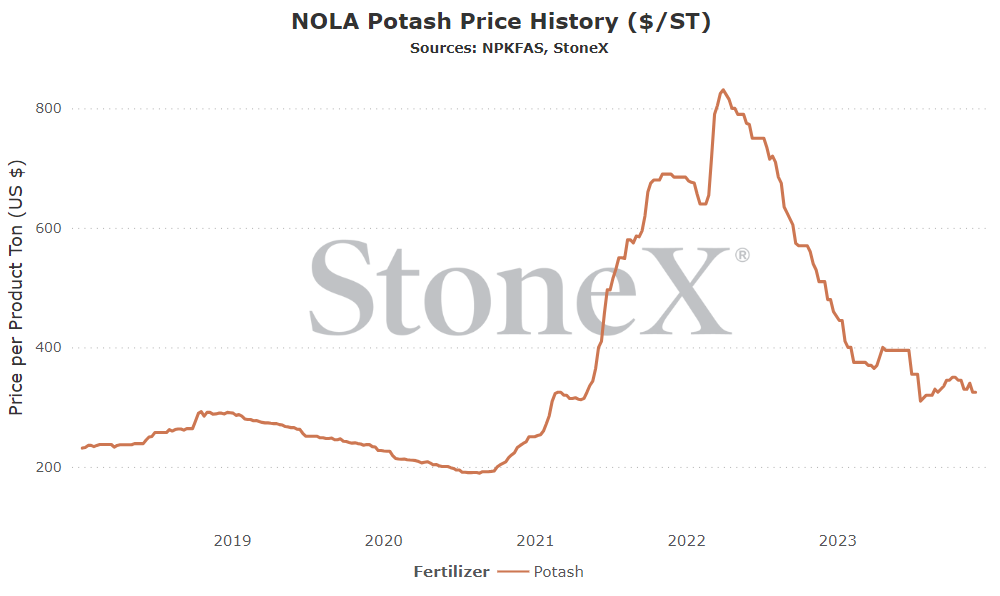
For NOLA potash, the potash market bottomed out the last week of July/first week of August at an average of around $317.50. Today, that market is relatively unchanged. This week, we set our price at $325.
The Midwest U.S. average isn't much different. The lowest value was late July and was set around $380 - $385. Today, that average is closer to $415 - $420.
You might be wondering why the Midwest value has risen so much more than NOLA. That is going to be due to logistics. This summer, logistics were much more healthy than they are today. Now, we are dealing with slow rail movements and low water flows on the rivers. Unfortunately, it is costing more to move from point A to point B.
In the end, it hasn't done much.
NOLA/New Orleans Louisiana
Vs 30 days ago - -2% or approximately $5 lower
Vs 90 days ago - unchanged
Vs 6 months ago - -18% or approximately $70 lower
Vs 1 year ago - -36% or approximately $185 lower
U.S. Midwest Average (average of several points across the Midwest)
Vs 30 days ago - unchanged
Vs 90 days ago - +3% or approximately $13 higher
Vs 6 months ago - -7% or approximately $31 lower
Vs 1 year ago - -31% or approximately $190 lower
- Israel/Hamas war could flare again – while the war between Israel and Hamas has slowed from its peak, it is far from complete/back to a truce. At any time, we could see this pick up again and with Israel being so important to the global potash market, this has to remain at the top of our bull factors.
- Big N.A. fall demand emptied warehouses - lot of the indications are that the fall N.A. potash application run was really good. If true (I believe it to be), that means we have emptied the system and now have a Herculean effort in front of us. While winter seems to linger forever, there is only 3 months until March. That doesn't leave a lot of time to refill the system.
- 2024 grain prices continue to hold – every time grain prices look like they are ready to give up and start falling, something happens and saves the day. Dec '24 corn was looking bearish...but suddenly the Brazil corn acreage estimates are being lowered due to their drought. As long as grain prices hold high, the fertilizer markets in general will continue to stay high as well.
- Longer term outlook remains soft with new production coming – this is a decently long term outlook (i.e. after/well after spring)...but it is going to be on the horizon. A lot of expansion plans were tabled when potash values fell from their high's...but not all of them. There are still plans for some new mines to be built. China continues to invest in Laos production which could largely remove them from the world demand list. From our vantage point, the outlook for potash is bearish...just a matter of when.
- High interest rates/logistics/etc. keeping demand on the sidelines - there are a lot of factors that are supporting potash values, so why wouldn't buyers step forward today? Well, there is a lot of risk in current values. Historically, we are still "high" priced. Then look at the costs. Logistics are expensive. Interest rates are high enough to be a line item so the earlier you purchase, the worse it will be. If these incidentals are big enough, demand could drag its feet...and drag prices with it.
- If it got done in the fall, it ain't there in the spring – could the fall have been big enough to steal from the spring? If the fall was that big, buyers do not need anything until fall '24. I'm not sure I'm willing to go that far...but the question has certainly been raised.
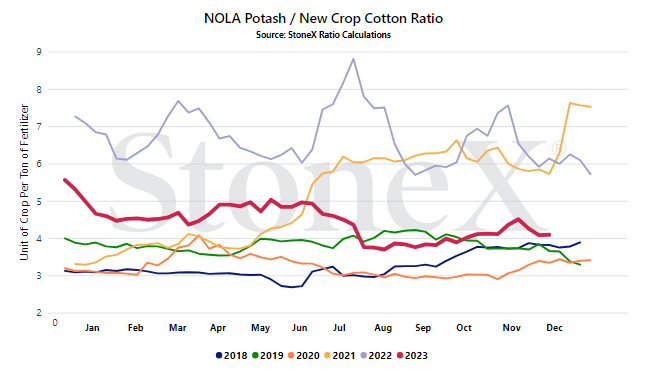
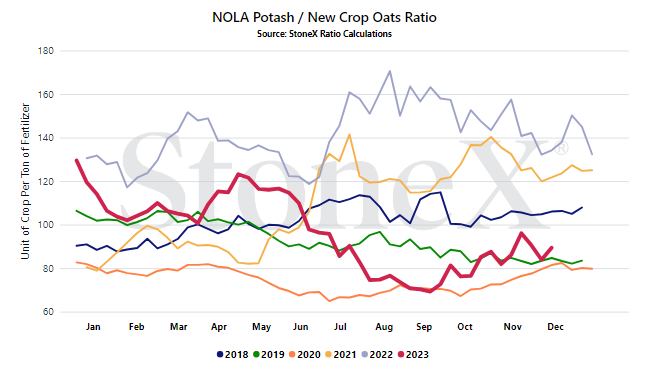
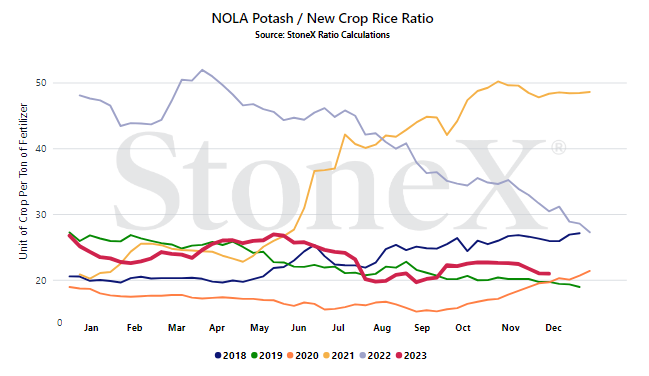
We believe that only looking at the flat price of either grains or fertilizer can be misleading:
-
Only selling grain can hurt you if fertilizer prices rise substantially
-
Only buying fertilizer can hurt you if grain prices fall
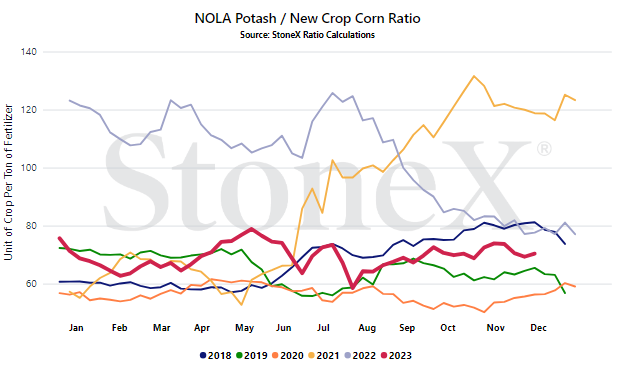
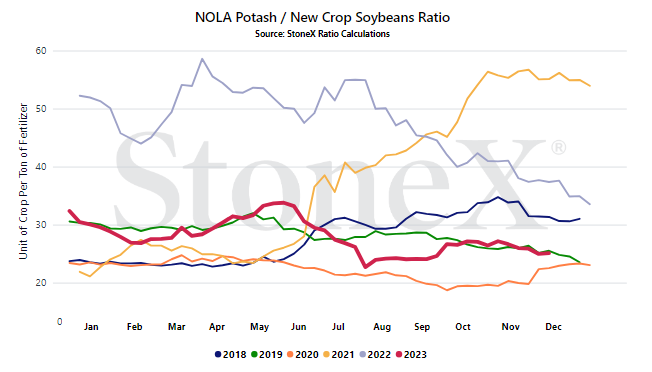
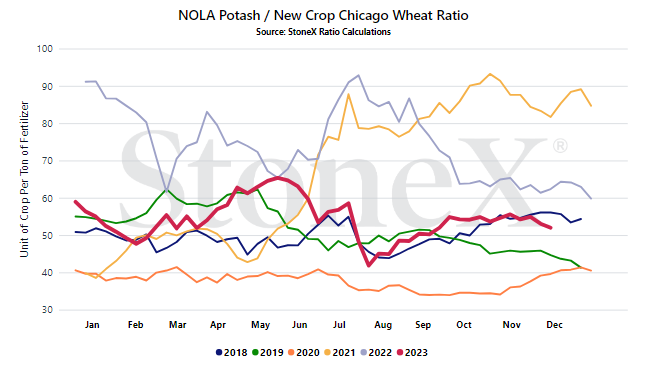
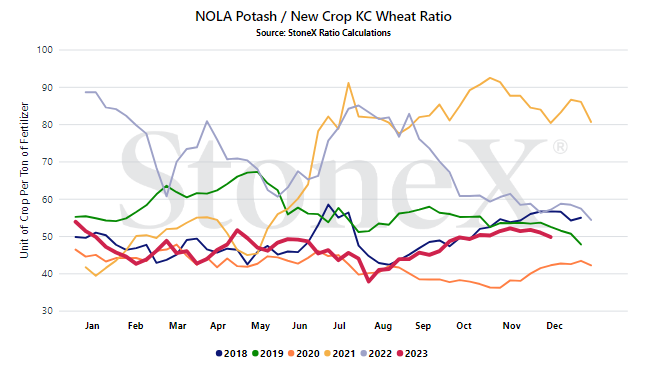
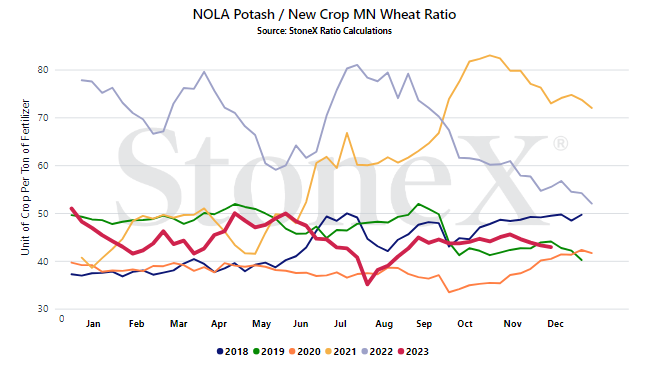
We look at the ratio "value" to get a better indication of where we are or how many bushels of X does it take to pay for 1 ton of fertilizer.
Would you rather:
-
Spend 120 bushels to pay for 1 ton of potash
-
Spend 60 bushels to pay for 1 ton of potash
When we compare the current ratio value against recent years, we start to see if we are high or low.
YOUR VALUES WILL LOOK DIFFERENT
This graph looks at the NOLA potash price vs the flat grain price. There are no logistics on either product. Your location will look different due to fertilizer logistical costs, grain basis, etc.
- Tight N.A. inventories coming out of fall season - while there is still time for more fall fertilizer application across N.A., we are getting close to the end. So far, the feedback has been that potash demand has been very good. That makes sense because the price is where it should be vs grain values. Because of that, we are likely headed into winter low on inventory levels...and there is only 3 months before March. A bigger fall run will help reduce spring demand, but a lot of indicators are that spring should be solid as well. Expect suppliers/manufacturers to remain in control of price negotiations.
- Continued solid value vs grains - already hit on the first point, potash still looks good vs grains. Hard to see demand waning with this type of relationship. As long as demand remains, hard to see prices falling off. Weirder things have happened, but we certainly do not expect it.
- Israel/Hamas war - as mentioned in previous months, Israel was the 4th largest potash exporter in the world last year. Fortunately, operations have remained untouched in Israel. Even more fortunate is the fact that tempers are dropping. We are not out of the woods, but it has slowed tremendously and both sides have been willing to exchange people/hold a cease fire/etc. Hopefully this bullet point can be removed from consideration shortly...just not today.
StoneX Ratio Calculation
The ratio calculation is derived from Bloomberg historical grains values as well as fertilizer values from StoneX, NPKFAS, and Argus.
The calculation is simply dividing the fertilizer price by each grain price.
All data was sourced from StoneX unless otherwise noted.
This material should be construed as market commentary, merely observing economic, political and/or market conditions, and not intended to refer to any particular trading strategy, promotional element or quality of service provided by the FCM Division of StoneX Financial Inc. (“SFI”), StoneX Financial (Canada) Inc. (“SFFC”) or StoneX Markets LLC (“SXM”). SFI, SFFC and SXM are not responsible for any redistribution of this material by third parties, or any trading decisions taken by persons not intended to view this material. Information contained herein was obtained from sources believed to be reliable, but is not guaranteed as to its accuracy. Contact designated personnel from SFI, SFFC or SXM for specific trading advice to meet your trading preferences. These materials represent the opinions and viewpoints of the author, and do not necessarily reflect the viewpoints and trading strategies employed by SFI, SFFC or SXM. The FCM Division of StoneX Financial Inc., a subsidiary of StoneX Group Inc., is a member of the National Futures Association (“NFA”) and registered with the U.S. Commodity Futures Trading Commission (“CFTC”) as a futures commission merchant and commodity trading advisor. StoneX Financial (Canada) Inc. is currently registered as a Futures Commission Merchant or equivalent in all provinces of Canada and is a member of the Investment Industry Regulatory Organization of Canada.