The intention of the below graphs are not to use to say "my price should be X based on this graph". These prices are derived from an FOB price point average. The intent is to show major global price movement trends. Your values will likely have significant basis difference (similar to your local grain price being different than the traded market price).
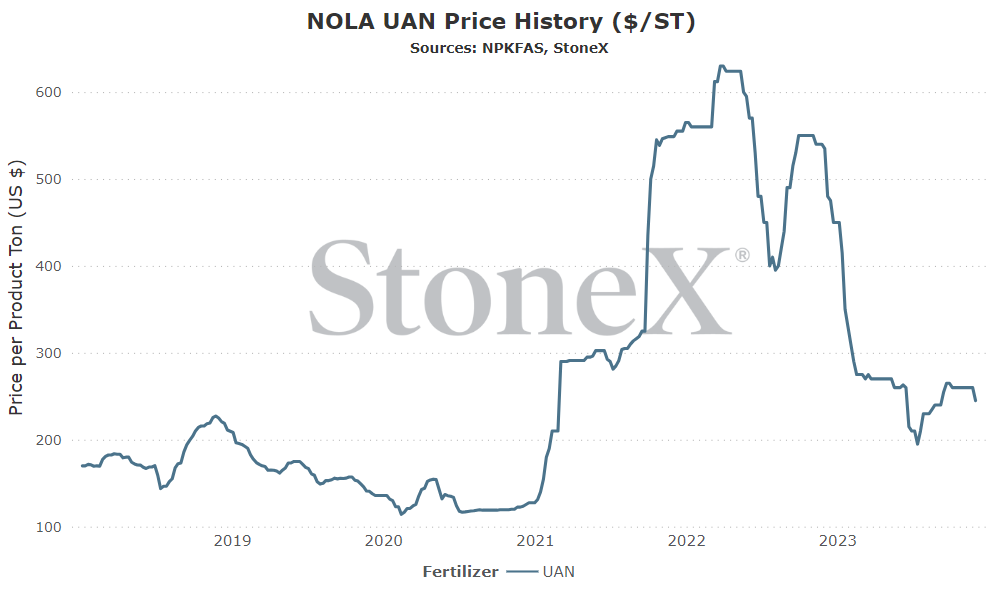
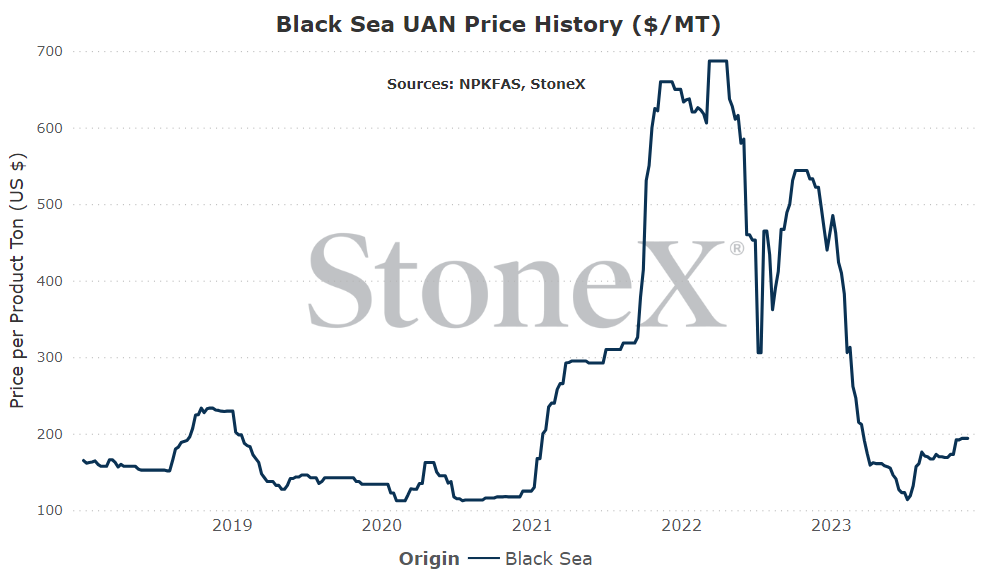
This graph is labeled as MT in USD currency.
| NOLA UAN | |
| December | $250.00 |
| January '24 | $245.00 |
| February | $245.00 |
| March | $245.00 |
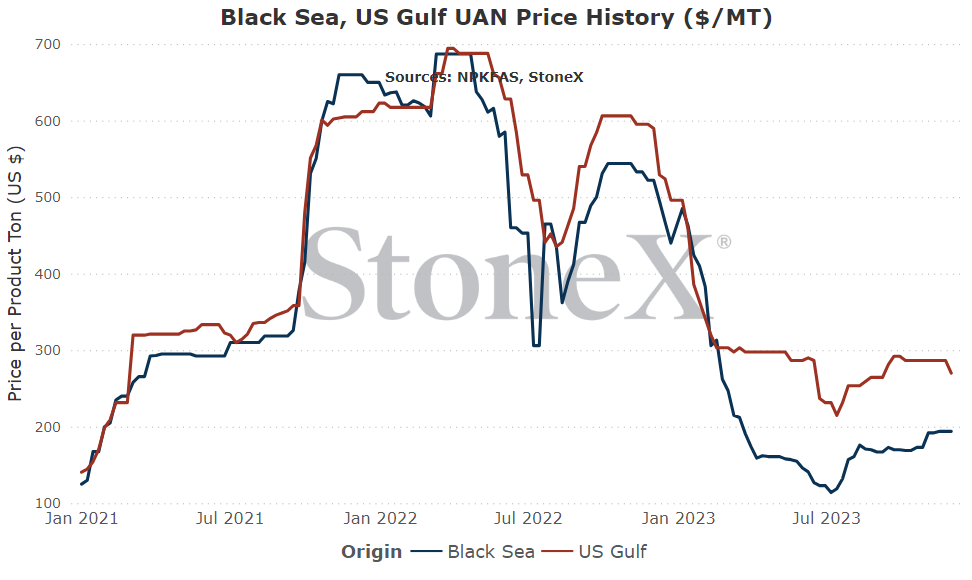
Global values have remained flat in the face of declining urea values
There really hasn't been much change on the global side of the UAN marketplace.
- Russian FOB values haven't really budged.
- European production rates for UAN remain unchanged.
- North American import/exports are near ton for ton.
Honestly, the only thing that has really changed is that urea values have fallen. After the last India tender, there has been relatively few buyers in the world and values have seen a lot of pressure. UAN went from being almost underpriced to be overvalued. Now, we are starting to lean more to the bullish side going forward on the urea market so this is probably going to be short lived.
Still, sometimes fertilizer markets can get like this where nothing happens for a period of time. UAN is there now.
North American market supplies remain snug on heavy exports/production issues
The North American UAN marketplace has had a lot of hits this year:
- Starting inventories for the fertilizer year were lower than expected due to "running out" of urea.
- Several N.A. production plants had planned downtime which chewed into normal supplies.
- Those same plants and others had unplanned downtime which really chewed into normal supplies.
- The import/export balance is near even, meaning N.A. hasn't really gained additional product.
All of these combine to create a marketplace that is much more snug than we would have thought months ago. Unfortunately, that is the market as it is and we have to deal with it. It doesn't mean product is going to be impossible to find, though some to the north have been dealing with a situation that is nearly that. It is a situation where prices are going to be more proud.
NOLA/New Orleans, Louisiana
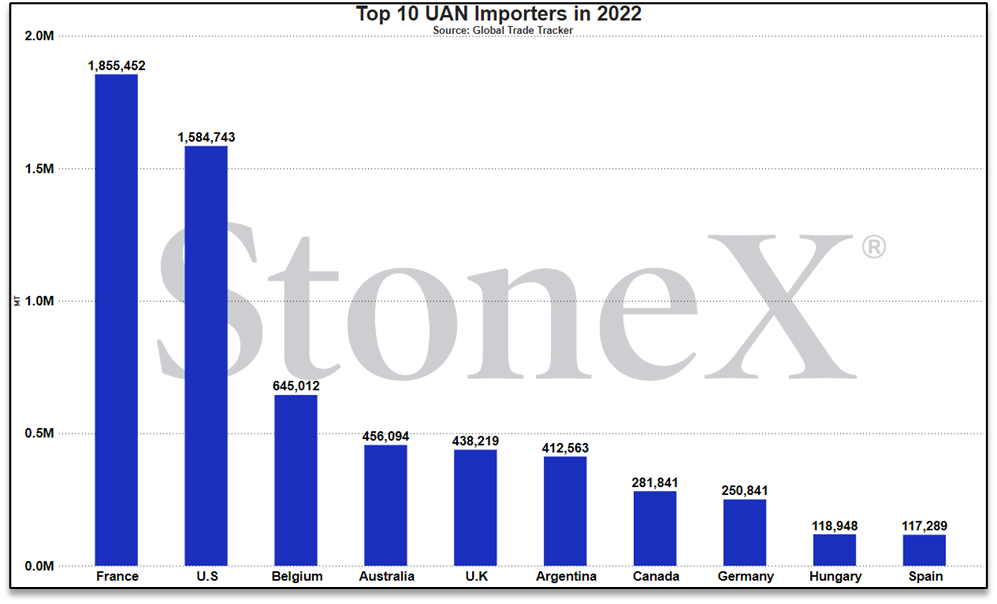
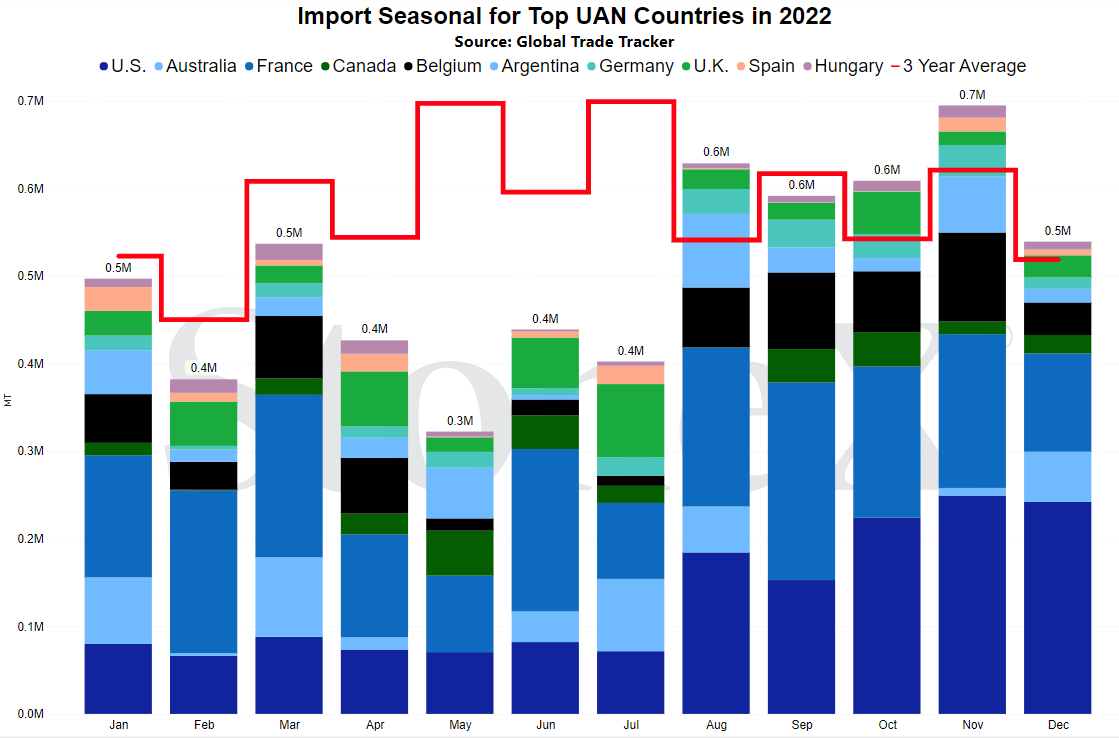
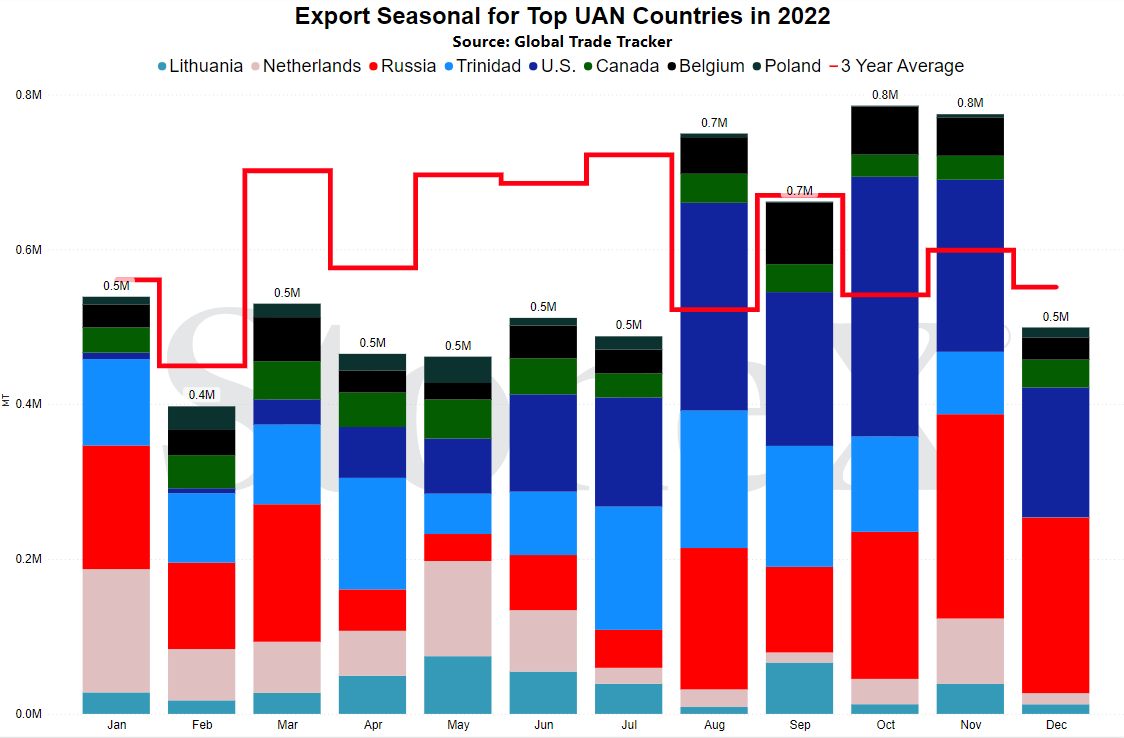
Number 2 global importer in 2022
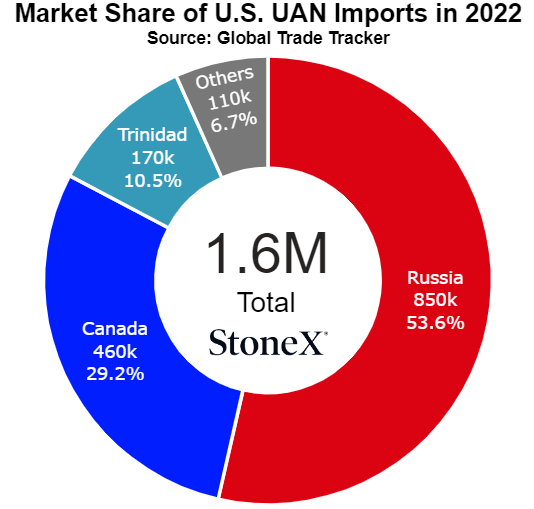
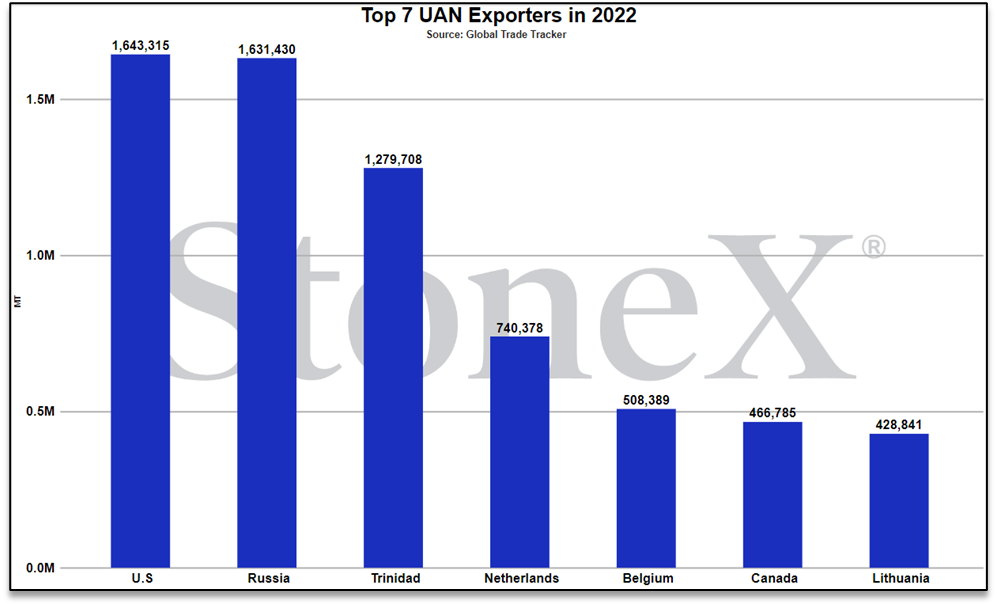
Number 1 global exporter in 2022
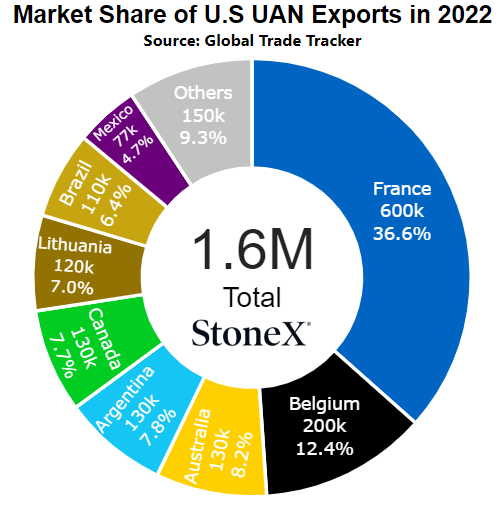
Price Comparisons
Vs 30 days ago - -6% or approximately $15 lower
Vs 90 days ago - +2% or approximately $5 higher
Vs 6 months ago - -6% or approximately $15 lower
Vs 1 year ago - -54% or approximately $290 lower
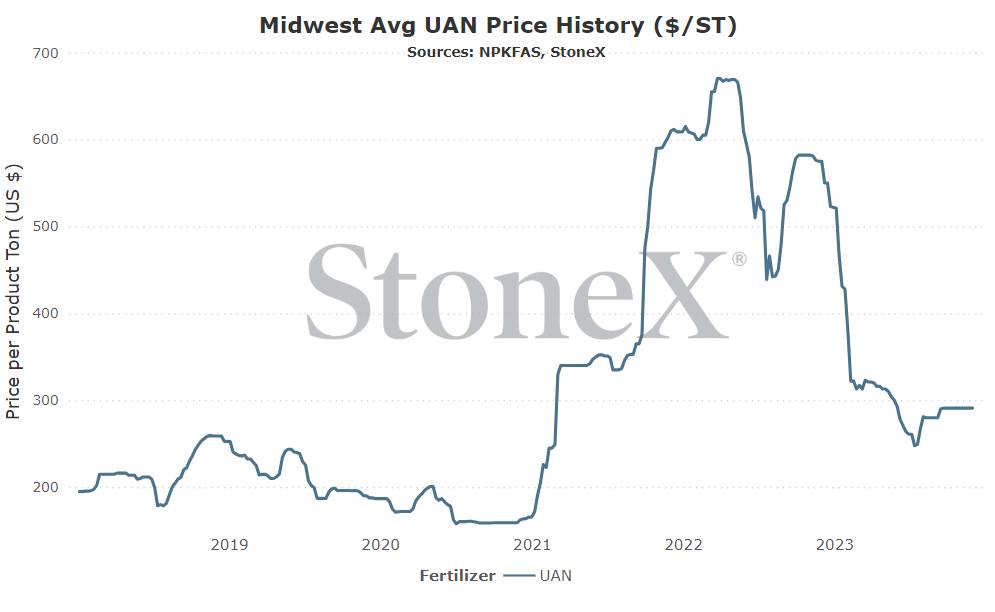
U.S. Midwest Average
Vs 30 days ago - unchanged
Vs 90 days ago - +4% or approximately $12 higher
Vs 6 months ago - -1% or approximately $2 lower
Vs 1 year ago - -49% or approximately $284 lower
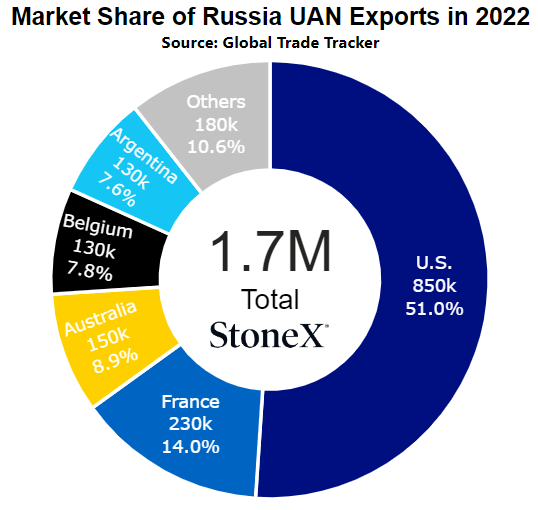
Black Sea (Russia)
Number 2 global exporter in 2022
Price comparisons
Vs 30 days ago - unchanged
Vs 90 days ago - +9% or approximately $24 higher
Vs 6 months ago - -10% or approximately $30 lower
Vs 1 year ago - -52% or approximately $301 lower
- Spring N demand outlook remains high – there are a lot of reasons to stay optimistic for nitrogen demand going forward. Especially for UAN. Brazil is struggling with a tough drought and corn acre expectations are being cut. My guess is those bushels are still needed and could see North America step up. Brazil doesn't use UAN...but North America does. The swing of acres could bump up UAN in that way.
- N.A. inventories remain snug – tight beginning fertilizer year inventories + summer production problems cutting into expected available tonnage + imports/exports being almost the exact same = a marketplace that doesn't have a lot of extra product laying around. That is a win for manufacturers.
- European production remaining steady/higher is far from a slam dunk – yes, Dutch TTF values have seen the winter months fall back to the $13 - $14MMbtu range and raise the prospect of remaining offline plants might reconsider and restart...but I'm not holding my breath that happens. Likely we will remain steady to where we are now...sub normal production rates.
- Urea values have been falling – in the last week or two for NOLA, UAN was a heft premium vs urea. It was enough that there was a slight cut in UAN prices to help boost sales. The fact that urea rebounded $30 on Friday likely means the price cut will be gone at the beginning of this week. Still, it shows that if urea falls back or further down, UAN could struggle to hold. It does not want to repeat the sins of last winter.
- European outlook remains decent for production – what I mean by this is that current production rates are still 70 - 80% or normal, and Dutch TTF values have been under a little pressure. I doubt we see further plants restart, but it does lower the chance of losing more.
- Year end/beginning sales could disappoint – this is a bit of a stretch. Frankly, I do not believe it right now. Lot of signs pointing to a solid amount of dollars to be spent. However, if after last winter farmers decide to go with the cheaper urea alternative, UAN could be disappointed and forced to lower values to compete. Again, I am not a believer in this one, but it is something to watch.
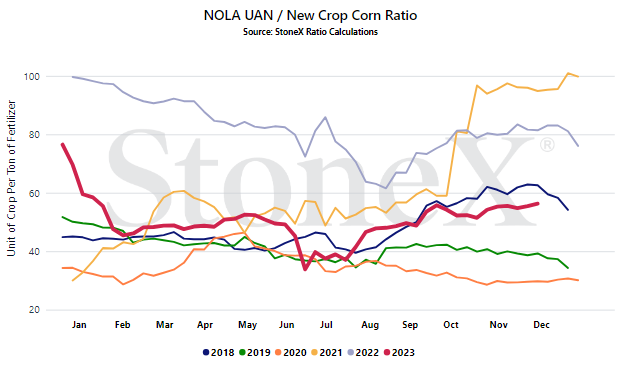
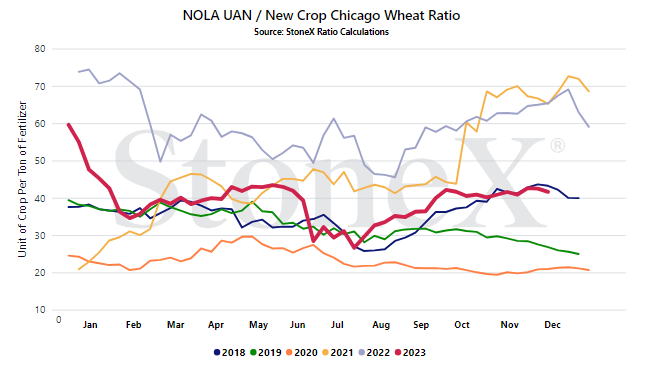
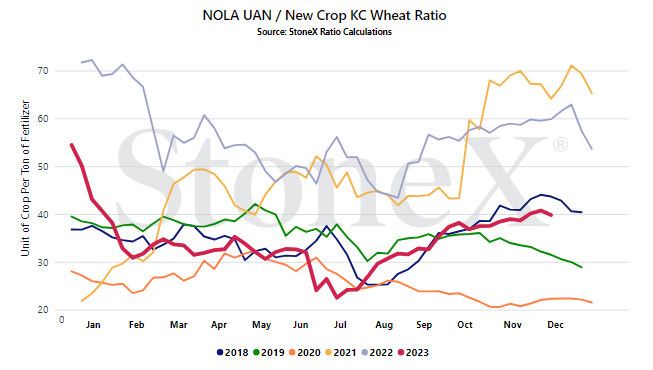
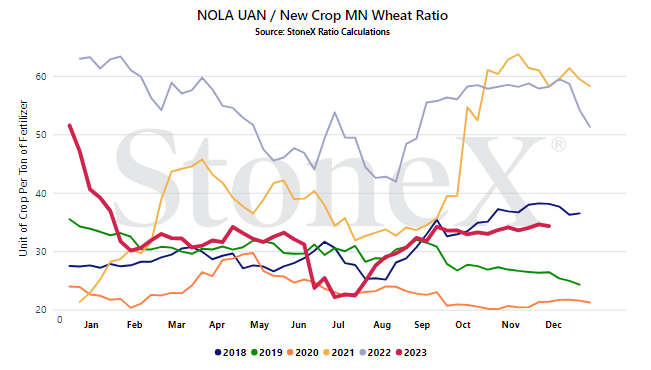
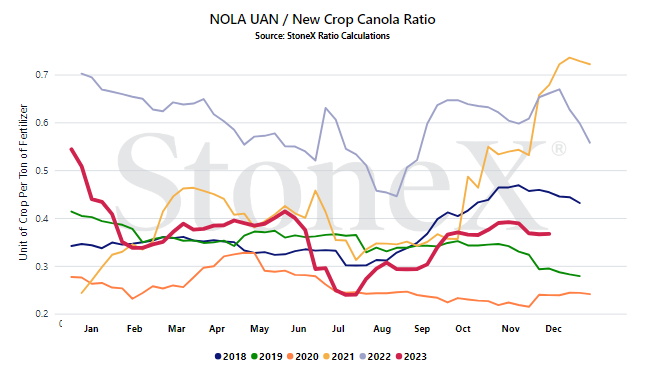
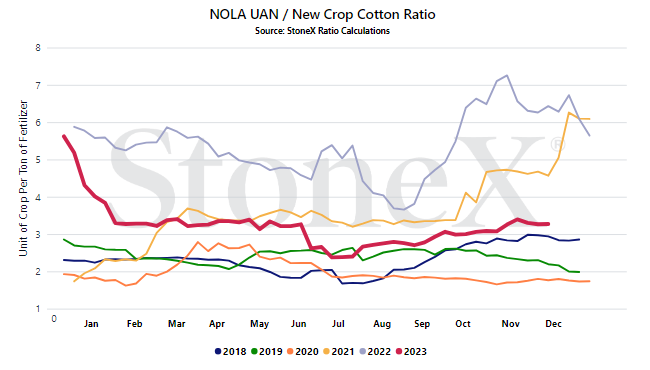
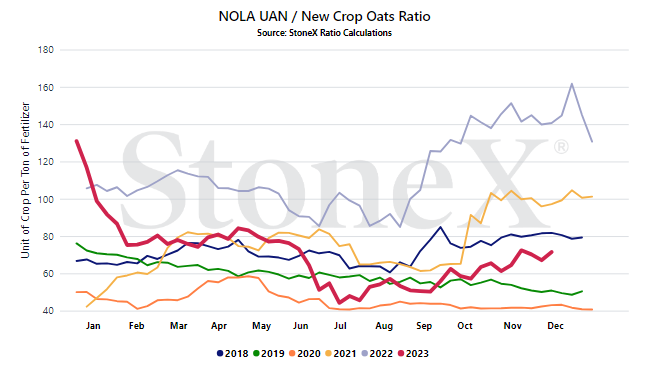
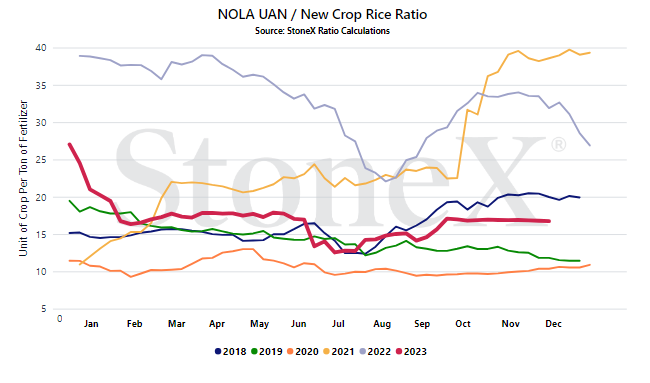
We believe that only looking at the flat price of either grains or fertilizer can be misleading:
-
Only selling grain can hurt you if fertilizer prices rise substantially
-
Only buying fertilizer can hurt you if grain prices fall
We look at the ratio "value" to get a better indication of where we are or how many bushels of X does it take to pay for 1 ton of fertilizer.
Would you rather:
-
Spend 100 bushels to pay for 1 ton of UAN
-
Spend 60 bushels to pay for 1 ton of UAN
When we compare the current ratio value against recent years, we start to see if we are high or low.
YOUR VALUES WILL LOOK DIFFERENT
This graph looks at the NOLA UAN price vs the flat grain price. There are no logistics on either product. Your location will look different due to fertilizer logistical costs, grain basis, etc.
- European production rates/Dutch TTF values - unfortunately, Europe remains the high cost producer in the world for UAN which means it goes a very long way in determining global values as it is turned on and off to balance the global S&D. Fortunately, Dutch TTF values have been under pressure heading into winter but a change in longer term forecast could change that direction in no time.
- North American year end/beginning prepay success/failure - we will soon find out how the rest of the fertilizer year is going to go. The year end/beginning prepay season is very important for the direction of UAN. If sales volumes are good, manufacturers will be comfortably sold into the start of spring and can be more proud of values. If it is a bust (like last year), values will struggle to hold as those manufacturers struggle to find sales.
- Urea markets - urea is a nitrogen fertilizer. UAN is a nitrogen fertilizer. While each operates on its own unique S&D, they are still related and struggle to get too out of sync. If urea values remain under pressure like they have been, UAN might be forced to drop. If urea values rebound or start pushing higher, it could easily pull UAN values up with it.
StoneX Ratio Calculation
The ratio calculation is derived from Bloomberg historical grains values as well as fertilizer values from StoneX, NPKFAS, and Argus.
The calculation is simply dividing the fertilizer price by each grain price.
All data was sourced from StoneX unless otherwise noted.
This material should be construed as market commentary, merely observing economic, political and/or market conditions, and not intended to refer to any particular trading strategy, promotional element or quality of service provided by the FCM Division of StoneX Financial Inc. (“SFI”), StoneX Financial (Canada) Inc. (“SFFC”) or StoneX Markets LLC (“SXM”). SFI, SFFC and SXM are not responsible for any redistribution of this material by third parties, or any trading decisions taken by persons not intended to view this material. Information contained herein was obtained from sources believed to be reliable, but is not guaranteed as to its accuracy. Contact designated personnel from SFI, SFFC or SXM for specific trading advice to meet your trading preferences. These materials represent the opinions and viewpoints of the author, and do not necessarily reflect the viewpoints and trading strategies employed by SFI, SFFC or SXM. The FCM Division of StoneX Financial Inc., a subsidiary of StoneX Group Inc., is a member of the National Futures Association (“NFA”) and registered with the U.S. Commodity Futures Trading Commission (“CFTC”) as a futures commission merchant and commodity trading advisor. StoneX Financial (Canada) Inc. is currently registered as a Futures Commission Merchant or equivalent in all provinces of Canada and is a member of the Investment Industry Regulatory Organization of Canada.