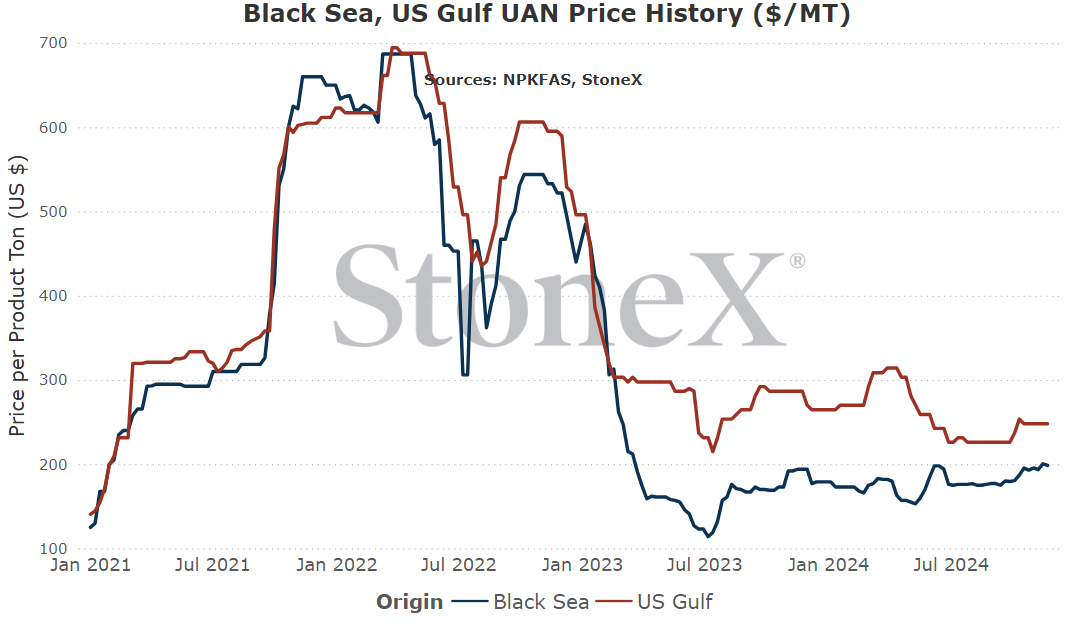
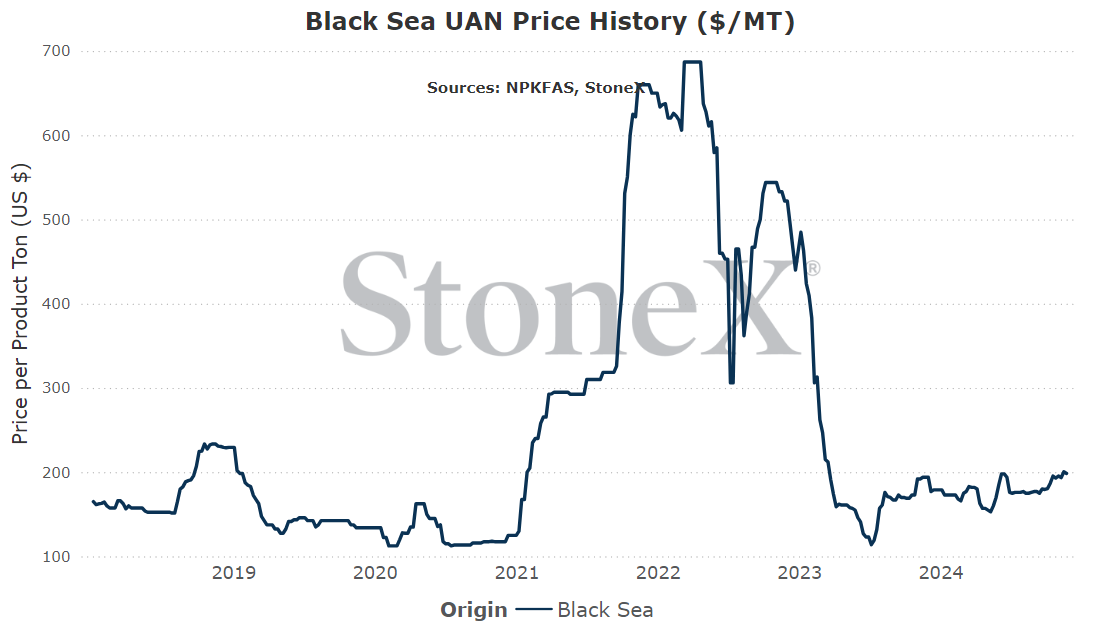
The intention of the below graphs are not to use to say "my price should be X based on this graph". These prices are derived from an FOB price point average. The intent is to show major global price movement trends. Your values will likely have significant basis difference (similar to your local grain price being different than the traded market price).
This graph is labeled as MT in USD currency.
Escalations in the Russia/Ukraine war raise export worries
Recently, we have seen major escalations in the war between Russia and Ukraine. One would think that the war claiming the lives of over 1M soldiers would be enough of an escalation...but this week proved otherwise. The first step was made by Ukraine when they got permission from the west and used the American made ATACMS missile system on Russian targets in Russian territory. Putin had long warned that using this system on Russian soil would be seen as a major escalation and would cause Russia to respond.
Putin didn't take long to respond.
Only a couple days later, a Russian missile attack used previously unused equipment. It was originally thought to be ICBM's but was later discovered to be systems never used on battlefield before. Regardless of what it was, it was a statement attack. Putin was effectively warning the world that if it continues to support Ukraine, these weapons are at their disposal.
As of this writing, we have not seen any response from the Ukraine, but we are watching closely.
So, what could this mean for fertilizer?
Our fear is that this escalation will be seen as a last straw and more western nations/Ukraine allies will begin to block Russian produced fertilizers. This morning saw Poland, Latvia, Estonia, and Lithuania submitting letters to the EU to make these steps. Putting the atrocities of war aside, we need to focus on the fertilizer impact here. What could these types of steps mean for UAN?
For most other fertilizer commodities, this isn't that large a deal. Let's use an example where Russia exports 1M tons of fertilizer X annually. That 1M tons is used in the global fertilizer markets annual S&D. Now, western allied nations start saying no to Russian imports and block the flows. Should the global value rise? Well, that depends. If there are enough nations around the world that say no that Russia can no longer find homes for 1M tons per year, then that lowers supplies and prices should rise. However, if they can shift their shipments to "friendly" countries like Brazil, India, etc. and their exports remain at 1M tons per year, global supplies have not changed. Now, the countries that blocked the tonnages from Russia are going to pay a higher price as they have actively blocked a supply flow and forced its market to find replacement product from other locations. On the flip side, Russia should get more aggressive in the nations it can still ship to in order to force out other suppliers. In this case, those with tariff's have higher prices and those without have lower.
When we look at urea/potash/phosphate, we think Russia will have enough friendly nations to continue shipping normal supplies...but not UAN.
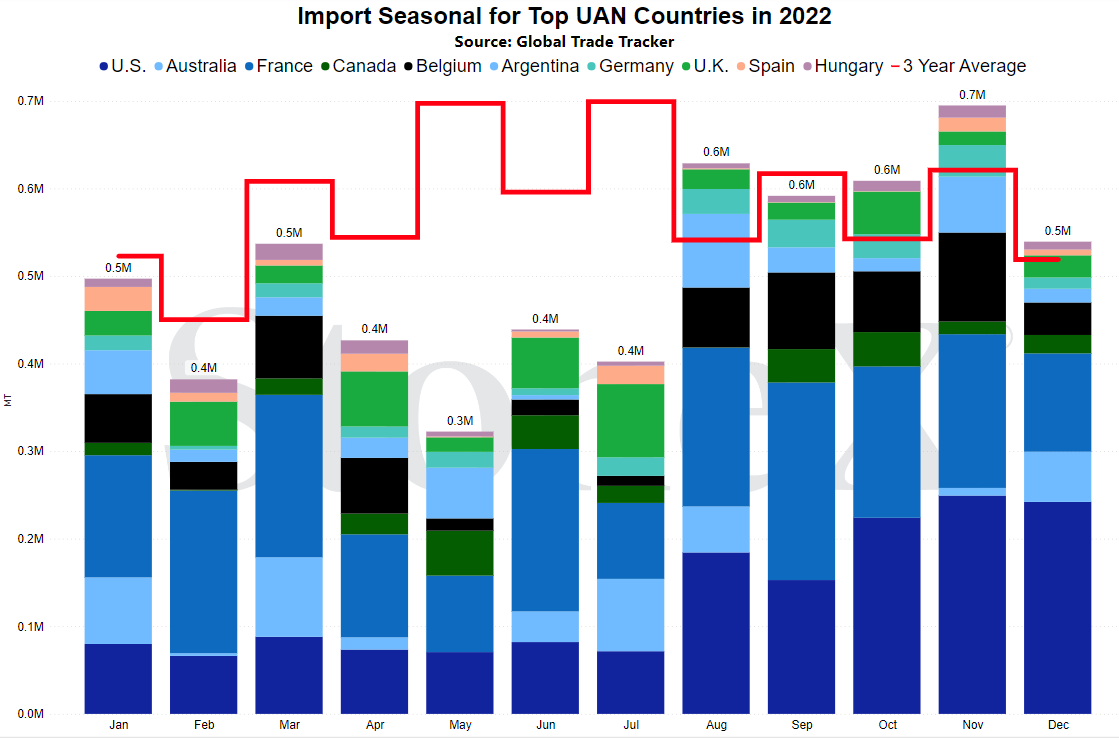
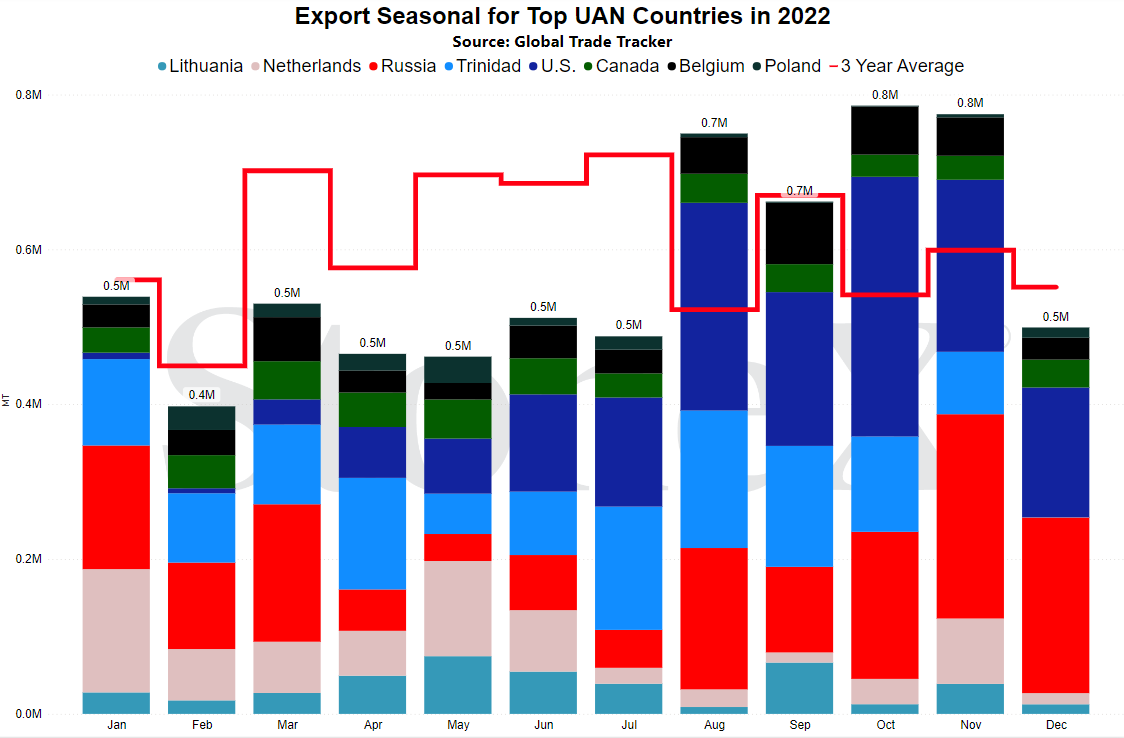
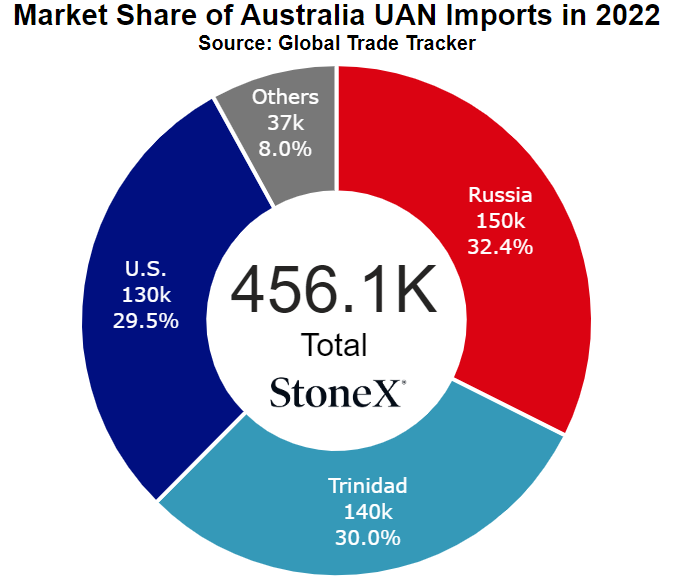
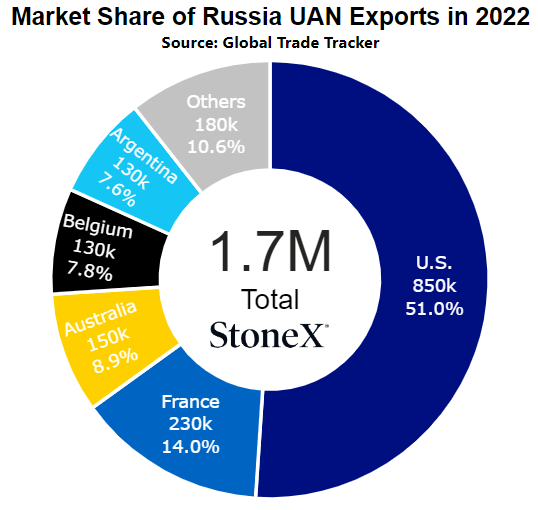
We have already been seeing Russian UAN exports lower this year due to inability to find homes. Australia and Canada have both shut their borders. Europe has made it difficult, and it looks like it could get much worse soon. That leaves the U.S. as one of the remaining "major" destinations open to Russia...and there is certainly a case to be made that we could see that door close.
UAN simply isn't the major nitrogen product globally like urea and NH3 are. Liquids are harder to transport and harder to apply. Dry products can be used globally. You can stick the product in 50-pound sacks which are easy to move around. Farmers that still use basic equipment can apply the product by flinging it to the field using their hands. A nation has to have a rather sophisticated and technologically advances application process to use UAN.
Going forward, if we see the EU collectively block Russian UAN, it should make Russia that much more reliant on the U.S. to offload its product...but how much and for how long? If the U.S. becomes one of the few major destinations, Russia should get more aggressive and keep prices in check. However, if we suddenly see Washington D.C. take steps to mirror our allies in the EU, N.A. manufacturers will have almost full control of the market by being able to either sell at home...or over to Europe to backfill offline production.
Right now, we do not know if the EU will move forward with these threats. We do not know how the war will continue to escalate. We do not know how the rest of the world will respond to Russia's invasion.
What we do know is that these events halfway around the world matter at home...
What does this mean for Aussie farmers
If Russian tensions continue, UAN is the one fertilizer export that they do not have a lot of options on. The U.S. has become one of their few major demand homes and if they lose that, they are stuck. Now, incoming President Trump and President Putin seem to have a more cordial relationship than with the current administration. There is a chance we could see the conflict brought to a close...but no guarantee.
Just know that if we head down a road where the U.S. blocks UAN imports from Russia, it gives manufacturers there more confidence to move price ideas higher...and that should translate to higher values being offered to Australia.
European gas values rise, how long can nitrogen production continue?
Not only are some EU nations calling for further import restrictions on Russian produced fertilizers, but the region is also now having to start fearing more domestic production shutting down due to higher natural gas values.
For a short backstory, the EU region has historically had cheap natural gas from Russia. The flows would come thru the Nordstream pipeline and provide cheap inputs to the industrial sector and provide cheaper values to the public. However, when Russia was wanting to lean more into the shipments by building the Nordstream 2, Europe was moving quickly to green alternatives. Then, fears started to grow that Russia was planning an invasion of Ukraine which further heightened tensions. Long story short, Russia eventually stopped gas flows, and "someone" made sure those flows didn't restart by attacking the pipeline in deep ocean waters. The result was devastating. Dutch TTF (European natural gas market we track) historically had remained in the low to mid-single digits range. By August 2021, that same market reached a record high $103MMbtu. Industrial demand, including nitrogen production, was forced to shut down as losses mounted.
Recently, values have corrected. Last winter saw a warmer winter than normal combined with extremely full storage. The result was that values feel back to $7MMbtu. Most nitrogen fertilizer production restarted, but about 25% remained offline and the fear is growing that these plants will not produce another ton.
Now, gas values are climbing again. Nowhere near the triple digit price seen in August '21 but still a historically healthy $15 price for January/February. As these prices climb, our fear is that some high-cost manufacturers will be forced to idle production once again. Global nitrogen urea values have been under pressure and costs to produce are rising...dangerous combination.
Today, we have neither seen nor heard of any online plants shutting down. The fear is purely speculation, but the fundamentals support the fear. If input prices continue to rise, eventually there will be a pain point where someone(s) say enough is enough and Europe is already reliant on other global manufacturing regions for their production shortfalls. N.A. has been a healthy recipient of this newfound demand which has helped keep their values higher.
What does this mean for Aussie farmers
The global UAN market is already relatively small which means any production losses are going to be felt.
If more European based N production goes offline, that reduces their supply and builds global demand that should be taken care of by N.A. manufacturers. If N.A. manufacturers now have even more places to go with product, they will be more confident in pushing their price ideas higher. If they push their price ideas higher, that will include any exports destined for Australian shores...
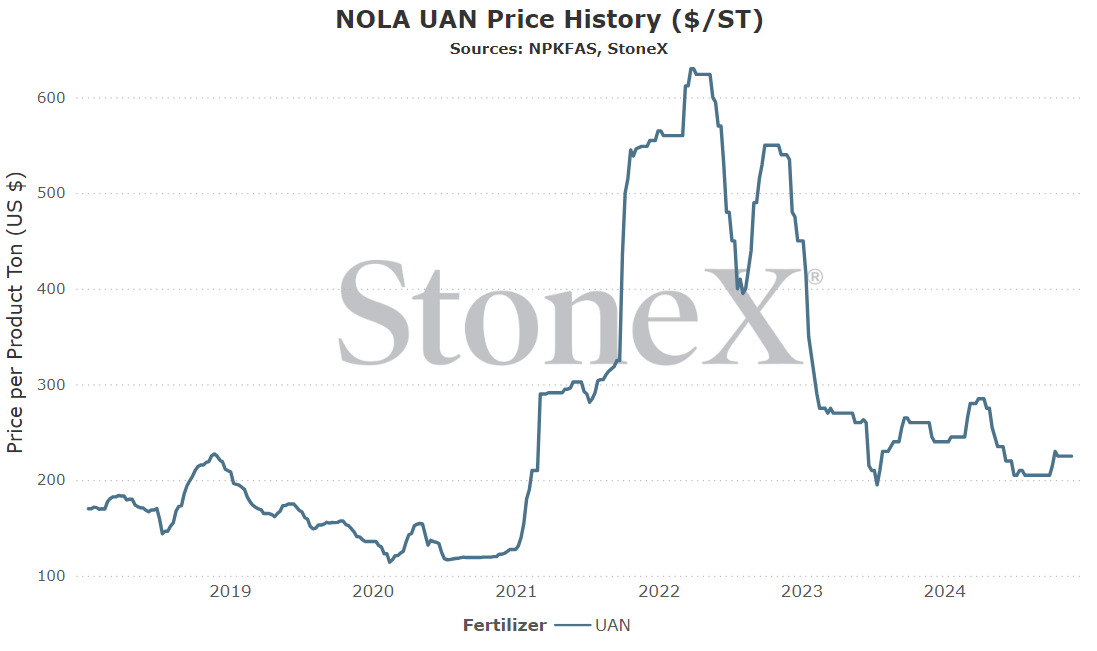
NOLA/New Orleans, Louisiana
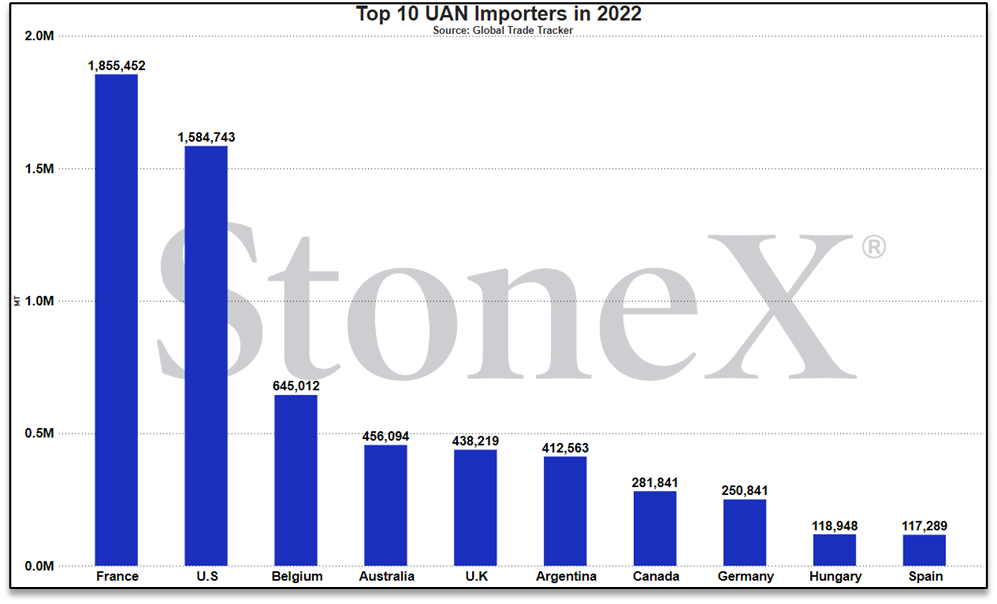
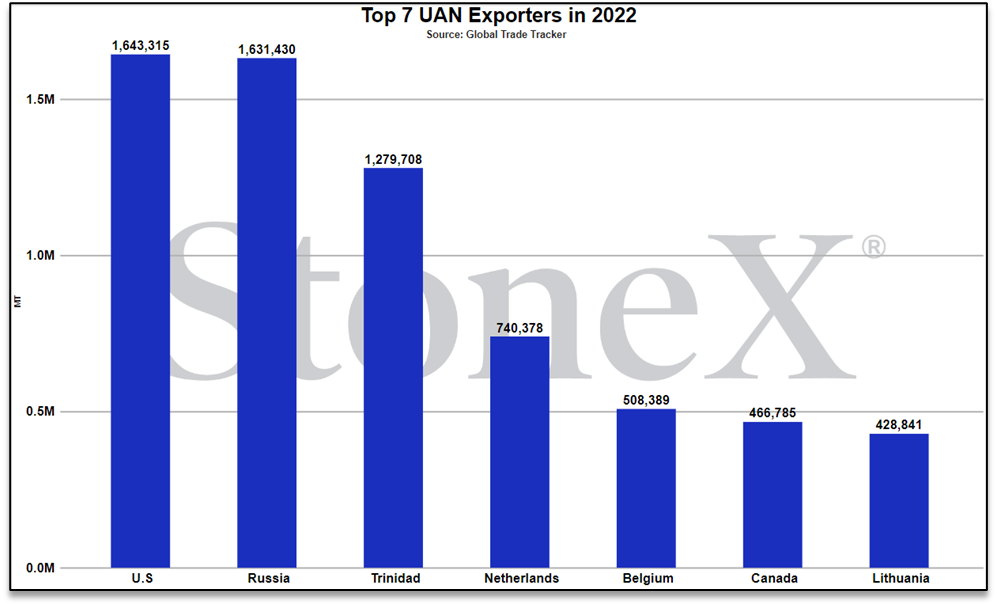
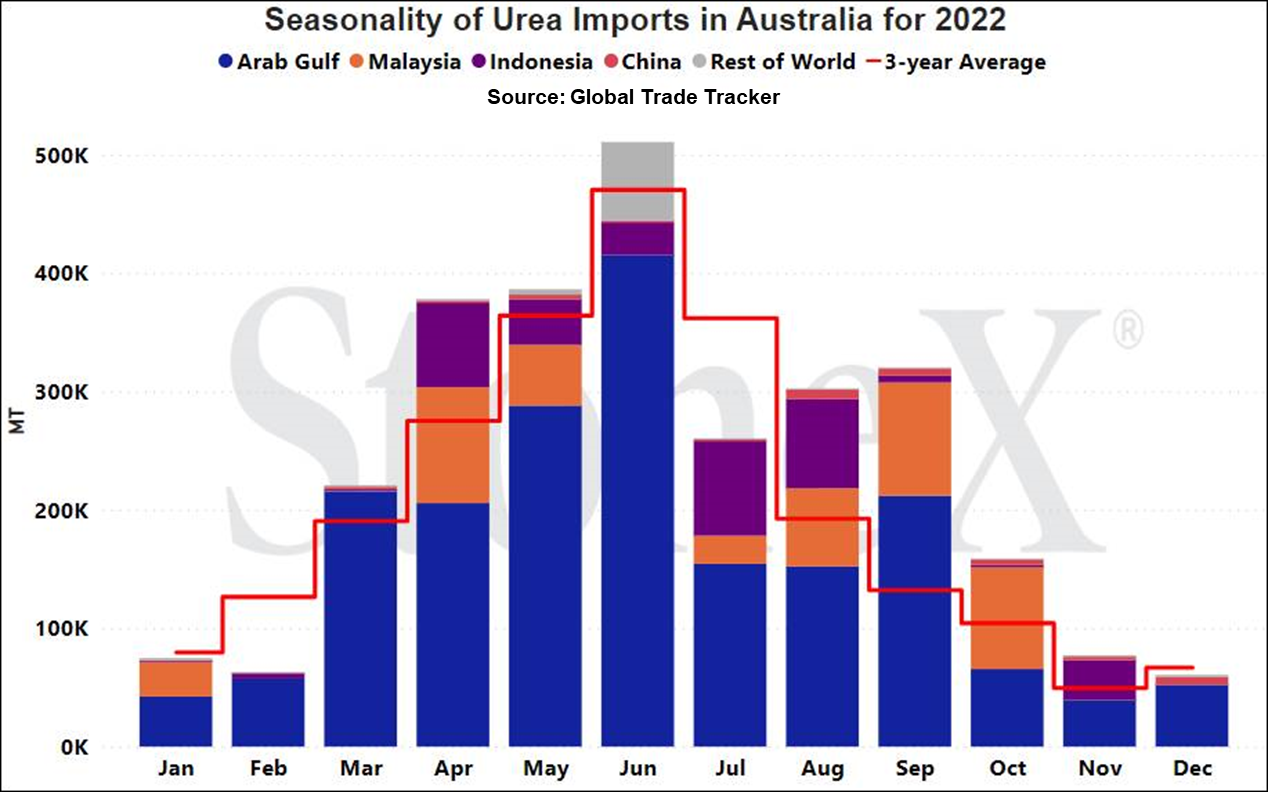
Number 2 global importer in 2022
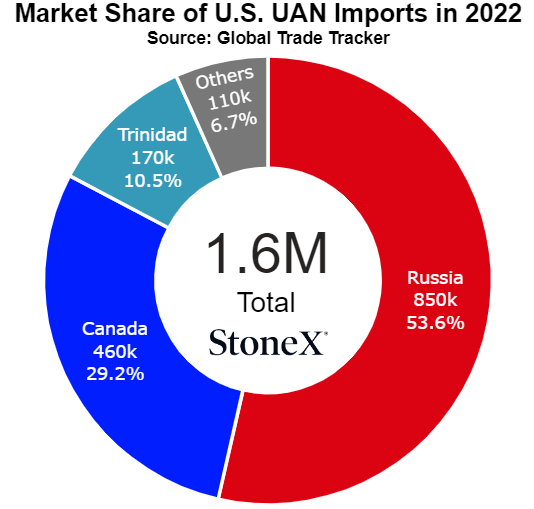
Number 1 global exporter in 2022
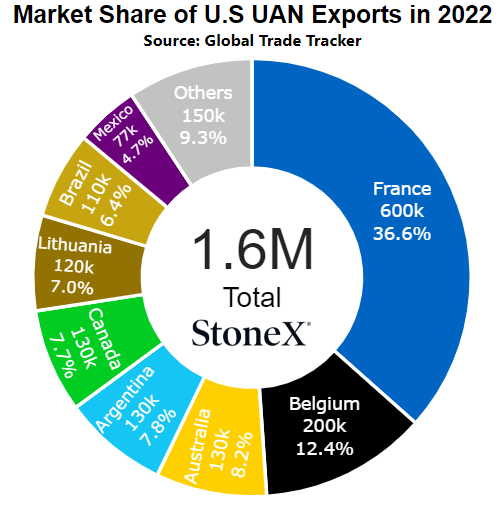
Price comparisons
Price Comparisons
Vs 30 days ago - unchanged vs 30-days earlier
Vs 90 days ago - 10% or approximately $20 higher
Vs 6 months ago - unchanged vs 6-months earlier
Vs 1 year ago - -13% or approximately $35 lower
Black Sea (Russia)
Number 2 global exporter in 2022
Price comparisons:
Vs 30 days ago - 3% or approximately $6 higher
Vs 90 days ago - 13% or approximately $23 higher
Vs 6 months ago - 7% or approximately $14 higher
Vs 1 year ago - 2% or approximately $5 higher
- Russian UAN exports start getting blocked – the world already has Australia and Canada not receiving Russian produced fertilizers. Now, several NATO/EU countries are calling to take similar steps. If we see all western nations (i.e. U.S.) do the same, it will limit the number of tons available to buyers. Lower supplies = less competition = higher prices.
- Further production curtailments/stoppages in Europe – Dutch TTF values has steadily crept higher to close at $15 recently. While we haven't seen nor heard of any plans to shut down production in Europe, the math is working against producers. If the price continues to rise, eventually some plants will need to make that hard decision.
- U.S. fall NH3 ends a failure – if the U.S. fall NH3 application ends in failure and that nitrogen demand does not disappear (not likely), then spring will see even more UAN demand as the market scrambles to make up the difference. That increase in demand helps to give manufacturers more confidence in price ideas. That will affect Aussie price ideas.
- U.S. becomes last large destination if Europe blocks Russia – if Europe takes more steps to completely block Russia and the U.S. does not respond in kind, Russia should get more aggressive in their export to U.S. flows. That means more competition and more need for U.S. manufacturers to get rid of excess inventories...Australia becomes a friendly option.
- Global urea values continue to fall – international urea values have fallen much harder than I expected to see. I wasn't surprised by some slippage due to the lack of demand and looming quiet period, but this has blown thru any expectation I had. The more urea values fall and UAN remains unchanged, the more it makes UAN look expensive. Buyers are already not really interested in nitrogen purchases. If they were, they certainly are going to look at the splits and factor that into what they do.
- U.S. Midwest farmers get their 2 - 3-week window for NH3 – if U.S. farmers get their fall NH3 applied, then the fear that UAN demand will skyrocket will go away. That would hopefully calm markets even more and possibly give manufacturers more reason to be more aggressive to any Aussie purchase opportunities.
We believe that only looking at the flat price of either grains or fertilizer can be misleading:
-
Only selling grain can hurt you if fertilizer prices rise substantially
-
Only buying fertilizer can hurt you if grain prices fall
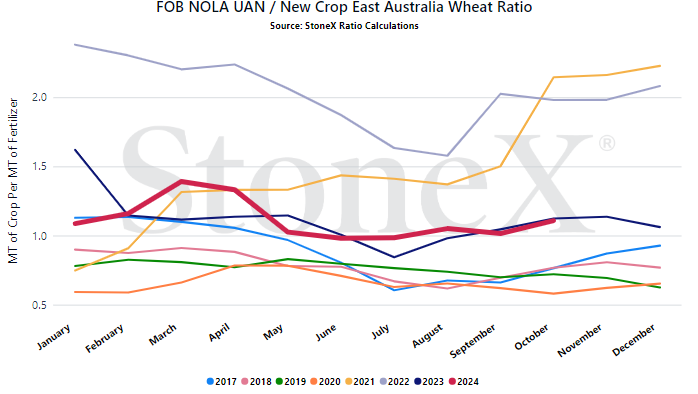
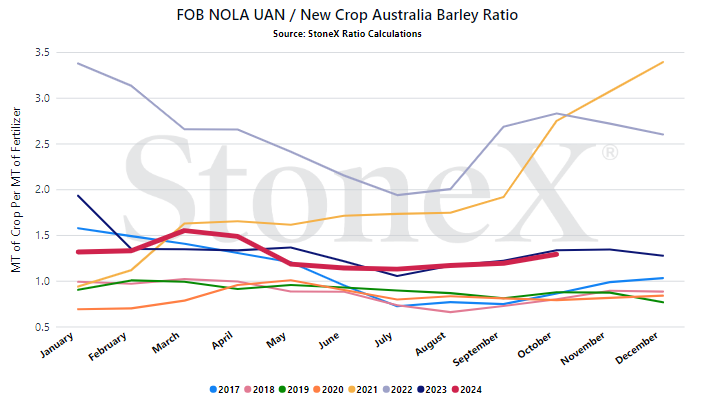
We look at the ratio "value" to get a better indication of where we are or how many bushels of X does it take to pay for 1 ton of fertilizer.
Would you rather:
-
Spend 100 bushels to pay for 1 ton of UAN
-
Spend 60 bushels to pay for 1 ton of UAN
When we compare the current ratio value against recent years, we start to see if we are high or low.
YOUR VALUES MAY LOOK DIFFERENT
This graph looks at the NOLA UAN price vs the flat grain price. There are no logistics on either product. Your location will look different due to fertilizer logistical costs, grain basis, etc.
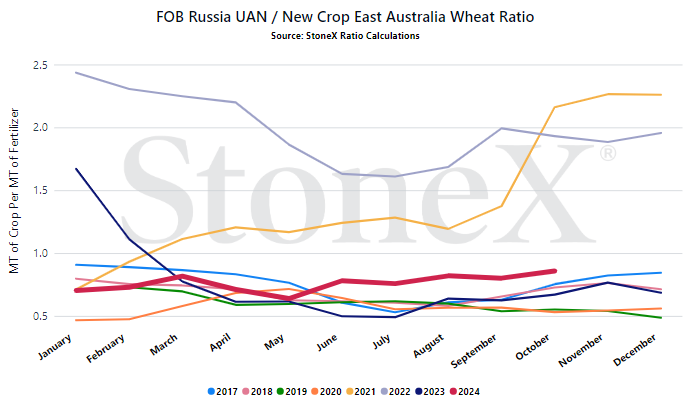
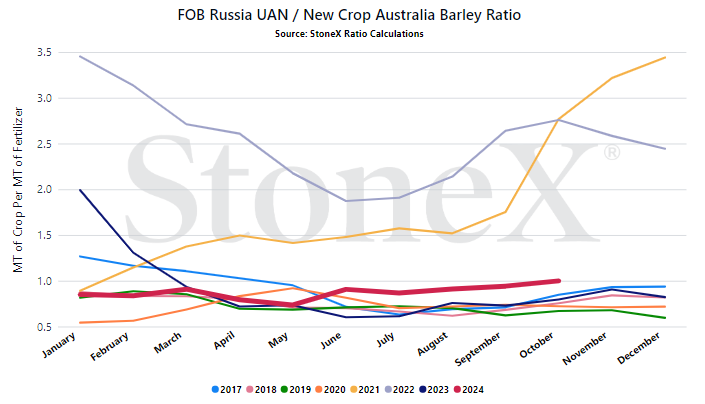
- The world vs Russia - I'm hoping that the situation with Russia plays out like a lot of other fears in the past where we fear the worst, but calmer heads prevail. Even this morning, there have been statements from Russia saying they are looking forward to work with the Trump administration which gives me hope that they will not overreact. Unfortunately, it looks like Europe is going to take steps to start blocking Russian fertilizers. UAN is the one product that this step would have the biggest impact, and the impacts depend on who/how many nations block them. UAN is a "small" enough commodity that these political moves could have major price implications around the world.
- European cost of production - at the same time that European countries are discussing blocking Russian tonnages, European natural gas values are climbing and are getting high enough to start plant stoppage conversations. There has been NO report/confirmation of any company/plant talking about shutting down. I am only saying that for me, $15MMbtu Dutch TTF was the price at which I start watching closely again. If we start losing more European production, it is going to be hard for the global market to not react.
- U.S. fall NH3 application success/failure - no need to beat you over the head with all the details again. You likely read the above piece breaking out the scenarios. All to say the success or failure of the fall NH3 season has a direct impact on spring nitrogen demand needs. I'm really hoping that by the January edition, we are talking about having gotten application done...but just in case.
StoneX Ratio Calculation
The ratio calculation is derived from Bloomberg historical grains values as well as fertilizer values from StoneX, NPKFAS, and Argus.
The calculation is simply dividing the fertilizer price by each grain price.
All data was sourced from StoneX unless otherwise noted.