GLOBAL
I sure wish I could start this by saying I saw global prices dipping in the last 30-days, but I am more than happy to own up to my misses.
When I look at the global urea fundamentals, I still see a world that is very tight on supplies and demand that looks very closer (if not slightly higher) than last year. Chinese exports are still not returning. European natural gas prices are getting higher which is starting the conversation of when the next production cuts are coming. India just soaked up a lot of the excess inventory in the world for the rest of 2024 which should put manufacturers on firm footing to start the New Year. I've been trying very hard to make sure that I am not getting married to my bullish POV but every time I break down the market, I see prices higher.
Quiet demand periods in fertilizer do typically cause values to slip and that is what we expected for the remainder of 2024. However, I will not be surprised to see some Q1 demand step forward fairly soon as they see the lower values. My POV is that it isn't a matter of if the markets turn higher, it is when.
IPL (India) completes another purchase tender
Another month, another big purchase of urea by India!
To catch up on the story, the last purchasing trend ended with a bit of a whimper. Expectations were that they would secure over 1M tons split between west and east coast ports. There were enough tones that were offered. The shipment window granted plenty of time to find/secure/produce tonnage to meet commitments. However, once offer information was released, it was quickly concluded that the west coast was going to struggle. A trading firm had set the L1 at an almost unheard of $25+ discount to the next lowest price. The market had rallied in the days leading up to offers being due and it looks like someone forgot to mention it to them! All other offers refused to budge on their value and only 50K tons were secured. The total was around 700K but with the majority going to the east coast, another tender was needed.
Hence the fresh November tender announced by India firm IPL. At the onset, they were clear with their needs/desires. They were looking to secure 1M tons and they were only going to focus on the west coast. This time around, no one seems to have missed the memo and the offer price range didn't come with any surprises.
Very long story short, IPL hit their mark. After negotiating with all offers, they were just barely able to hit their 1M ton goal.
When one India purchase tends door closes, the market starts to discuss when the next window will open. It is highly anticipated that they will need to purchase more tonnage. While there have been government reports that "India will be self sufficient in 2025", most in the global market do not believe this. However, they hit their goal in this last tender and that had a shipment window thru December 25. Historically speaking, India does not like to overlap tenders. They would rather conclude one and then start the next. Between the tones secured and reported lower domestic demand, our expectation is that we will not see them return until January.
Still, this purchase helped to alleviate a lot of the "excess" inventory that was available. While there are always tons that can be found (if you are willing to pay the price), there does not seem to be a glut outside of North Africa and Iran. That "should" mean manufacturers are comfortably sold thru 2024 and will be able to start 2025 in a relatively comfortable position. They will know that the northern hemisphere spring is just around the corner. That creates a fairly strong negotiation POV. Does this guarantee higher prices? No. Does it make higher prices more likely? From my POV, yes.
What does this mean for Aussie farmers
Honestly, not much right now. There wasn't much of a reaction from the global markets so things remained quiet. Australia is out of its urea import/buy/apply cycle so there is even less reason to change domestically.
More, this is something to watch for the future. If we see another tender that starts to reveal a tightly supplied global market (more details on that below) and prices start to appreciate, then we have something to consider but today it is quiet.
European gas markets rise...are nitrogen production cuts coming?
The European natural gas market saga continues.
For a bit of backstory for the newcomers, historically, the European natural gas market was relatively cheap and very stable. More than adequate flows from Russia meant that the European region had little to be concerned with. This was great for the public demand. This was great for domestic nitrogen fertilizer production. It was a low and steady input cost that allowed Europe to produce what Europe needed.
Then tensions began to rise.
Originally, it started over the Nordstream 2 pipeline. This is when European countries were really leaning into their "green" initiatives. Burning natural gas simply didn't match their perceived importance of moving toward solar/wind/etc. energy. Then, rumors/reports that Russia was planning an invasion of Ukraine started to circulate. When everything played out, Russia not only cut their natural gas shipments to Europe, "someone" sabotaged the Nordstream pipeline. Even if relations were to normalize, massive repairs to the pipes would be necessary. With them in deep waters, this is no simple or fast task.
As shipments ceased to exist, the Dutch TTF (the market that we track for general European natural gas price movements) moved from their historical normal price in the mid-single digit range to a high in August 2021 of $103MMbtu. Needless to say, European based nitrogen fertilizer production suffered. Estimates were that production rates dropped to around 25% of normal and the only reason it wasn't lower is that some plants were able to import natural gas or NH3 from around the world and continue to receive "lower" priced feedstock.
Fortunately, that was the worst of it. As free markets tend to do, a new normal was found. Global trade flows started to shift and supply Europe with much needed inventories. By the time the new low was found last winter, Dutch TTF values had fallen to $7MMbtu. As natural gas values had fallen, production started to turn on and reached a new "high" of 75% of normal. The last winter was unseasonably warm so natural gas inventories were extremely high. We were hopeful that single digit gas costs would bring the rest of offline plants back online, but it never happened.
Today, we are watching gas values climb. As I look at the market while I write this, prices have rallied back to around $15MMbtu. Fortunately, we have not seen nor heard of any EU based N plants shutting off due to high input costs...but we are watching very closely. At some point, plants/owners will need to cry uncle and stop production. They simply cannot sustain losses for very long. If we start to see plants shutting down, not only does that lower global supplies but it also raises European urea demand.
Europe continues to be one of the biggest price drivers of the world given that they represent the highest cost production. Their tonnages are needed to balance the global S&D and right now it seems the market is careening toward losing more of these tons...
What does this mean for Aussie farmers
If European natural gas values continue to rise to the point where European nitrogen production starts to falter once again, it will means less supply around the world and more demand than before.
All in all, it means more competition which generally means higher prices as manufacturers have more options.
Today, there isn't a rush for Australia on the urea markets. The next application cycle is a little ways away...but nitrogen production does not turn on/off like a light switch. These processes are expensive, take a bit of time and can be dangerous. That means that if a European based nitrogen production facility decides to shut down, they are not shutting down for a few days. They are likely shutting down for months...which means it should still be offline when Australian imports start their urea purchases.
If Europe sees more plants offline, that reduces global supply because those plants are "gone" but it also raises demand because they have to replace those tons. If it happens, it should have an effect.
Global markets settle as a quiet end to 2024 comes into focus
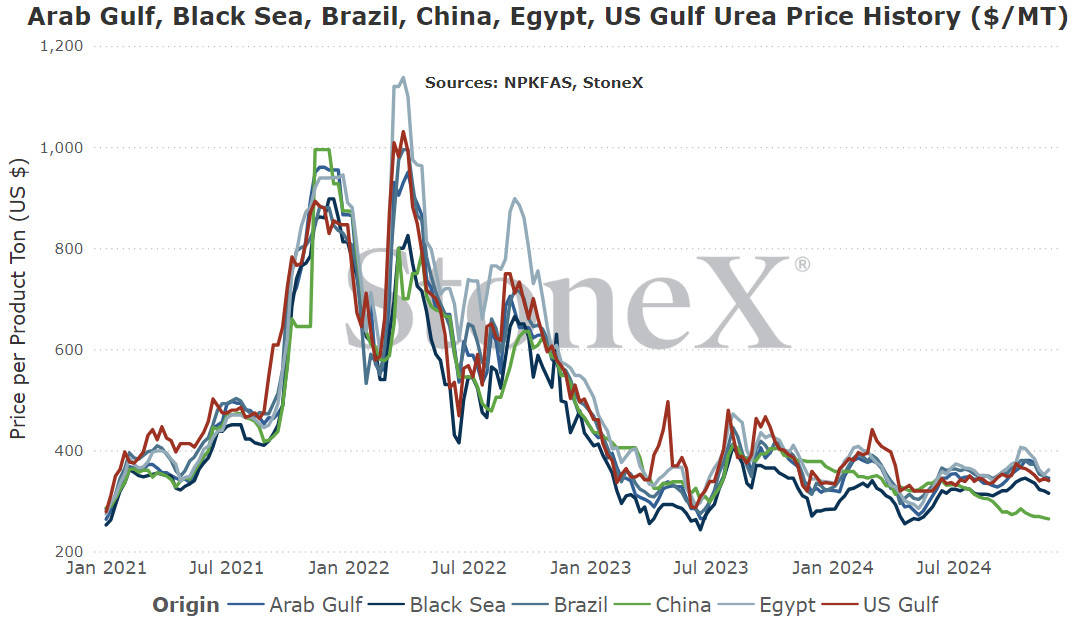
One of the bigger surprised to me in the last 30-days have been global urea values softening. Following the conclusion of the October India urea purchase tender, it seemed that global prices were steady to firm. Manufacturer inventories were either sold or were expected to be sold into the next November India urea purchase tender. Most were starting to circle around the story of tight inventories for remainder of 2024 and looming 2025 demand.
Then values began to soften.
India unsurprisingly announced their November purchase tender, but values failed to firm as many (again, myself included) believed they would. When tender offers were submitted, lower prices were revealed but there was a belief that India had soaked up most of the excess tonnage left for the calendar year. That would allow manufacturers to be comfortable until 2025.
Again, that has not been the case as I sit and watch values slide further.
Now the raging question is what happens during the remaining weeks of 2024. The fundamentals continue to point to tighter supplies. As detailed above, the situation in Europe is getting worse rather than better. Continue reading, and you will see that Chinese exports have failed to emerge. They alone could cause a 5M ton shortfall for the calendar year (normally exporting 5 - 5.5M/year). Even Iran remains a question mark. While their fight with Israel has taken a backseat to the Russia/Ukraine situation, tensions remain very high there. For reference, Iran exported nearly 5M tons of urea in 2023. That essentially is the same size as China who we talk at length about in terms of their importance for global supplies.
However, this is fertilizer, and fertilizer does not always follow fundamentals. Sometimes, emotions get the best of the market. Then, others buy into that story and follow along, increasing the speed of the move. This dip was a surprise but eventually someone is likely to see it as an opportunity. If that happens, it signals demands return and back to the races for the market.
What does this mean for Aussie farmers
It means supplies are tight...and the market has yet to really respond to the situation.
Internally, I've been hoping that I am wrong on this situation. Wrong either that the supply situation isn't as bad as I think (the data doesn't prove that) or that the market will not respond like I fear due to grain prices suffering. Unfortunately, the fundamentals of a marketplace remain unbeaten over time.
My POV is that once we start getting into Q1 '25, the market will shift. Today, there is a lot of time until a lot of the world's application season. The market is worried about going too high too early and scaring everyone off. However, once the calendar shifts to their favor, they will be more emboldened (assuming the supplies remain the same).
Why does this matter? Well, importers have to start their purchases well before application season begins which means we could be seeing prices reacting to tight supplies about the same time the first purchases for Australia begin. It sets the tone.
Brazilian imports well ahead of average for 2024
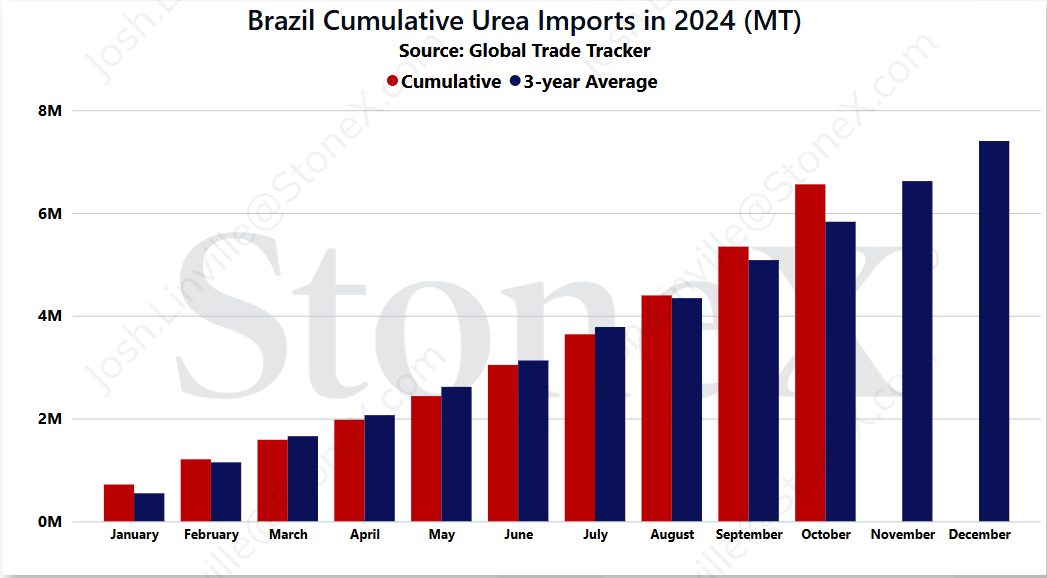
One thing that could be leaning on global urea price ideas is how far ahead Brazilian imports are thru October.
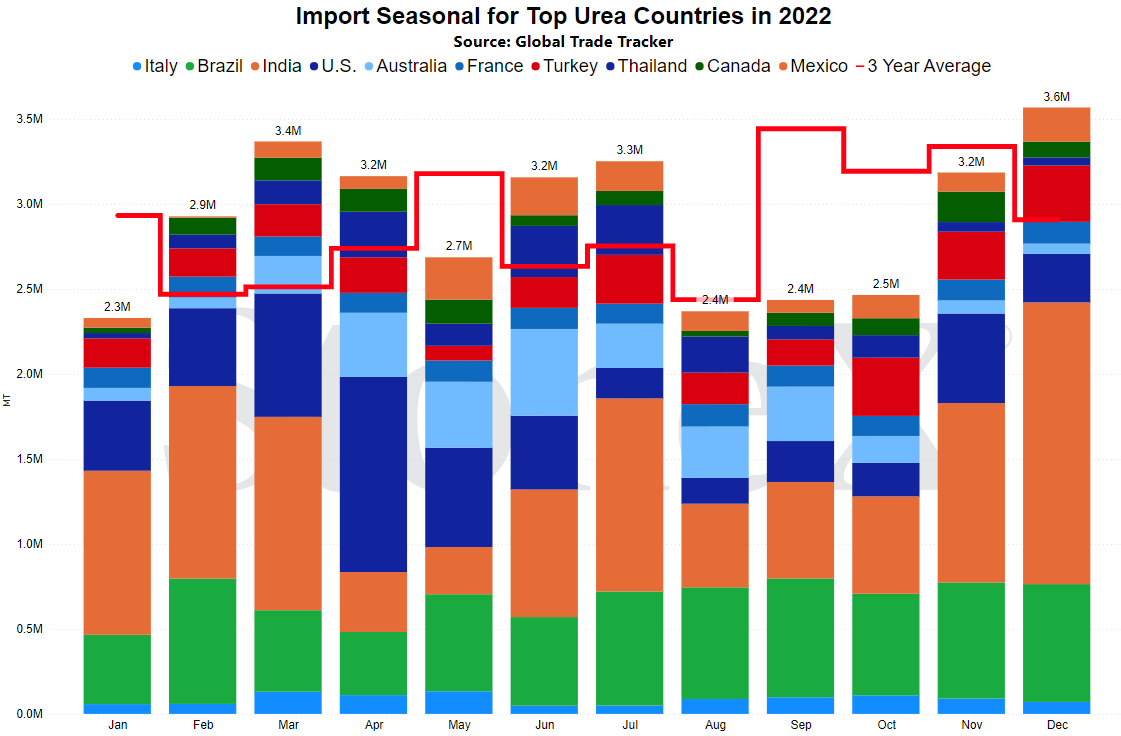
Over the last 3 years, Brazil would normally import around 5.8M tons. Now, there is certainly a case to be made that there is nothing normal about the last 3 years but given their relationship with countries like China/Russia, their supplies have been more reliable than other western linked countries. This year thru October, Brazil has brought in nearly 6.6M tons.
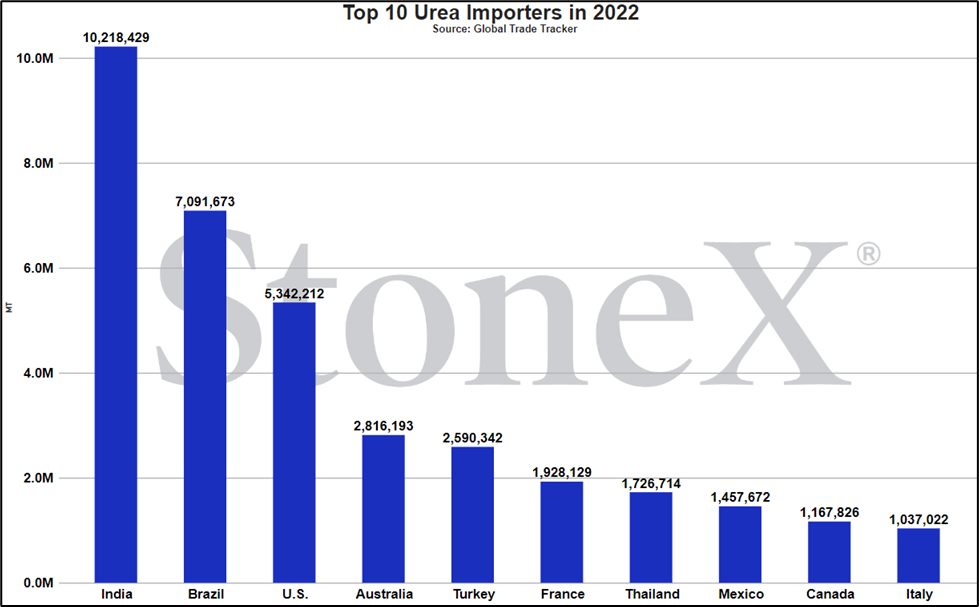
That raises a significant question: does the 2nd largest importing country in the world need much for the rest of 2024?
This could be part of the reason for global urea values falling over the last 30-days. If one of the largest buyers are well ahead of schedule, that could mean that they are slowing their purchases for November and December. This doesn't mean they completely disappear, but sometimes small changes illicit big moves in the market.
What does this mean for Aussie farmers
How one of the largest buyers/importers of urea globally approach the market affects every farmer on earth. Australia is no different.
If Brazil being ahead of schedule on imports means that they stop buying for a short time, global values could start to sink as everyone realizes it. If that is enough for the global market to get a little nervous and get a little more aggressive in wanting to sell, the price ideas fall. That is good for buyers.
While it may not be something seen immediately domestically, it should eventually make its way here.
October trade data shows China STILL not exporting
Chinese urea exports are a story that we have been discussing at length for the last several months. For that, I apologize for the repetition.
If it wasn't important, I would not continue to hit the same talking point over and over.
Unfortunately, it is important and October trade data further pressed that.
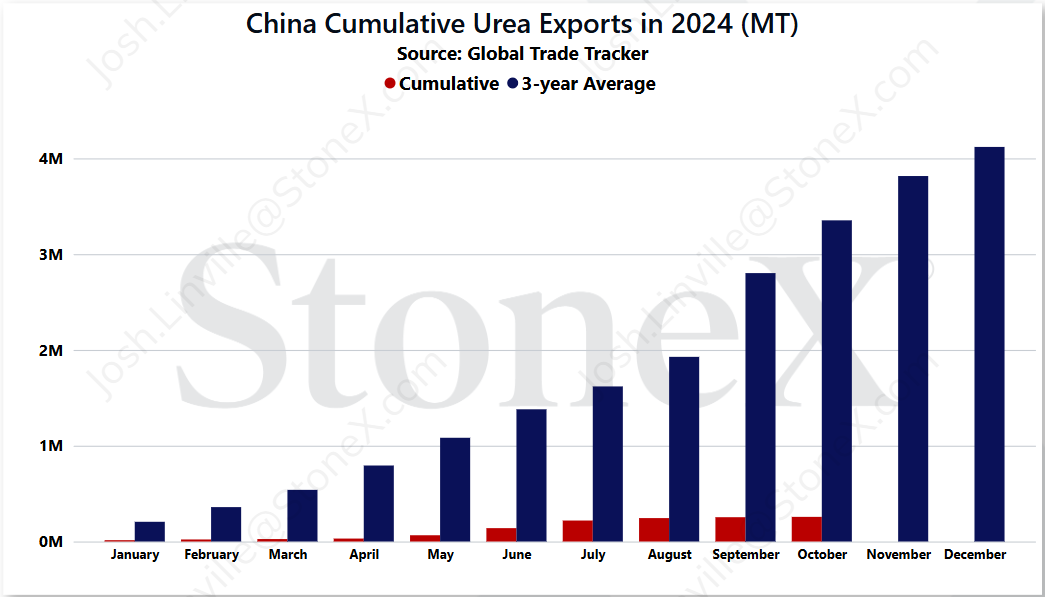
In recent history, Chinese urea exports have been in the 5 - 5.5M ton range. That represented approximately 10% of the global export marketplace and Chinese tons were largely seen as the boogey man in the market. When they were participating heavily in exports, the markets tended to see more bearish pressure. Traders were less than enthused about taking long positions for fear of getting beat up by Chinese tons. Global buyers felt they had just a little bit more time before they needed to step in because tons felt plentiful.
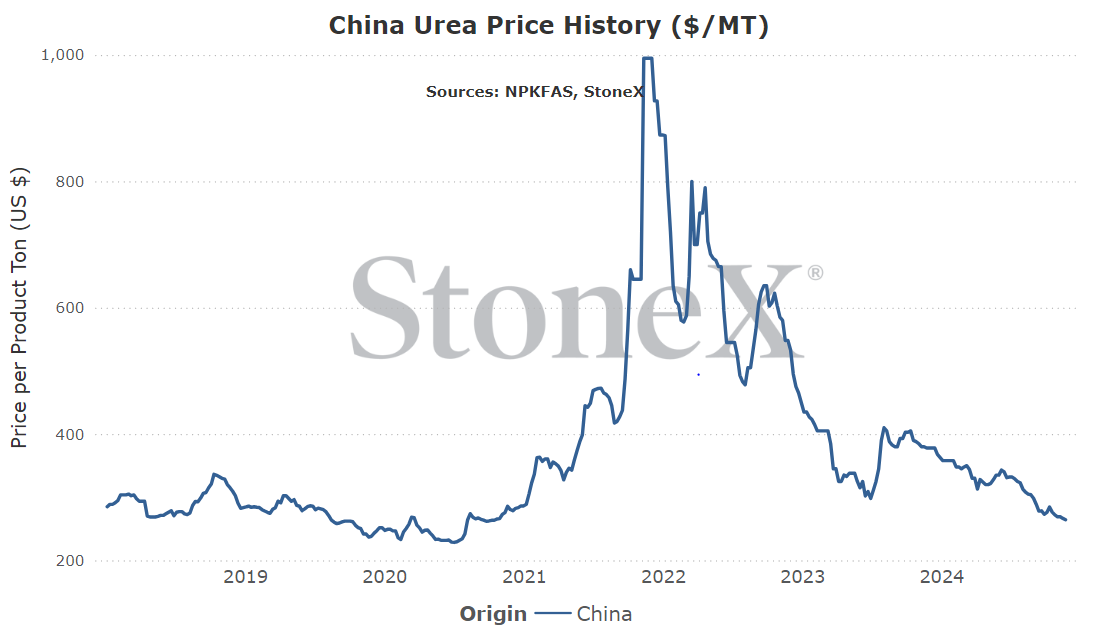
However, the last few years have seen Chinese exports all over the place. During the worst of the 2021/22 cycle, the Chinese central government recognized that global values were extremely high, and inventories feared getting extremely tight. Rather than run the risk of losing all domestically produced tons to the export market, the central government stepped in and started to restrict exports. The hope is that it would accomplish two goals:
1. It would provide plenty of inventory for Chinese farmers.
2. It would lower domestic values in relation to the world.
Fortunately for Chinese farmers, this approach worked.
Unfortunately for the rest of the world, this approach worked.
The government continues to track the fertilizer markets closely and when they see price appreciation happening, they have been much faster to react. Last year saw them taking steps to returning to normal, but that was short lived. Thru this calendar year, exports have been all but non-existent. The cumulative January thru October export total only sits at 257K tons. Again, 5 to 5.5M tons on an annual basis is considered "normal". It is very reasonable at this point to think that they will fall 4.5 to 5M tons short of that pace which is effectively 10% of the global export marketplace just...missing.
We continue to hold out hope that we will see a change in strategy soon. There are rumors that they expect to release the restrictions...but not until Q2 '25. However, there are also rumors that this is now normal as the government has charged farmers to raise enough grain to be self-sufficient. That requires more fertilizer and as long as this mandate remains, they have little to no reason to export going forward.
Ultimately, when it comes to China, we do not know what they are going to do. We can make educated guesses. We can try to take pieces of stories we hear to put together a story. However, we never know. They do a good job of keeping that information close to vest. Until that changes (if ever), we remain reactionary to one of the largest exporters in the world...well, at least they were.
What does this mean for Aussie farmers
This is big for the world. China is typically one of the largest global urea exporters. Their historic normal export pace of 5 to 5.5M ton/year equates to roughly 10% of the global export market. I challenge anyone to find a market where losing 10% of exports doesn't affect price ideas.
For Australia, China disappearing is an even larger issue. That is due to the reliance on the Asian production markets for supply. With China essentially "gone", buyers in the region are forced to find new suppliers. That means reaching out to countries/companies that Australia has historically relied on. More competition in this case equates to higher price ideas. Then, as products are gobbled up, buyers are forced to look further around the world for supplies. That means longer sail times and higher freight rates.
Globally, this means tight supplies which should equate to higher prices.
Regionally, this means tight supplies which should equate to higher prices.
Domestically...well, you get the picture.
Escalations in the Russia/Ukraine war raise questions about Russian exports
Since this newsletter is monthly, there is never anything really considered "breaking news". If there were, it would certainly be the recent situation between Ukraine and Russia.
In the days leading up to my starting this month's newsletters, there have been significant escalations in the conflict. One of Putin's hard red lines has been Ukraine not using U.S. missiles to attack inside Russia. For him, that was considered a major escalation that would be responded to. Well, that happened in recent days and Russia did not take it likely. Overnight, it was reported that Russia has since responded with a missile attack of their own. However, this wasn't just an ordinary attack. This one involved ICBM's.
If Russia was looking to make a statement, they certainly made one by using those.
Now the question is surrounding what the next steps will be. Is this a one and done for Russia? Will Ukraine continue using U.S. systems to attack inside Russia or will allies request that they back down? These steps could go a long way in determining fertilizer supplies.
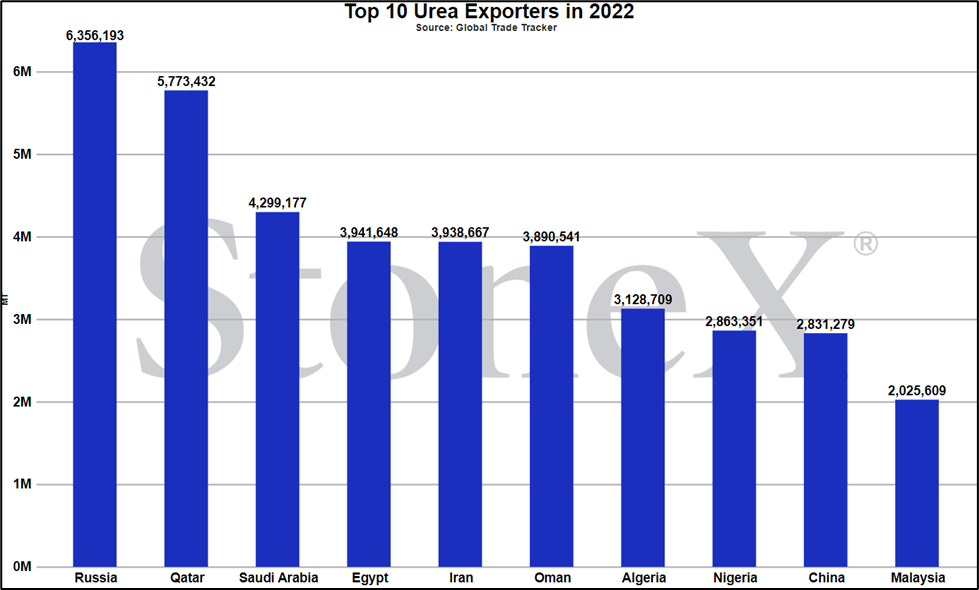
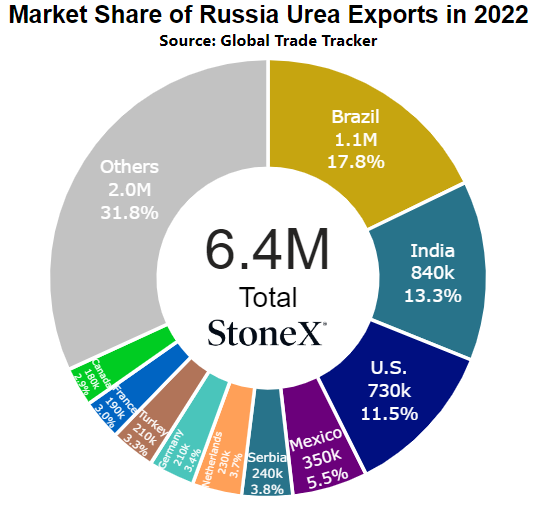
In 2023, Russia was the largest exporter of urea, with just shy of 7.8M tons being sent to the world. For comparison, Qatar was the 2nd largest exporter and only hit 5.2M tons. That is a massive differential that should put into context how important Russia is to global urea flows. As this war continues on, we have to wonder Russia's place and destinations for their product. We could certainly see next steps involving western allies of Ukraine blocking Russian produced fertilizer. However, in the urea world, that likely will not have the desired effect.
What we have seen over the last few years is Russia being able to export their product to "friendly" nations like India, Brazil, etc. Blocks can be put in place to stop shipments to certain locations, but as long as they are able to export, the global S&D does not change so overall values should not change...but they will for the countries that place the blocks. Those nations will lose their natural and logistically superior supply lines. It doesn't mean you cannot get product, it just means that you have to go elsewhere that very well may cost a bit more. Unfortunately, we all know where that buck stops.
Today, we have heard no conversations or heard any reports of imminent steps toward this. These are just the type of low probability/high impact situations that we have to keep on our radars. I continue to hold out hope that calmer heads will prevail but given the current world, we need to consider the possibility.
How does this mean for farmers?
Today, this means nothing. We have not seen further escalations in the fighting. Nor have we seen any sort of change in Russian export flows.
As long as that remains the case, then it should be status quo for global urea markets.
However, this is still a low probability/high impact type of situation. If Russia starts getting blocked, the reaction on pricing will depend on who.
- As long as countries like India/Brazil will buy their product, limited global price reaction.
- If the whole world shuts down their exports, that is a massive situation as the world loses its largest supplier.
If this careens out of control, fertilizer flows might be the smallest story as it likely means the world is taking sides on World War 3. Hopefully this is a watch point that never plays out.
Number 1 exporter (as a region, not as individual nations)
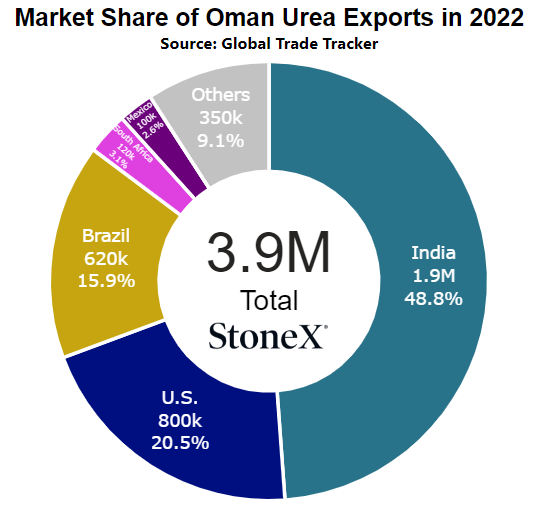
Vs 30 days ago - -9% or approximately $35 lower
Vs 90 days ago - 3% or approximately $10 higher
Vs 6 months ago - 11% or approximately $35 higher
Vs 1 year ago - 4% or approximately $13 higher
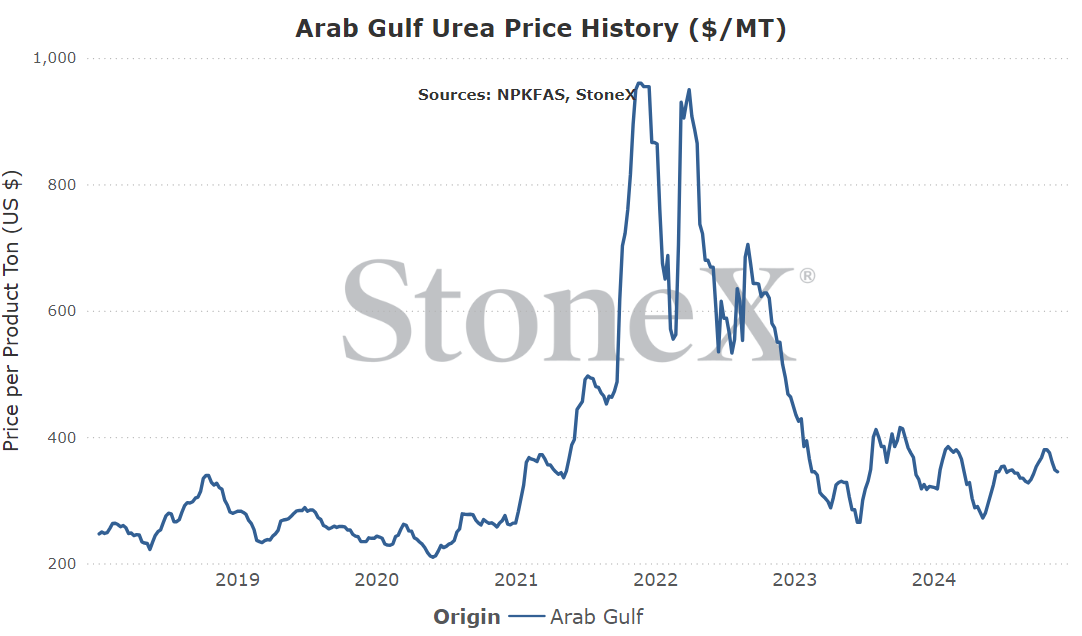
Egypt
Number 4 global exporter in 2021
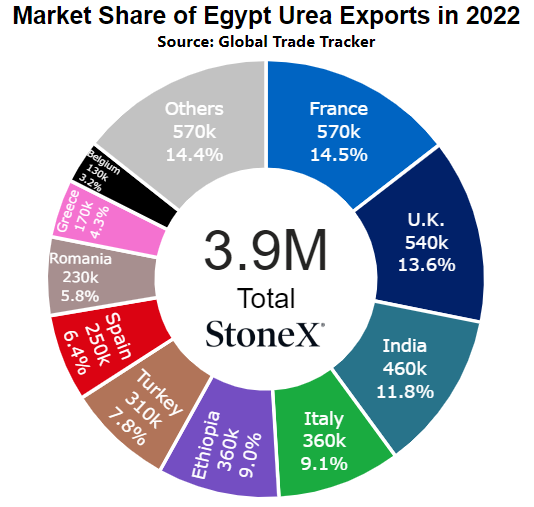
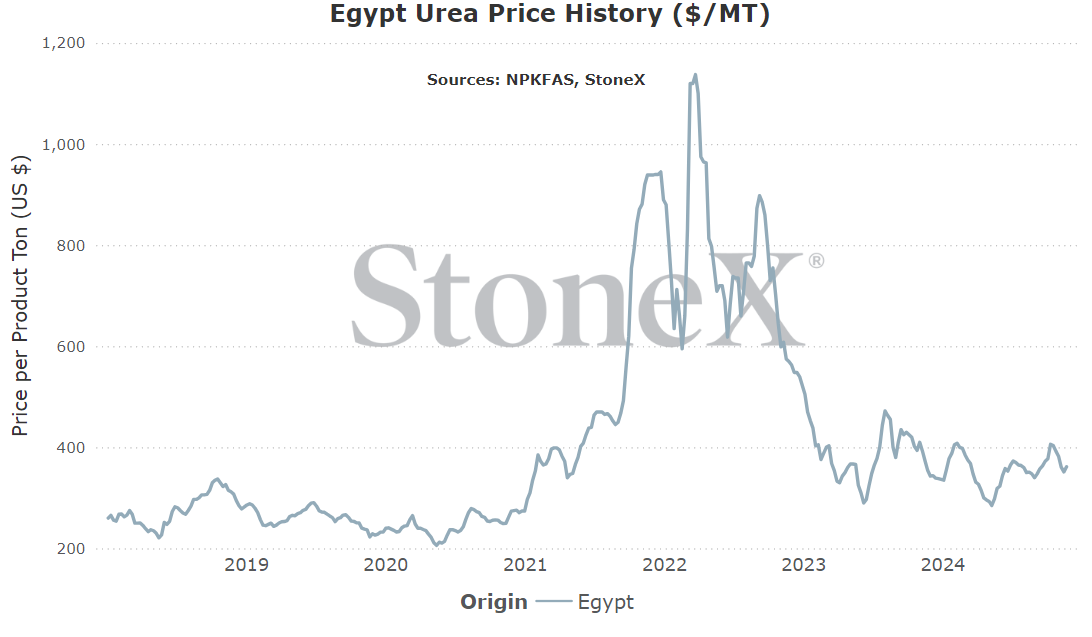
Price comparisons
Vs 30 days ago - -8% or approximately $31 lower
Vs 90 days ago - 4% or approximately $14 higher
Vs 6 months ago - 12% or approximately $39 higher
Vs 1 year ago - 2% or approximately $8 higher
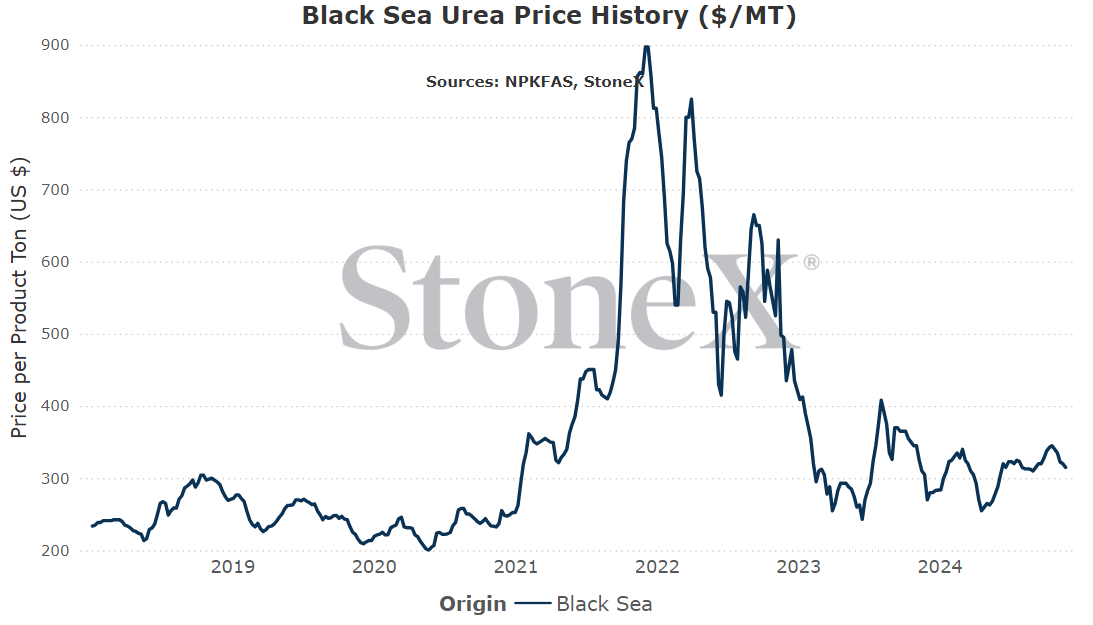
Black Sea
Number 1 global exporter in 2022
Price comparisons
Vs 30 days ago - -7% or approximately $25 lower
Vs 90 days ago - 1% or approximately $3 higher
Vs 6 months ago - 10% or approximately $28 higher
Vs 1 year ago - 3% or approximately $10 higher