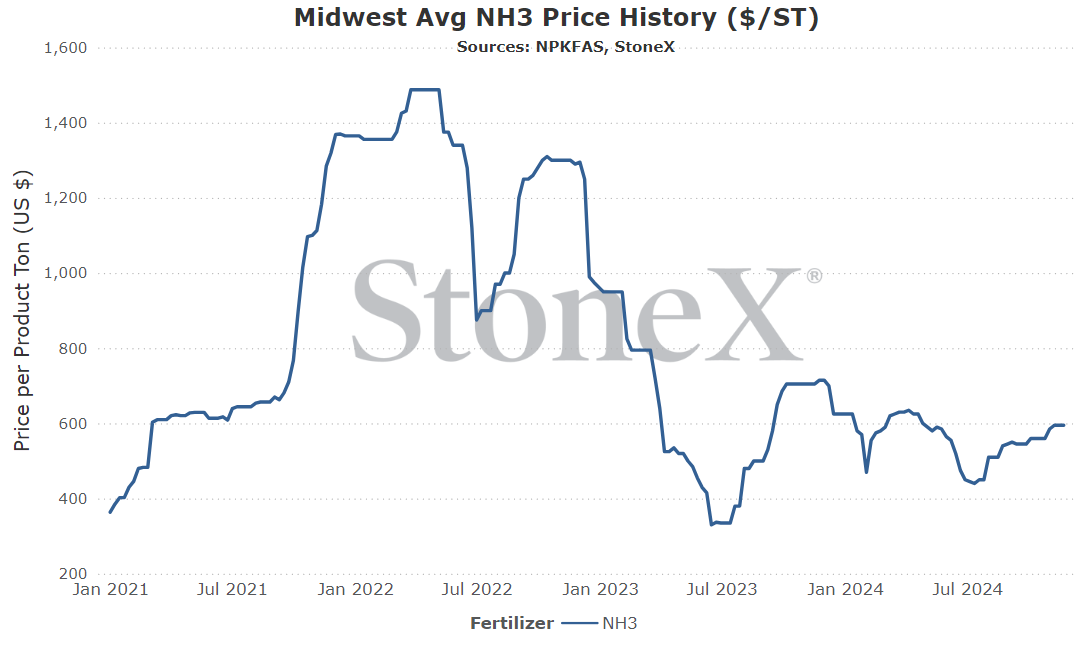
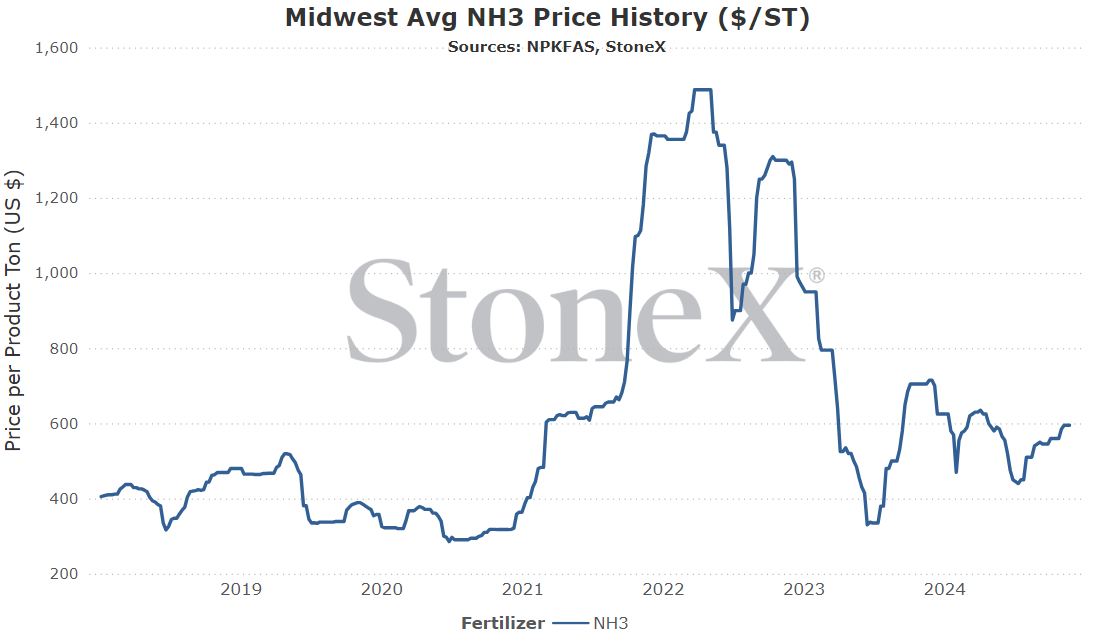
The first graph is the AVERAGE of the entire Midwest US region. That means your local value WILL be different than what the graph reflects. Please do not take this into your retailer and say "why isn't my price the same as here". That is comparing apples to oranges. You might be on the cheaper or more expensive side of this graph. This doesn't take into account logistics/storage/interest/insurance/shrink/etc.
This graph looks at the price from a short ton and USD currency POV.
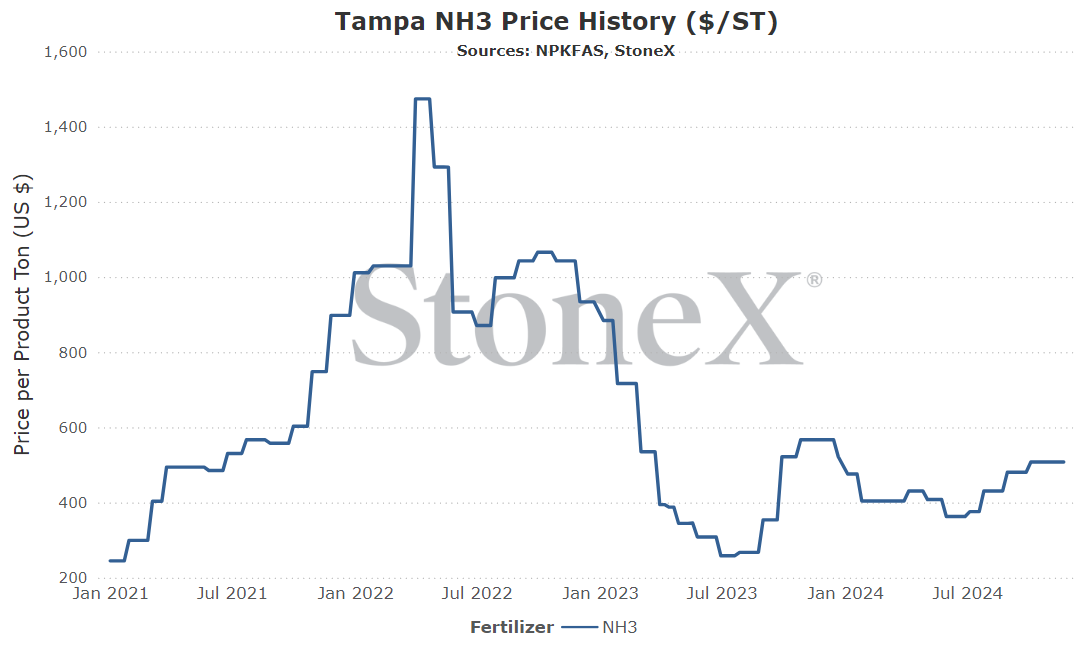
This second graph looks at the price set for Tampa NH3. This value does not have a high correlation to Midwest values. It is a talking point used when prices are rallying...yet somehow gets skipped on the way down. This price is more an indication of the global price. This price is set by two parties (purchaser - phosphate producer in Florida / seller - international producer providing NH3 to FL phosphate production).
This graph CAN be used as an indication of global market price directions/trends. This graph SHOULD NOT be used to determine a Midwest value. Tonnage is listed in short ton and currency in USD.
There really isn't much to get excited about on the global NH3 stage. We have not seen or heard any production hiccups. We have not seen or heard anything new regarding Russia's export return. The only think that has really changed is a watch point and that is Europe due to higher natural gas costs...but we have not seen any plant changes. It's...quiet.
Looks like NH3 should remain relatively steadily priced and quiet...which could lead to some lower price ideas. We all know how the market reacts to quiet demand periods, and it isn't typically bullish. I'm going to go on a limb and say that we could see value down between now and 2025...but not hugely so.
North America
This completely depends on the next 3 - 4 weeks.
If Midwest farmers can access their fields for a couple weeks, they can get most of their fall application done. If that happens, we should have a lot of the system empty. Manufacturers will have less need for winter fill sales and so can keep price ideas level to higher.
However, if more rains come thru and we do not have a fall season, completely different. You WILL see manufacturers needing to make sales. Their storage will be full, and they will know better than anyone that the system is also full across North America. In this case, they need to be aggressive for any open storage. They want to make sure they make the sale rather than risk having to shut down their plant. That said, once they solve the winter storage problem, spring is a whole new bag. 50% of the fall NH3 that doesn't get applied stays NH3 in the spring. Demand can absolutely blow up beyond the logistical capability of the market. Manufacturers know they need to keep the S&D balanced and if they cannot raise supplies, they need to destroy demand by forcing it to other N products. How do you do that? Raise prices until a pain point force change.
Ultimately, it is likely we see spring values higher. How is plays out between now and spring all depends on how the next 30 days happens.
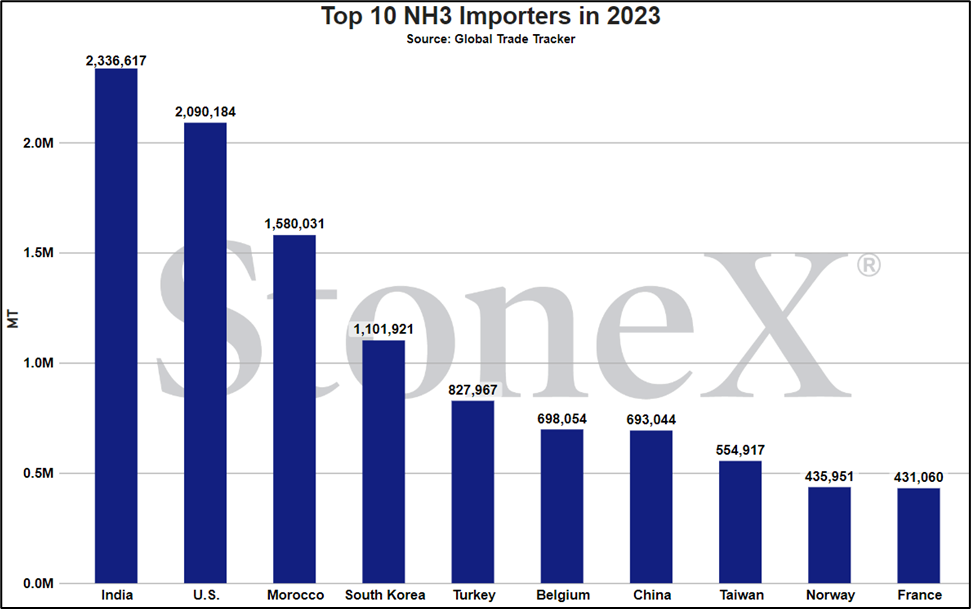
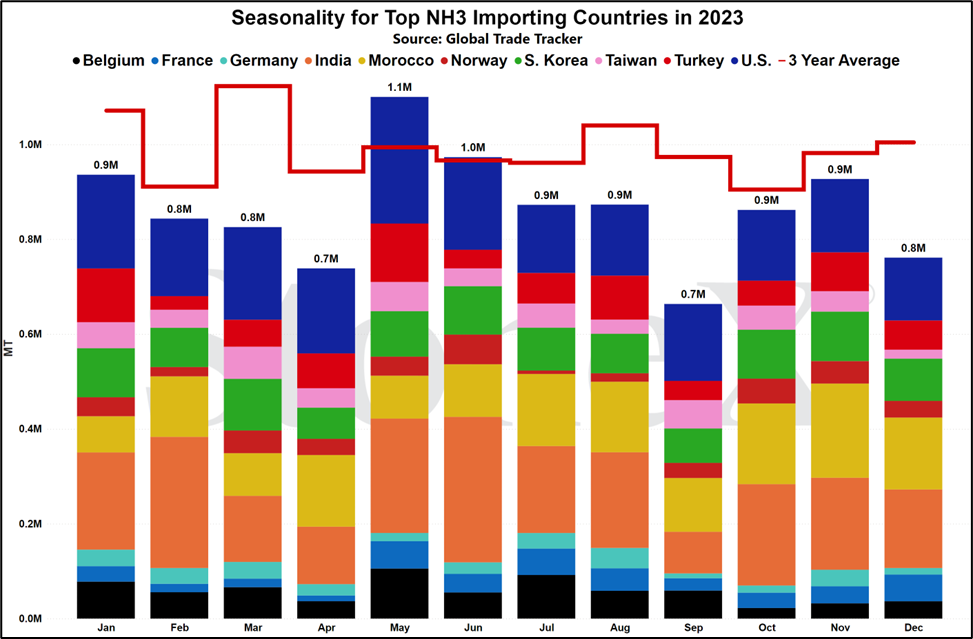
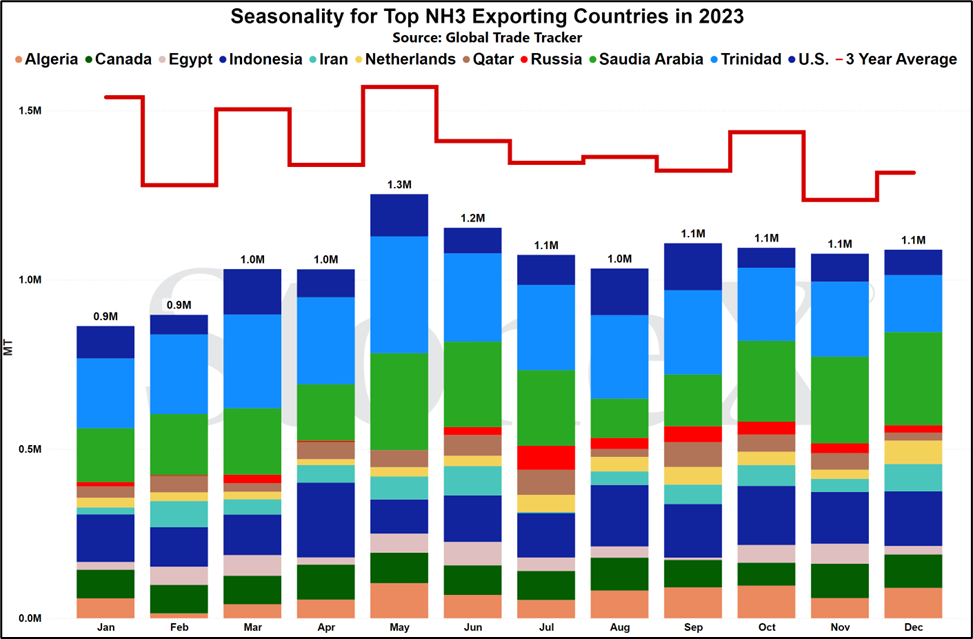
Another month, no change to Russian exports
If this were not such a major supply loss to the world, I would stop talking about it.
...but it IS a major supply loss.
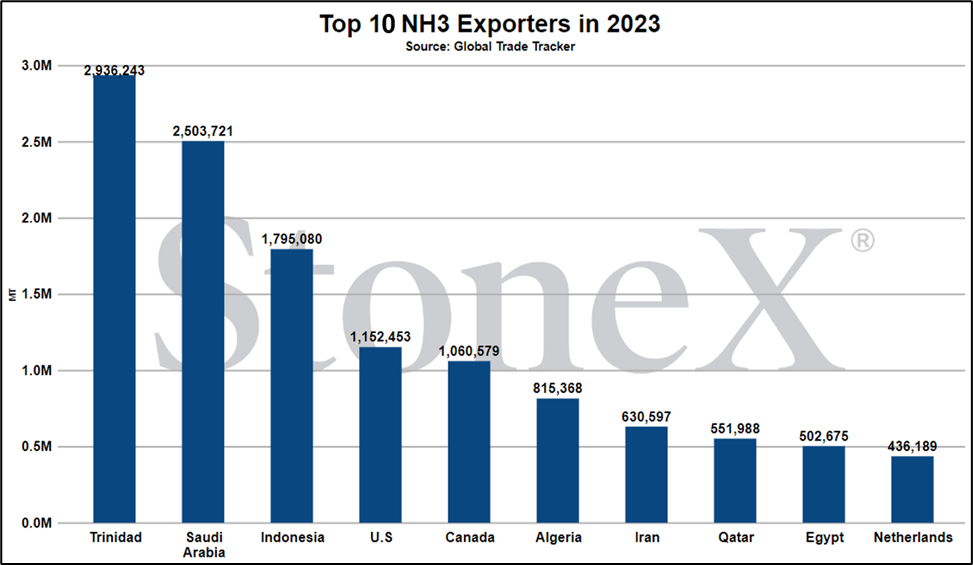
- 2021: Russia exported 4.418M tons of NH3
- 2022: Russia exported 884K tons of NH3
- 2023: Russia didn't break the top 10 of global exporters
Why the fall off? For those of you that have been part of this for a while, not only do you know but you are probably sick and tired of reading it monthly!!! If that is the case, skip to the next section!
For those that are new, it has to do with Russia's invasion of Ukraine.
In the past, Russia produced NH3 inside of Russia, shoved it into a pipeline that ended at a deep seaport and then onto vessels that sailed it around the world. This process went without question for years and years...until Russia invaded Ukraine. The problem is that the pipeline mentioned before started in Russia but then traveled across east/southeast Ukraine and eventually ended around the Odessa region. Hard to convince the country you are actively trying to take over to continue flowing your product to a port so it can be sold and provide income...which would be used for weapons to further attack you. Very quickly, the pipeline was shut down and Russia lost its ability to export.
This was a decent win for Ukraine to stop a small sliver of Russia's cash income, but it was a huge hit for global NH3 markets. The stoppage of the pipeline removed the world's largest exporter/provider of NH3. For further reference, in 2021:
- Russia was the world's number 1 exporter @ 4.418M tons
- Trinidad & Tobago were the world's number 2 exporter @ 3.373M tons
The loss has left global buyers scrambling to other nations/regions in search of alternative sources. That means more competition for the same tons which ultimately gives the manufacturer more footing to take prices higher.
On the brighter side (strictly from an NH3 buyers POV), Russia has been working on building new deep seaports that will replace their "normal" flows thru Odessa. One facility near St. Petersburg (Ust Luga) has long been discussed but another in Teman looks like it should be operational sooner than later. If/when that facility starts to load NH3 onto vessels, it will be cause for celebration by NH3 buyers around the world...but a couple cautionary tales.
- Just because they start exporting does not mean 4+M additional tons are available day 1. Values are likely to fall around the world when they return. The return of the largest exporter will do that...but it will not have a huge fundamental impact on the first day. Rather, it will be the emotion of a market that is now scared to go long product. That is all to say that values will likely improve on their return, but it will be much more emotionally based.
- Teman is well within reach of Ukrainian attacks. Now, I am not saying that an NH3 export facility is the biggest and most attractive target that Ukraine can go after. However, a small attack could have big implications. If you hand NH3, you know how dangerous even a pinhole in a hose can be. Now imagine an explosion in a facility handling millions of tons of product. If Ukraine decides this is an easy target, a small explosion could result in months of repairs/testing/etc.
The timing of this facilities start date remains in question. We have been talking about it since the beginning of this year...and have been wrong every time. Simply, we do not have a hard start date, but this could be a large enough event that it needs to be watched.
What does this mean for farmers
The world is missing its largest supplier of NH3. I do not care what market you consider, losing the largest supplier is no small thing.
As long as Russian exports are non-existent, global values are going to err on the higher side. That does not mean prices cannot slip, but overall, they are going to be higher than they would otherwise be.
U.S. Midwest fall NH3 run struggles due to wet conditions
What a difference 30 days makes.
As I was gearing up to write the November newsletters, the biggest fear that I had domestically was how dry it was. Much of the Midwest couldn't buy a rain and stories were starting to be shared that it was simply too dry to apply anything. For NH3 applicators, this was a major deal. The first fear was in being able to get the toolbar to break the dirt. If that was successful, then the fear was the additional diesel fuel to power the toolbar thru the dirt and the wear and tear on equipment. Get past both of those, then you have to deal with sealing the soil...or not in this case.
Fortunately, as October was wrapping up, rains started to emerge. It was a great break for farmers who had been going constantly on harvest and beyond measure for giving farmers a chance to apply fertilizers. Then it rained again. And again. Then again. It just wouldn't stop and suddenly we were mid to late November and time was running out. It wasn't that we were flooding, more that the soil doesn't dry fast in November. The sun isn't very powerful and isn't out very long. Conditions were just too wet to get much done outside of some pockets in the far south and north.
Now, as I write this on the 25th, we are finally getting a push. Most areas across the Midwest started late last week or over the weekend. And they are pushing with a passion. Any opportunity to apply this time of year is a gift and one that needs to be taken advantage of. The question today is just how long application of NH3 can continue. Looking at the long-range forecast, it is dry, but it gets COLD. Temps in the Kansas City area are calling for weekend lows in the lower 10's. If we get a hard freeze, then we have a similar issue to being too dry. Equipment will not be able to break the soil and if it can, it will not seal and keep the N in place. Wasted effort. During the day, if the sun is out and temps rise, there can be short windows, but it will not be wide open as we need.
Today, I'm crossing my fingers. It always amazes me how much can get done in a short amount of time...but there are limitations. If we end the fall season short of our expectations, then we are going to be seeing much heavier demand in the spring without any improvements to logistics. Not to say the spring would be impossible, but it would be much harder.
I am holding out hope that when I write January, we will have had a solid 2 - 3-week window to apply and this story will go away...but if it doesn't, there will be spring implications that we need to discuss.
Let's hope that isn't the case.
What does this mean for farmers
The current N.A. NH3 system is built with a normal fall/spring application split in mind. It is not built to have all of fall go on in the spring. It is sort of like building a church and deciding if you build it for Christmas and Easter or the regular Sunday's. Most are built for Sunday's.
If we fall well short of our fall expectations and demand does not change by spring, we have a huge undertaking in front of us as that demand spills over and on top of already in place spring demand. There are only so many logistics that can move gas. This would be made worse in the event of a late winter/wet spring that keeps applicators out of the field.
We need our fall run...
US Midwest Wholesale price average
Vs 30 days ago - 6% or approximately $35 higher
Vs 90 days ago - 10% or approximately $55 higher
Vs 6 months ago - 6% or approximately $35 higher
Vs 1 year ago - -17% or approximately $120 lower
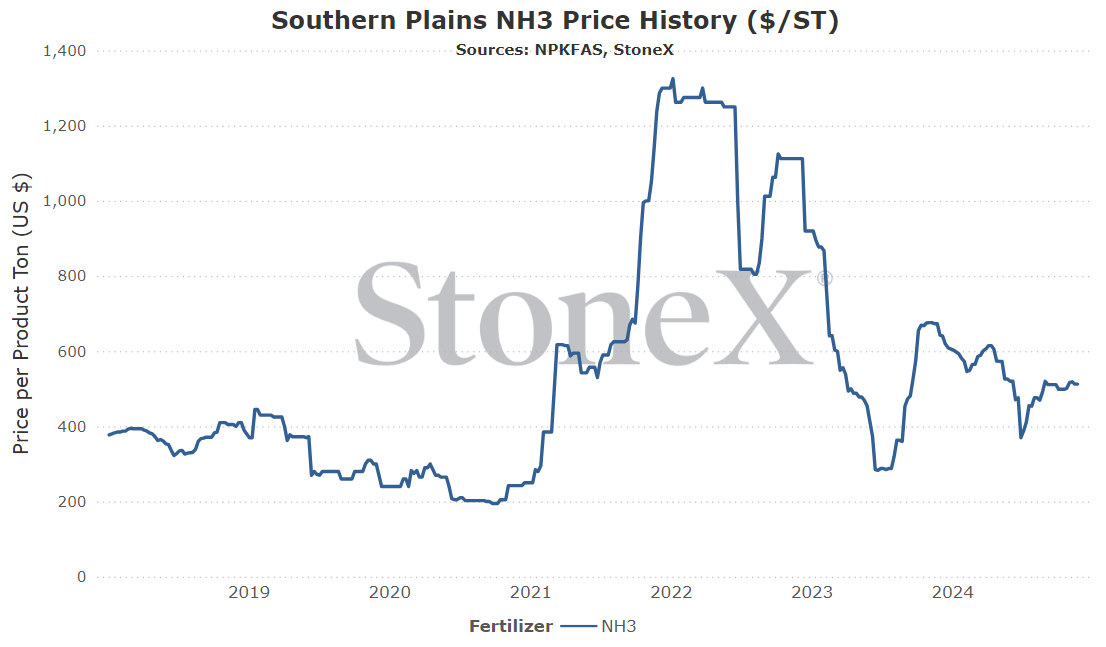
US Southern Plains price average
Vs 30 days ago - 2% or approximately $11 higher
Vs 90 days ago - 4% or approximately $21 higher
Vs 6 months ago - -1% or approximately $8 lower
Vs 1 year ago - -24% or approximately $160 lower
- Further European N production plant stoppages - while I think this is still a little way off, with European natural gas values rising it is certainly something that needs watched. European nitrogen production has been operating at around 75% of normal for a while now. There was a time last winter when Dutch TTF values plunged to $7MMbt that we thought more plants would restart...but they never did. Now, those same values have been around $13 - $15MMbtu and if winter gets cold, those could jump quickly. Nitrogen production plants can only handle its biggest input cost rising so much before hard decisions need made.
- Any further production hiccups like Trinidad earlier this year - the world is already looking at a tight S&D with the continued absence of Russian exports. It can ill afford losing more supply...but that doesn't mean it cannot happen. Trinidad has seen production lowered because of tight gas supplies. We could expand this to include any production lost in the Middle East. Even N.A. has seen production struggle in the winter due to artic blasts. Any hiccup that removes supply is going to be supportive prices.
- Condensed U.S. Midwest application window - today, I am celebrating the fact that farmers across the Midwest are finally getting their shot at application (yeah Northern Plains and southern farmers, we have been jealous!!!!). However, it looks like it could be a short window. That means the entire Midwest is sprinting to the feed trough at the same time. There is only so much that storage facilities can load per day. There are only so many trucks/railcars/barges/pipe capacity per hour. The more condensed the season, the more pressure on logistics...which could make its way to the farmer.
- Russia returns - this is going to be my biggest bearish factor until it happens!!! Losing the biggest global exporter played a big part in global NH3 values rising so their return should mean the opposite. There will always be a fear that the facility is attacked by Ukraine but until/unless that happens, Russian tons should put price pressure on the market.
- Higher price causes global buyers to drag their feet - there is nothing cheap about today's NH3 marketplace. It is expensive and buyers tend to wait when a price is high. Better to sit back and see if anything better happens in the future. While it may not change the overall S&D of the market, it can cause short term prices to fall as the market struggles with illiquidity. This doesn't look likely today, but something to watch.
- U.S. fall run falls well short of expectations (short term dip) - we currently are forecasting the U.S. fall NH3 application around 2.1 to 2.2M tons. If we were to fall to half of that, it would be a huge increase in spring demand...but we would have short term issues. The market would already be full heading into winter months which is a danger to manufacturers. They need to have somewhere to go with their NH3 or risk having to shut down. That means they get more aggressive on their winter fill programs. They want to get every sale possible and will do what they must to make it happen. Once they find enough sales, they should pivot to higher prices for spring, but it would have some short term bearish impacts.
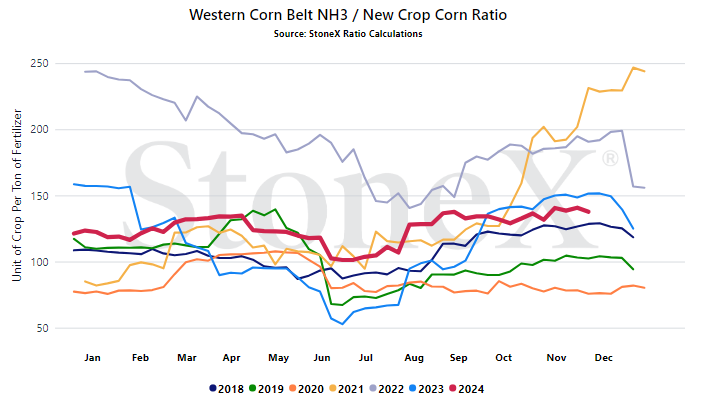
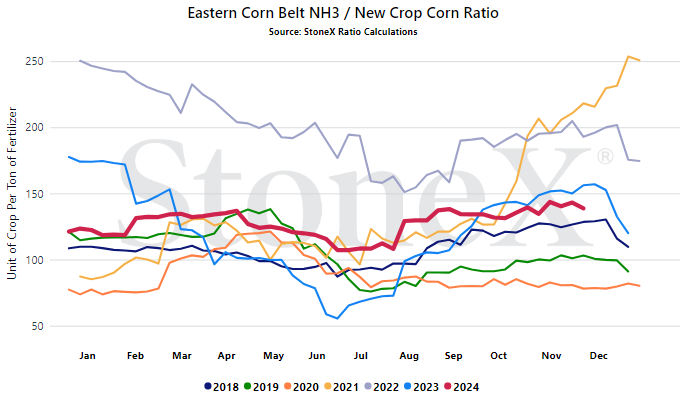
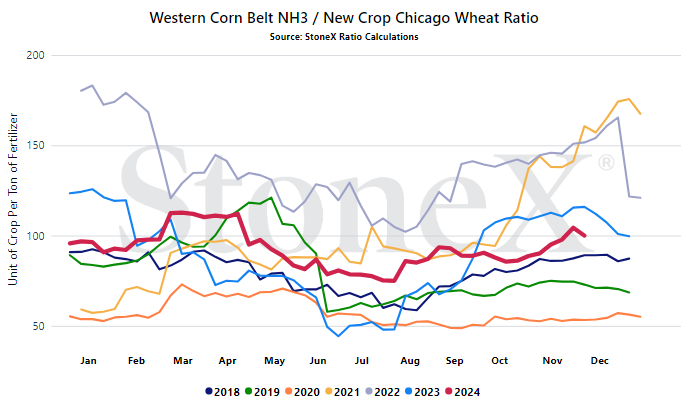
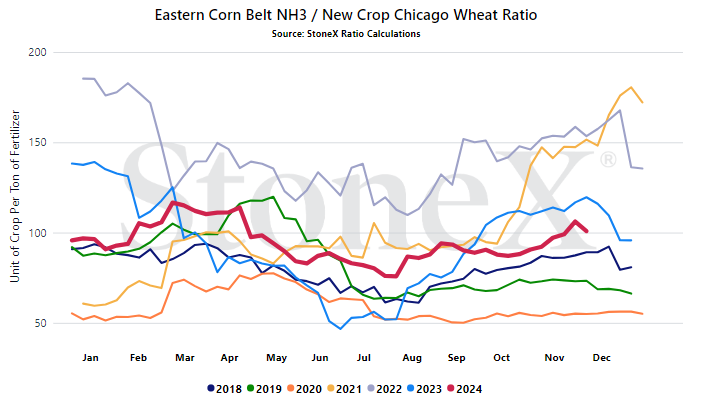
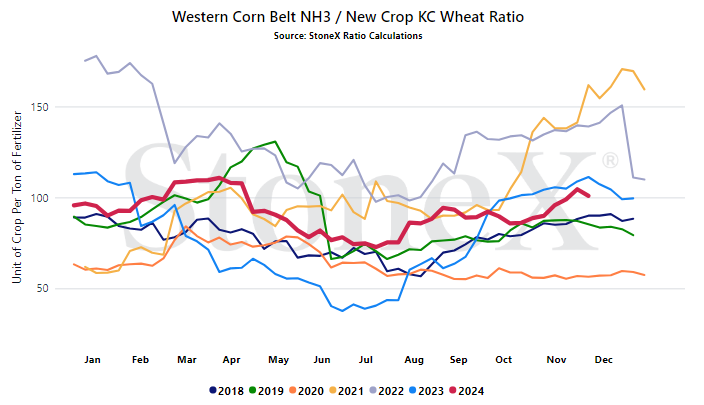
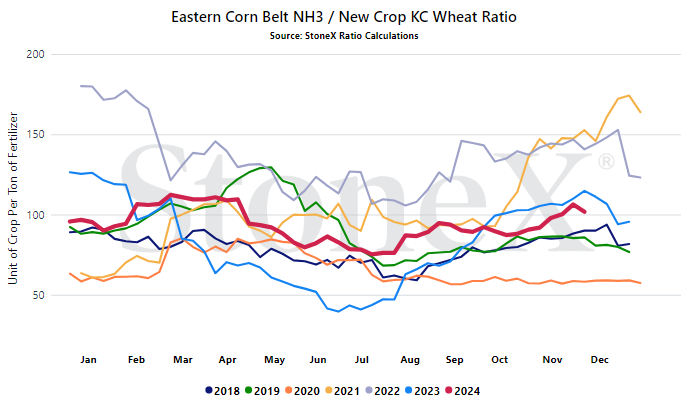
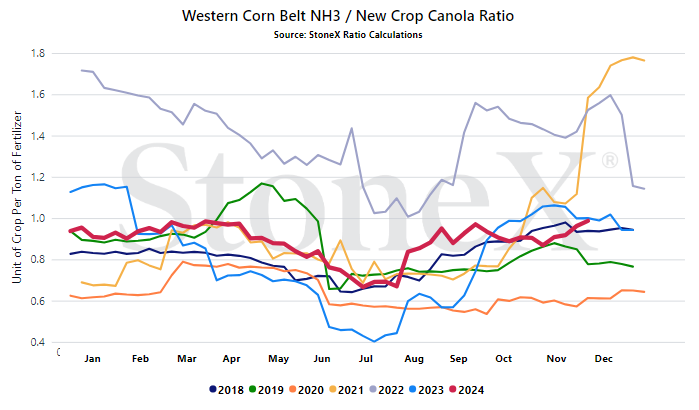
Where are the current NH3/grain ratio values today
We believe that only looking at the flat price of either grains or fertilizer can be misleading:
-
Only selling grain can hurt you if fertilizer prices rise substantially
-
Only buying fertilizer can hurt you if grain prices fall
We look at the ratio "value" to get a better indication of where we are or how many bushels of X does it take to pay for 1 ton of fertilizer.
Would you rather:
-
Spend 150 bushels to pay for 1 ton of potash
-
Spend 100 bushels to pay for 1 ton of NH3
When we compare the current ratio value against recent years, we start to see if we are high or low.
YOUR VALUES MAY LOOK DIFFERENT
This graph looks at the NOLA NH3 price vs the flat grain price. There are no logistics on either product. Your location will look different due to fertilizer logistical costs, grain basis, etc.
- Russia's export return - the eventual return of the world's largest exporter should usher in more aggressive pricing around the world...whenever that happens. This has the greatest potential to change price ideas around the world.
- U.S. fall application success/failure - closer to home, we are watching the next week or two very closely. I think we are going to have a solid week of application. After that, I'm not so confident. Seeing 12 and 17 as the low's this weekend spooks me that we get a hard freeze and never restart until spring. I know December can have windows open, but they are the exception rather than the rule. We are living on borrowed time, and the alternative is a very questionable spring season.
- Any further impacts to production - I know this is one of those "duh" focal points, but given how tight the world supply is without Russia, it is worth talking about. If we had Russian exports normal, the world could more easily handle some hiccups to production. Unfortunately, we just do not have any buffer today like we would have in the past. We have very little room for error.
StoneX Ratio Calculation
The ratio calculation is derived from Bloomberg historical grains values as well as fertilizer values from StoneX, NPKFAS, and Argus.
The calculation is simply dividing the fertilizer price by each grain price.
All data was sourced from StoneX unless otherwise noted.