StoneX logo

Farmer Fertilizer Focus - Phosphates

By: Josh Linville, Vice President- Fertilizer

PHOSPHATES
 
Josh Linville
Vice President - Fertilizer
What everyone wants to know first, what do we think will happen going forward
The N.A. and global phosphate markets are going to get really hard to call in the coming months.  There are several reasons that we should see phosphate weaken in price.  There is only one reason why prices should remain steady to higher...but it is a big and important reason.
North American phosphate values look to largely hold steady   
There will be price volatility.  It isn't as though prices will remain dead.  However, it seems as though it will be hard for prices to break much lower or higher not only in the next 30 days but the next few months unless something changes regarding Chinese exports.
If it were not for the lack of Chinese exports, we would be looking at a very bearish marketplace:
  • Ending spring inventories were much higher than expected
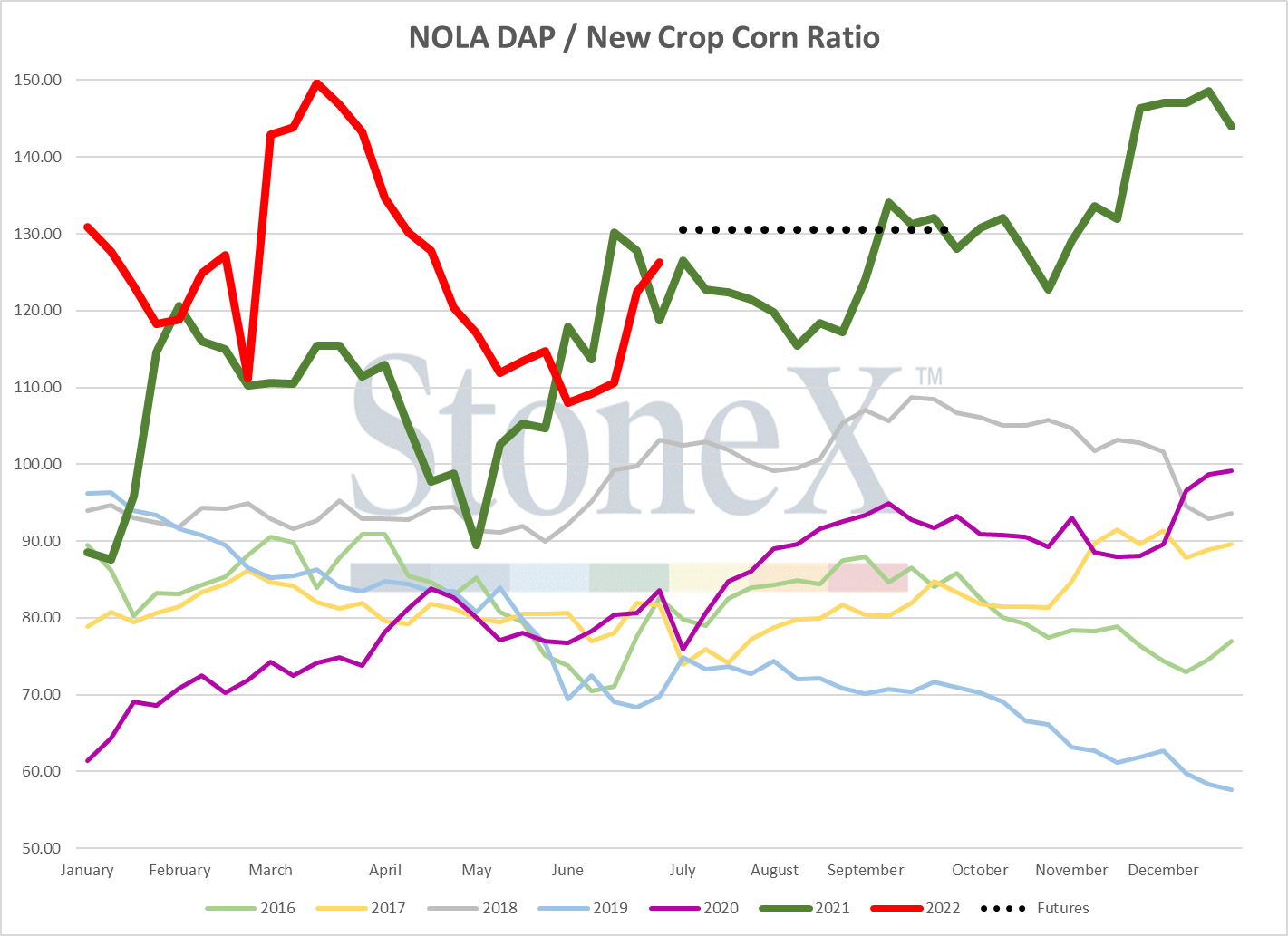
  • Current phosphate prices are far too high vs current corn prices
  • Current phosphate prices are historically high and could cause demand to wait

Any one of these bullet points would normally push prices lower.  The combination should mean this thing falls apart.

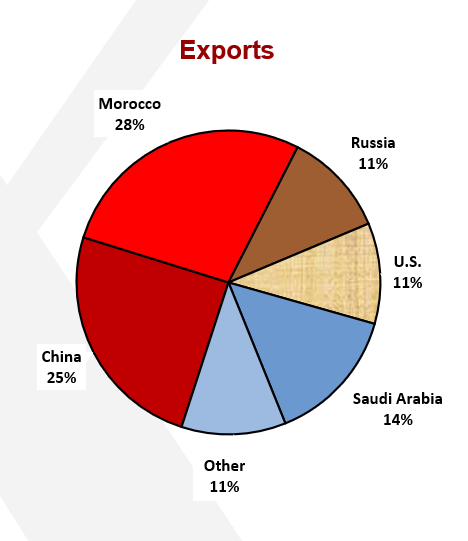
Unfortunately, we ARE living in a world without Chinese exports.  They are the single largest producing nation in the world and the single largest exporting country in the world...when they were exporting.

Without Chinese exports, there are a lot of nations around the world looking for a new supplier.  That means global producers, North American producers included, have more sales opportunities for their product.  

The global phosphate market is no different than North America in that values should hold without China

Having Russian tons find homes around the world certainly helped global supplies.  That was a welcome surprise.  Unfortunately, those tons alone are not enough to completely tip the scales lower.

The world needs China back, plain and simple.  Without their product, the world is losing its largest exporter.  We have seen demand down around the world this spring with phosphate values where they are.  Unfortunately, that demand cut is not enough to outweigh a world without China.

There is, of course, still a chance that their government changes course and allows a full return.  It isn't likely but is a possibility.  If that happens, everything changes.  I just wish I could tell you that it is just a matter of time...
Should you buy your fall '22/spring '23 phosphate needs?
Unfortunately, there is no clean answer.  This is a farm by farm decision.
Most of the metrics that I use to look at markets and decide if I think it is worth buying or waiting are pointing toward waiting today.  
  • Current values are still historically high
  • Current phosphate/grain values are still extremely high
  • Something as simple as China returning to full exports could cause prices to plummet
  • There is still 4 months before November
  • There is still 8 months before March

This should be as simple as me screaming "do not touch phosphates today.  Wait for better days".

Unfortunately, I do not know if better days are coming anytime soon.

We have seen no indication of China returning and without their exports, the global S&D is tight.  As I sit here and write this, I have little hope that they do return so my mind starts to move toward what makes sense and that isn't an answer that I can make for you.

If I am farming, I am asking myself:

  • Can I buy my inputs, sell my grain and secure a profit for 2023?
  • If I drag my feet on fall needs, can I get everything done next spring?
  • If I drag my feet on fall needs, can my supplier/retailer get everything done next spring?
  • Am I willing to risk prices rising due to large '23 demand/no China in the hopes that China returns?

If you can lock in inputs, sell your grain and lock in a profit you are happy with, I think that goes a long ways to your answer.  If you are near production points, you are likely more able to wait as there is product nearby.  The further away from production you are, the more susceptible you are to poor just in time logistics.

I'm sorry my answer sucks.  I know it does.  This time, it comes down to you and what makes sense for your farm...

What has happened in the last 30 days?
Russian phosphate exports continue to find homes
I am leaving this unchanged from the June newsletter because it still makes sense today.  The return of Russian exports have helped global supplies rise and as a result, have helped prices weaken.
When Russia invaded Ukraine, we saw the world economy stand as one and draw a definitive line in the sand.  It was not going to do business with Russia.
Then, countries started to figure out that they really needed Russian fertilizer for their people, and that line has...blurred.
That means we have gone from thinking Russian exports being 0 to being a decent percentage of normal.  We continue to believe that exports are down, but anything higher than 0 beats expectations.  There are multiple reports that the back up in vessels unloading in Brazil mostly come from Russia.  We have seen sales made to India from Russian phosphate producers.  
Many countries/economies continue to shun Russia and Russian exports but as long as there are some countries around the world willing to buck that POV, those tons will flow into the global market.
Still no official statement from the Chinese government regarding exports
Another month without an official statement from the Chinese government.
I highly expected that we would have seen something by now.  When the ban was put into place last fall, it was stated that it would be in effect thru June '22.  June is now in our rearview mirror and we still have not seen an update.
As mentioned last month, I have heard a wide range of speculation on what would happen.  Anywhere from a full return to a complete ban thru June '23.  I have continued to expect that we will see exports allowed but at lower and controlled pace.  Unfortunately, like so many others, I am merely making educated guesses.
At the end of the day, we need to wait for that statement before we know.  Until we do, the world is losing a VERY important player which will keep prices elevated around the globe.
image 42448
North American phosphate production costs are much higher than "normal"
I am going to tread very lightly on this next statement as I know that there are a lot of high emotions regarding phosphate producers in North America.
...alright, here I go...
North American phosphate producers are not making nearly as much as people think and if prices dip too much from where they are today, we run the risk of them shutting down production.
OK, breath...!!!!!
Don't worry, producers are doing just fine on current margins!  That said, their margins are not nearly as fat as many believe them to be.
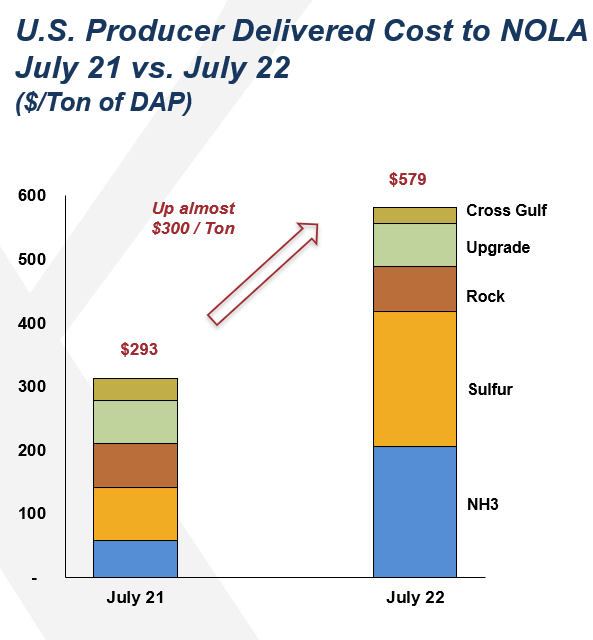
Over the past year, both sulfur and NH3 values have skyrocketed which have caused phosphate production costs to skyrocket with them.  In the last year, we have seen our estimated cost up almost $300/ton.
What I am trying to point out is to the crowd that thinks we should see prices back to the $300 range.  I'm with you, I would love to see it happen while keeping grain prices high and boost farmer margins.  Unfortunately, that isn't how the world works today.  If prices start to dip near production costs, we could easily see production rates drop which would lower supply and end up pushing prices higher once again.
image 42449
Estimates on 2023 demand are all over the place
I recently put out a poll asking people's expectation for 2023 corn acreage numbers.  I had one call me out that it was a bit dumb to be thinking about that already.  While it may seem too early, we are already in the fertilizer year 2023 cycle which means we need to start making estimates on what next years crops look like.
Today's numbers will change from current estimates.  That said, we are already putting a very conservative number at 90M with talk that we could easily see that rise upwards of 94-95M.  That means we are set for another big demand period.
On the flip side, we are also estimating that not only will overall application rates be down, it is feasible that fall demand will be down with farmers dragging their feet in hopes of a winter price dip.
It will continue to be all over the place but overall, demand is going to continue to be big which is a win for the producer.
Where are current values in relation to the past
For DAP, we use NOLA/New Orleans Louisiana as our base point as it is the easiest spot to track.
  • Vs 30 days ago - -3.7% or approximately $30 lower
  • Vs 90 days ago - -21.5% or approximately $215 lower
  • Vs 6 months ago - +8.3% or approximately $60 higher
  • Vs 1 year ago - +29% or approximately $178 higher
Bull/Bear Factors
Because no market is ever guaranteed to go higher/lower, we try to consider the factors that can sway values so that we are able to act when they occur rather than react.
Bullish Factors
  • 2023 crop expectations pointing to solid demand – India monsoon's appear to continue their phenomenally good streak which will mean solid demand.  Brazil weather continues to beat up crops which means a need for more in the future.  N.A. corn acreage was lower than expected and will need to be made up.  All of these and more factors should combine for a very solid phosphate demand picture as we start to focus on 2023.
  • Without Chinese exports, the world is left needing tons – normal global supply routes are a thing of the past with China out of the export picture.  Nations that would normally rely on tonnage from China are not going to simply go without phosphates.  They will look to the remaining producers for their needs.  That gives those producers options to sell.  That puts them in a VERY comfortable position.
  • Fall season is just around the corner for the northern hemisphere – as I wrote that highlight, I questioned myself several times.  Unfortunately, the statement is true.  November is just under 4 months away.   Yes that is a third of a year but with global producers currently having little issue finding buyers, it is likely that they will remain comfortable.  4 months will go by in an instant. 
Bearish Factors
  • High inventory carryover from spring could weigh on values – normally, this would be an extremely large bear factor.  Spring demand never seemed to come as many (myself included) expected.  It feels as though inventories are higher than normal coming into the summer and that means fewer options for producers to ship their product.  The lifeline for producers this year is the lack of Chinese exports which gives them other export options.  That said, if global demand goes dark, this factor could creep up (or down in this case) on prices.
  • China could start exporting tomorrow – is it likely?  Nope.  Is it possible?  Yep.  China is that important to the global phosphate marketplace and whether we like it or not, regardless of where you are reading this from, we are part of the global phosphate marketplace.  If the Chinese government decides to take export restrictions off and allow full exports, prices will come under pressure very quickly.
  • Reluctant buyers could be an issue - let's cut to the chase, most farmers are at least a little pissed at current values.  Guessing I could say that most farmers are really pissed at current values!  While it remains to be seen, we could see demand be reluctant.  We could see application rates dip once again.  We could see buyers wait until the very last minute to buy.  Retailers are also worried about the price risk and will be worried about buying product.  If enough demand stops dead in its tracks, it could put more pressure back on the producer.
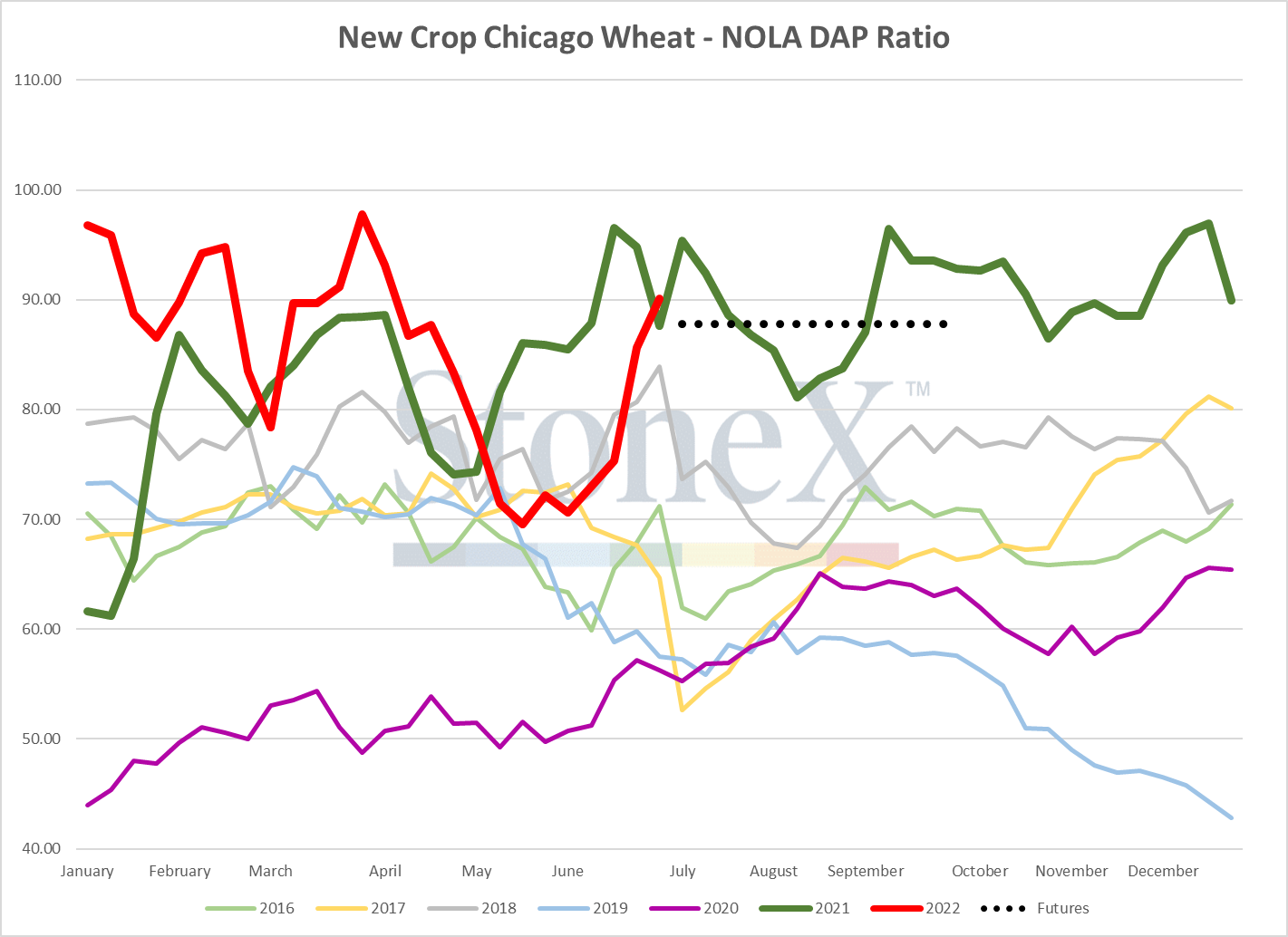
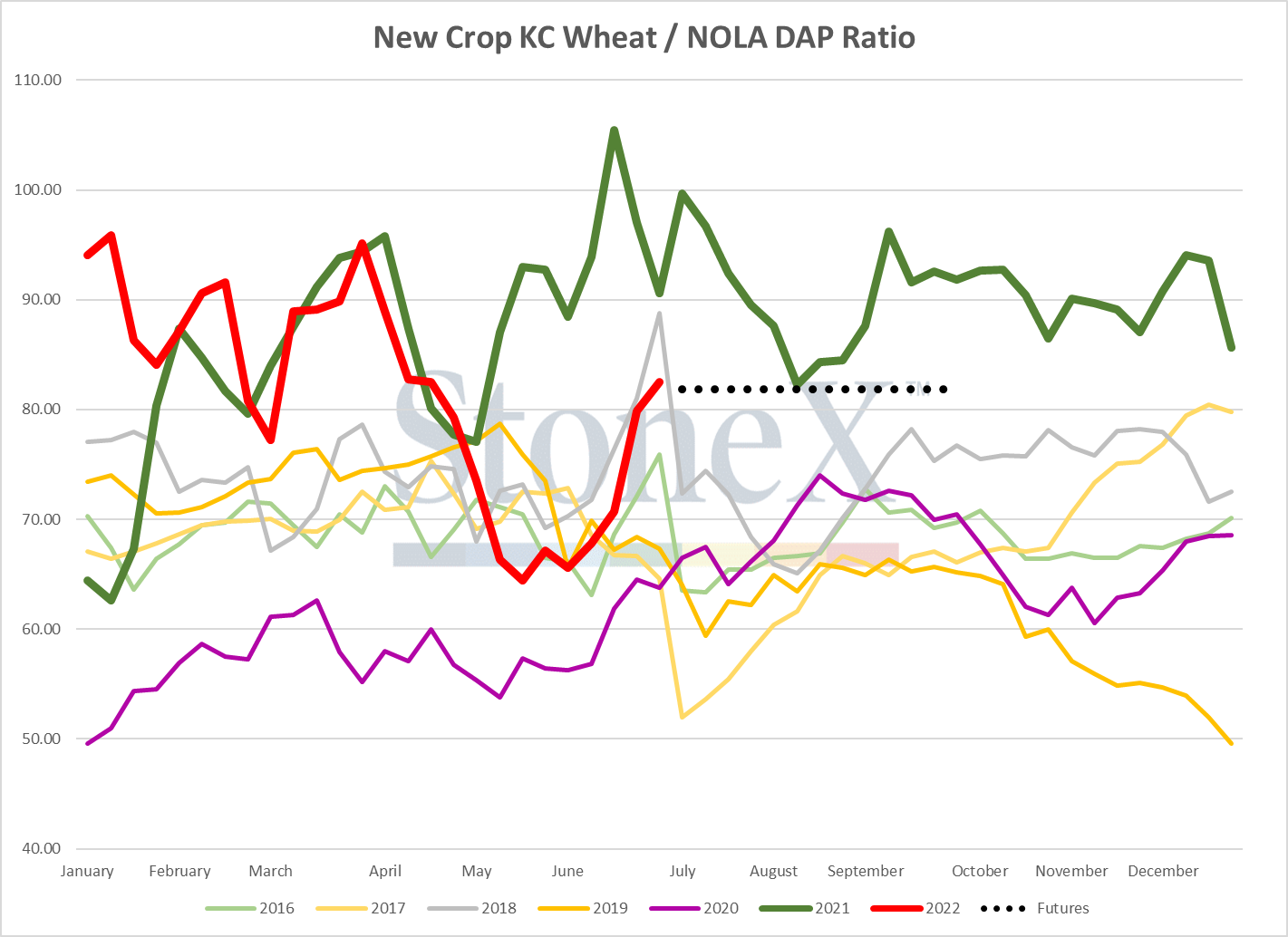
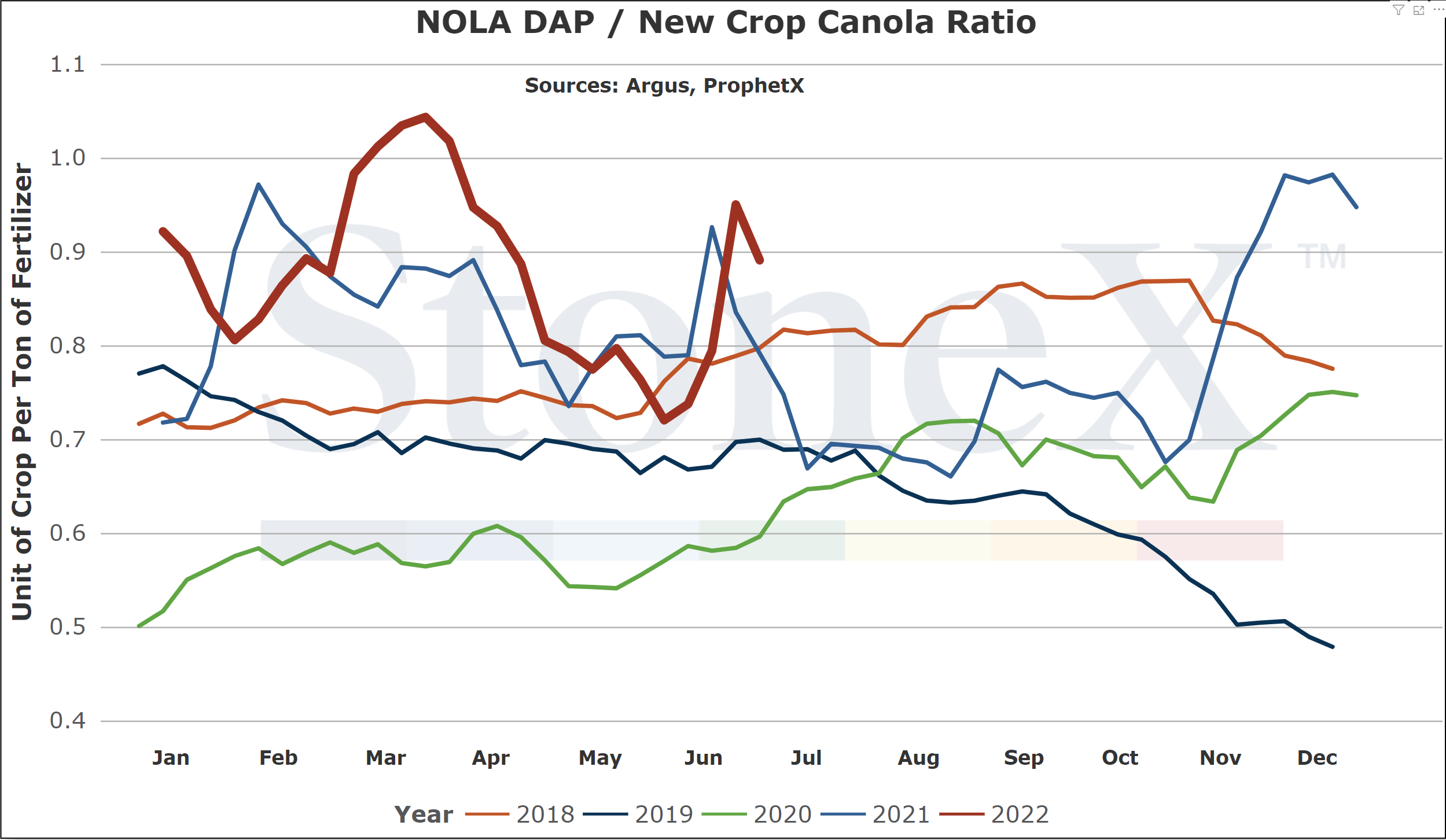
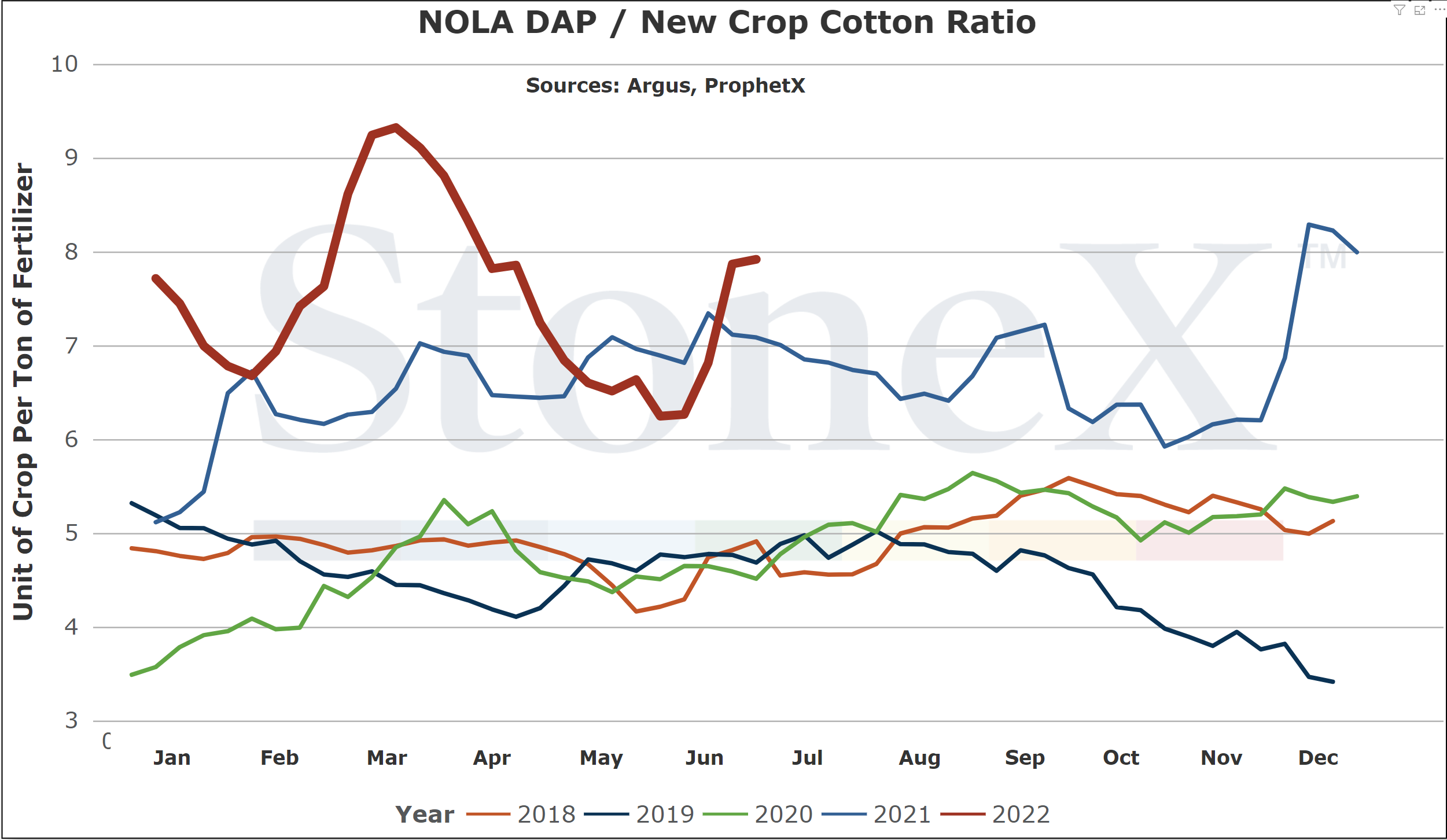
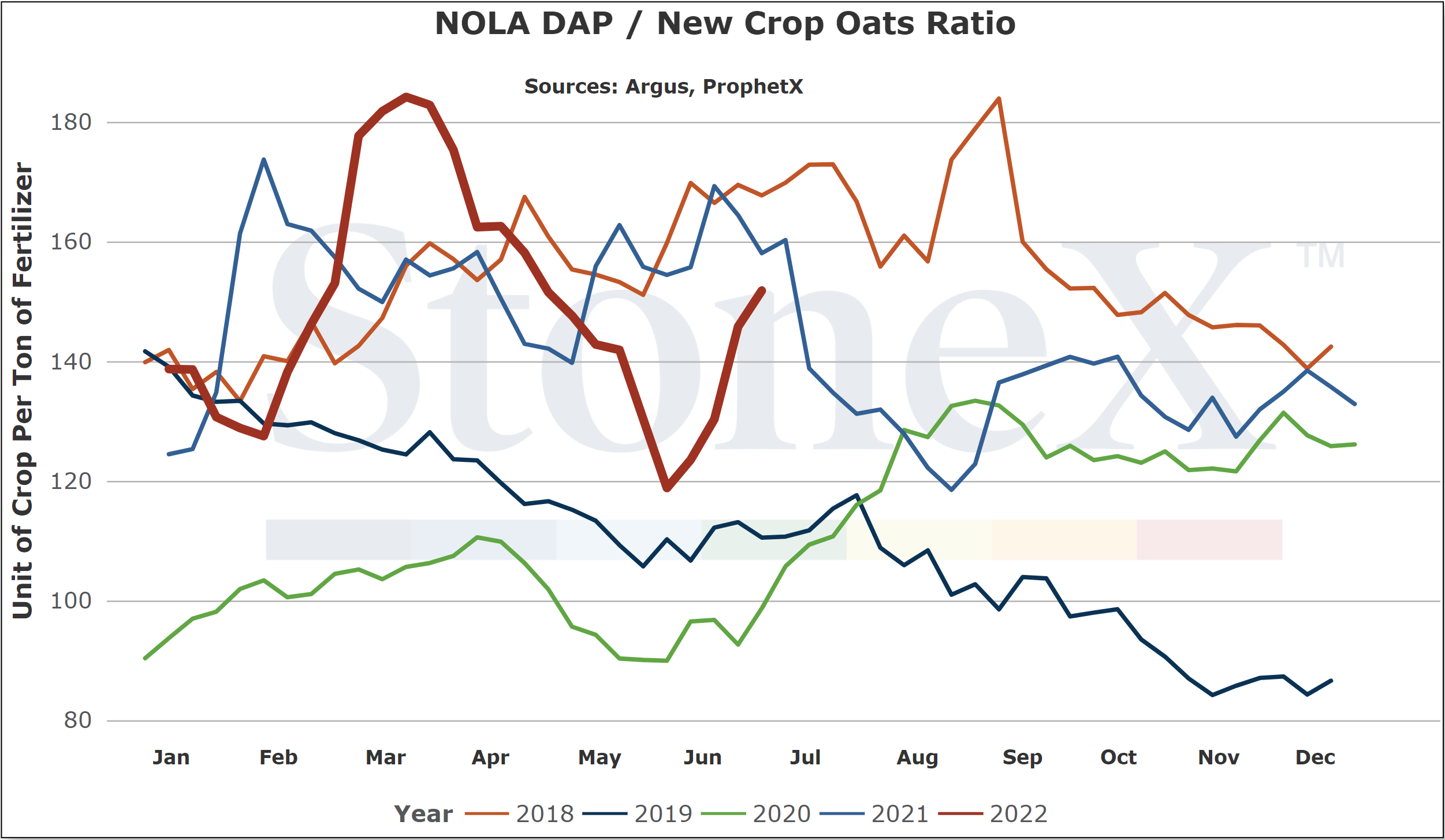
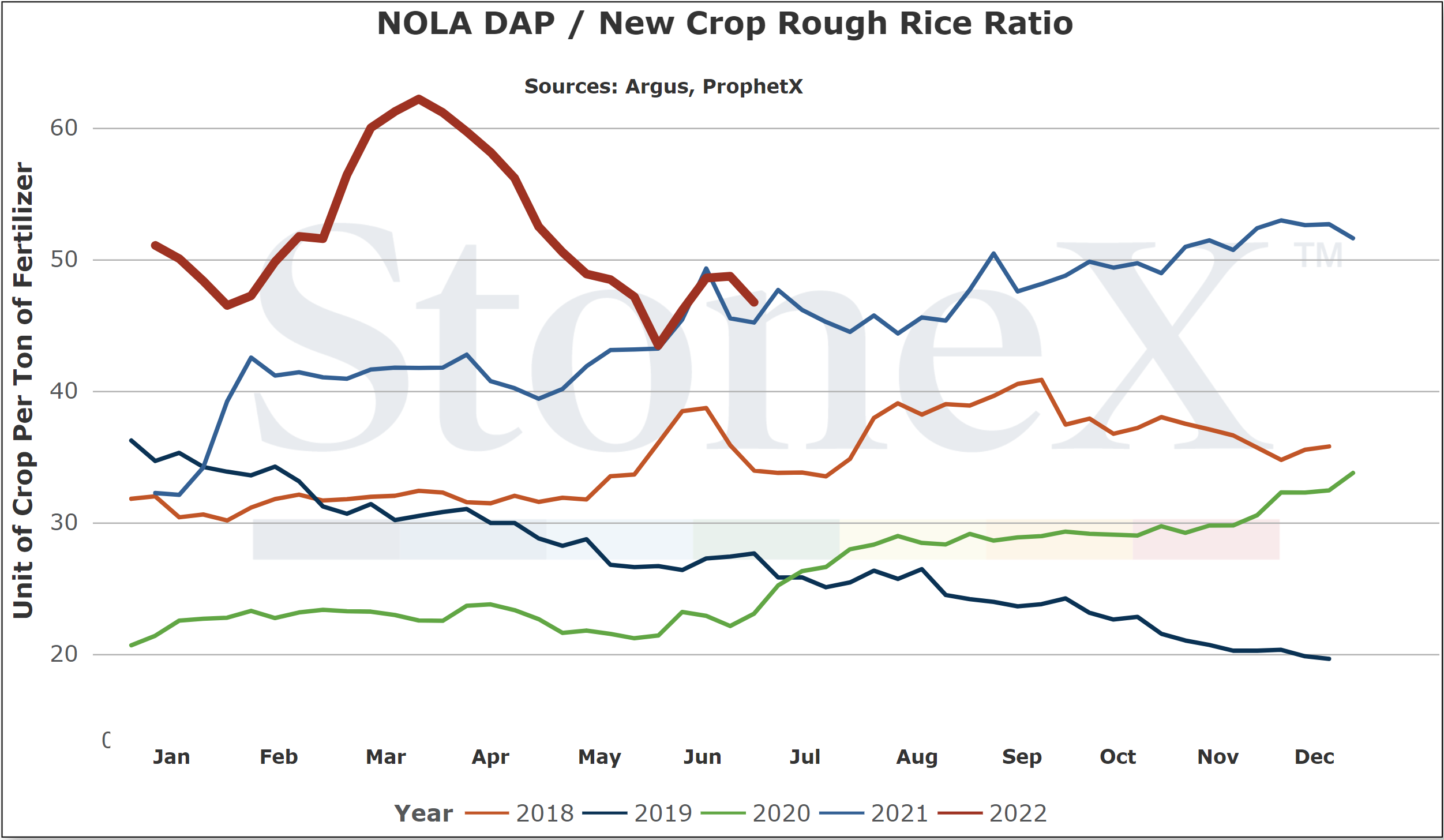
Where are the current phosphate/grain ratio values today?
We believe that only looking at the flat price of either grains or fertilizer can be misleading:
  • Only selling grain can hurt you if fertilizer prices rise substantially
  • Only buying fertilizer can hurt you if grain prices fall
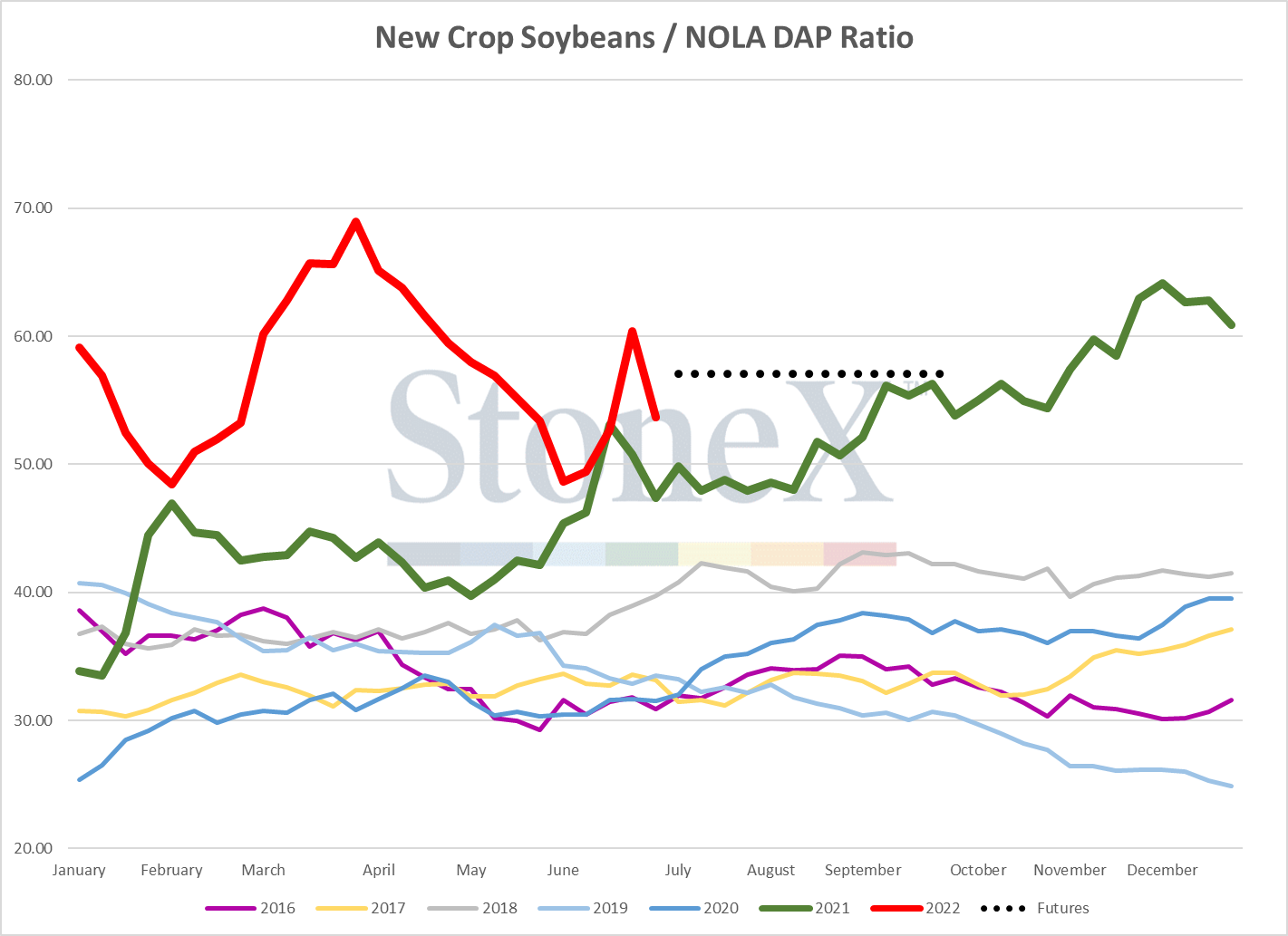
We look at the ratio "value" to get a better indication of where we are or how many bushels of X does it take to pay for 1 ton of fertilizer.
Would you rather:
  • Spend 120 bushels to pay for 1 ton of DAP
  • Spend 80 bushels to pay for 1 ton of DAP
When we compare the current ratio value against recent years, we start to see if we are high or low.
YOUR VALUES WILL LOOK DIFFERENT
This graph looks at the NOLA DAP price vs the flat grain price. There are no logistics on either product. Your location will look different due to fertilizer logistical costs, grain basis, etc.
image 42440
image 42441
image 42442
image 42443image 42444
image 42445
image 42446
image 42447
Josh Linville’s Thoughts
  • I'm sorry I do not have great information on what to do - as I mentioned above, this decision needs to come down to your farm and ability to make money.  If you can lock in your inputs, sell your grain and make a solid profit, it is hard to pass that up in times like this.  If it is a struggle, it might be worth taking a wait and see approach.
  • Remember, hope is not a strategy 


  • Fertilizers

This material should be construed as the solicitation of an account, order, and/or services and represents the opinions and viewpoints of the individual authors or presenters. It does not constitute an individualized recommendation or take into account the particular trading objectives, financial situations, or needs of individual customers.


The views are current only through the date stated and are subject to change at any time based upon market or other conditions, and StoneX Group Inc. (“SGI”) disclaims any responsibility to update such views. Actual results, performance, or achievements may differ materially from those expressed or implied. Information is based on data gathered from what we believe are reliable sources. Past performance does not guarantee future results.


The StoneX Group Inc. group of companies provides financial services worldwide through its subsidiaries, including physical commodities, securities, exchange-traded and over-the-counter derivatives, risk management, global payments and foreign exchange products in accordance with applicable law in the jurisdictions where services are provided.


References to certain OTC products or swaps are made on behalf of StoneX Markets, LLC (SXM), a member of the National Futures Association (NFA) and provisionally registered with the U.S. Commodity Futures Trading Commission (CFTC) as a swap dealer. SXM’s products are designed only for individuals or firms who qualify under CFTC rules as an ‘Eligible Contract Participant’ and who have been accepted as customers of SXM.


StoneX Financial Inc. (SFI) is a member of FINRA/NFA/SIPC and registered with the MSRB. SFI is registered with the U.S. Securities and Exchange Commission (SEC) as a Broker-Dealer and with the CFTC as a Futures Commission Merchant and Commodity Trading Advisor. StoneX Financial (Canada) Inc. (SFCI) is registered in Canada and is a member of CIRO and CIPF. References to certain securities trading are made on behalf of the BD Division of SFI and are intended only for an audience of institutional clients as defined by FINRA Rule 4512(c). References to certain exchange-traded futures and options are made on behalf of the FCM Division of SFI. Wealth Management is offered through SA Stone Wealth Management Inc., member FINRA/SIPC, and SA Stone Investment Advisors Inc., an SEC-registered investment advisor, both wholly owned subsidiaries of SGI.

R.J. O’Brien & Associates, LLC (RJO) is registered with the CFTC as a Futures Commission Merchant and is a member of NFA.


StoneX Financial Ltd (SFL) is registered in England and Wales, company no. 5616586. SFL is authorized and regulated by the Financial Conduct Authority (FCA) (registration number FRN:446717) to provide services to professional and eligible customers including: arrangement, execution and, where required, clearing derivative transactions in exchange traded futures and options. SFL is also authorized to engage in the arrangement and execution of transactions in certain OTC products, certain securities trading, precious metals trading and payment services to eligible customers. SFL is authorized and regulated by the FCA under the Payment Services Regulations 2017 for the provision of payment services. SFL is a category 1 ring-dealing member of the London Metal Exchange. In addition SFL also engages in other physically delivered commodities business and other general business activities which are unregulated and not required to be authorized by the FCA.


This communication is issued in the European Economic Area by StoneX Financial Europe GmbH (SFEG). StoneX is the trade name used by STONEX GROUP INC. and all its associated entities and subsidiaries. StoneX Financial Europe GmbH (“SFEG”) is a securities trading firm registered in Germany under Company No. HRB 80844.


StoneX Financial Pte Ltd (Co. Reg. No 201130598R) (“SFP”) is regulated by the Monetary Authority of Singapore and is a Capital Markets Service Licence holder (for dealing in capital market products), an Exempt Financial Adviser (for advising on investment products and issuing or promulgating analyses/ reports on investment products) and a Major Payment Institution (for domestic and cross-border money transfer services).


SFP may distribute analysis/report produced by its respective foreign affiliates within the StoneX Group of companies pursuant to an arrangement under Regulation 32C of the Financial Advisers Regulations Recipients should contact SFP at (65) 6309 1000 for any matters arising from, or in connection with, this webinar.


StoneX APAC Pte. Ltd. (“SAP”) (Co. Reg. No 200616676W) is regulated as a Dealer (PS20190001002) under the Precious Stones and Precious Metals (Prevention of Money Laundering and Terrorism Financing) Act 2019 for purposes of anti-money laundering and countering the financing of terrorism.


StoneX Financial (HK) Limited (CE No.: BCQ152) (“SHK”) is regulated by the Hong Kong Securities and Futures Commission for Dealing in Securities and Dealing in Futures Contracts.


StoneX Financial Pty Ltd (ACN 141 774 727) holds an Australian Financial Service License (AFSL: 345646) for Dealing in Securities, Exchange-Traded Derivatives Contracts, OTC Derivatives Contracts and Foreign Exchange Contracts, and is regulated by the Australian Securities and Investments Commission.


StoneX Securities Co., Ltd. (“SSJ”) (Co. Reg. No 010401047199) is regulated by the Japanese Financial Services Agency as a Type-I Financial Instruments Business Operator (Kanto Local Finance Bureau (FIBO)No.291’), is a member of the Financial Futures Association of Japan for dealing and broking FX and FX Option transactions, and is a member of the Japan Securities Dealers Association for dealing and broking stock indices and option transactions.


Trading swaps and over-the-counter derivatives, exchange-traded derivatives and options and securities involves substantial risk and is not suitable for all investors. Past performance of any futures or option is not indicative of future success. Indicators are not a trading system and are not published as a specific trade recommendation. The information herein is not a recommendation to trade nor investment research or an offer to buy or sell any derivative or security. It does not take into account your particular investment objectives, financial situation or needs and does not create a binding obligation on any of the StoneX group of companies to enter into any transaction with you. You are advised to perform an independent investigation of any transaction to determine whether any transaction is suitable for you. No part of this material may be copied, photocopied or duplicated in any form by any means or redistributed without the prior written consent of StoneX Group Inc.


The report/analysis herein is not directed to, or intended for distribution to or use by, any person or entity who is a citizen or resident of or located in any locality, state, country or other jurisdiction where such distribution, publication, availability or use would be contrary to law or regulation.


© 2026 StoneX Group Inc. All Rights Reserved.

Satellite view of Earth at night showing illuminated cities across Asia and the Middle East

Discover more insights

Our subscribers have access to comprehensive market analysis from StoneX spanning commodities, equities, currencies and more.

StoneX: We open markets

Our market expertise, advanced platforms, global reach, culture of full transparency and commitment to our clients’ success all set us apart in the financial marketplace.

Reach

With access to 40+ derivatives exchanges, 180+ foreign exchange markets, nearly every global securities marketplace and numerous bi-lateral liquidity venues, StoneX’s digital network and deep relationships can take clients anywhere they want to go.

Transparency

As a publicly traded company meeting the highest standards of regulatory compliance in the markets we serve, our financials and record of accomplishment are matters of public record. StoneX’s commitment to “doing the right thing over the easy thing” sets us apart in the industry and helps us build respect, client trust and new partnerships.

Expertise

From our proprietary Market Intelligence platform, to “boots on the ground” expertise from award-winning traders and professionals, we connect our clients directly to actionable insights they can use to make more informed decisions and achieve their goals in the global markets.