What everyone wants to know first, what do we think will happen going forward
N.A. and global phosphate values have seen prices degrade in the last 30 days. Not violently lower but enough to help. Partly due to an overall lack of demand (buyers skeptical of buying too early at these high prices). Partly due the typical summer lull. Now, we are getting closer to a turning point it feels as we move into August. Somehow, flipping the calendar from July to August makes it feel as though we are quickly moving toward fall season for the Northern Hemisphere.
Global phosphate could continue to see slight weakness but with N.A. production costs high, a firm price floor is near. That means the market feels like it has more upside than downside price potential.
Never in my life did I think I would see today's values and actually say out loud that there seems to be more upside than downside price risk.
For me, now that we know what the Chinese government is allowing to export, my focus is shifting to N.A. production. Specifically, Mosaic production.
The reason for this: I think N.A. phosphate production is the highest costing phosphate in the world today. There are more details below but given current input costs for freight/sulfur/NH3/etc., we believe their cost of production to sit in the $550 - $600st USD (more likely on the higher side of that range). Current NOLA markets sit in the mid-$700's. Yes, that is still huge margins but in today's day and age, that isn't a big difference. Last week, we saw the urea markets moving triple digits so $150 margin could, in the right scenario, be gone in a matter of days.
What I am trying to say is that while I still see potential for price weakness, with that price floor in place, there is limited downside and plenty of upside potential...I feel dirty even saying that...!!!!
Should you buy your fall '22/spring '23 phosphate needs?
November is coming up fast. If you are a fall application farmer, are far away from production sites and the numbers work, time to start making a hard consideration to lock up fall needs.
THIS IS NOT A ONE SIZE FITS ALL ANSWER.
Let me repeat that
THIS IS NOT A ONE SIZE FITS ALL ANSWER.
For me, if I am a farmer having to make a decision, I am asking myself how the current phosphate price looks vs next years grain values.
- My first reaction is going to be that these prices are too damn high
- After a drink or three, I'll get over the shock
- Then I need to figure out if I can make money at these values
I only look at these markets in the lens of fertilizer/grain. You do not have that luxury. You also have to consider rent/diesel/chemical/spraying/seed/equipment/etc. You need to take the entire organization into account. If you are looking at your operation and you feel like you can lock in a profit, then that gives you your answer for phosphate.
We also have to consider the ramifications of waiting. The fertilizer system is built to handle a fall/spring split. This is not to say that you cannot shift from one to the other. However, if the majority of the market does this, logistics are going to struggle. The further away you are from production, the more difficult this gets as more tons become reliant on just in time logistics. More times than not, just in time equates to higher priced and delayed shipping. Again, not saying it cannot be done but it is worth a conversation with your supplier.
These are not easy decision times and this is not one of those times that I can give a sweeping suggestion. If a hard recession happens, we could of course see phosphate prices down significantly. 2008 taught us that anything is possible. With the information at hand, it seems as though the downside is limited. Just make sure whatever you decide, it is what you decide.
What has happened in the last 30 days?
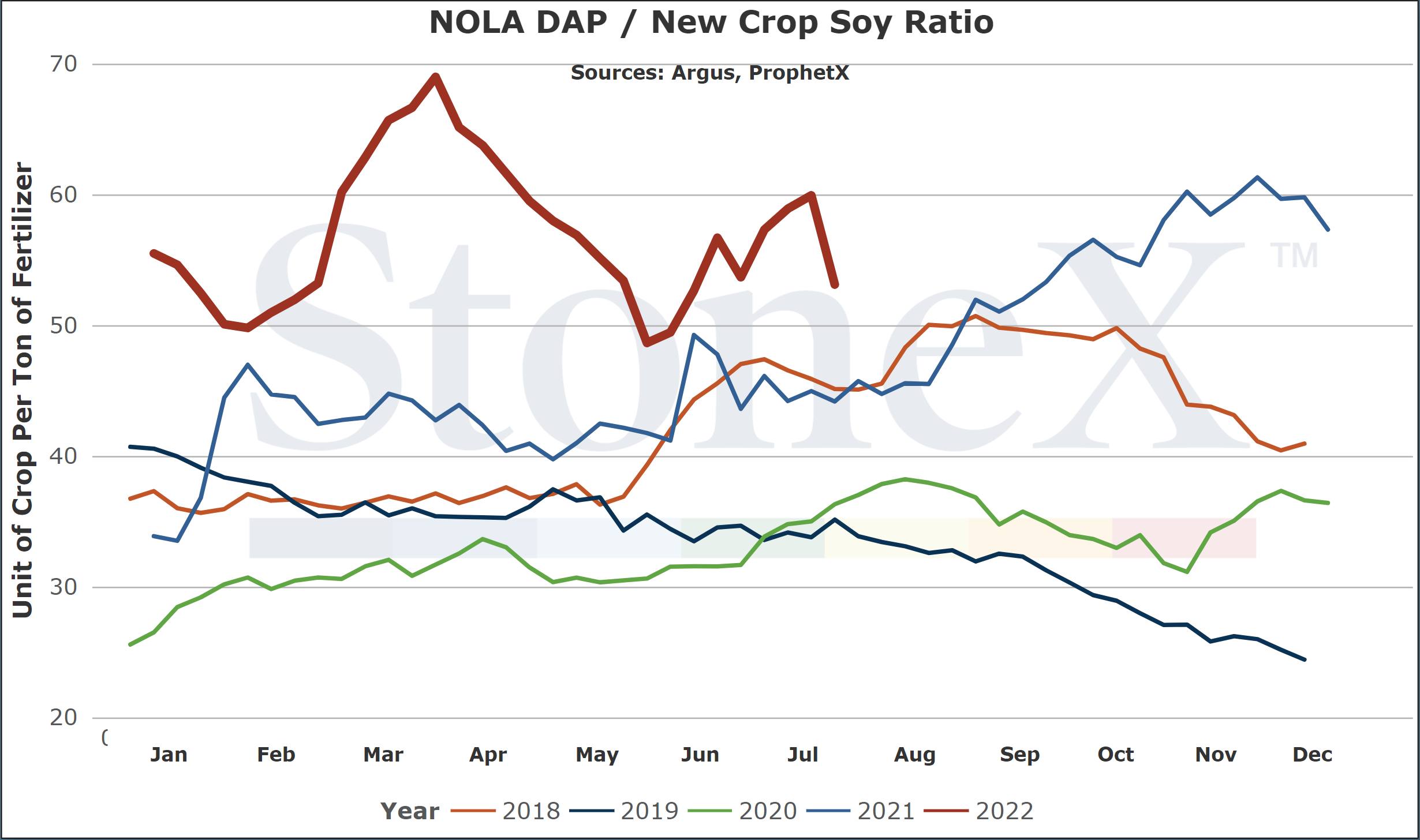
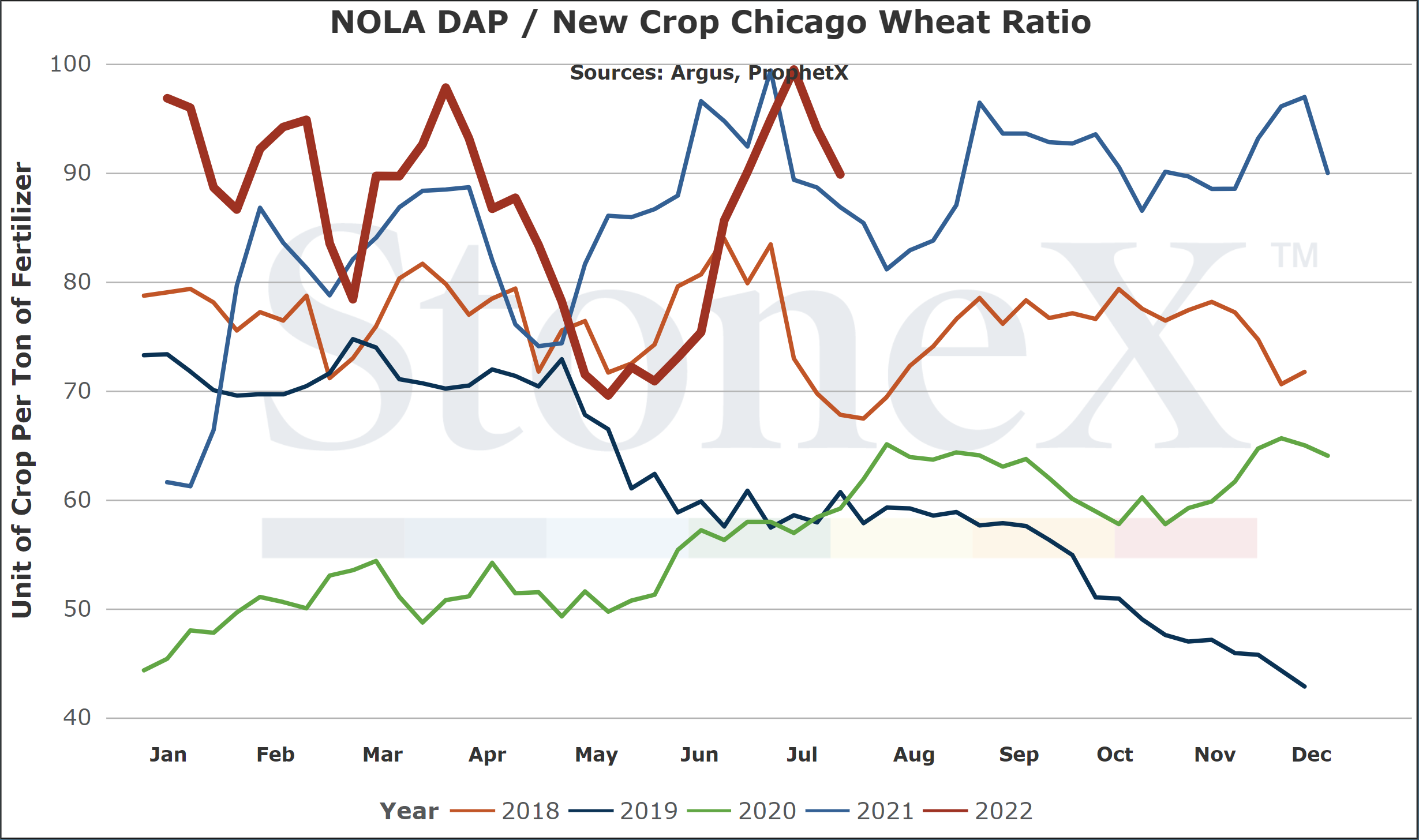
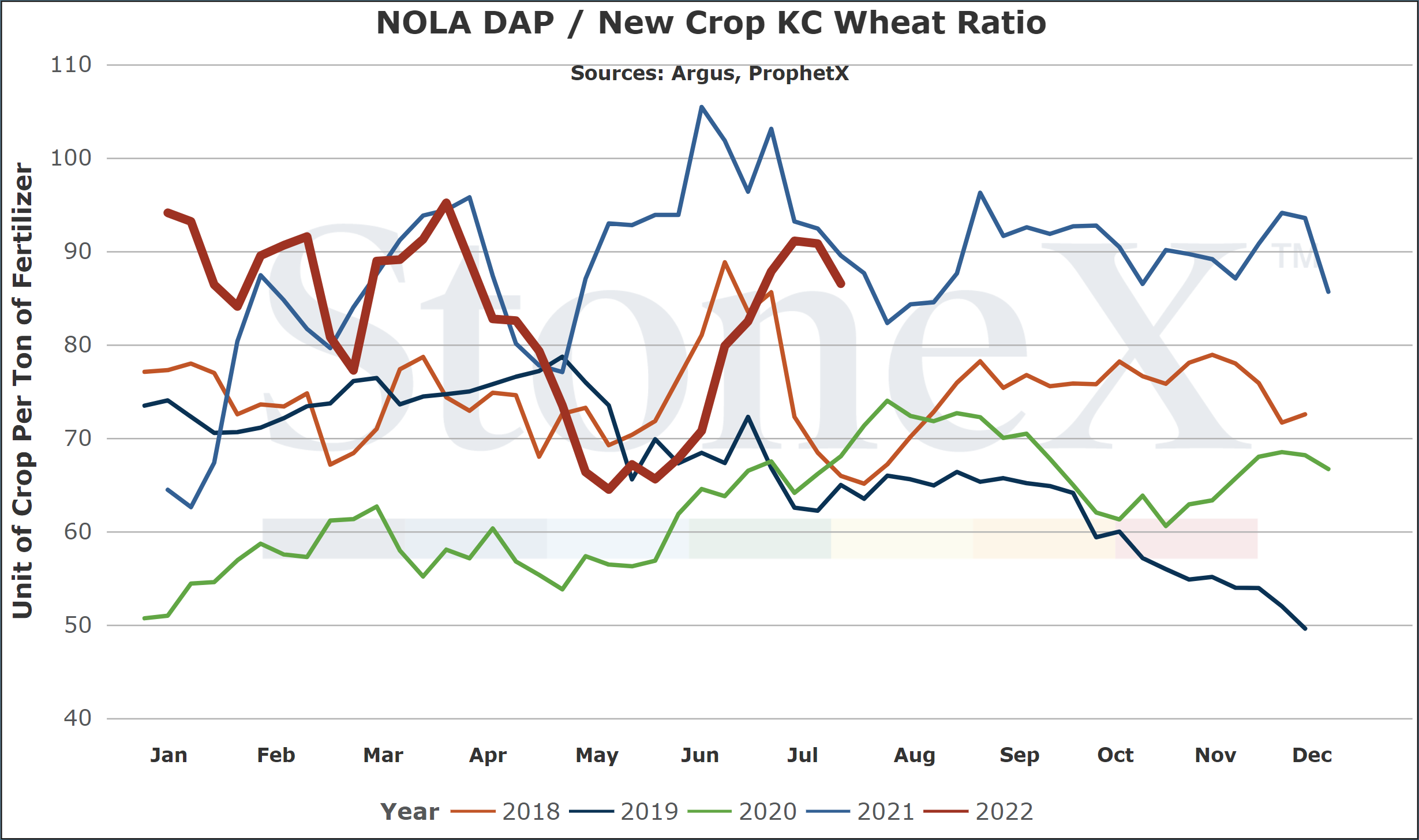
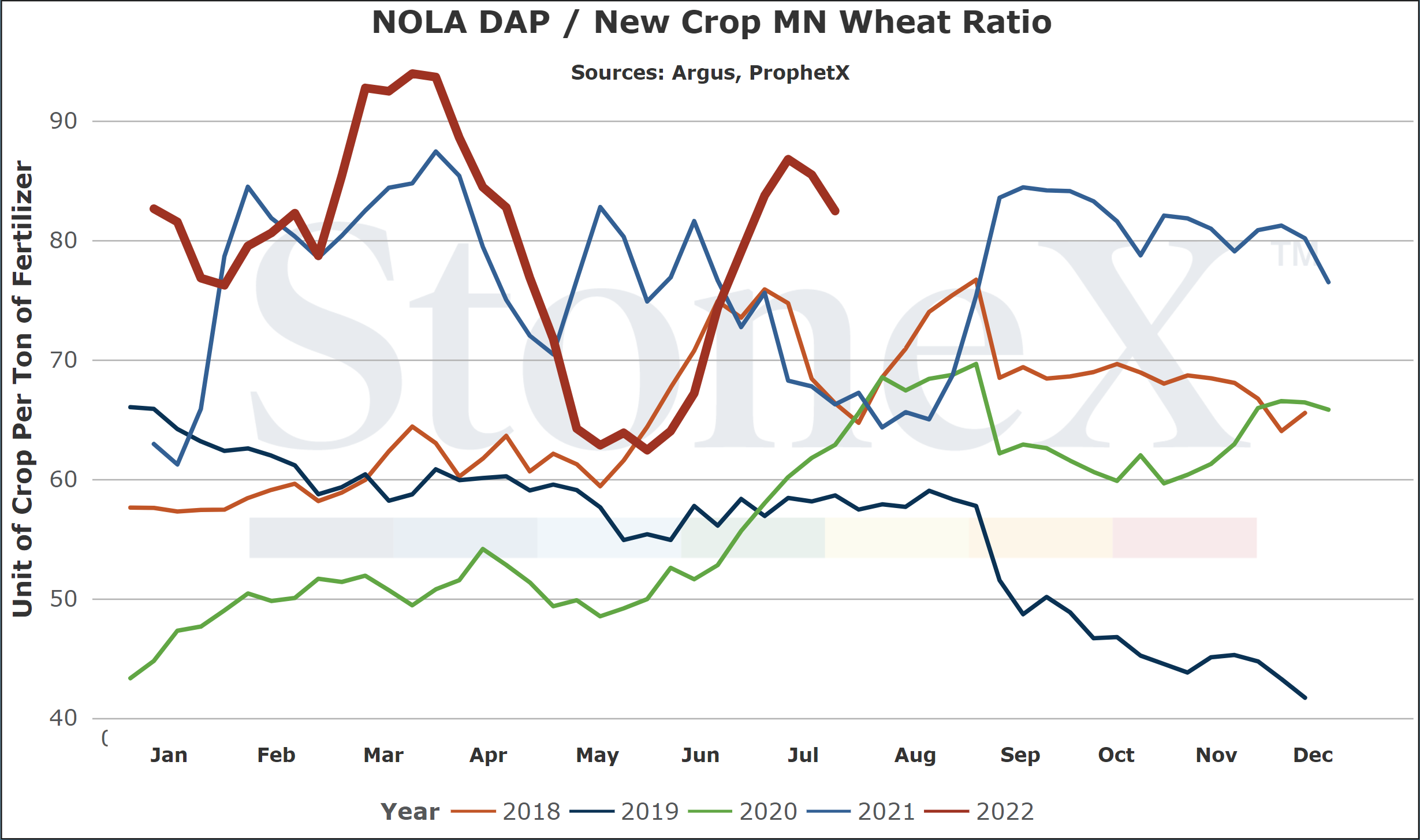
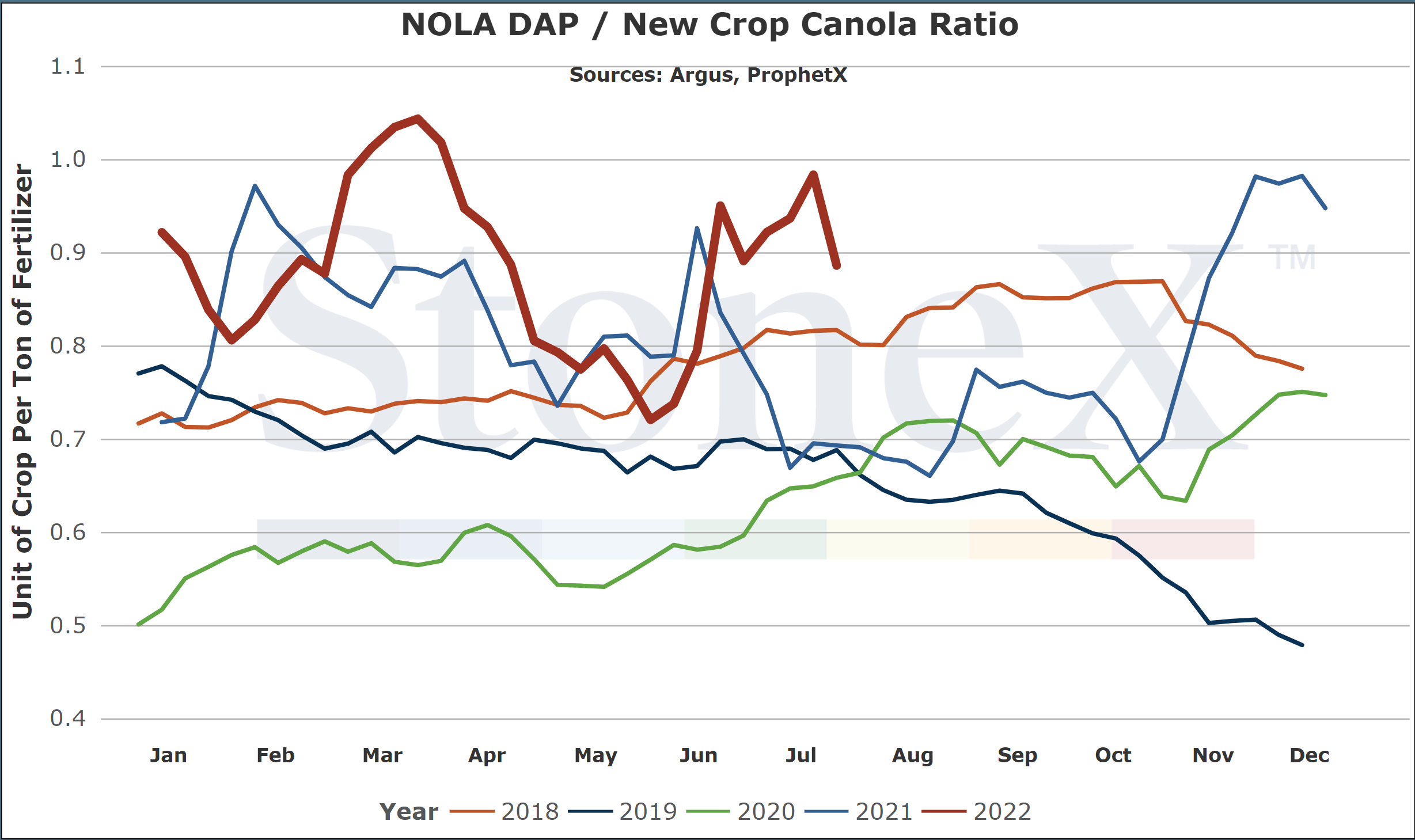
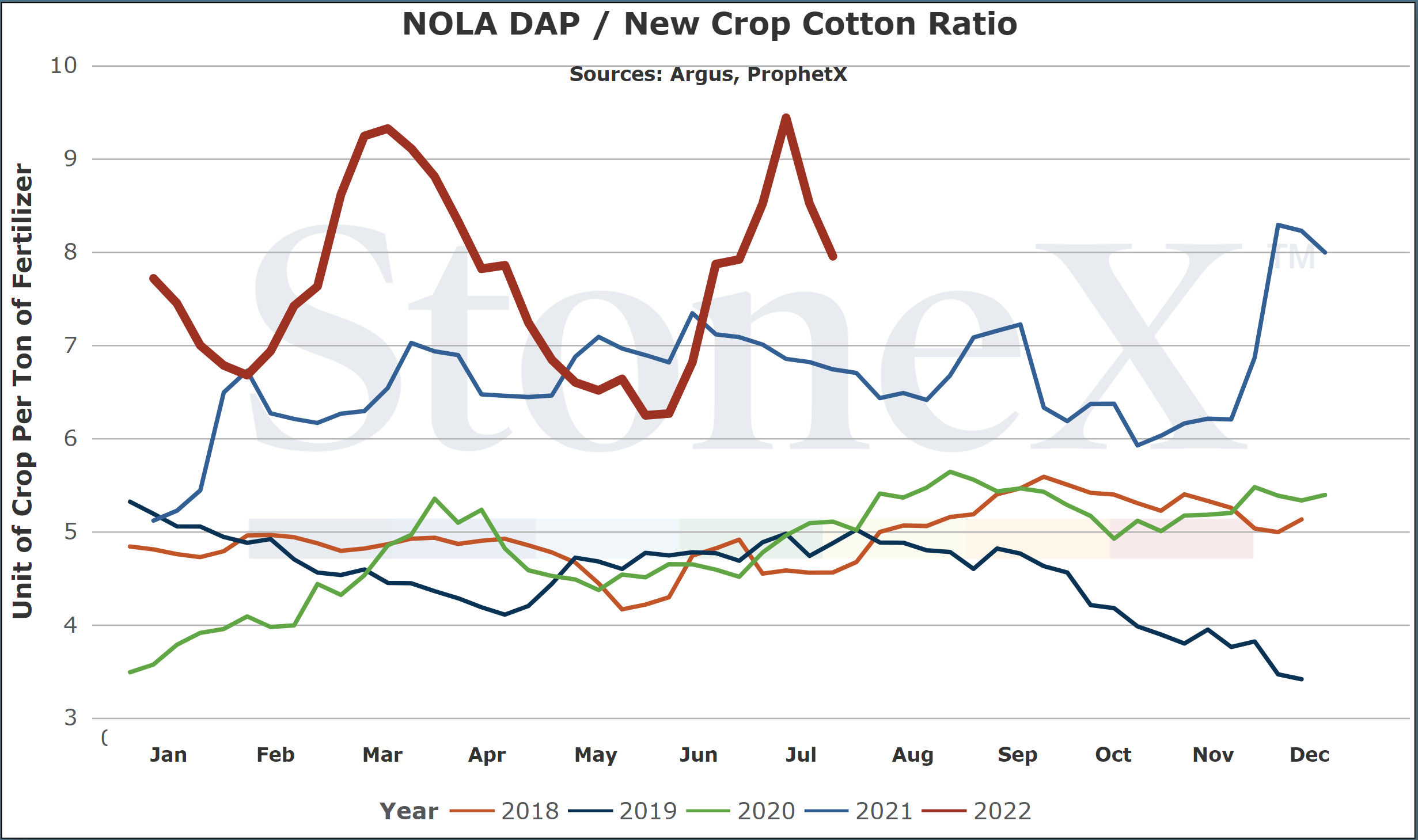
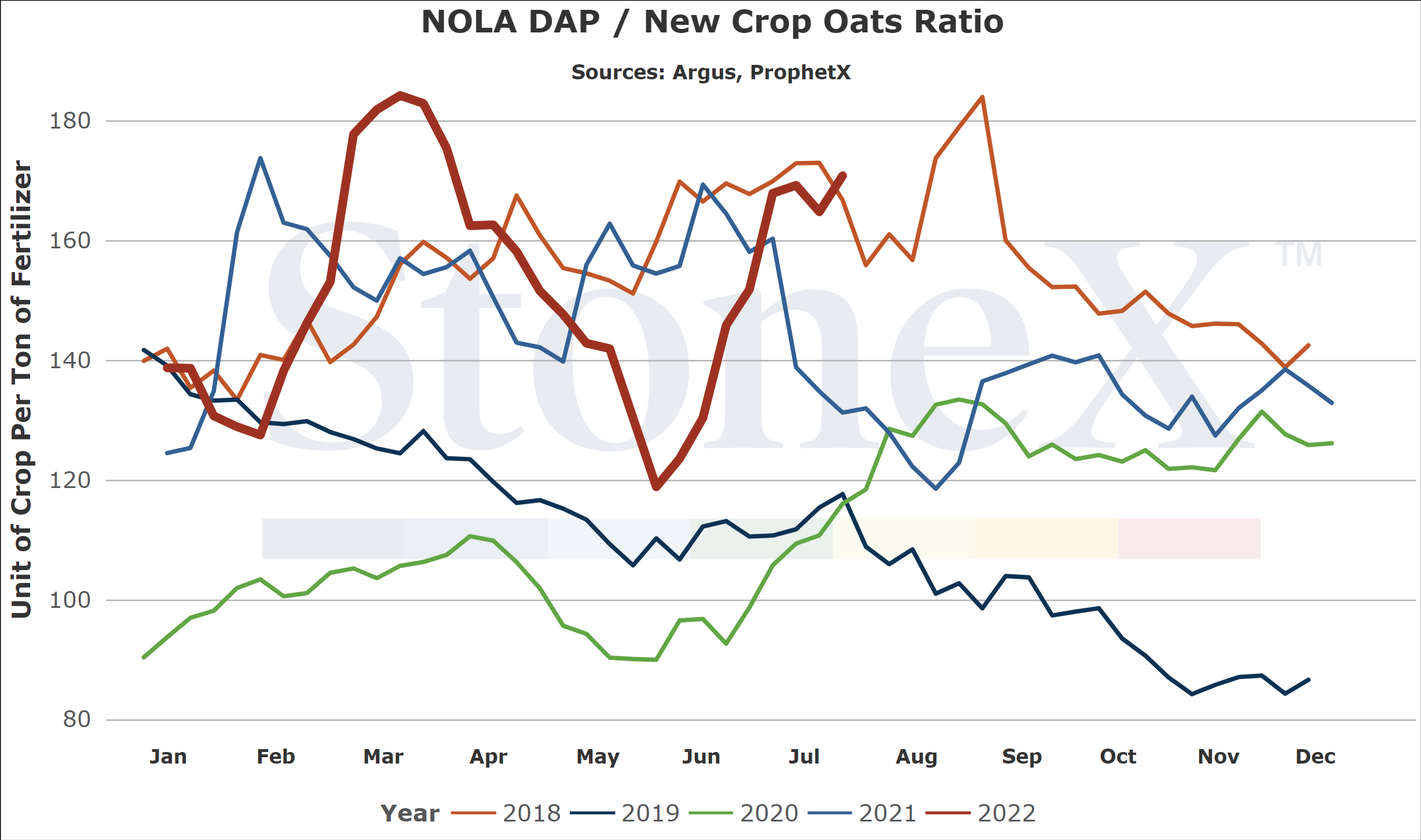
Phosphate/grain ratios are high and do not look to improve much
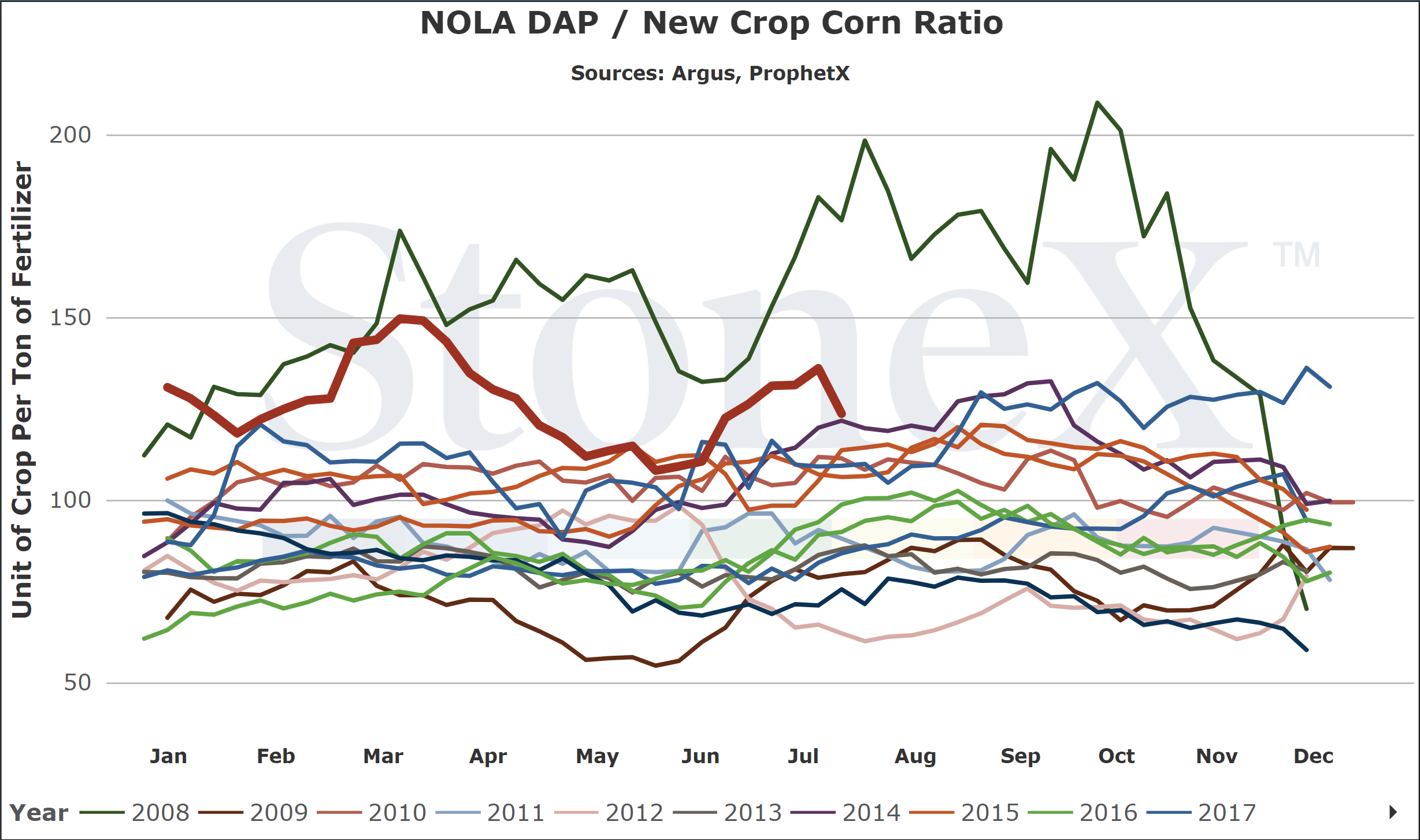
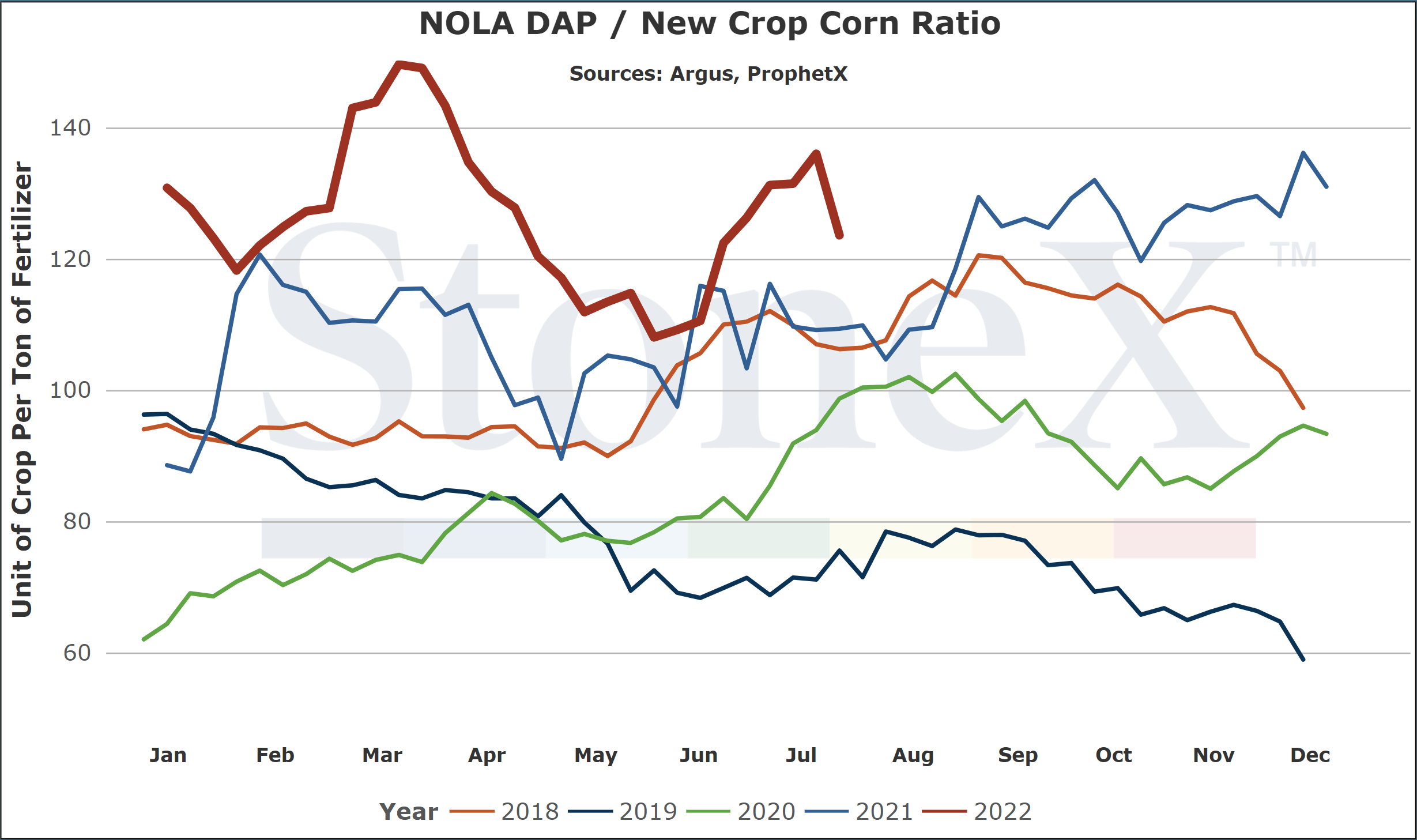
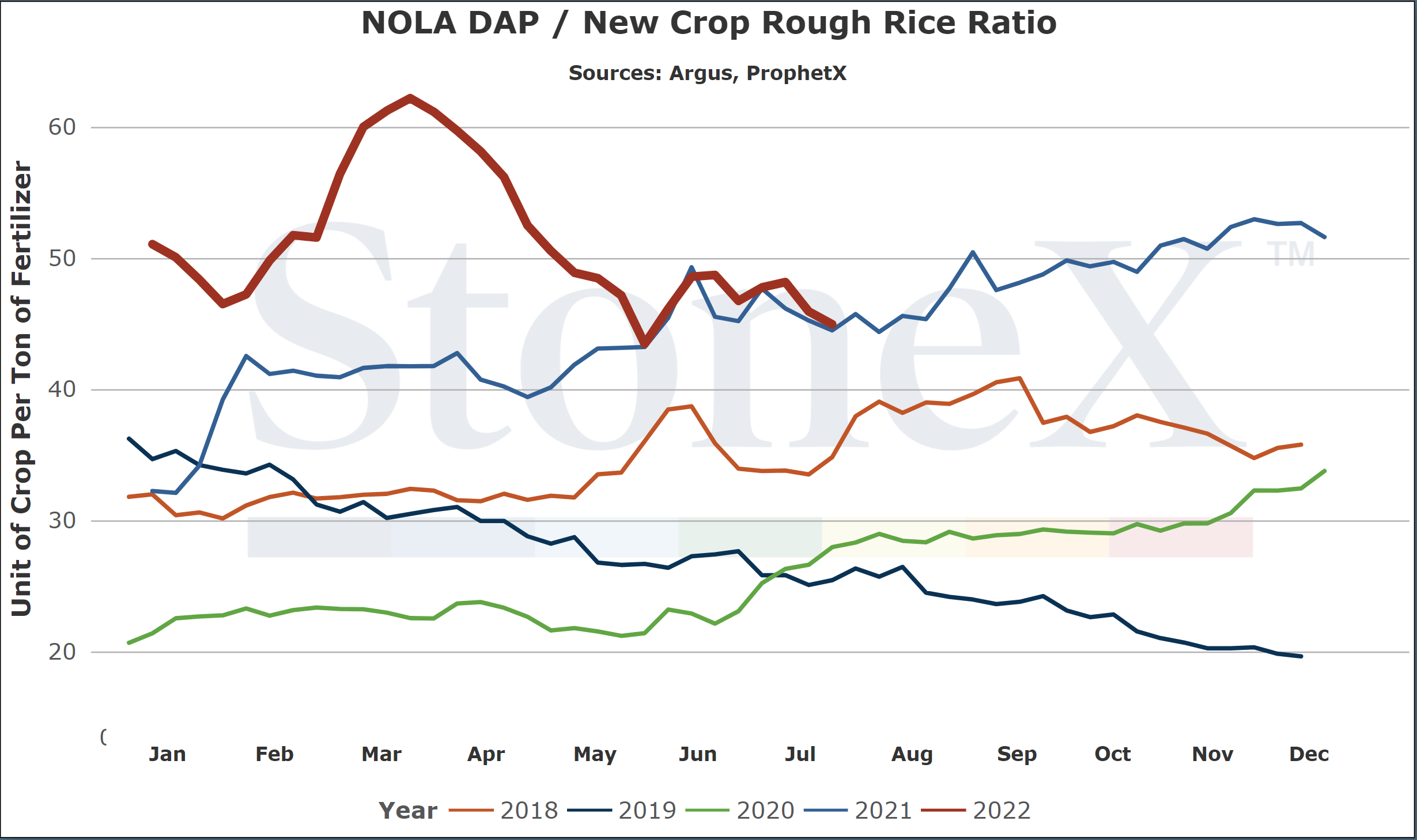
You will see the graph below but today's grain vs phosphate values are extremely high. Actually, let's take a look at where the current Chicago corn/NOLA DAP ratio resides vs all the years since 2008 (last time we had these types of values):
That dark red line is this year...the only time it has been worse than where we are today was in 2008. What this basically means is that you are spending more of your hard earned bushels to pay for a single ton of DAP.
As I mention repeatedly, this only takes into consideration the grain and fertilizer values. You have to consider your full operation.
China is allowing phosphate exports!!!....just not as much as we hoped for
We finally got an announcement from the Chinese government regarding phosphate exports! Unfortunately, it was the best case scenario for those of us hoping for lower global pricing.
As mentioned in previous month's editions, there was a wide range of expectations from expecting a full return to exports by July 1 to a full ban of exports thru June '23. For those expecting to see a full ban, this was bearish news. For those expecting a full return, this was bullish news. For us, this is in line with what we expected. The Chinese government was not likely to allow a full return to exports because that would push their domestic price higher (in line with international markets) and raise the possibility that enough tons were exported to the point where there was not enough product for their farmers. This approach not only ensured adequate product for domestic demand but it also allows Chinese producers to cash in.
Keep in mind that 3.6M is a very big number. However, when broken down, it isn't nearly as big as it seems. The 3.6M includes every form of phosphate, not just DAP/MAP which is what most of the world market is based on. That means products like NP/NPK/Calcium phosphate/SSP/etc. are all included in that number. Also, 3.6M is less than half of what China would "normally" export.
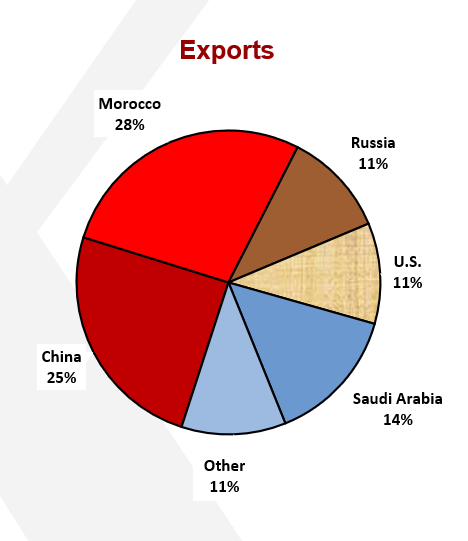
As the chart below shows, China is a major exporter to the world. In years past, they were the largest exporter in the world. In recent years, they have given that award to Morocco but are still playing as a major #2. As long as China restricts the flow, global inventories will remain snug.
U.S. phosphate is finding its way around the world
If you ever thought that you would see "mid-$700's NOLA DAP" and "cheap" in the same sentence without the use of "nowhere effing close to" in the middle, please raise your hand!!.
Well, as much as it pains me to say, NOLA phosphate values ARE cheap vs global pricing...and that is why we continue to hear of product departing U.S. shores for global destinations.
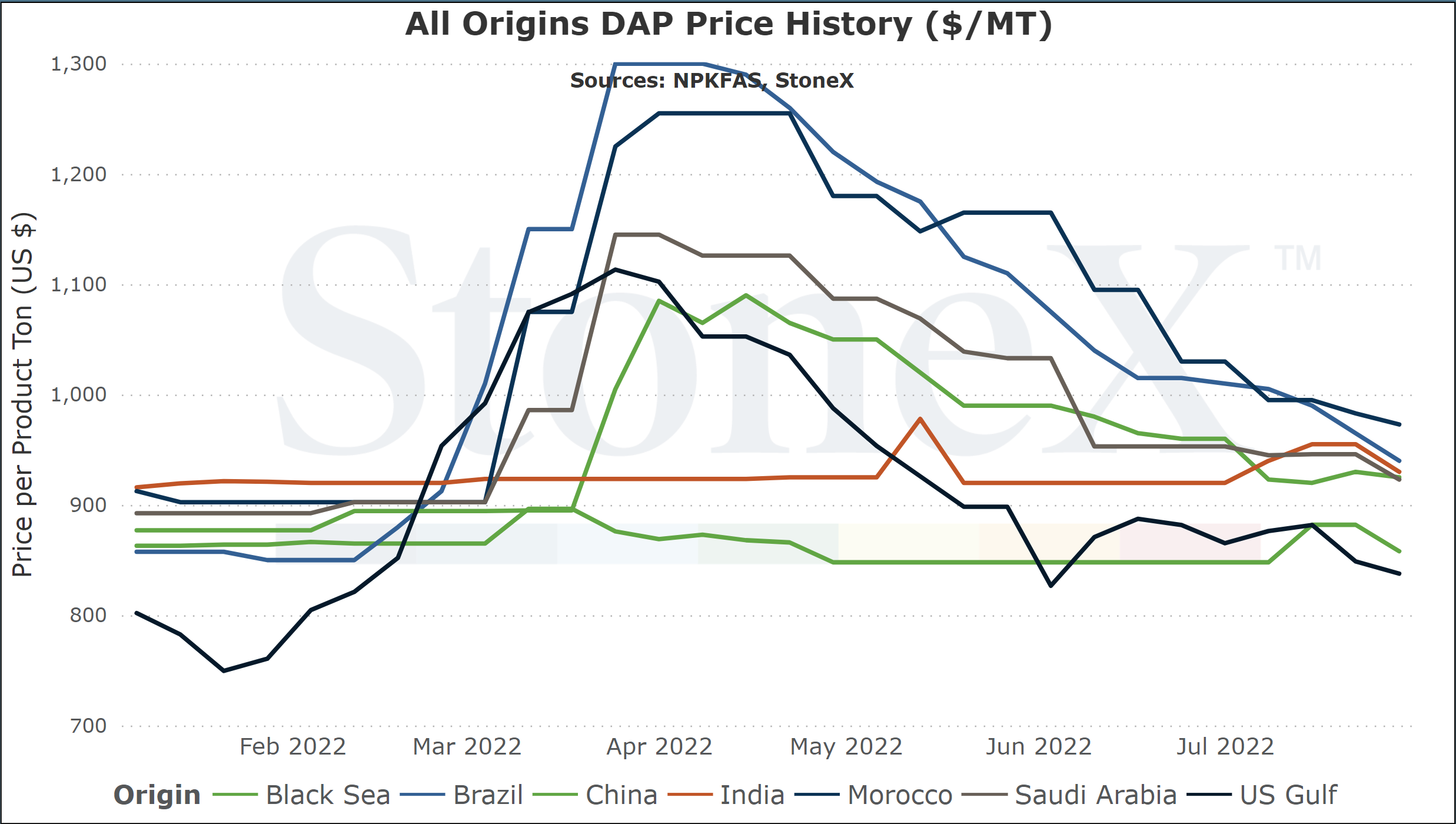
The graph is below but since those lines can look similar:
NOLA DAP - $760st which converts to $838mt (global tonnage)
Black Sea DAP - $858mt
Saudi Arabia DAP - $923mt
China DAP - $925mt
Morocco DAP - $973
This means that with N.A. buyers reluctant to step forward, producers have plenty of options on the global market.
We will not know the extent of the exports for a couple months as the U.S. government delays the reporting of import/export info by 60 days. Still, we have to assume tons are leaving our shores which will keep supplies tight which will keep prices up...
U.S. / N.A. phosphate cost of production remains very high
We thought we were finally seeing some reprieve as the sulfur market saw prices softer. As one of the big inputs for phosphate production, that meant a lower cost of production and the possibility of prices declining. That was more than offset by the August Tampa NH3 price rising $160 from July to settle at $1,100.
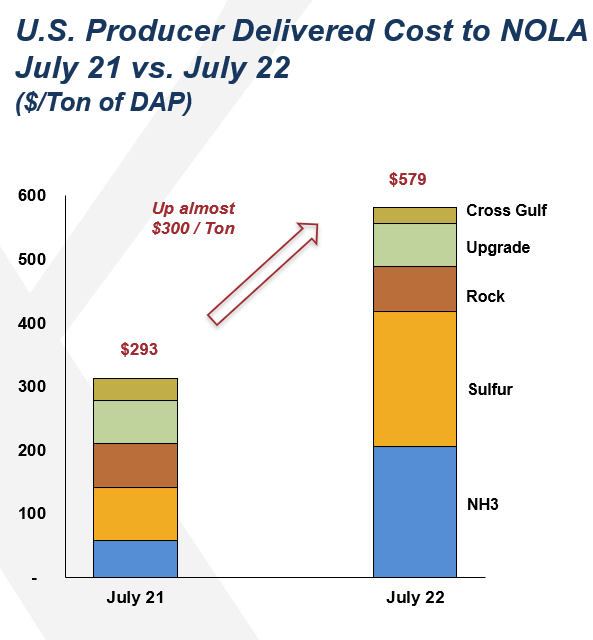
The numbers below are still taking into account the July input costs but the story is still the same. While the sulfur part of the bar will shrink, the NH3 part will widen with the net result still being near $600 production cost for one ton of DAP NOLA (New Orleans, Louisiana).
This is a major thing to watch as N.A. phosphate production remains one of, if not the, highest costs in the world. If we were to get into a situation where values started falling hard, N.A. would likely be first in line to have costs challenged. With phosphate companies not in the business of losing money, once we dip below their cost, they would likely curtail/stop production. Once enough production is cut, the supply side of the equation starts to get brutalized and eventually the S&D gets back in line...at a higher cost.
Today, the NOLA DAP market remains well above the cost of production but with double/triple digit price moves in a matter of days becoming the norm, this could be challenged much more quickly than anyone can anticipate.
What will fall demand look like?
This is the biggest question facing the supply side of the phosphate market today. What do they plan for? Do they put 100% of normal demand in place? Do they reduce that number? If they do reduce it, by how much? Will that demand still be there in the winter/spring? Can they take the risk of putting product in place for a farmer that may or may not show up to buy it?
I'm not saying this in an attempt to make you feel sorry for them. We are all adults and know our place/risk in the market. However, this fall is a really tough call.
As mentioned above, we are proceeding with the expectation that demand for the 2023 crop cycle will be 10 - 15% lower than normal. I'm not sure how much confidence I have in that range today as I can easily see it higher or lower just on grain market up or down. What is more difficult is figuring out WHEN the demand will take place. I think a lot of farmers will look at current phosphate and potash values and consider dragging their feet if they do not need to spend money this year. Why lock into some of the highest prices ever seen for the fall if you can wait and see what happens. Nothing says you cannot wait until winter or spring. Sure, you run a risk doing that but could the reward be sitting on the other side?
I, for one, would rather make sure I have soil levels built and ready for planting next spring as I we do not know what weather will do. Number one, I am fairly conservative. Number two, I am not a farmer so take what I think with a grain of salt.
Hopefully we will see a more definitive answer as we get closer to harvest but today, this will continue to be a difficult question and one that can absolutely sway the market going forward.
CF lost it's UAN counter vailing/anti-dumping duty case. Does that mean Mosaic counter vailing duty case is next on the blocks?
For the longer version, go read thru the UAN section. For here, just know that CF lost its case to place duties on Russian and Trinidad produced UAN imports. This was a major shock as it rarely happens and it was a major win for buyers hoping for lower pricing. After the festivities, the next looming question arose: is Mosaic's duty against Russian and Moroccan produced phosphate next?
This has become the rally cry for buyers across N.A. If the ITC saw fit to say no to duties on the UAN market, then they MUST think the same for phosphate.
I cannot speak well regarding the legal procedure of this. Many are pushing for the ITC to rereview the case in hopes of another vote. Others are pushing their Congress and Senate representatives to pressure the White House to use an executive order to do away with the duty. I think this is plausible as President Biden could use the approach that food production is at the top of the national security list. You have to be able to eat. If that is the case, fertilizer remains an extremely important part of the food production industry. So many nations around the world are taking steps to keep fertilizer home for their farmers while the U.S. is actively pushing imports away. Whether this happens or not remains to be seen.
Unfortunately, I'm afraid that if the duty is cancelled, the effects will not be as many hope for (some thinking price cuts in the hundreds of dollars).
My first reason is the cost of production for N.A. producers. As stated above, if the price dipped $200 from current values, production would shut down. The second reason is that U.S./N.A. values are some of the cheapest in the world. There is little reason for countries like Morocco and Russia to come here when there are other demand points around the world willing to pay more than we are. We could see tons come here in a revenge setting but the prices do not support it.
While I do not know how this will play out, I am fairly certain it will remain a talking point.