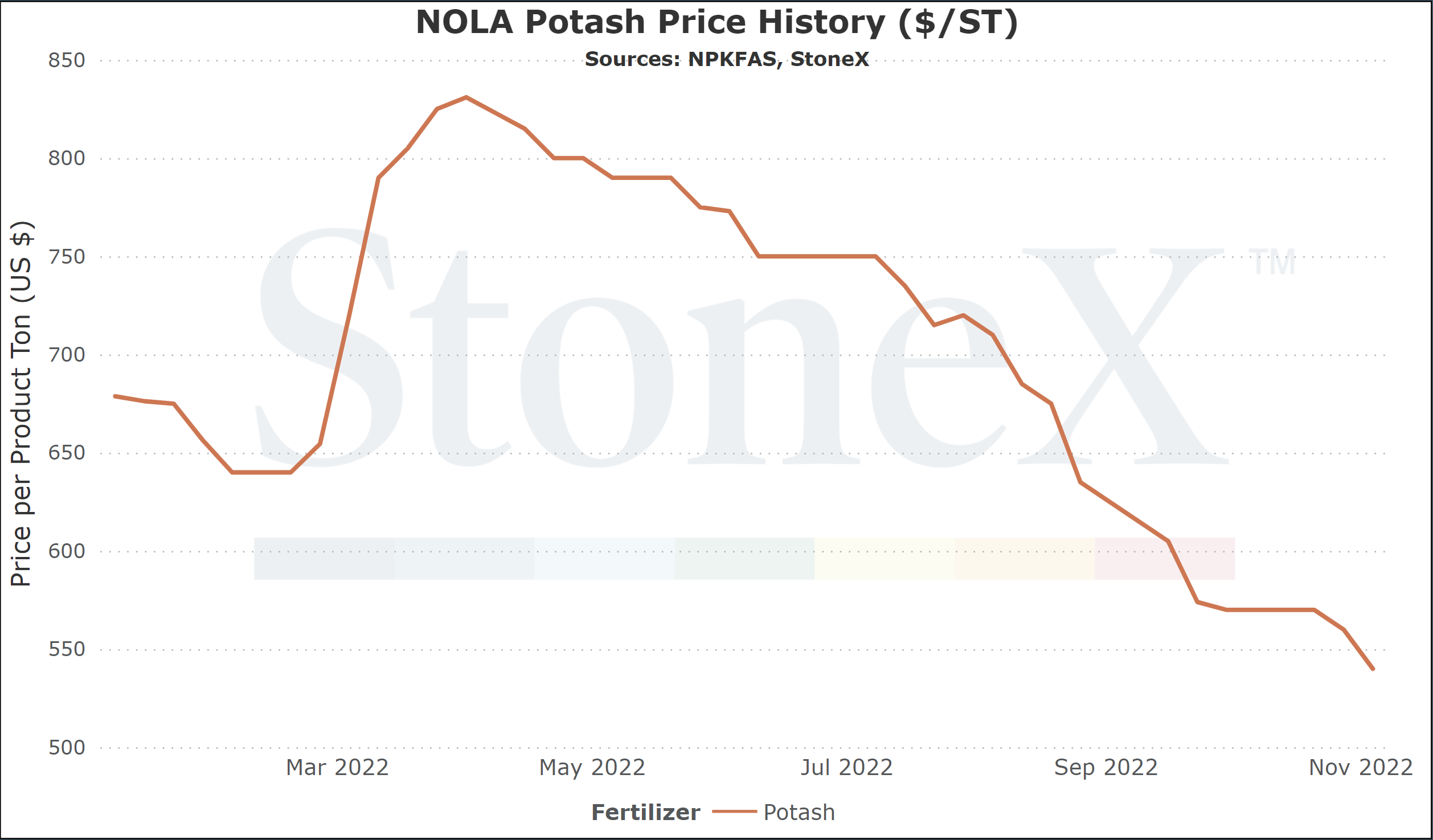
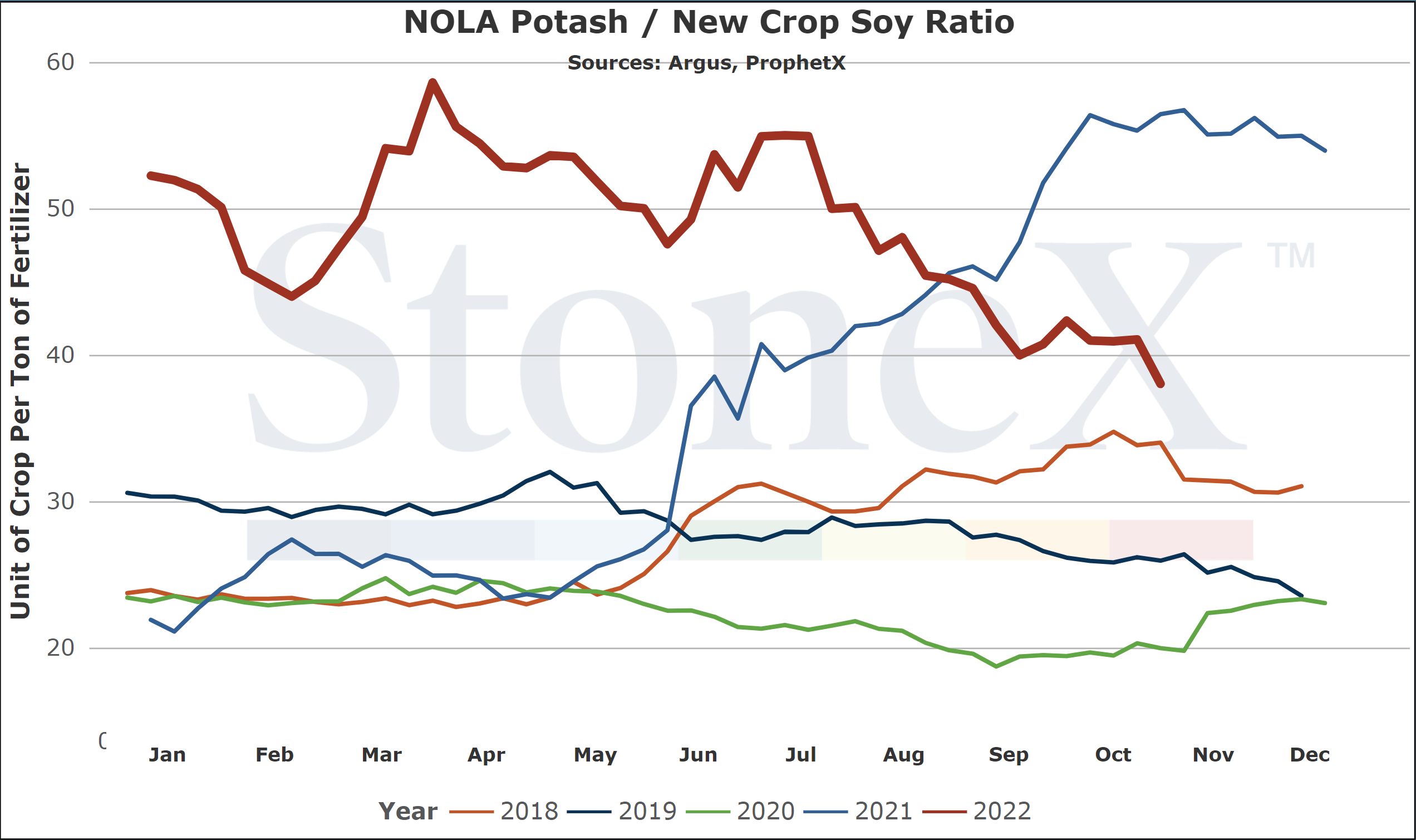
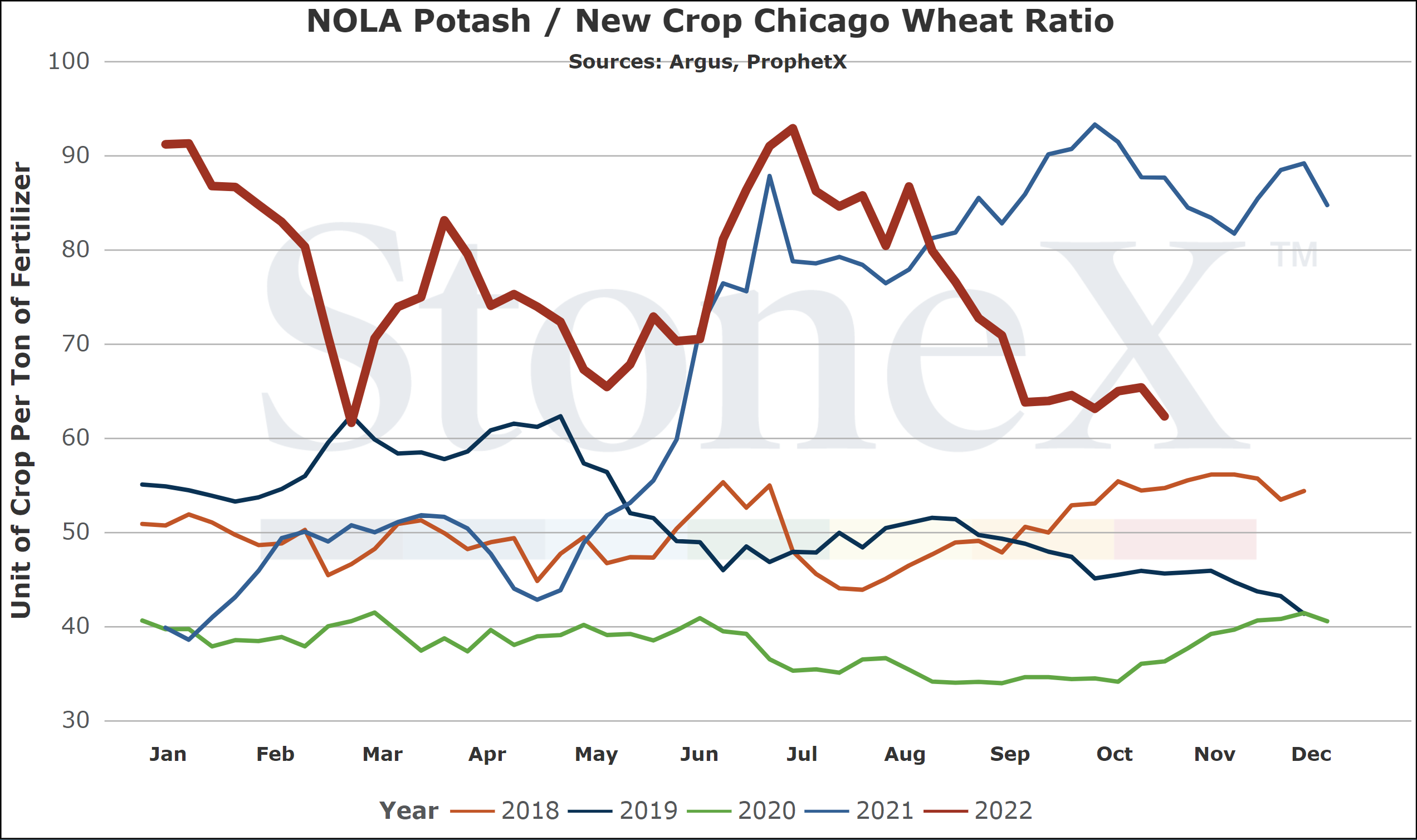
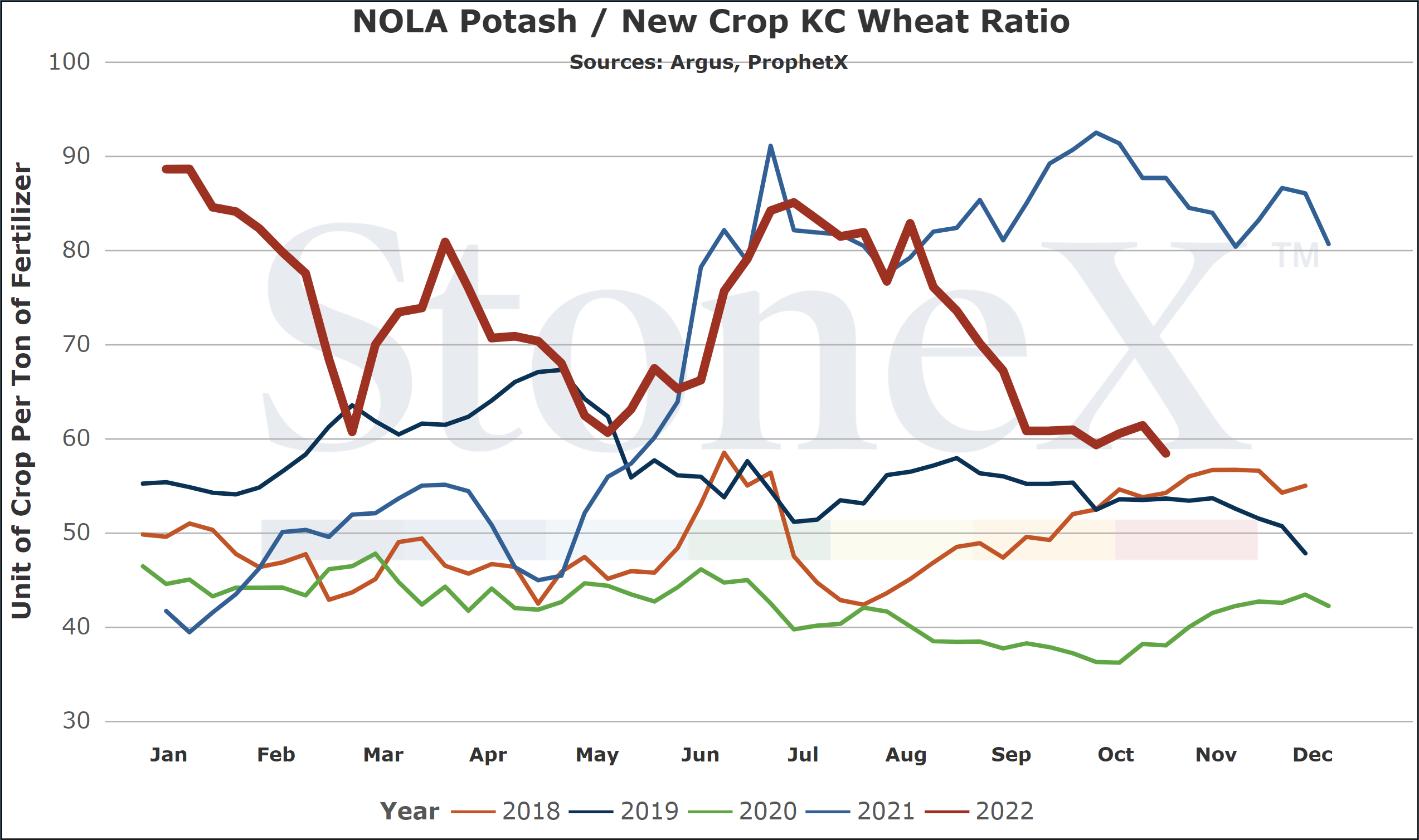
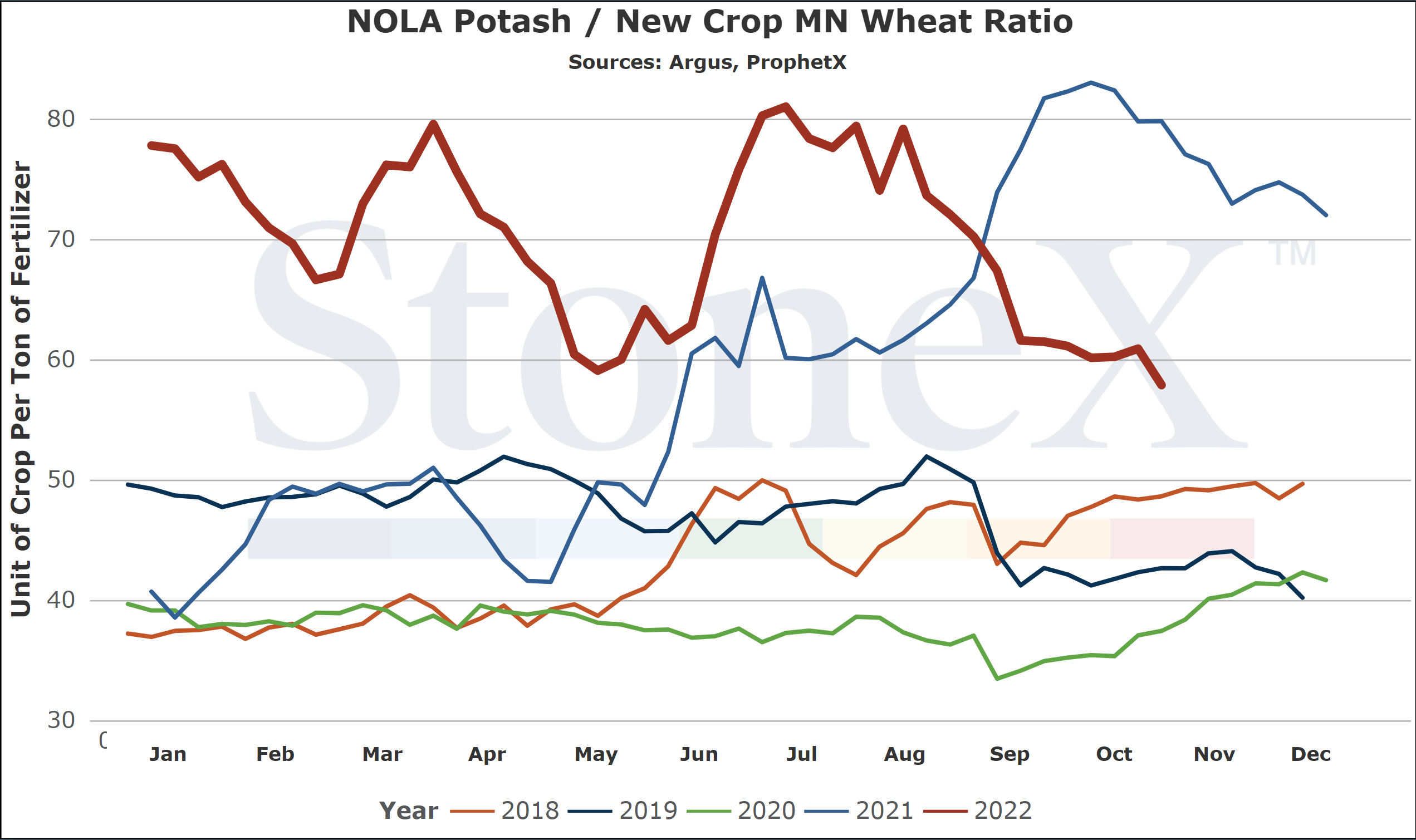
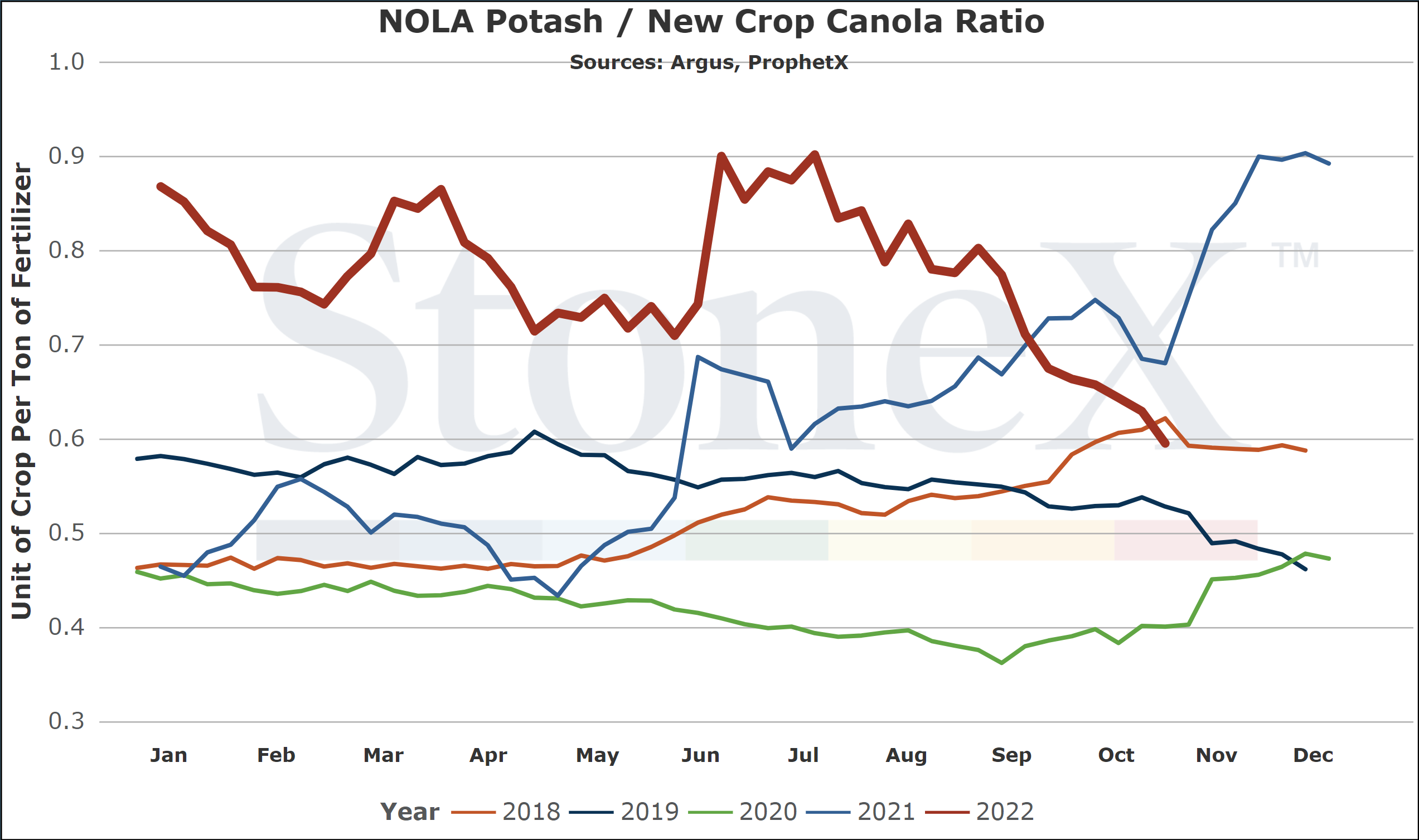
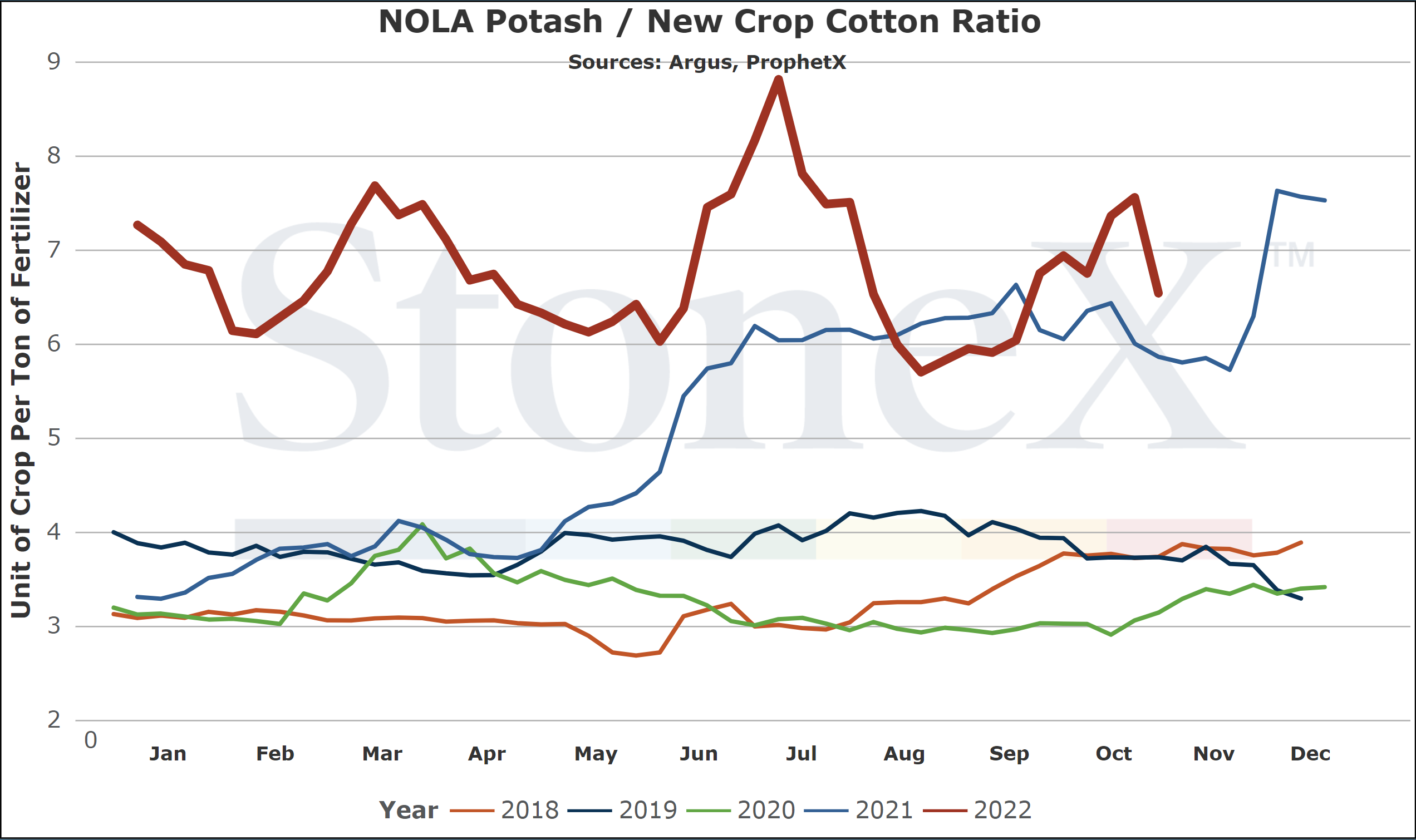
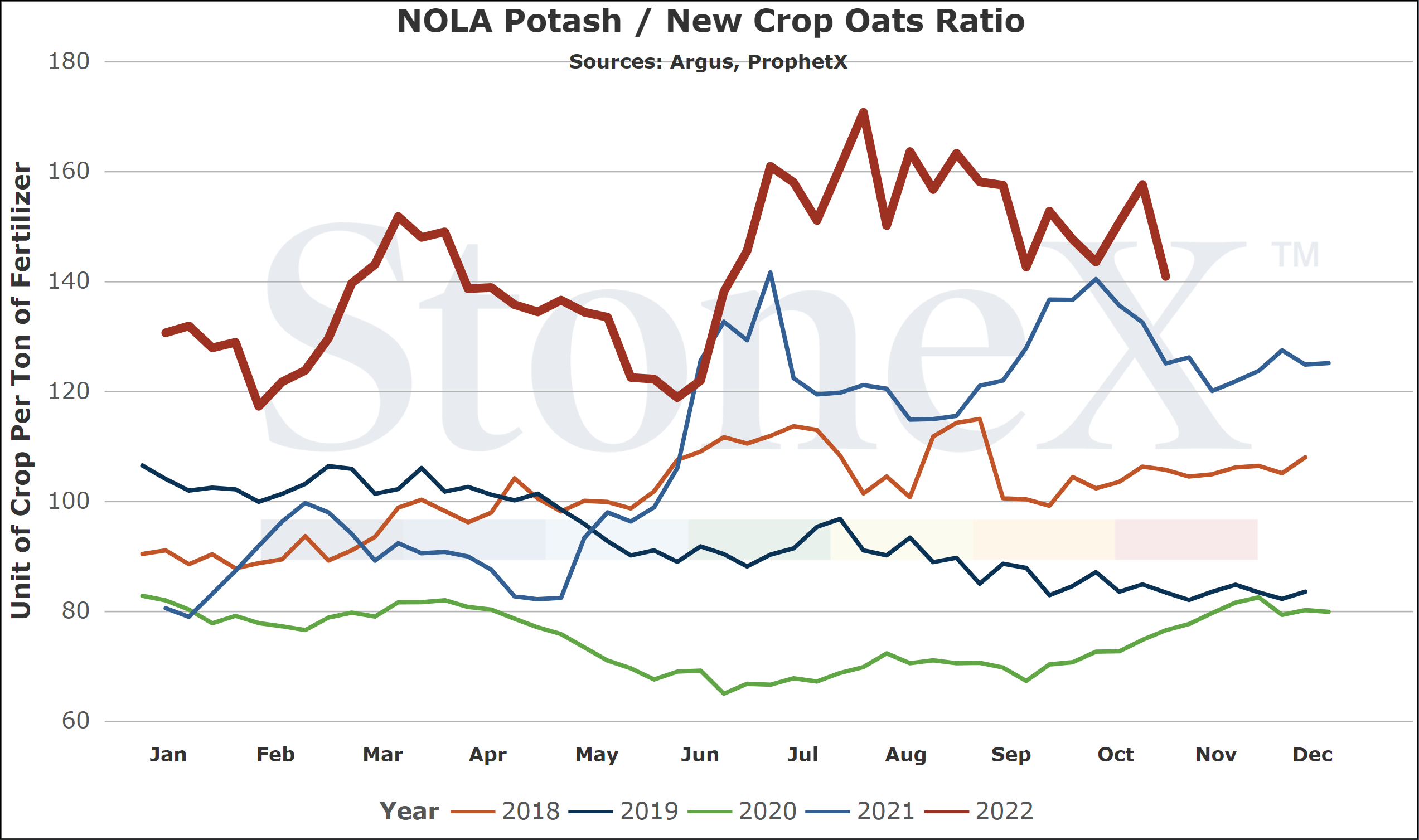
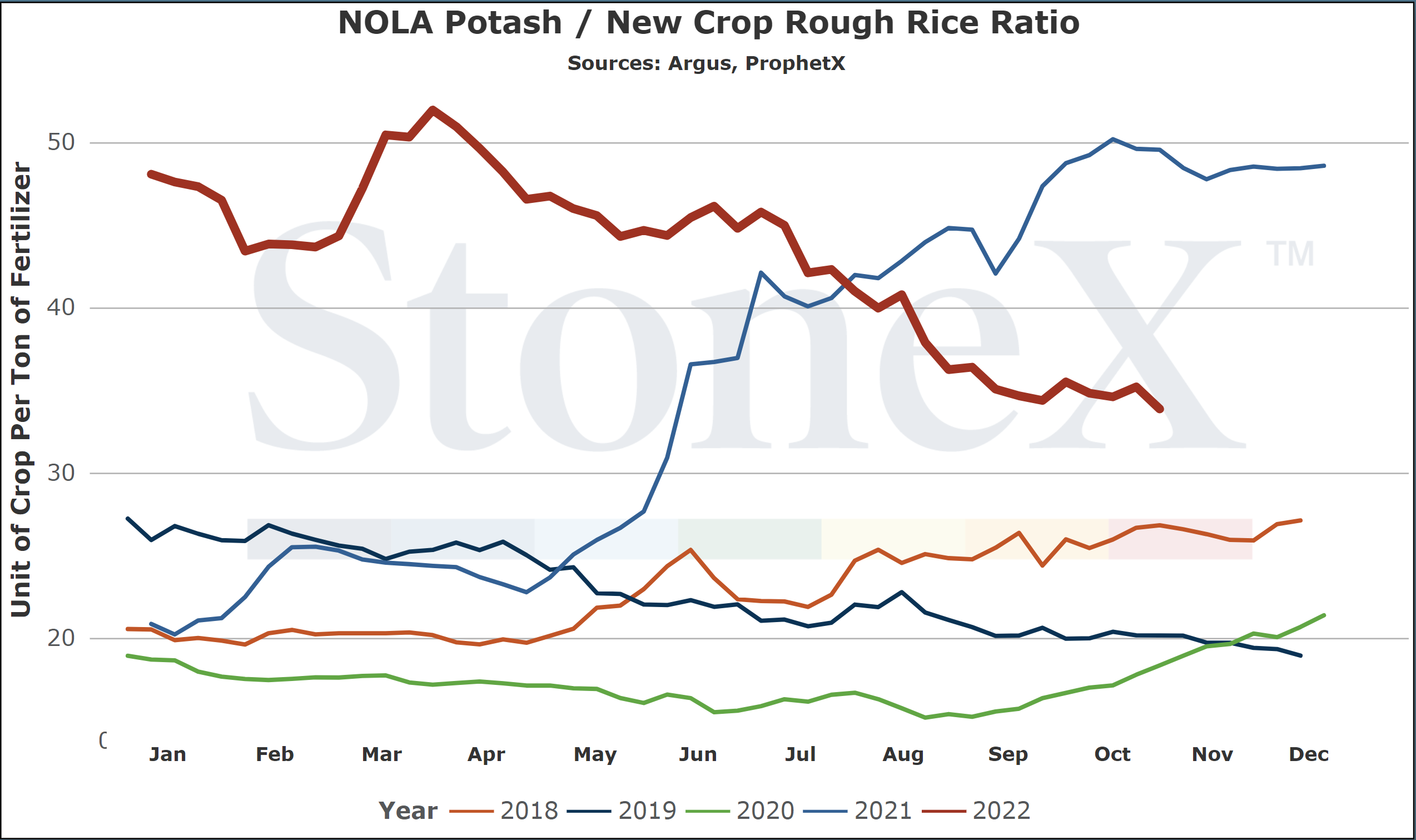
NOLA potash price graph
Please remember that this is looking at the cost of one short ton of potash sitting in a barge at NOLA (New Orleans, Louisiana). Your cost is not going to be the same. This should be looked at more in regards to the price direction rather than the actual pricing.
What everyone wants to know first, what do we think will happen going forward
If you have been on this newsletter for a while, you have probably noticed a trend: potash isn't very exciting when compared to phosphate and nitrogen!!!
The potash markets are relatively quiet. 4 countries control approximately 80% of global capacity. Typical price movement cycles typically take months to over a year to complete. Not to say that volatility isn't possible, it just isn't common.
That said:
Like last month, the potash negative price trend continues to be our friend (if you are a buyer, that is).
There are some factors that we need to watch that could turn the market around:
- Added stress on the rail system due to poor barge logistics could cause inland values to push higher.
- Lot of indications are pointing to solid demand in 2023 (U.S. corn expected in the 92 - 94M range)
- Continued political tensions with important global exporters such as Russia and Belarus could disrupt trade flows further.
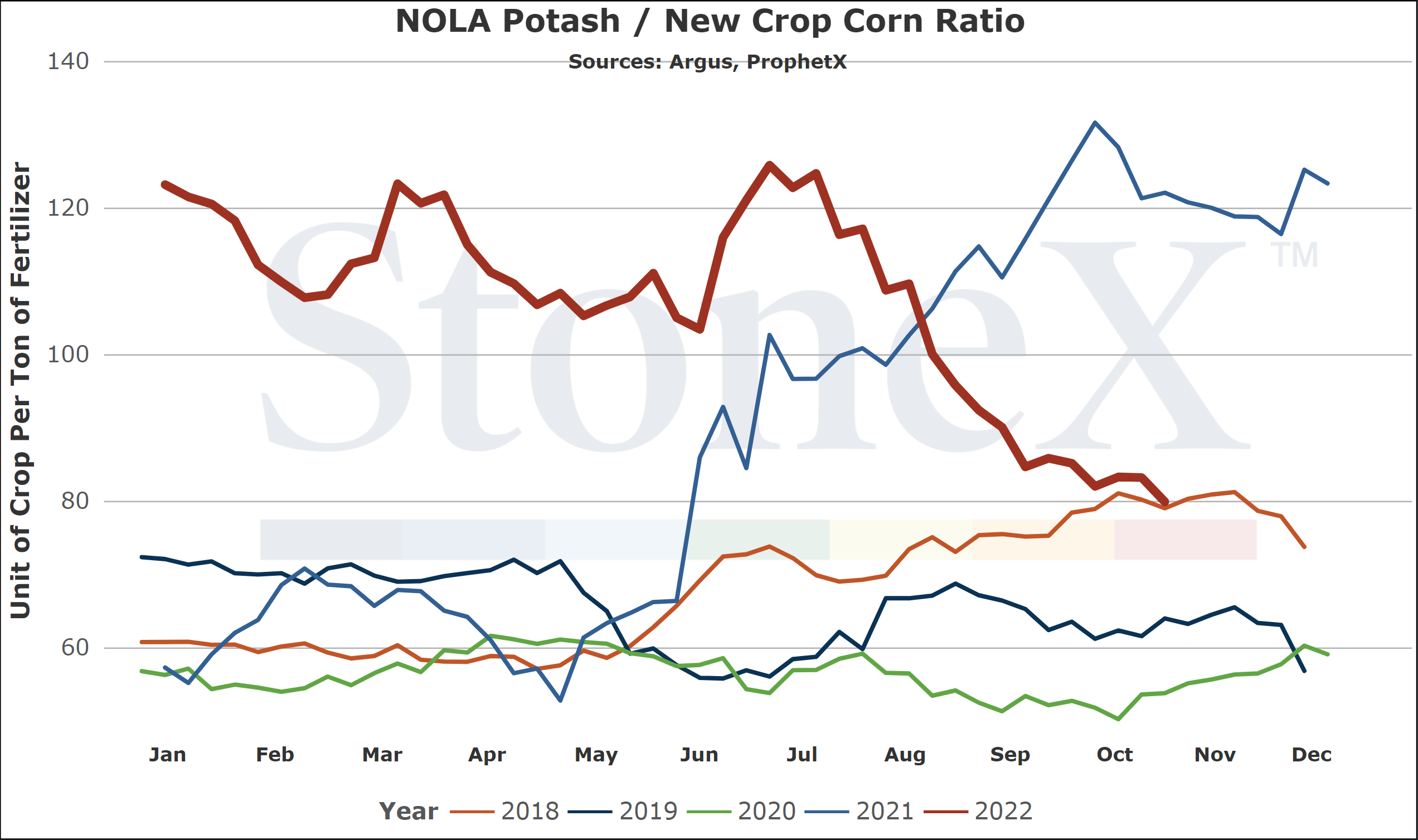
That said, it continues to appear that price remain under pressure. We are nervous regarding overall demand as farmers may look at the price, determine it to be too high and decide to cut back application rates for the 2nd year in a row. Fall applicators could make the decision to delay their application until winter/spring in hopes of prices falling further.
Adding to those fears is the continued belief that more supply is coming. Nutrien and Mosaic have made steps to increase production, new mines in Russia will help global supplies and we continue to believe that Belarus will find its way back to the world.
In the end, there are reasons to watch potash for a trend turnaround but today, a lot more paths appear to push price ideas lower in the short term.
Should you lock in fall '22/spring '23 potash needs today?
If you are planning on applying this fall, I cannot stress this enough: YES
I know that just above I said that the trend is our friend and prices continue to move lower and all that.
If you are going to apply this fall, ignore the above.
The fertilizer market has serious issues in front of it today. This mostly revolves around price risk and logistics.
- Price risk - the price of potash has been steadily falling since late March/early April. We have talked about it on this newsletter. You have likely seen it in the markets. That has caused you to hold off on purchasing for the fall in hopes of lower prices/fears of buying too high priced product. Guess who else is living that world...your retailer/coop/supplier. They are buying thousands/tens of thousands of tons and have to deal with the exact same price risk. Many in the market lived thru the 2008 and 2012 cycles where tremendous amounts of money, jobs and companies were lost. Your supplier's only hedge in this scenario is to not put product in place until the farmer purchases it.
- Logistics - the Lower Mississippi River situation is bad. It's really bad. Not only does it strain barge shipments, but it also puts added stress on rail as traders/suppliers look to alternative methods of moving product. Potash is highly dependent on rail so this makes it harder to move from point A to point B.
- Possible rail strike - this could go along with logistics but figured it was worth giving its own bullet. There are more and more rumors that a strike is imminent. I have long believed that a strike will not ultimately happen but the news is starting to worry me. Imagine a North American world where barge traffic suffers from low water levels and the rail system strikes...
All this to say, if you are going to apply potash this fall, I implore you to have that conversation with your supplier sooner than later. I like the idea of holding in hopes that prices drop further. However, I am much more worried about a situation where we hold off a little longer and then find out the product is not available. For a lot of operations, the price of potash moving $30 - $50 does not equate to a lot of bushels per acre. The risk is significant.
Spring applicators are different and can likely continue to hold.
Spring will be here before we know if but we do have a decent amount of time for markets to change. With 4 months until March and the trend continuing lower, there isn't much of a reason to get excited today.
That said, if you can lock in your potash, sell your grain and secure a profit you are happy with, do not pass that opportunity. With the volatility in the markets today, who knows what the next 4 months have in store. The trend may be lower today, but if the last 2.5 years have taught us anything, markets can change on a dime.
What has happened in the last 30 days?
Lithuania STILL blocking Belarus shipments
Seriously, I do not enjoy leaving entire stories unchanged from month to month but when the story continues to be the same....
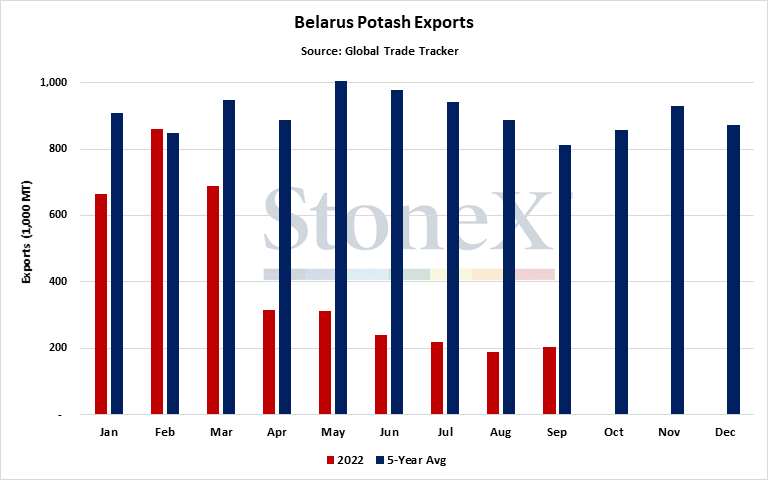
For those new to this newsletter, the lack of Belarusian exports has been a major event for global potash markets. Back in February, the Lithuanian government imposed a blockade of any Belarusian products. The reason why this was so important and detrimental to Belarus potash is that Belarus is landlocked. In the past, most of their material either went south (Ukraine) or north (Lithuania) and out to the sea.
Belarus has helped Russia in its invasion of Ukraine. That means I have a better chance of calling the markets correctly than Belarus does of Ukraine allowing them to ship product thru their country!! It also seems there is little chance that Lithuania is going to reverse course and allow shipment in the short term. Product does not naturally flow east/west. To the west is Poland which is another country unhappy with Belarus's role in the invasion. To the east is Russia. There continue to be reports of infrastructure being developed to increase shipments...but that will take a lot of time.
For now, the potash world continues to lose one of its top 3 exporters.
Russia exports flowing, but slowed a bit in August/September
The surprise of the 2022 potash market was Russian exports.
Following their invasion of Belarus, many (myself included) thought that exports of all fertilizers would dry up. I mean, Starbucks and McDonald's pulled out so it was going to be serious!
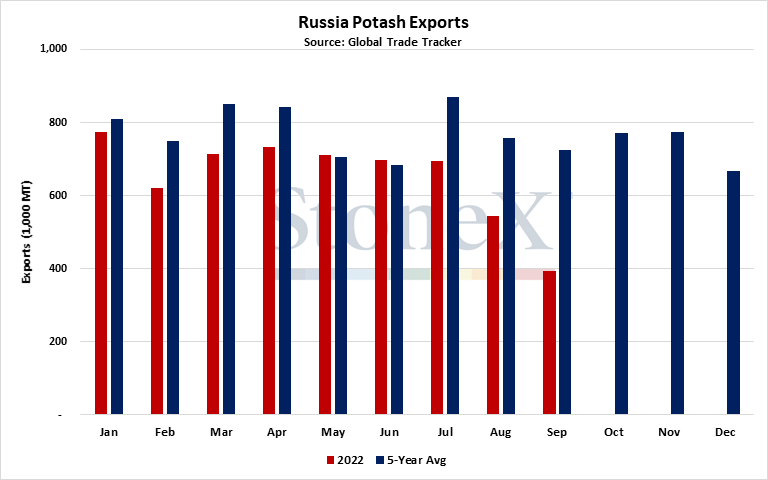
We quickly found out that exports were slightly lower than the 5-year average, for the most part they were normal. The addition of these tons back onto S&D's helped price ideas to fall.
However, the last couple months (August and September) for updated trade flow are showing that Russian exports are slowing. Now, we need to keep in mind that trade data is not always 100% accurate. Countries like Russia do not report their information so we are forced to back into their flows using destination data. That can cause discrepancies.
If we assume the chart below is right, this could be worrisome. A few hundred thousand tons in the world market does not seem like a big number but sometimes small changes is enough to change the course.
Fall '21/spring '22 demand was down. Will fall '22/spring '23 be down again?
This is my biggest question today: how much will potash demand be down this growing cycle?
Let's face it, potash is one of the first fertilizer inputs to be cut when costs get high. While many potash manufacturers tried to downplay the results, potash demand was down big last cycle. The question now is can that occur for a 2nd year in a row?
Unless grains start to climb substantially, we tend toward yes demand will be lower again. That said, you will be that final answer and that answer will not come until this winter at the earliest.
New capacity is coming...but when will it hit?
Potash is the one fertilizer that we can point to an improving supply situation moving forward.
Canadian producers Mosaic and Nutrien have both stated that they were ramping up production. Nutrien in the form of added capacity at existing mines while Mosaic is restarting their mine in Colonsay.
There are a couple projects based in Russia that will add new production to the global S&D.
On top of those, we continue to believe that Belarus will eventually find its way back into the world marketplace. The popular rumors have continued to be that they will build infrastructure to ship product from their mines toward St. Petersburg where a new deep sea port will be build to load vessels.
While the timing of each of the above is sketchy, we have high hopes that all will happen. If/when they do, we could finally be looking at a global potash market that has more supply than it has demand...and you know what that means for price ideas!