Last Wednesday, December 1, StoneX updated its estimates for grain crops (click here to access the full report).
Due to the weather irregularities observed in Rio Grande do Sul, the 2021/22 1st corn crop production was reduced to 29.6 million tonnes, a cut of 2.8% compared to the November report.
On the other hand, StoneX has raised its production estimate for the safrinha crop to a new record of 88.9 million tonnes, 1.5% higher than the first estimate. Thus, considering the three crops, total Brazilian production is estimated at 120.1 million tonnes, a new record for the country.
Despite the optimistic expectations for production in this coming season, the scenario is not expected to be of a smooth supply and demand balance, at least in the first half of 2022. One of the reasons for this is the Brazilian trade balance. Due to the shipments pace observed so far and the recent increase in the attractiveness of export prices, StoneX promoted an increase in exports for the 2020/21 cycle to 18.5 million tonnes versus 16 million tonnes in the previous report. However, even with an increase to 3 million tonnes in imports, 500,000 tonnes more than in the last report, ending stocks retreated to 10.25 million tonnes.
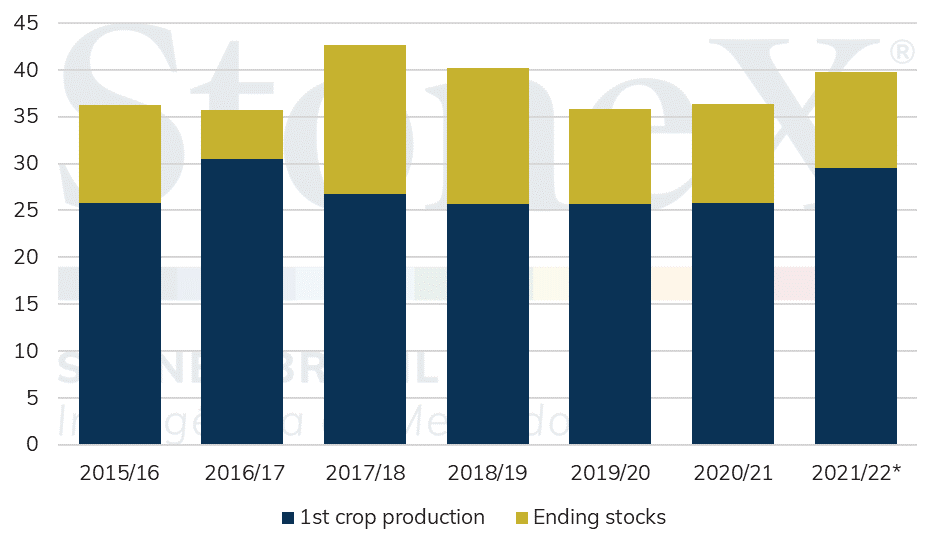
Thus, if the corn availability in the first half of 2022 was estimated at 42.67 million tonnes (12.25 million of ending stocks in 2020/21 + 30.42 million of production of the 2021/22 first crop) it is now estimated at 39.82 million tonnes.
Corn availability in the 1st semester - Brazil (million tonnes)
Source: StoneX and Conab. Design: StoneX. *Estimate.
The graph above shows that, despite lower availability compared to the first half of the 2017/18 and 2018/19 crops, the volume is above that recorded in other seasons, which could lead to the conclusion that the scenario is not a tighter balance in the first months of the 2021/22 cycle. However, it is also essential to observe the demand issue to perform such an analysis.
Amid expectations of continued high demand for corn for feed, StoneX projects domestic consumption at 75.5 million tonnes, 2 million more than projected in the November report and 4 million more than the estimate for the 2020/21 season.
Furthermore, to understand this increase in demand, it is also important to look at the corn-based ethanol sector in Brazil. Biofuel production in the country has been increasing yearly, a trend that should continue steadily in the coming seasons. According to StoneX's latest sugarcane crop estimate report, released on November 30, corn-based ethanol production in Center-South should reach around 3.5 million m³ in 2021/22 (Apr/21-Mar/22), representing an annual advance of 37.1%. For the 2022/23 season, StoneX projects a 12.8% year-on-year growth to 4 million m³. You can access the full report here.
Thus, in a simplified way and dividing the projection for domestic consumption in the first half of the year, the Brazilian domestic demand would be around 37 million or 38 million tonnes of corn, a level very close to the sum of the ending stocks of the 2020/21 crop with the 2021/22 first crop production. Thus, the first half of 2022 should still be of supply and demand quite adjusted.
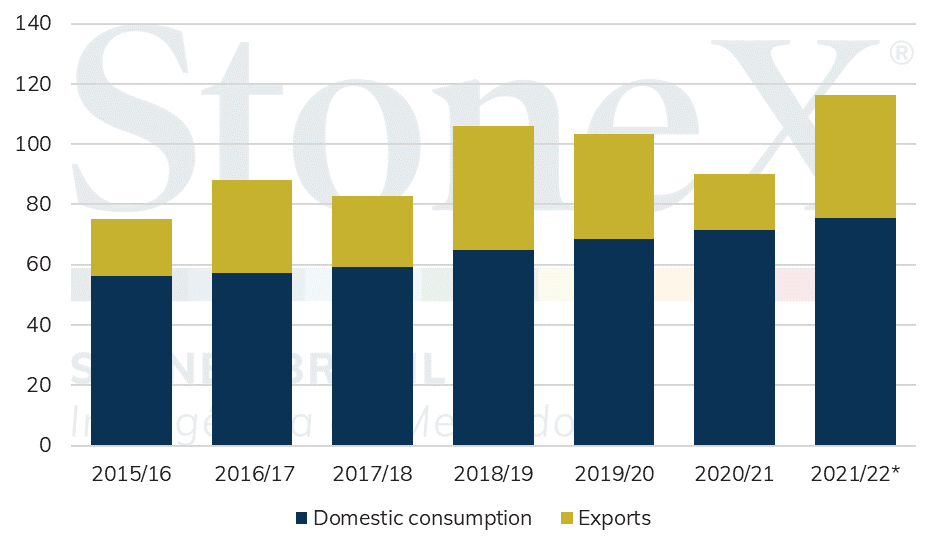
On the foreign market side, StoneX estimates that Brazil will send 41 million tonnes to the international market over this next season, a volume in line with the record recorded in 2018/19 and that will possibly return Brazil's position as the 2nd largest global exporter of corn. However, it is worth remembering that shipments are concentrated in the second half of the year, with the availability of the safrinha corn.
Total demand for corn - Brazil (million tonnes)
Source: StoneX and Conab. Design: StoneX. *Estimate.
Considering the figures mentioned above, the total demand for Brazilian corn in 2021/22 would total 116.50 million tonnes, 26.5 million tonnes more than the observed in the 2020/21 season and the highest total demand ever recorded.
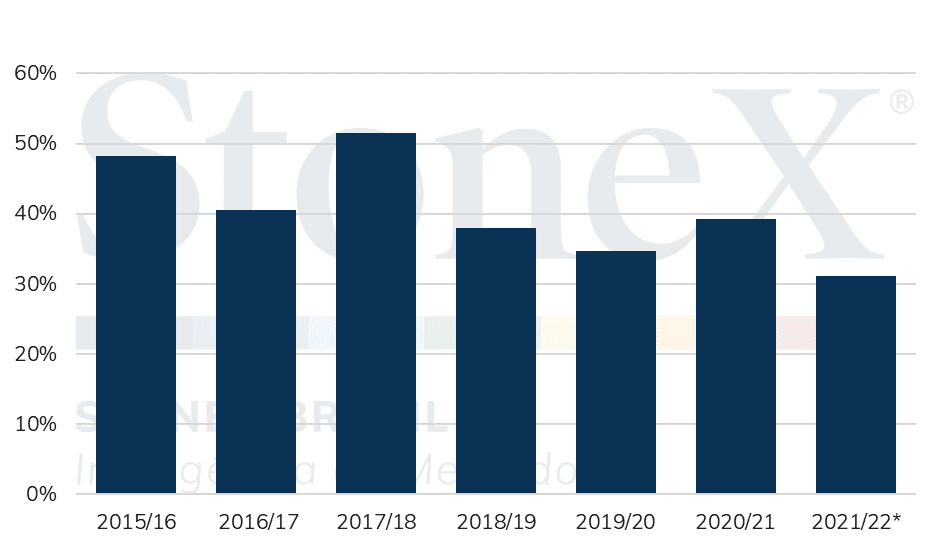
Thus, the ratio between the total supply in the first half of the 2021/22 crop and the total demand in the season would stand at 31.3%, the lowest value of the last years. Therefore, no matter how much expectations point to an increase in stocks at the end of next season, the S&D balance will tend to be tight and prices supported until the safrinha crop. However, the season is still in its early stages and, as the winter crop is naturally riskier, estimates are subject to significant changes. In addition, it is worth noting that with the recent weather problems in Rio Grande do Sul, there may be a new cut in the production of the summer crop, further tightening the S&D balance in the first half of next year.
On the foreign market side, StoneX estimates that Brazil will send 41 million tonnes to the international market over this next season, a volume in line with the record recorded in 2018/19 and that will possibly return Brazil's position as the 2nd largest global exporter of corn. However, it is worth remembering that shipments are concentrated in the second half of the year, with the availability of the safrinha corn.
Ratio between supply in the first half** and total demand (Brazil)
Source: StoneX and Conab. Design: StoneX. *Estimate. **First half supply = Beginning stock + 1st crop production